
An object roughly the size of Jupiter has been detected orbiting a brown dwarf just 73 light-years from Earth, and astronomers say it may represent the strongest exomoon candidate ever identified. If confirmed, this discovery would mark one of the most consequential moments in the history of planetary science — proof, at last, that moons exist beyond our own solar system.
A Jupiter-Sized Moon 73 Light-Years Away
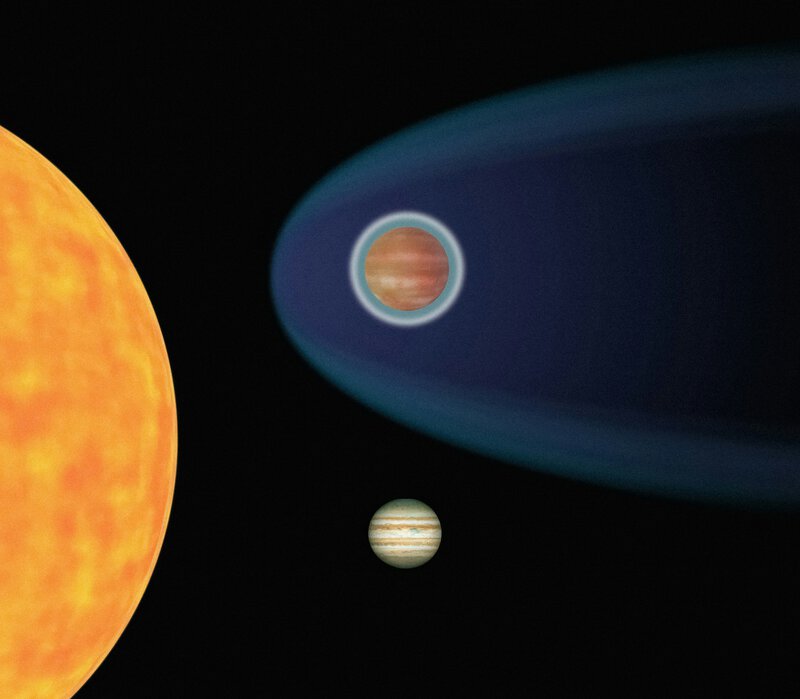
Every moon in our solar system — from Earth’s familiar companion to Saturn’s cloud-shrouded Titan — would be dwarfed by this candidate object. Earth’s Moon spans roughly 3,474 kilometers in diameter; Jupiter’s diameter is more than 40 times that. An exomoon the size of Jupiter would be, by any measure, a genuinely alien kind of world.
The detection, reported by astronomers studying a system 73 light-years away, centers on a signal that cannot easily be explained by the host brown dwarf alone. Researchers flagged the object as a candidate exomoon — a natural satellite orbiting a body outside our solar system — while carefully stopping short of declaring a confirmed discovery. That distinction matters enormously in a field where the evidentiary bar has never been cleared.
The core tension is this: astronomers have now catalogued more than 6,000 confirmed exoplanets orbiting distant stars, yet not a single moon orbiting any of them has been definitively confirmed. Every credible exomoon candidate therefore arrives as headline news, scrutinized as intensely as it is celebrated.
Why Finding an Exomoon Is So Much Harder Than Finding an Exoplanet
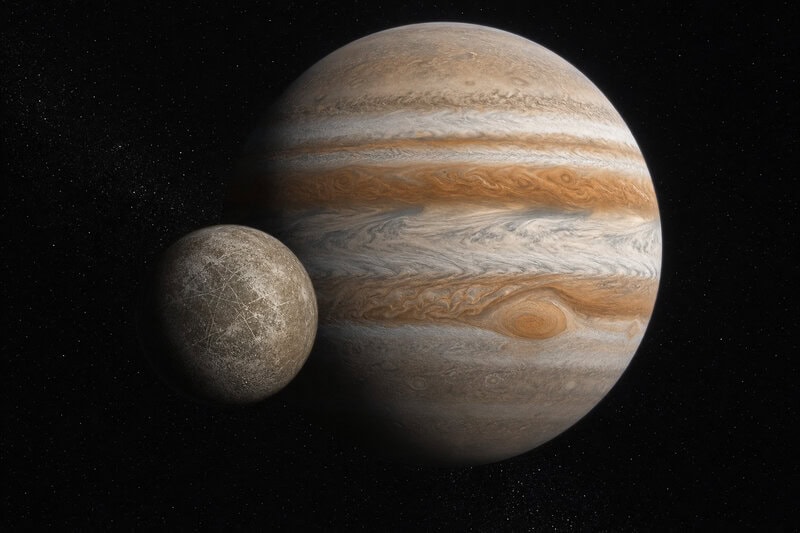
An exomoon is a natural satellite orbiting a planet outside our solar system — the extrasolar equivalent of the Moon circling Earth, or Titan circling Saturn. The concept is straightforward; the detection is not.
Planets are already difficult to find around distant stars. Moons are far smaller and dimmer than the planets they orbit, which means the gravitational and light-blocking signals they produce are correspondingly tiny — often buried in the noise of instrument error, stellar variability, or background interference. Picking out a moon’s signature from across light-years of space requires pushing telescopes to, and sometimes beyond, their design limits.
Two main detection strategies have emerged. The first is transit photometry: measuring the faint dimming of a star’s light as a planet crosses in front of it, then looking for an additional, smaller dip that might indicate a moon trailing behind. The second is transit timing variations, or TTVs — subtle, measurable wobbles in the precise moment a planet transits its star, caused by the gravitational tug of an orbiting moon. Both methods produce suggestive rather than definitive evidence, because other phenomena — a second planet, a starspot, instrument drift — can produce similar signals.
Astronomers have reported hints of exomoons roughly a dozen times using different techniques, yet none has survived the full weight of scientific scrutiny required for confirmation. That unbroken string of near-misses reflects not a failure of ingenuity but the extraordinary difficulty of the task.
The New Candidate: A Brown Dwarf System 73 Light-Years Away
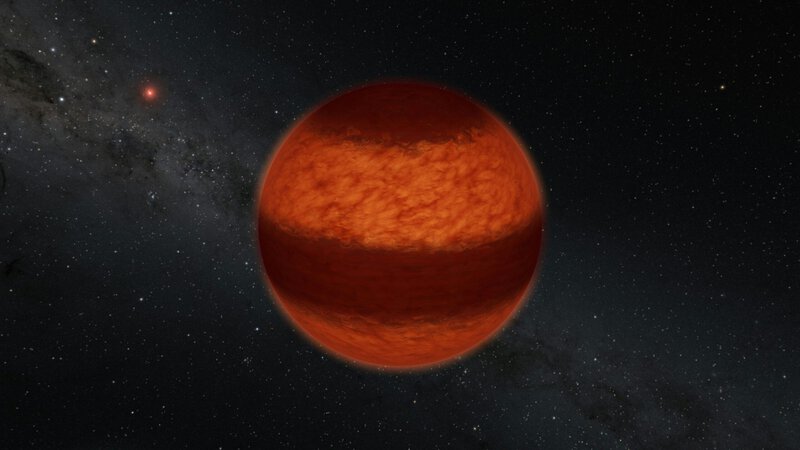
The strongest current candidate involves a brown dwarf — a “failed star,” too massive to be classified as a planet but too small to ignite the sustained hydrogen fusion that powers ordinary stars like the Sun. Brown dwarfs occupy a murky middle ground in astrophysics, and their relative dimness compared to true stars is actually an observational advantage: a companion object produces a proportionally larger and more detectable signal against a fainter background source.
In this system, astronomers identified a photometric anomaly — a pattern in the light data — that the brown dwarf alone could not account for. The residual signal is consistent with a companion roughly the size of Jupiter orbiting the brown dwarf at a distance that places it in the category of a satellite rather than an independent planetary body.
The object’s Jupiter-like size, while staggering by solar-system standards, is physically plausible in context. When the body being orbited is itself a substellar object — more massive than a planet, less massive than a star — the boundaries between “planet” and “moon” become genuinely complicated. A Jupiter-mass companion to a brown dwarf sits in a mass regime where planetary formation models predict a range of possible outcomes, and researchers are careful to note that classification at these scales remains an open scientific question.
The finding has been described as a candidate, not a confirmed detection, and the scientific team behind it has been explicit about the need for independent follow-up observations before any stronger claim can be made.
The Other Key Candidate: A Neptune-Sized Moon 4,000 Light-Years Away
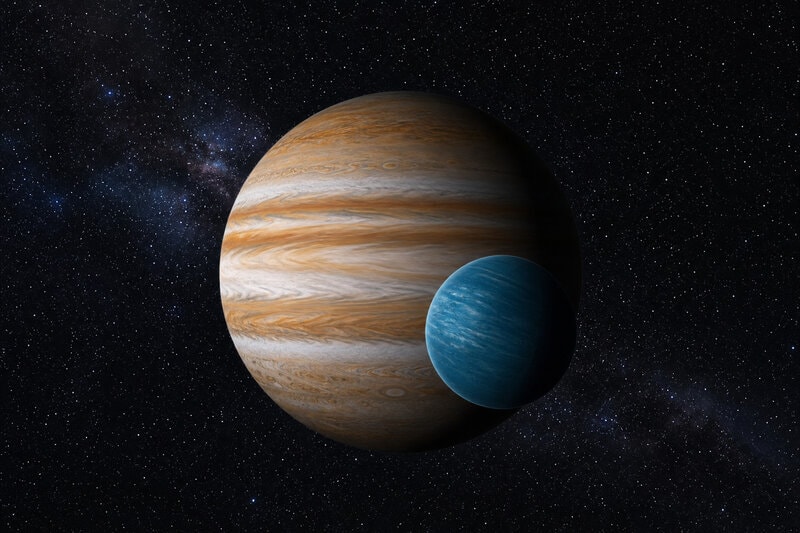
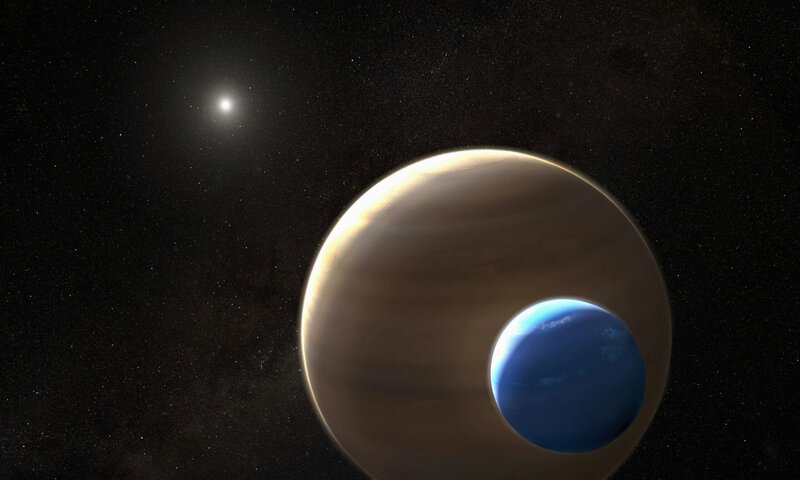
The 73-light-year system is not the only active lead in the exomoon search. A second major candidate involves an object roughly the size of Neptune, orbiting a Jupiter-sized exoplanet approximately 4,000 light-years from Earth. That finding demonstrates this is a field with multiple plausible detections in play, not a single anomalous data point.
This candidate was identified through transit photometry, with archival data from space-based observatories revealing a secondary dip in the light curve of the host planet’s transits. A Neptune-scale object is considerably easier to detect than a small rocky moon, which is part of why this signal rose above the noise threshold — but its very size also complicates interpretation.
Some researchers have suggested this object could be something genuinely strange — neither a conventional moon nor a planet in any straightforward sense — an entity that challenges the working definitions scientists use to distinguish between the two categories. If a moon can be Neptune-sized, the line between “satellite” and “planet” begins to blur in ways that current classification frameworks were not designed to handle.
The Neptune-sized candidate has attracted serious attention from serious researchers, but it has not been confirmed, and alternative interpretations — background objects, instrument artifacts, an undetected second planet — have not been fully ruled out. It is a provocative hypothesis, not a settled finding.
What Would Confirm an Exomoon — and Why It Matters

The confirmation standard in exomoon science is demanding by design. Independent observations from multiple telescopes, using different detection methods, must converge on the same conclusion. Stellar variability, instrument systematics, and background contamination must each be ruled out as alternative explanations. Only when all credible alternatives have been excluded can scientists responsibly call a candidate confirmed.
The James Webb Space Telescope is widely regarded as the instrument most capable of providing the spectroscopic and photometric precision needed to settle ambiguous cases. Webb’s sensitivity to infrared light and its ability to characterize the environments of distant objects give it capabilities that previous observatories lacked. Several research groups are already planning or awaiting Webb observation windows on the strongest current candidates.
A confirmed exomoon would carry implications well beyond the discovery itself. It would demonstrate that the processes by which moons form — from the disk of material surrounding a young planet, or through gravitational capture — operate universally, not just in our own solar system. It would place new constraints on models of how planetary systems form, migrate, and evolve over billions of years. And it would sharpen a question researchers find genuinely compelling: some moons, warmed by tidal forces or sheltered beneath ice, might harbor liquid water and conditions that could, in principle, support life.
6,000 Exoplanets and Zero Confirmed Moons
The telescopes and missions that built the exoplanet catalog — Kepler, TESS, and ground-based radial-velocity surveys — were engineered primarily to detect planets. Finding the satellites of those planets requires extracting signals that sit at or below the threshold of reliable measurement with those instruments. The absence of confirmed exomoons is not evidence that moons are rare; it is evidence that finding them is extraordinarily hard with existing tools.
The next generation of observatories is expected to change that calculus. The James Webb Space Telescope is already operational. The Nancy Grace Roman Space Telescope, designed for wide-field infrared surveys, will bring new statistical power to the search. Ground-based Extremely Large Telescopes, currently under construction, will offer angular resolution and light-gathering capacity that dwarf anything available today. Together, these instruments should either confirm the strongest current candidates or reveal entirely new ones.
The deeper motivation for the search is not simply to add moons to a catalog. If moons are common around the billions of exoplanets astronomers now know to exist, some fraction of them could sit in conditions hospitable to liquid water — and possibly to life. The exomoon search is, at its core, part of the broader effort to understand whether life-supporting environments are rare accidents or routine features of the universe.
What Scientists Say Now — and What Comes Next
The current scientific consensus is unambiguous on one point: no exomoon has been confirmed. On another, the picture is more nuanced. The accumulation of roughly a dozen candidate signals, spread across multiple detection methods and multiple research groups, suggests that the field is genuinely closing in on a real detection rather than chasing statistical noise.
Researchers working on the strongest candidates have been consistent in their public statements: the evidence is suggestive, alternative explanations have not been fully excluded, and independent confirmation is the necessary next step. That measured posture reflects a scientific community that has learned hard lessons from premature announcements and is determined not to repeat them.
The most immediate next steps are observational. Follow-up transit windows for the 73-light-year brown dwarf system will allow astronomers to test whether the candidate signal repeats with the periodicity expected of an orbiting moon. Webb observations of the most promising systems could provide the photometric precision needed to distinguish a genuine moon from instrumental artifacts. Radial-velocity campaigns, which measure subtle Doppler shifts in a host body’s spectrum caused by an orbiting companion, could add an independent line of evidence.
Each of these observational campaigns will either strengthen the case for a specific candidate or rule it out — and either outcome advances scientific understanding. A ruled-out candidate narrows the parameter space and refines future searches. A confirmed one changes everything.
For now, the universe’s moons beyond our solar system remain tantalizingly out of reach — but for the first time in the history of astronomy, scientists believe they may be close enough to finally touch one.