
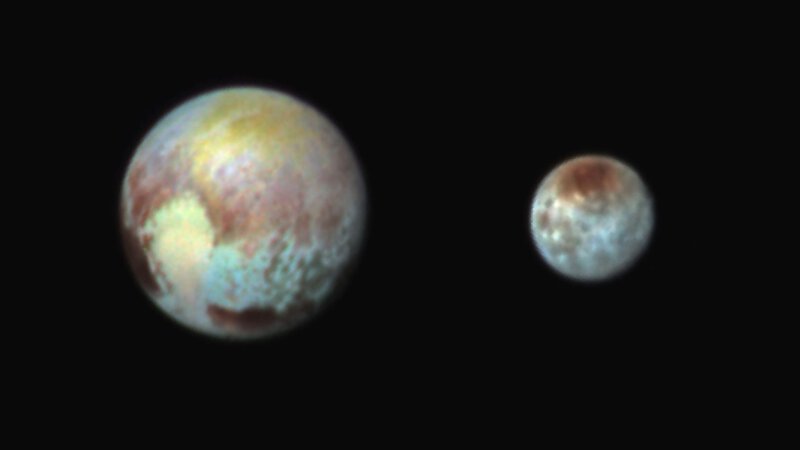
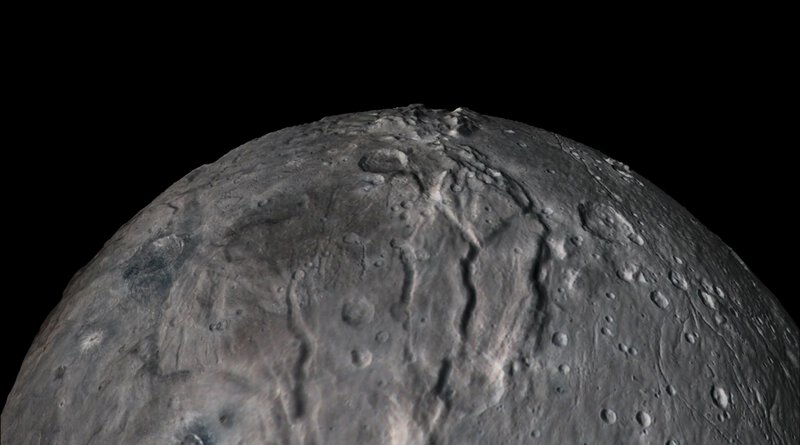
When NASA’s New Horizons spacecraft swept past the Pluto system on July 14, 2015, its cameras captured something nobody had anticipated: a distinct reddish-brown stain smeared across the north pole of Charon, Pluto’s largest moon — a feature no ground-based telescope had ever resolved and no planetary scientist had predicted would be there.
A Rusty Cap at the Frozen Edge of the Solar System
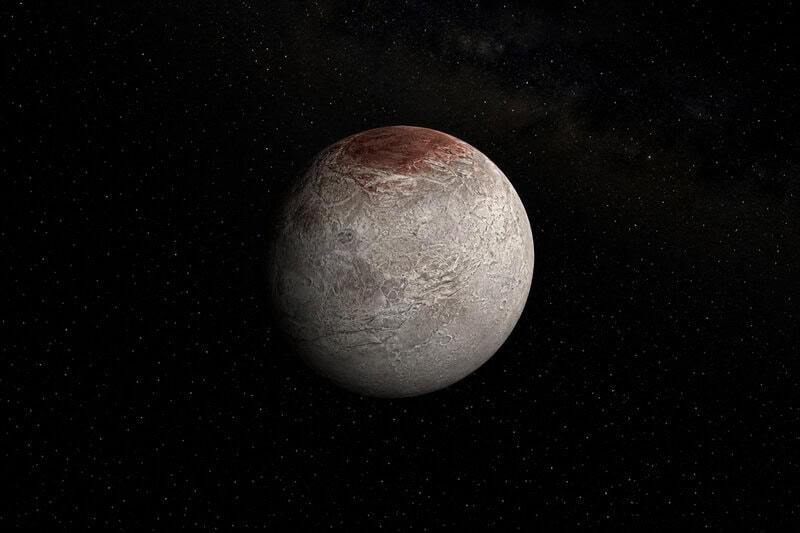
The polar cap, spanning hundreds of kilometers across Charon’s northern reaches, is colored by tholins — complex organic molecules produced when ultraviolet light or high-energy radiation breaks apart simpler carbon- and nitrogen-bearing compounds and reassembles them into stickier, more complex structures. The word “tholin” comes from the Greek tholos, meaning muddy, and was coined by the late astronomer Carl Sagan to describe the reddish residue that ultraviolet light produces from methane and nitrogen mixtures. The same chemistry colors the haze layers of Saturn’s moon Titan, patches of Pluto’s own surface, and the ruddy exteriors of many Kuiper Belt objects. Seeing it concentrated so dramatically at one pole of a moon was, in the words of mission scientists, entirely unexpected.
What made the discovery doubly striking was the stature of the object carrying it. Charon is not a minor player in the outer solar system. At roughly half of Pluto’s diameter — about 1,212 kilometers across — it holds the distinction of being the largest known satellite relative to its parent body anywhere in the solar system. It is the sixth-largest known trans-Neptunian object, after Pluto, Eris, Haumea, Makemake, and Gonggong. A world of that scale sporting an unexpected, chemically active polar feature immediately demanded explanation.
What Charon Actually Is: Essential Context

Charon was discovered in 1978 by astronomer James Christy at the U.S. Naval Observatory — nearly half a century after Pluto’s own detection. Christy noticed a subtle, recurring elongation on photographic plates of Pluto that other observers had dismissed as an instrumental artifact. That elongation turned out to be a separate world, orbiting Pluto at a distance of roughly 19,570 kilometers with a period of about 6.4 Earth days.
The geometry of the Pluto-Charon system is unusual enough to warrant careful attention. Most moons keep the same face pointed toward their parent planet — our own Moon does this — while the planet itself rotates independently. In the Pluto-Charon system, however, both bodies are mutually tidally locked: Pluto always keeps the same face toward Charon, and Charon always keeps the same face toward Pluto. The two worlds perpetually face each other across their shared gap, each invisible from the opposite hemisphere of the other. This arrangement has direct consequences for understanding how atmospheric material moves between them.
Charon’s surface, as seen by New Horizons, is dominated by water ice and ammonia-bearing compounds, giving it an overall gray-blue appearance. Against that muted palette, the reddish-brown polar cap is visually jarring and chemically anomalous. The broader Pluto-Charon system sits in the Kuiper Belt, a vast reservoir of icy bodies beyond Neptune, where sunlight is roughly 1,600 times weaker than at Earth. That dim, cold environment is precisely what makes the polar chemistry possible — and persistent.
The Mechanism: How Pluto’s Own Atmosphere Paints Charon Red
Pluto maintains a thin but real atmosphere composed primarily of nitrogen, with smaller quantities of methane and carbon monoxide. During the portion of Pluto’s 248-year elliptical orbit when it draws closest to the Sun, this atmosphere expands and partially escapes into space. Some of that escaping gas — particularly methane — drifts across the 19,570-kilometer gap and reaches Charon.
At Charon’s polar regions, several conditions conspire to trap the arriving methane. Because Charon is mutually tidally locked with Pluto and its rotational axis is tilted, its poles experience decades-long winters during which they receive no sunlight whatsoever. Temperatures in these polar cold traps can plunge to somewhere between 25 and 40 Kelvin — roughly −248 to −233 degrees Celsius — cold enough to freeze methane directly onto the surface. The pole becomes, in effect, a cryogenic collector for Pluto’s leaking atmosphere.
Once that methane ice is deposited, it is bombarded continuously by two energy sources: ultraviolet solar radiation and high-energy cosmic rays. Both break methane molecules apart and drive photochemical reactions that reassemble the fragments into increasingly complex organic compounds — the tholins responsible for the cap’s reddish-brown color. When polar summer eventually returns and sunlight strikes the pole again, the more volatile components, including nitrogen and carbon monoxide, warm and sublimate back into space. The tholins, being heavier and far less volatile, remain behind. Over geological timescales, each polar winter adds another thin layer of processed organic material, and the cap builds as a semi-permanent residue.
This sequence was described in the initial New Horizons science results published in Science by Stern and colleagues in 2015, and elaborated in a peer-reviewed analysis by Grundy and colleagues published in Nature in 2016, which directly linked the polar coloring to Pluto’s atmospheric escape. Researchers at the Southwest Research Institute (SwRI), which co-leads the New Horizons mission alongside the Johns Hopkins Applied Physics Laboratory, sometimes informally call the process “atmospheric transfer.”
What New Horizons Revealed: Reading the Data
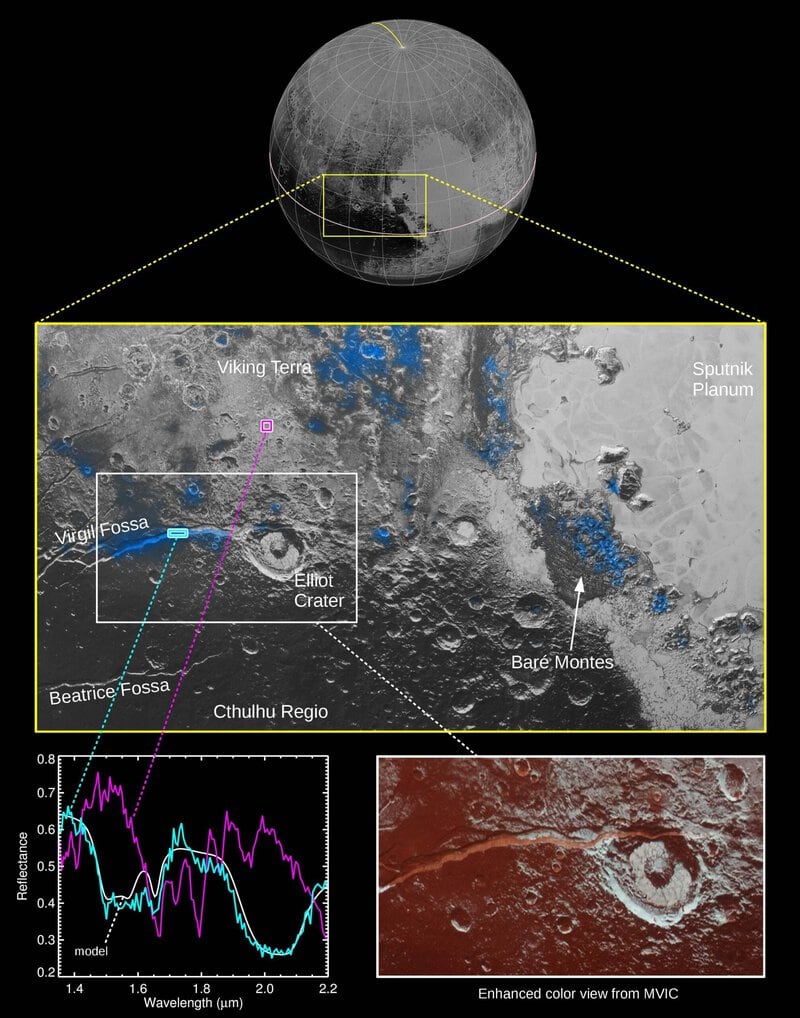
The New Horizons flyby gave scientists a narrow but remarkably detailed observational window. The spacecraft’s MVIC instrument — the Multispectral Visible Imaging Camera — captured color images of Charon across multiple wavelengths, making the polar cap’s distinct spectral signature clearly visible. The LEISA infrared spectrometer provided compositional data, allowing researchers to identify the chemical fingerprints of water ice, ammonia hydrates, and the tholin-rich polar material.
Beyond the polar cap, New Horizons revealed that Charon is geologically complex in ways nobody had foreseen. A vast canyon system, informally named Argo Chasma, stretches more than 1,600 kilometers across the moon’s surface — a scar indicative of past tectonic stress, possibly caused by the freezing and expansion of a subsurface ocean early in Charon’s history. A smooth plain in the southern hemisphere, called Vulcan Planitia, shows signs of past cryovolcanic resurfacing, where slushy water-ice material appears to have welled up from the interior and flooded the landscape. These geological features are separate from the polar chemistry story, but together they recast Charon as a world with a dynamic past rather than an inert, frozen rock.
One critical limitation applies to all Charon data: the flyby was a single, non-repeatable observation. New Horizons was traveling too fast to enter orbit, and every close-range measurement of Charon comes from roughly 72 hours of approach and departure. Every conclusion about Charon’s polar chemistry, geology, and atmospheric interaction is built on that one pass — a constraint scientists are consistently candid about.
Why This Matters Beyond Charon Itself
Charon’s red polar cap represents the first clearly documented case of one world’s escaping atmosphere being chemically processed and durably deposited onto a neighboring body. That makes it scientifically significant not merely as a curiosity of the Pluto system, but as a proof of concept for a broader class of interworld chemical exchange. If two bodies in a close gravitational relationship can transfer and transform atmospheric material in this way, similar processes may operate in other binary or near-binary systems elsewhere in the outer solar system — and potentially in exoplanetary systems as well.
For astrobiology, the tholin connection is worth noting carefully and precisely. Laboratory experiments have demonstrated that tholins can serve as precursor molecules to amino acids and nucleobases under the right conditions. Scientists are uniformly careful to state that the presence of tholins does not imply biology, active chemistry of biological relevance, or habitability. Charon is far too cold, dry, and radiation-exposed to be considered a candidate for life. But the organic richness of the outer solar system, illustrated vividly by Charon’s red cap, is relevant to understanding how organic complexity arises in cold, low-energy environments — a question that matters for the broader story of chemistry in the universe.
The finding also carries an indirect implication for understanding Pluto itself. The amount of methane deposited on Charon’s poles over time serves as a rough historical record of how actively Pluto has been losing atmospheric gas across its long, elliptical orbit. By modeling the tholin accumulation rate, researchers can work backward toward estimates of Pluto’s atmospheric escape history — a dataset that would otherwise be very difficult to reconstruct from any other source.
What Remains Unsettled
Several important questions about Charon’s polar cap remain open. The thickness and total mass of the tholin layer have not been directly measured; they are inferred from spectral reflectance models, and different modeling assumptions produce meaningfully different estimates. Whether the deposition process is currently active depends on Pluto’s present atmospheric escape rate, which remains a subject of ongoing scientific debate following re-analysis of atmospheric occultation data collected during the flyby.
There is also an unresolved question about energy sources. Some researchers have argued that charged-particle bombardment from the solar wind may contribute more significantly to tholin formation at Charon’s polar latitudes than ultraviolet photolysis alone. The relative contributions of these two processes have not been definitively established, and the answer would affect both the rate of cap formation and its detailed chemical composition.
Perhaps the most consequential uncertainty is practical: no follow-up spacecraft mission to the Pluto-Charon system is currently approved or funded. The 2015 New Horizons dataset will almost certainly remain the sole close-range observational foundation for Charon science for decades to come. Resolving questions about tholin layer thickness, current deposition rates, the surface chemistry difference between Charon’s Pluto-facing and Pluto-opposing hemispheres, and the precise role of solar wind will require either a future dedicated orbiter or substantial advances in remote sensing from Earth or space telescopes — neither of which is imminent.
An Asymmetry That Has Not Yet Been Tested
The mutual tidal locking of the Pluto-Charon system generates a testable prediction that current data cannot yet evaluate. Because Charon’s Pluto-facing hemisphere is perpetually exposed to the highest concentration of escaping Plutonian gas, atmospheric transfer effects should, in principle, be asymmetric: the Pluto-facing side should accumulate more transferred material than the hemisphere permanently turned away. Confirming or refuting that asymmetry would require imaging Charon’s anti-Pluto face at comparable resolution — data that New Horizons’ flyby geometry did not fully permit.
That unanswered question is representative of where Charon science now stands: a single, richly detailed snapshot of a world whose full story has not yet been read. Reddish surfaces are a recurring feature across dozens of Kuiper Belt objects, but most are so small and distant that their surface features cannot be resolved at all. Charon, examined up close by New Horizons, provides the clearest documented example of how that reddening actually works — not as a vague statistical trend in telescope photometry, but as a specific, mechanistically explained polar deposit tied to an identified source next door.
Fifty Years of Discovery, One Flyby, Many Questions
James Christy’s 1978 detection of Charon from a photographic elongation — initially treated skeptically before independent confirmation arrived — and the 2015 revelations of New Horizons together form a fifty-year arc of discovery that illustrates how fundamentally new technology can transform understanding of even named, catalogued objects. What was once a dot of light ambiguous enough to be mistaken for an instrumental artifact is now a case study in interworld chemistry, organic molecule formation, and the surprisingly active dynamics of the cold outer solar system.
Scientists at NASA, SwRI, and research institutions worldwide continue to analyze the 2015 dataset, extracting new interpretations from observations collected during a single, unrepeatable encounter nearly a decade ago. By most accounts, the Pluto-Charon system has not yet given up all of its secrets — which is precisely what makes the absence of a follow-up mission so pointed a gap in humanity’s exploration of the solar system’s outermost frontier.