
On July 3, 2026, a robotic spacecraft called Katalyst LINK lifted off on a $30 million mission with a single, audacious objective: catch a falling space telescope before gravity and atmospheric drag finish what two decades of orbital life began. NASA’s Swift observatory — a 21-year-old gamma-ray hunter now locked in a slow-motion descent through low-Earth orbit — has become the unlikely centerpiece of what engineers and space agencies are calling an unprecedented rescue attempt, and a live stress test of humanity’s ability to manage a growing crisis above the atmosphere.
What “Falling Out of Orbit” Really Means — and Why It Takes Years
The phrase “falling from orbit” conjures images of a sudden plunge, but the reality of orbital decay is far more gradual — and in some ways more insidious. A satellite in low-Earth orbit (LEO), the band of space roughly 200 to 2,000 kilometers above Earth’s surface, is not sitting still. It moves at approximately 7.5 kilometers per second, continuously “missing” the ground as it falls — a balance between velocity and gravity that defines a stable orbit. What breaks that balance is atmospheric drag: the friction a satellite experiences as it grazes the uppermost, vanishingly thin wisps of Earth’s atmosphere.
At Swift’s operating altitude of roughly 500 to 600 kilometers, that drag is subtle but relentless, shaving meters of altitude per orbit. As the satellite descends even slightly, it enters denser air, which increases drag, which lowers the orbit further — a self-reinforcing loop that, left unchecked, ends in reentry. NASA’s Goddard Space Flight Center describes orbital lifetime in LEO as primarily a function of three variables: altitude, the satellite’s cross-sectional area facing the direction of travel, and solar activity. All three are currently working against Swift.
Unlike a controlled deorbit burn — a deliberate engine firing that directs a spacecraft to a predictable reentry point, such as the remote ocean corridor used for the International Space Station — a decay-driven reentry is uncontrolled. Ground controllers cannot reliably predict where debris will land until hours before impact, transforming a manageable engineering problem into an unpredictable hazard.
The Solar Storm Factor: Why Space Weather Is Accelerating the Fall
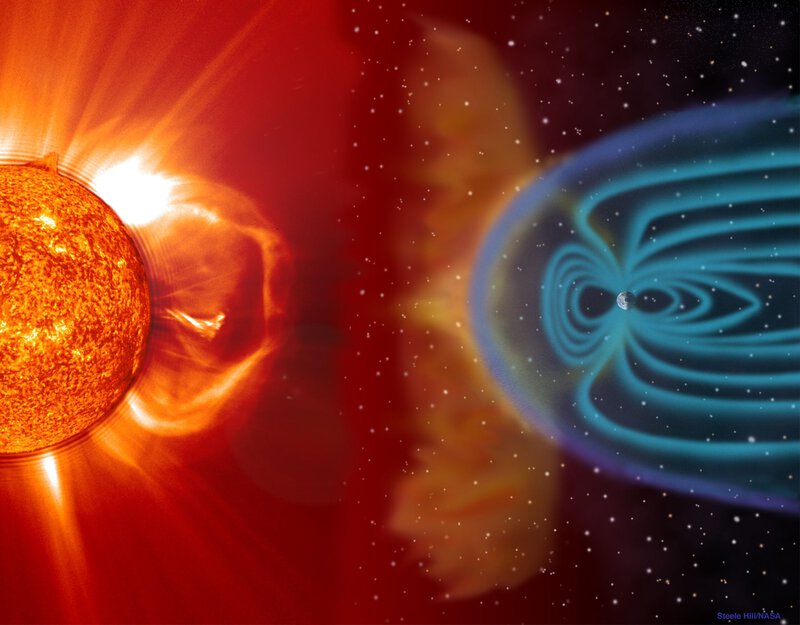
Solar storms have been cited as a key factor in Swift’s accelerating orbital decay, and the underlying mechanism explains why. When the Sun ejects bursts of charged particles — events known as coronal mass ejections — those particles interact with Earth’s upper atmosphere, depositing energy that heats and expands the gas outward. This atmospheric blooming effectively raises the ceiling of the atmosphere into the altitude band where satellites like Swift operate, dramatically increasing drag on everything in that zone.
NOAA’s Space Weather Prediction Center has documented that during solar maximum — the peak of the Sun’s approximately 11-year activity cycle — LEO satellite lifetimes can shorten by months or even years compared to quieter periods. The current cycle, Solar Cycle 25, has been more active than forecasters initially predicted, according to joint assessments published by NOAA and NASA in 2024, a development that has accelerated orbital decay across the broader satellite fleet. Swift, which lacks functioning onboard propulsion capable of reboosting its orbit, has no mechanism to counteract this effect. It can only fall.
What Science Says About the Danger of Uncontrolled Reentry

When a large object enters Earth’s atmosphere at orbital velocity, aerodynamic heating — generated by compressing air faster than it can flow away from the object’s path — creates temperatures exceeding 1,600 degrees Celsius. Most of a satellite’s material, particularly aluminum structures, melts and vaporizes in this process. However, NASA estimates that roughly 20 to 40 percent of a satellite’s mass typically survives to reach the surface as debris, with denser components such as titanium fuel tanks, reaction wheels, and optical mirror assemblies most likely to endure.
Swift’s mass of approximately 1,470 kilograms places it in a category where meaningful fragments could survive reentry. A 2023 study published in Nature Astronomy by researchers at the University of British Columbia found that reentry debris fields from large satellites follow statistically predictable latitude distributions, with populated mid-latitude regions bearing a disproportionate share of statistical risk. The European Space Agency’s Space Debris Office notes that while the probability of any individual being struck by satellite debris remains extremely low — estimated at less than one in ten thousand per reentry event for large objects — cumulative risk rises as the number of decaying satellites increases. Scientists are deliberate in drawing a distinction: an uncontrolled reentry of an object Swift’s size is genuinely undesirable, but it is not a catastrophe. That nuance matters for public understanding of the real risks posed by decaying satellite orbits.
Enter Katalyst LINK: How a Robot Plans to Catch a Tumbling Observatory
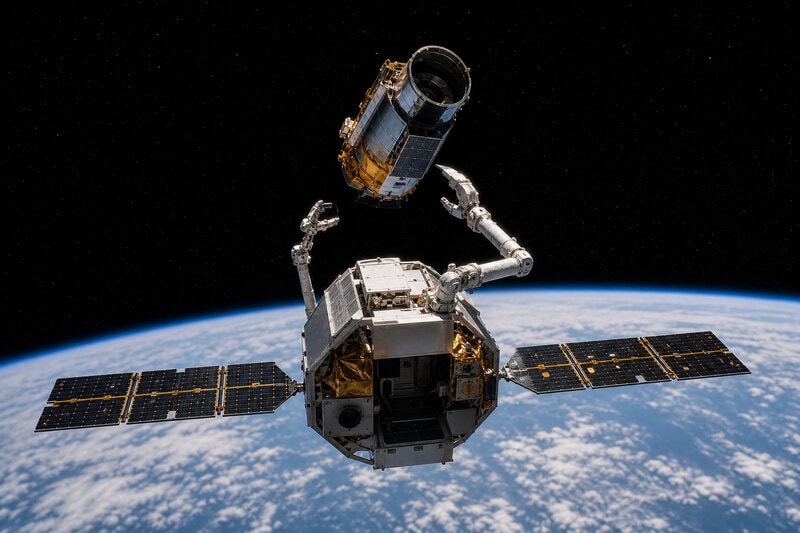
The Katalyst LINK spacecraft launched on July 3, 2026, with the objective of rendezvousing with Swift in LEO, physically attaching to the telescope, and then providing propulsion — either to reboost Swift’s orbit and extend its operational life, or to guide it into a controlled, targeted reentry over an unpopulated ocean zone. Mission planners had not publicly confirmed which outcome was the primary goal as of launch, a distinction with significant scientific and financial consequences.
The technical demands are formidable. Rendezvous and proximity operations at orbital velocities require navigation precision measured in centimeters, achieved through a combination of radar, lidar, and optical tracking systems. The challenge is compounded by the fact that Swift was not designed to be caught: it has no dedicated docking port, and any attachment approach must account for the telescope’s slow rotation and the collision risk during final approach. Programs like DARPA’s Orbital Express demonstration and NASA’s Restore-L project have worked to address these challenges in prior years, providing a technical foundation that Katalyst LINK builds upon — though none of those predecessors attempted capture of a large, uncooperative science satellite.
The $30 million mission cost, while substantial, is positioned as economically rational against the alternative. Building and launching a comparable replacement observatory would carry an estimated cost of $250 to $400 million, according to NASA program cost benchmarks for science missions of equivalent complexity. Whether the mission is framed as a rescue or a controlled disposal, the arithmetic favors the attempt.
Why This Mission Is Unprecedented — and What It Signals for a Crowded Orbit
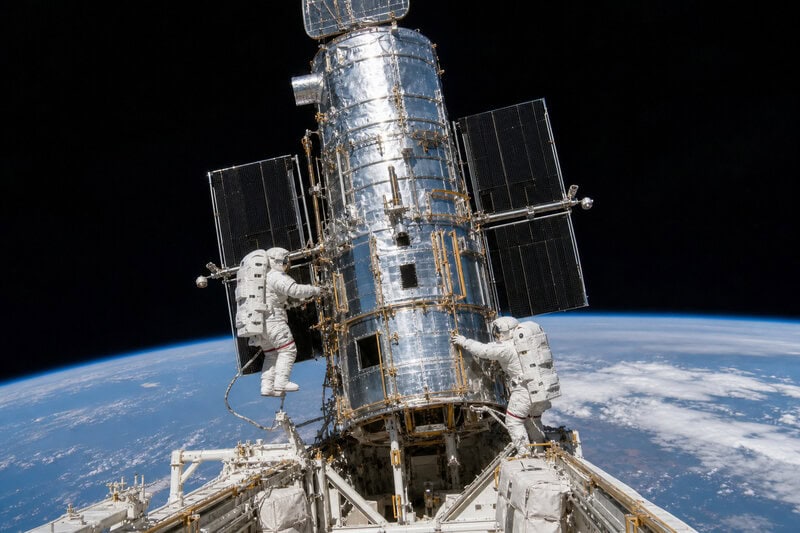
Earlier satellite servicing missions — most famously the series of Hubble Space Telescope repair flights conducted by Space Shuttle astronauts — were possible in part because Hubble was specifically designed with servicing in mind, equipped with handholds, accessible components, and a known mechanical interface. Swift was not. Descriptions of the Katalyst LINK effort as first-of-its-kind reflect this distinction: intercepting and attaching to a passively cooperative but not purpose-built large science satellite in LEO represents a meaningful step beyond anything previously attempted in robotic on-orbit servicing.
The broader context makes the mission’s implications clear. The Inter-Agency Space Debris Coordination Committee (IADC), which includes NASA, ESA, and JAXA, recommends that satellites in LEO deorbit within 25 years of end of mission. According to ESA’s 2024 Space Debris Report, industry-wide compliance with that guideline remains below 50 percent — a gap that will widen as hundreds of satellites launched during the commercial constellation boom of the early 2020s age into their deorbit windows simultaneously. If Katalyst LINK succeeds, it establishes a commercial template for satellite life extension and controlled deorbit services. Market analysts at Northern Sky Research have estimated that sector could reach $3 to $4 billion annually by 2035 as aging satellite constellations mature.
ESA’s ClearSpace-1 mission, designed to remove a single rocket adapter piece from orbit, represents the current frontier of active debris removal. Katalyst LINK’s attempt on a full observatory is a step up in both mass and operational complexity — a proof of concept that, if successful, could meaningfully reframe how the industry approaches the end-of-life problem at scale.
What Swift’s Fall Reveals About the Orbital Economy
Swift’s fate over the coming months will function as a live case study in orbital mechanics, space weather effects, and the practical and financial limits of satellite rescue. The scientific stakes are real and specific: NASA has not announced a funded replacement for Swift’s gamma-ray burst monitoring capability. Should the rescue fail and Swift reenter uncontrolled, a gap in high-energy astrophysics coverage will open that no currently funded mission is positioned to fill immediately — a reminder that scientific infrastructure, once lost, is not easily reconstructed.
The deeper lesson is architectural. Satellites designed without end-of-life disposal built in are liabilities, not merely aging assets. Swift was conceived in an earlier era, when the consequences of that oversight were largely abstract. They are now concrete — measured in drag telemetry, rescue mission budgets, and the quiet urgency of a robotic spacecraft closing distance across hundreds of kilometers of vacuum to catch something no one planned to catch. Whether that catch succeeds or not, the attempt will shape how engineers, mission planners, and policymakers think about what they send into orbit — and what responsibilities follow those objects when they can no longer sustain themselves there.