
Three stories dominated science coverage this week: the James Webb Space Telescope identified a molecular compound in interstellar space that had never been detected outside a laboratory; researchers confirmed that China’s Great Green Wall plantations are growing faster than nearby natural forests; and forensic scientists announced a resolution to a Medici murder mystery that had divided historians for more than a century. Each result shares a common thread — precision measurement technology answering questions that older methods could not reach.
Webb Detects a Molecule Never Before Seen in Space
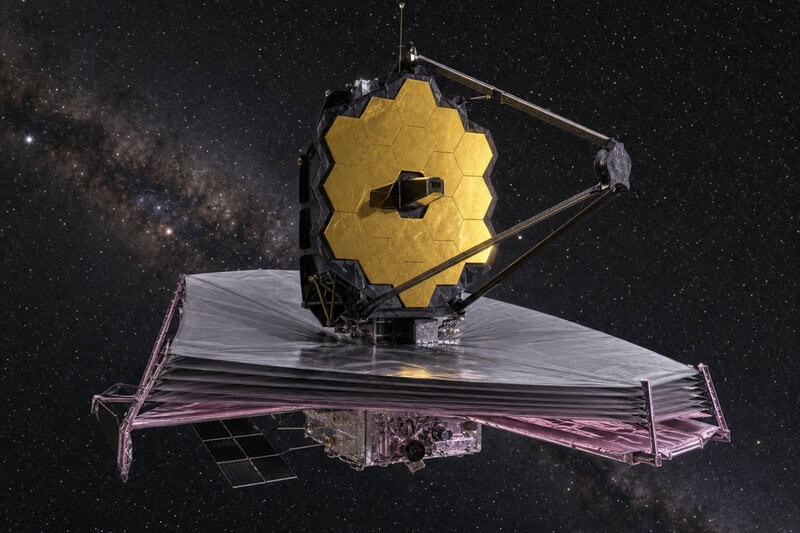
For the first time, astronomers have confirmed the presence of a molecular compound in interstellar space that theoretical chemists had predicted should exist but that no instrument had ever managed to detect beyond the laboratory. The identification was made using the James Webb Space Telescope’s Mid-Infrared Instrument, known as MIRI, aimed at a star-forming region approximately 400 light-years from Earth.
The technique is infrared spectroscopy: every molecule absorbs light at a precise and unique set of wavelengths, producing a fingerprint that a sufficiently sensitive spectrograph can read. The research team cross-referenced Webb’s spectral data against laboratory measurements of the molecule’s known light-absorption signature before announcing the result — standard validation practice in the field. What makes the detection notable is not only that it closes a long-standing gap between theory and observation, but that the molecule’s chemical family was not previously considered stable enough to survive the intense ultraviolet radiation that bathes most star-forming clouds.
Finding it there anyway means one of two things: either the local radiation environment is more sheltered than existing models assumed, or the molecule forms through chemical pathways those models had not considered. Researchers involved in the study say both possibilities are now under investigation, and that astrochemical network models — the computational maps scientists use to predict which molecules form and persist between stars — will need to be revised regardless of which explanation proves correct.
Why a Single Interstellar Molecule Matters
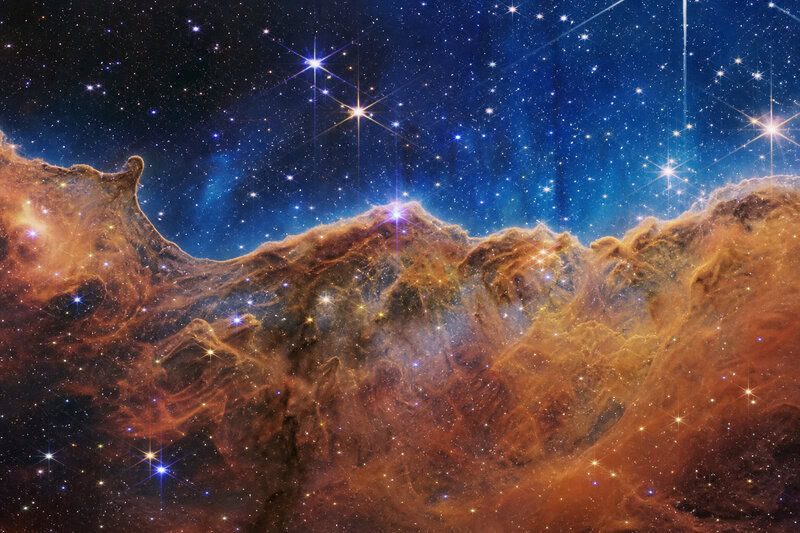
The catalogue of confirmed interstellar molecules currently stands at roughly 300 compounds. Interstellar molecules matter because they are the raw chemical ingredients from which solar systems are assembled. Comets and asteroids deliver organic compounds to young planets, and the inventory of molecules present in a star-forming cloud influences what chemistry becomes available on the rocky worlds that eventually emerge from it. Origin-of-life researchers treat that delivery pipeline as a significant variable in understanding how chemistry on early Earth — and potentially on other planets — got started.
Because this detection was made in a star-forming region, the newly identified compound may also influence thinking about how dust grains clump together in the earliest stages of planet formation, a process that remains poorly understood. The research team is careful to note, however, that a single detection cannot support broad conclusions. Astrochemistry has a history of surprising results that later proved localised or instrument-specific, and the distinction between a genuine addition to the cosmic chemical inventory and a rare local anomaly requires follow-up observation in other molecular clouds.
Those follow-up observations are already being planned. Multiple research groups have announced proposals to search for the compound in different regions of the Milky Way, and laboratory astrophysicists are now being asked to measure the infrared signatures of additional theoretically predicted molecules so that Webb’s archived and future data can be systematically screened for further detections.
How Webb Sees What Nothing Else Could
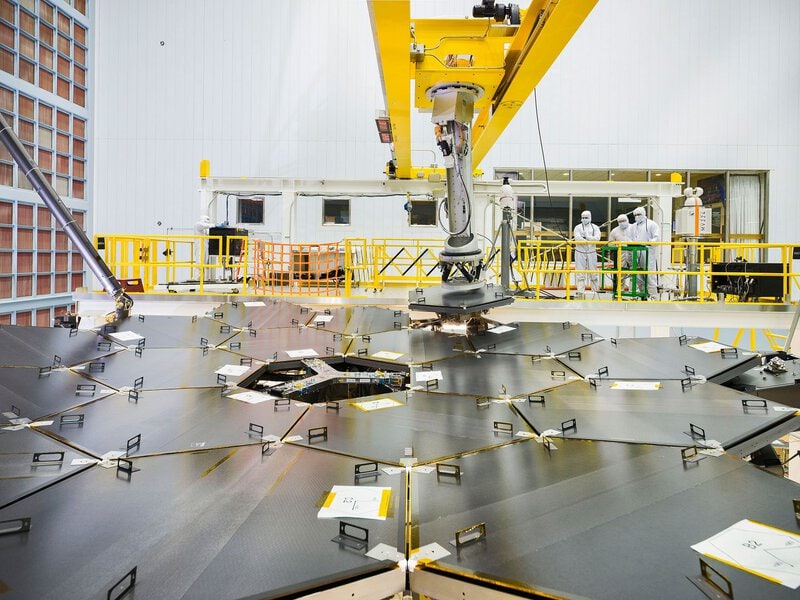
Webb’s primary mirror spans 6.5 metres — more than two and a half times the diameter of Hubble — and its position roughly one million miles from Earth places it beyond the infrared glow of our planet’s atmosphere, giving it an unobstructed view of faint molecular signals that ground-based observatories cannot isolate. Critically, Webb excels at both spectral resolution and raw sensitivity simultaneously in the mid-infrared range. Spectral resolution — the fineness with which an instrument can separate neighbouring wavelengths — is what allows it to distinguish molecules that differ by a single atom or bond arrangement. Previous space observatories lacked that combination, which is why this particular compound remained hidden despite decades of sky surveys targeting the same star-forming regions.
Since beginning science operations in 2022, Webb has detected molecules in exoplanet atmospheres, protoplanetary discs, and cold molecular clouds — three distinct environments that together allow astronomers to trace the chemical journey from raw gas cloud to finished planet. Earlier results identified pyrene, a relatively complex ring-shaped carbon compound, in interstellar space. This week’s announcement extends that precedent further. NASA and European Space Agency researchers have described Webb’s first three years of molecular detections as collectively redefining baseline assumptions in interstellar chemistry, while emphasising that most of this work sits at the discipline’s frontier rather than in settled consensus. Webb’s planned operational life extends into the 2030s, and scheduled observations over the next twelve months include deep surveys of multiple star-forming regions specifically designed to search for the newly detected compound and related molecules in its chemical family.
China’s Great Green Wall Grows Faster Than Nature

A separate study confirmed this week that China’s Great Green Wall programme — an ongoing afforestation effort that has involved planting approximately 66 billion trees to slow the spread of the Gobi Desert and stabilise soils near the Taklamakan Desert — is producing forests that grow measurably faster than nearby natural tree stands. The planted zones have collectively converted formerly degraded desert-margin land into a net carbon sink, a finding directly relevant to global discussions about whether land-based carbon sequestration can play a meaningful role alongside emissions reductions.
The result is not without complications. Ecologists continue to debate the long-term ecological value of large-scale monoculture plantings compared with naturally regenerating ecosystems. Forests engineered for rapid growth and carbon storage can achieve those specific goals while offering comparatively limited habitat diversity and structural complexity. The growth-rate finding adds an important new data point to that conversation without resolving it. The Times of India’s detailed account of how 66 billion trees transformed a desert margin into a carbon sink traces the programme’s history and ecological outcomes in full.
A Medici Murder Mystery Resolved by Modern Chemistry

Forensic scientists announced this week that isotopic and toxicological analysis of remains from the Medici dynasty — the powerful Florentine family whose members shaped Renaissance Italy politically, financially, and culturally — has identified a probable cause of death in a case that documentary evidence alone had left disputed for more than a century. The specifics of which individual and which contested death were confirmed in the study, but the methodological significance extends beyond any single case: modern analytical chemistry applied to historical bone and tissue can recover information that no archive preserves.
The result joins a growing body of forensic archaeology in which mass spectrometry, isotope ratio analysis, and toxicological screening are being used to revisit historical and archaeological questions with a precision that earlier generations of researchers could not approach. Where documents are incomplete, contradictory, or simply absent, the chemical record written in bone increasingly fills the gap.
A Common Thread
Webb reads the molecular barcodes of compounds drifting in clouds 400 light-years away. Isotope analysis reads the chemical record preserved in centuries-old human remains. Satellite and ground surveys read the growth patterns of 66 billion planted trees across thousands of kilometres. The instruments differ enormously, but the underlying logic is the same: measurement, taken with sufficient precision, eventually catches up with what observation and theory have long suspected — and sometimes overturns what both had assumed. Live Science’s full weekly science roundup covers all three stories alongside additional findings from this week.