
A round-trip radio signal between Earth and the Moon takes an average of 2.6 seconds — barely enough time to blink twice, yet long enough for a life-or-death command to arrive too late during a lunar surface emergency. That physics-imposed delay, accepted as a manageable inconvenience during Apollo, has quietly become one of the defining engineering challenges of humanity’s return to the Moon.
Why the Moon Is a Communications Nightmare

Apollo 11 managed its historic mission with a handful of Earth-based relay stations and a crew operating within line-of-sight of our planet. NASA’s Artemis program envisions something categorically more demanding: rotating crews, autonomous rovers, orbital gateways, and commercial landers all requiring simultaneous, high-bandwidth links. That is a qualitative leap in complexity that existing infrastructure was never designed to handle.
The lunar environment compounds every technical difficulty. The Moon’s far side is permanently shielded from direct Earth contact, meaning any rover or astronaut operating there is completely radio-silent without an orbital relay satellite — a coverage gap that no amount of additional ground-based antenna power can fix. No terrestrial engineering workaround closes it.
Beyond geometry, the physical environment is punishing in ways that ordinary wireless engineers rarely encounter. Lunar dust is electrostatically charged and abrasive. Temperatures swing from approximately -173 °C at night to 127 °C at lunar midday, stresses that degrade hardware reliability. Intense solar radiation degrades electronics over time, and solar storms can black out radio frequencies for hours — cutting off a surface crew at precisely the worst moment.
Current deep-space communication runs almost entirely through NASA’s Deep Space Network (DSN), a system of large dish antennas located in California, Spain, and Australia. That handful of facilities handles every NASA lunar and planetary mission simultaneously. A 2022 NASA Inspector General report warned that DSN capacity constraints already pose a measurable risk to upcoming missions including Artemis, making commercial supplementation not a luxury but a near-term operational necessity. Unlike Earth’s internet, which routes data through thousands of redundant nodes, the deep-space network NASA operates today has single points of failure that grow more acute as lunar traffic multiplies.
The $5 Million Contract Designed to Change That
Against that backdrop, NASA has awarded Lowell, Massachusetts-based AiRANACULUS a $5 million contract under its CCRPP initiative to develop the intelligent networking technology that could make a true lunar communications system possible. The award signals a broader NASA strategy: rather than building every antenna itself, the agency is seeding commercial innovators to architect the radio backbone of humanity’s next foothold in space.
The contract assembles an unusually broad industrial consortium. NASA Ames Research Center provides space-environment expertise. Nokia Federal Solutions contributes terrestrial 4G and 5G private-network engineering. NVIDIA and Dell Technologies supply AI compute hardware. Curtiss-Wright and Supermicro add ruggedized, radiation-tolerant computing platforms. Together, these partners are tasked with building next-generation heterogeneous communication networks for lunar and deep-space missions.
The phrase “heterogeneous communication network” — central to NASA’s contract language — refers to systems where lunar orbiters, surface relays, rovers, spacesuits, and Earth ground stations all speak a common, interoperable protocol regardless of the underlying radio technology they use. The analogy is instructive: Wi-Fi and cellular are technically different radio systems, yet both deliver the same internet to a smartphone. A lunar communications network needs to achieve the same seamless interoperability across far more hostile and varied conditions.
Funding at the $5 million level is consistent with NASA’s practice of using modest early-stage commercial contracts to de-risk technologies before committing to larger, mission-critical procurement — a model refined through the Commercial Crew program and the Commercial Lunar Payload Services (CLPS) initiative. At this stage, the CCRPP award funds technology development and demonstration, not deployment; it is a starting point, not a finish line.
The Science of Autonomous Space Networking
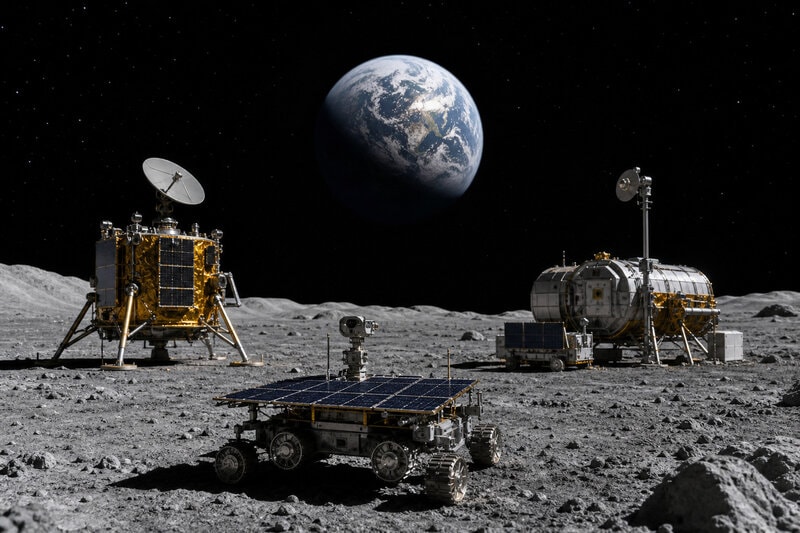
Two core technologies sit at the heart of what AiRANACULUS and its partners are developing, and understanding them clarifies why this work is harder than simply launching more satellites.
The first is Delay-Tolerant Networking, or DTN — a protocol stack originally developed by NASA and collaborators including Internet pioneer Vint Cerf. DTN allows data bundles to be stored at an intermediate node and forwarded only when a link becomes available, essentially giving the lunar internet a reliable fallback that prevents data loss during blackouts. When a lunar relay satellite dips below the horizon, data does not vanish; it waits, then moves. This store-and-forward approach is foundational to any credible lunar communications system and has already been demonstrated aboard the International Space Station.
The second is cognitive radio, the technology AiRANACULUS specializes in. Cognitive radio uses AI algorithms to scan available frequencies in real time and shift transmission to the clearest channel automatically. This capability could prevent mission-critical telemetry from being drowned out by competing landers or surface equipment operating on overlapping bands — an increasingly realistic problem as commercial activity on the lunar surface accelerates.
NVIDIA’s involvement points to the use of onboard GPU-accelerated inference: running machine-learning models locally on a lunar relay node so it can make network-optimization decisions in milliseconds rather than waiting 1.3 seconds for Earth-side instructions. NASA engineers have described this distinction — between a network that waits and one that acts — as the difference between a reactive system and a resilient one.
Nokia Federal Solutions brings direct precedent to the consortium. The company received a separate 2020 NASA Tipping Point contract to develop 4G LTE technology intended for lunar surface deployment, validating that commercial cellular protocols are being engineered to survive the lunar environment. That project remains in development and its on-surface performance has not yet been publicly verified, but the engineering foundation it established informs the current work.
How This Fits NASA’s Broader Lunar Internet Vision
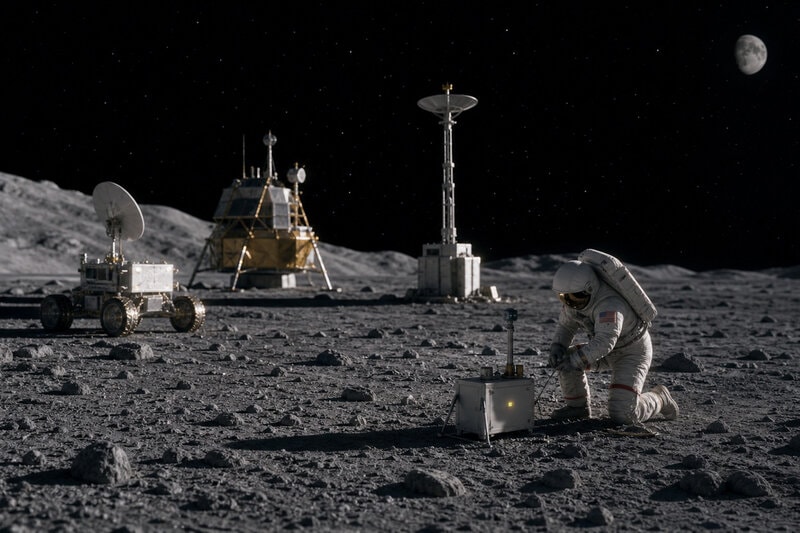
The AiRANACULUS contract does not exist in isolation. It is one piece of a larger architectural ambition NASA calls LunaNet, published by the agency’s Space Communications and Navigation (SCaN) program. LunaNet envisions a layered lunar communications system combining surface nodes, orbital relays, and Earth ground stations into a single interoperable fabric — much like the terrestrial internet’s layered TCP/IP model, where different physical networks share a common logical language.
The international dimension is significant. The European Space Agency’s Moonlight initiative and Japan’s JAXA are independently developing complementary lunar relay satellites, raising the genuine possibility of a multinational lunar communications grid. That makes interoperability standards — precisely the kind AiRANACULUS is developing — geopolitically important as well as technically necessary. A lunar relay satellite that cannot communicate with another nation’s surface assets is a liability, not an asset.
What remains unsettled is the governance question: whether the eventual lunar internet will be led by a single NASA-coordinated architecture, a consortium of national space agencies, or a competitive commercial market analogous to Earth’s telecommunications industry. That policy question will shape every technical investment being made today, and it does not yet have a clear answer.
The Stakes: Human Safety and the Path to Mars
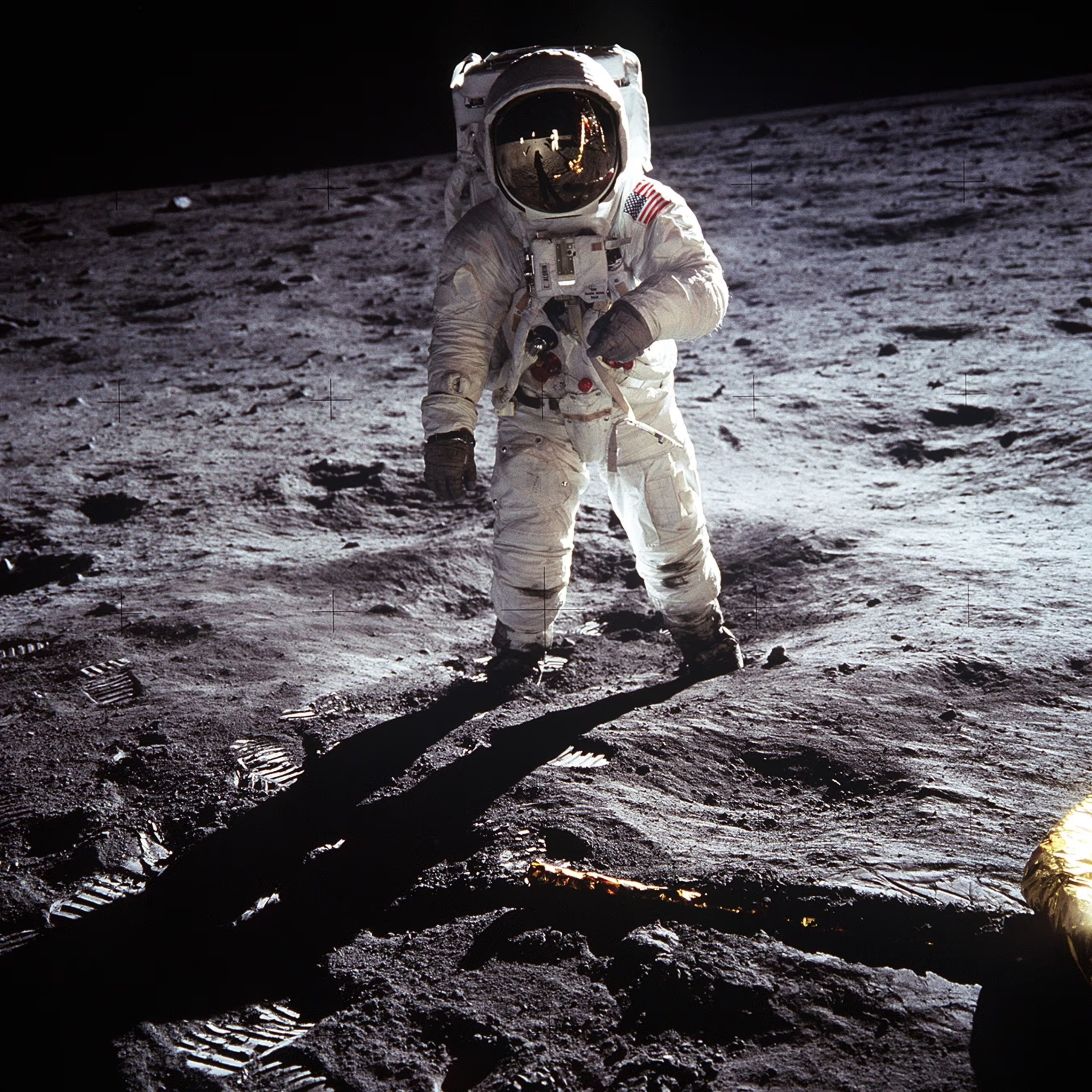
The human consequences of getting lunar communications wrong are not abstract. Artemis III, currently targeted for a crewed lunar surface landing, will require continuous high-rate video, biomedical telemetry, and command uplinks during extravehicular activities. NASA’s SCaN program has indicated that peak data demands for crewed surface operations will far exceed the bandwidth available to Apollo astronauts, who relied on narrowband voice and telemetry links.
Autonomous construction robots and science rovers planned for the lunar south pole cannot safely operate on pre-programmed scripts alone. They need low-latency links to human supervisors and AI systems to navigate unexpected hazards. A communications dropout is not a minor inconvenience in that context; it is a mission risk.
Most urgently, a communications outage during a medical emergency at a future lunar base would not merely disrupt operations. Crew survival could depend on transmitting high-definition diagnostic imagery and receiving expert guidance from Earth-based physicians in near-real time. That scenario is why network resilience has been classified by NASA as a human-factors issue, not just an engineering one.
Beyond the Moon, the networking protocols being validated now are explicitly designed to scale to Mars, where one-way signal delays reach up to 24 minutes. In NASA’s framing, the AiRANACULUS contract is an investment in the communications backbone of the entire solar system economy — not just the Moon. The cognitive radio and DTN architectures being tested in the relatively accessible lunar environment are intended to serve as the proving ground for every crewed deep-space mission that follows.
Open Questions and Legitimate Concerns
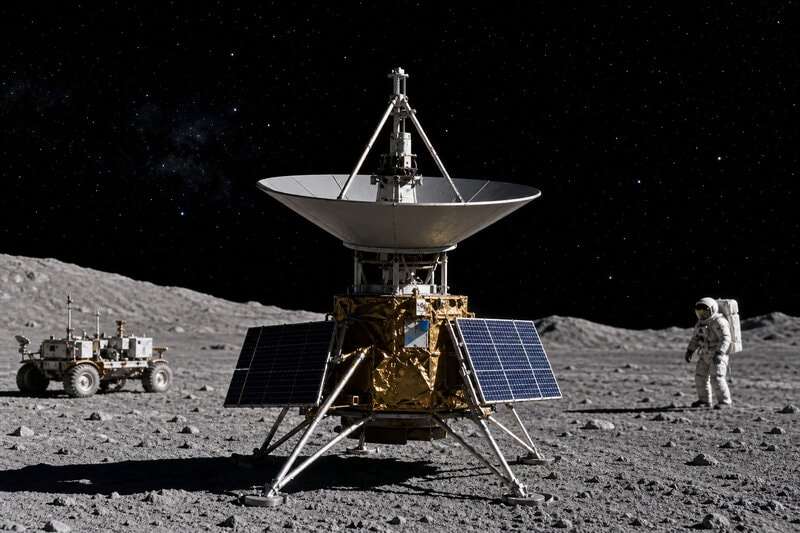
Critics of the commercial-first approach raise a legitimate concern: fragmenting lunar communications development across multiple vendors risks producing incompatible systems that cannot work together when it matters most. NASA’s LunaNet interoperability standards are designed to prevent that outcome, though independent verification of those standards’ enforceability remains an open question that has not been publicly resolved.
There is also the question of spectrum governance. The International Telecommunication Union (ITU) governs radio frequency allocations internationally, and securing dedicated lunar orbital spectrum for a growing number of commercial operators is a regulatory challenge that runs in parallel with the engineering work. Regulatory filings and ITU coordination will be as consequential as any technology demonstration.
Finally, $5 million is a modest sum relative to the infrastructure ambition it is meant to seed. If AiRANACULUS and its partners produce compelling demonstration results, the pathway to meaningful scale runs through follow-on procurement by NASA’s LunaNet program or Artemis surface systems contracts — neither of which is guaranteed. The commercial communications model has worked for cargo and crew transport to low Earth orbit, but lunar surface infrastructure presents durability and logistics challenges of a different order.
What to Watch Next
AiRANACULUS and its partners are expected to produce technology demonstrations under the CCRPP contract, with NASA Ames serving as the primary evaluating center. Successful results could position the consortium for follow-on integration contracts with the LunaNet program or Artemis surface systems — the pathway through which early-stage commercial contracts historically become operational infrastructure.
Several concrete indicators will signal whether this approach is gaining traction. Watch for published interoperability test results between different vendors’ systems, ITU regulatory filings for lunar orbital spectrum allocations, and NASA SCaN program announcements on LunaNet architecture partner selections. Progress on Nokia’s separate lunar LTE deployment will also serve as a real-world stress test of whether commercial cellular protocols can survive the lunar environment at all.
The clearest near-term test will be practical and unambiguous. When multiple Artemis-era landers and rovers attempt simultaneous surface operations, their communications systems will either work together or they will not. If they interfere with each other, the engineering gaps the AiRANACULUS contract is meant to close will become publicly and unmistakably apparent — and the 2.6-second problem will demand answers that no amount of additional funding can defer.