
On August 15, 1977, a volunteer astronomer named Jerry Ehman sat down with a computer printout from Ohio State University’s Big Ear radio telescope, scanned a column of routine data, and reached for a red pen. What he circled — and the single word he scrawled in the margin — launched a mystery that nearly five decades of scientific investigation has not been able to close.
One Annotation That Changed the Search for Alien Life
The string of characters Ehman circled read 6EQUJ5 — a shorthand notation representing the rise and fall of a radio signal’s intensity over time. Each character encoded a signal strength: digits represented values one through nine, and letters extended the scale beyond nine, with U indicating a peak intensity roughly 30 times above the ambient background noise of deep space. His marginal note — Wow! — gave the signal its permanent name and, in doing so, named one of the most enduring unsolved problems in modern astrophysics.
The Wow! signal lasted exactly 72 seconds — not because the transmission necessarily stopped after 72 seconds, but because Big Ear’s fixed-dish design gave it precisely that window to observe any single point in the sky before Earth’s rotation carried the source out of view. The signal may have continued far longer. Science simply had no way to know.
In more than 50 years of active SETI — Search for Extraterrestrial Intelligence — research, no candidate signal has come closer to matching the theoretical profile of an intentional transmission from beyond Earth. The Wow! signal is not disproven. It is not confirmed. It occupies a rare and uncomfortable position in science: officially unexplained, and stubbornly so.
What Made the Signal So Unusual
To understand why the signal drew such intense attention, it helps to understand what made it unusual in the first place. Most radio energy reaching Earth from space is broadband — spread across a wide range of frequencies, like static across an entire FM dial. The Wow! signal was narrowband, meaning its energy was concentrated in an extremely tight slice of the radio frequency spectrum. In the scientific community, narrowband signals are strongly associated with artificial, engineered transmissions, because natural astrophysical processes rarely produce such tightly concentrated bursts of radio energy.
The frequency at which the signal was detected made it even more striking. It arrived near 1420 megahertz — the precise frequency at which neutral hydrogen atoms naturally emit radio waves, a phenomenon known as the 21-centimeter hydrogen line. SETI researchers have long regarded this frequency as a logical cosmic meeting point: because hydrogen is the most abundant element in the universe, any technologically advanced civilization would almost certainly be aware of its signature. Transmitting near 1420 MHz, the reasoning goes, is the interstellar equivalent of choosing a shared language.
The signal was not found during a deliberate, targeted search. Big Ear was conducting a routine sky survey at the time — a fact that many scientists have found both striking and humbling. Its intensity was roughly 30 times stronger than the ambient background noise of deep space, a signal-to-noise ratio high enough to rule out many categories of ordinary radio interference. As the SETI Institute has noted, the combination of frequency, intensity, and narrowband character placed the signal well outside the range of anything easily dismissible.
How Big Ear Worked — and Why 72 Seconds Is the Key Number
Big Ear was not a steerable dish telescope that could be pointed and tracked like a camera following a moving subject. It was a flat-reflector radio telescope whose field of view was fixed in space, allowing Earth’s own rotation to slowly sweep the sky past its antenna — a design that gave it exactly 72 seconds of observation time on any stationary celestial point. That constraint turned out to be scientifically revealing.
The Wow! signal rose in intensity, peaked, and then fell in a pattern that precisely matched what astronomers would predict for a genuine point source in deep space passing through Big Ear’s beam. A local ground-based transmitter, by contrast, would not produce that characteristic rise-and-fall curve. The signal’s behavior was consistent with something far away and fixed against the celestial background — the kind of behavior expected from a star, a galaxy, or something transmitting from the vicinity of one.
Because Big Ear’s recording system logged data in batch intervals rather than streaming it in real time, Ehman did not examine the printout until several days after August 15, 1977. By then, the moment for immediate follow-up observation had passed. No second detection has been confirmed in any observation since. Big Ear itself was demolished in 1997 to make way for a golf course, permanently eliminating the original instrument from any future investigation.
The Two-Horn Problem
One technical detail has generated substantial and unresolved debate. Big Ear used two separate horn antennas to scan the sky, offset from each other by a small angle. A genuine point source passing through the telescope’s field of view would be expected to trigger detections in both horns, separated by a predictable time interval of roughly two to three minutes. The Wow! signal appeared in only one horn.
Some researchers interpret this as evidence of a genuine point source so brief or directional that it fell outside the second horn’s detection window — perhaps a pulsed or intermittent transmission that happened to switch off between passes. Others regard the single-horn detection as a complication that resists easy explanation and weakens the case for a coherent extraterrestrial source. Neither interpretation has achieved consensus, and the single-horn detection remains one of the signal’s most discussed and least resolved characteristics.
The Case for Taking the Signal Seriously
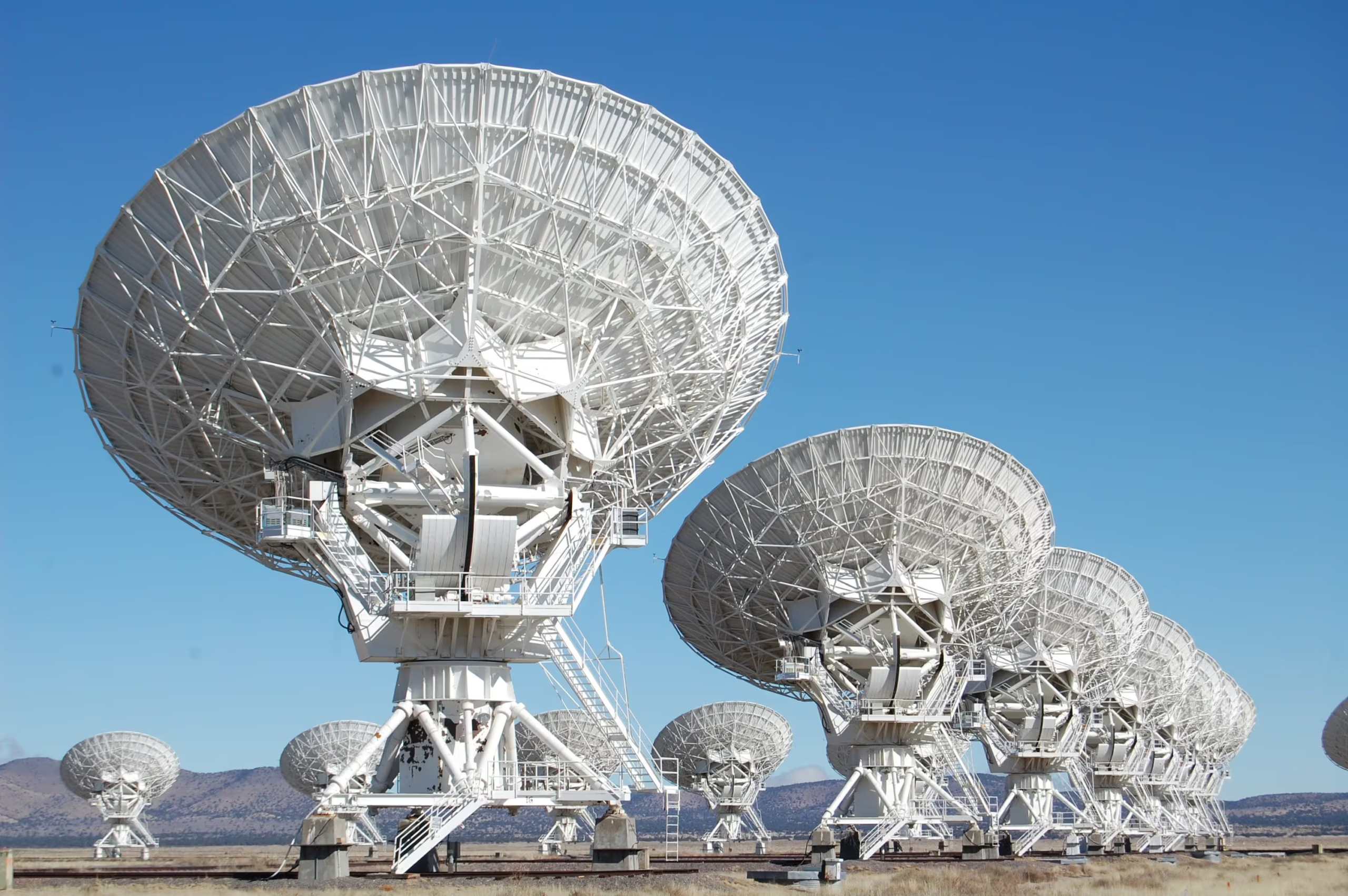
Despite that complication, the Wow! signal matched nearly every parameter that SETI theorists had predicted an intentional interstellar transmission would display: narrowband frequency, the correct part of the electromagnetic spectrum, apparent point-source origin, and extraordinary signal strength. Its position in the sky pointed toward the constellation Sagittarius — a direction dense with stars and containing no known solar-system object that could plausibly account for a transmission of that character.
The scientific community has consistently described the Wow! signal as the single strongest candidate for an extraterrestrial radio transmission in the history of SETI research — while simultaneously emphasizing that “strongest candidate” does not mean confirmed, or even probable. The standard of evidence required to make that claim is far beyond what a single 72-second observation can provide.
Natural Explanations: What Has Been Proposed and Why None Fully Fits
Science does not default to extraordinary explanations when conventional ones remain available, and researchers have worked methodically through the plausible natural candidates for the Wow! signal’s origin.
- Interstellar hydrogen clouds: Diffuse clouds of neutral hydrogen gas are known to emit narrowband radio signals near 1420 MHz. This makes them a logical candidate. The problem is that such clouds are extended, diffuse sources — not the sharp point sources that the signal’s rise-and-fall profile implied. A gas cloud large enough to produce significant emission would not behave like a discrete celestial object passing cleanly through a narrow antenna beam.
- Cometary hydrogen emission: A 2017 paper by astronomer Antonio Paris, published in the Journal of the Washington Academy of Sciences, proposed that two comets — 266P/Christensen and P/2008 Y2 (Gibbs) — were located near the signal’s sky coordinates at the time of detection and could have produced hydrogen emission sufficient to explain the observation. Subsequent researchers challenged this hypothesis on multiple grounds, arguing that comets of those types lacked the emission properties needed to generate a signal of the observed intensity and narrowband character. The comet hypothesis has not achieved scientific consensus and remains contested.
- Terrestrial and satellite interference: Radio frequency interference from human-made sources has been investigated and largely set aside. The signal’s frequency behavior, duration, and characteristic shape are inconsistent with known ground-based or satellite sources from that period. The 1420 MHz band is also internationally protected and reserved for radio astronomy, which further complicates a human-interference explanation.
No single natural explanation proposed to date has satisfied the scientific community as a complete account of the signal. That is a genuinely rare status in modern astrophysics, where most anomalies are eventually resolved.
Decades of Follow-Up — and Silence
Since 1977, dozens of follow-up observations have been directed at the same sky coordinates using progressively more sensitive instruments. None has produced a confirmed repetition of the signal. The Breakthrough Listen program at the University of California, Berkeley — one of the most sensitive and well-funded SETI efforts ever undertaken — has continued to search the relevant frequency range without a confirmed match.
The absence of a repeat detection is scientifically meaningful, but its meaning is ambiguous. A non-repeating signal could reflect a one-time or highly directional transmission, a transient astrophysical event, an instrument artifact that occurred only once, or a signal that has simply not been aimed at Earth again since 1977. Each of these explanations is consistent with the available data, and none can currently be ruled out.
In 2012, the Arecibo Observatory transmitted a response message toward the Wow! signal’s estimated origin coordinates — a gesture that was partly symbolic and partly a demonstration of how seriously portions of the scientific community continue to regard the candidate. Whether any message sent in that direction could reach an intended recipient, or whether any recipient exists, remains entirely unknown.
What the Wow! Signal Means for Science Going Forward
Scientists are unambiguous on one point: the Wow! signal does not prove the existence of extraterrestrial intelligence. What it demonstrates is that the universe is capable of producing radio signals that, with current knowledge, resist conventional explanation — and that such signals can appear without warning during routine observation.
The signal has directly shaped how SETI research is conducted. It prompted the field to adopt more rigorous confirmation standards, requiring independent detection from multiple instruments before any signal can be formally elevated as a candidate for extraterrestrial origin — a threshold the Wow! signal itself never had the opportunity to meet, given the circumstances of its detection and the impossibility of immediate follow-up.
Next-generation instruments offer a more realistic path toward resolution than anything previously available. The Square Kilometre Array (SKA), a multinational radio telescope project expected to reach full operation in the late 2020s, will survey the sky with sensitivity orders of magnitude beyond what Big Ear could achieve. If the Wow! signal’s frequency range contains repeating or similar transmissions — natural or otherwise — the SKA represents the most capable instrument yet built to detect them.
For readers who want to go deeper, the Astronomy Houston guide to the Wow! signal covers the technical parameters in detail, and a thorough video overview is available through this documentary discussion on YouTube.
Until a repeat detection is made or a verified natural mechanism is identified, the Wow! signal holds a place in science that few anomalies ever occupy: a 72-second event from August 15, 1977, that remains, nearly five decades later, the most compelling unresolved question in the search for life beyond Earth. For a mystery that fits in the margin of a computer printout, that is a remarkable kind of staying power.