
At 8:19 p.m. PDT, a Falcon 9 rocket split the California dusk above Vandenberg Space Force Base, carrying 24 more Starlink satellites into low Earth orbit. It was, by SpaceX’s own cadence, a routine mission — and that routineness is precisely what makes it worth examining carefully.
The Mission: What 24 More Satellites Actually Means
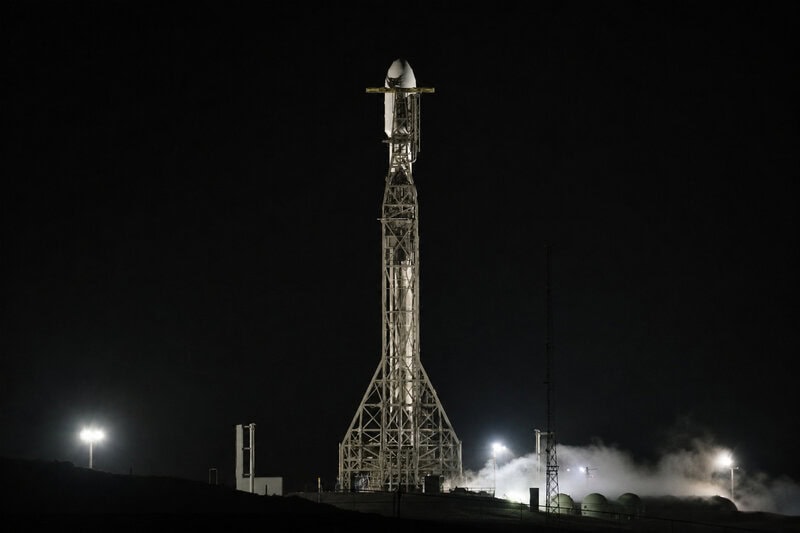
SpaceX confirmed a successful deployment of 24 Starlink satellites following the Starlink 17-45 mission, launched from Space Launch Complex 4E at Vandenberg Space Force Base in California. The deployment continues a launch cadence that has averaged roughly one Starlink mission every one to two weeks in recent years — a pace that peer-reviewed analyses have described as without historical precedent in the commercial space industry.
Each new batch does not simply add two dozen isolated points of light. Satellites are maneuvered into specific orbital planes and altitudes, filling gaps in coverage grids — the geometric scaffolding that determines how often any given satellite passes over any given surface location. A satellite constellation, to define the term precisely, is a coordinated network of spacecraft designed to function as a single integrated system, as opposed to a collection of unrelated individual satellites. SpaceX’s Starlink network has now surpassed 6,000 active satellites in low Earth orbit, making it the largest satellite constellation in human history by a wide margin — a number that rivals the total count of stars visible to the naked eye from a light-polluted suburb.
The connectivity benefits are real and substantial. Starlink delivers broadband internet to underserved communities on six continents, providing service in remote regions where terrestrial infrastructure is economically or geographically impractical. But missions like Starlink 17-45 also advance a quieter story: the measurable transformation of Earth’s shared night sky. The tension here is not between technology and ignorance — it is between two genuine public goods, connectivity and darkness, and peer-reviewed science is now quantifying exactly how large that trade-off is becoming.
Why Satellites Glow: The Physics of Reflected Sunlight
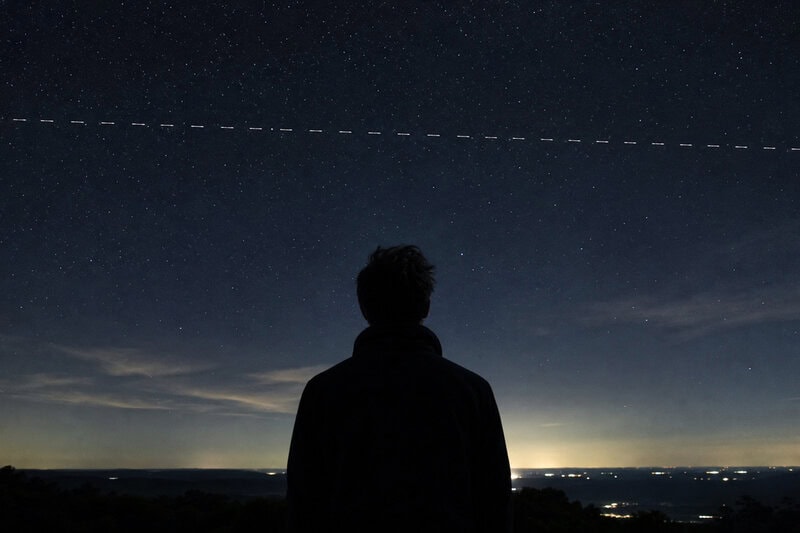
Starlink satellites orbit in low Earth orbit (LEO), typically between 340 and 570 kilometers altitude — close enough to the surface that they move visibly across the sky in minutes. The reason they are visible at all is straightforward physics: they reflect sunlight. During the middle of the night, satellites in low orbits pass into Earth’s shadow and go dark. But during the twilight windows before sunrise and after sunset, spacecraft at those altitudes remain illuminated by the Sun even as the ground below has grown dark. Those are precisely the hours when the contrast between a bright moving object and a dark sky is sharpest — and when Starlink satellites are most easily seen.
Astronomers measure brightness using apparent magnitude, where lower numbers indicate brighter objects. The human eye can detect objects down to about magnitude 6.5 under ideal dark-sky conditions. A 2023 study by Lawler and colleagues, published in Nature Astronomy, found that some Starlink satellites reach apparent magnitudes between 4 and 6, placing them within unaided-eye visibility for observers under suburban or rural skies. At magnitude 4, a Starlink satellite is roughly as bright as a moderately prominent star in the Big Dipper.
For professional astronomers using long-exposure imaging — the technique underlying most modern survey science — a single satellite crossing a telescope’s field of view during a multi-minute exposure can render an entire image frame scientifically unusable. The satellite’s reflected light smears across the detector as a bright streak, saturating pixels and destroying data. This problem has been documented extensively by the IAU Centre for the Protection of the Dark and Quiet Sky from Satellite Constellation Interference (IAU CPS), the international body established specifically to coordinate the scientific community’s response to satellite proliferation.
SpaceX has not been passive about this. The company introduced “VisorSat” sun-shading hardware on earlier satellites and later adopted a darkened anodized coating on newer units. The American Astronomical Society’s satellite constellation working group acknowledged that these measures reduced peak brightness. However, research by Anthony Mallama published in 2021 found that mitigation measures did not fully eliminate the problem across all orbital geometries — meaning that depending on a satellite’s angle relative to the Sun and the observer, even modified satellites can exceed the thresholds that disrupt sensitive astronomical imaging.
What the Science Actually Says: Sky Glow and the Brightness Budget
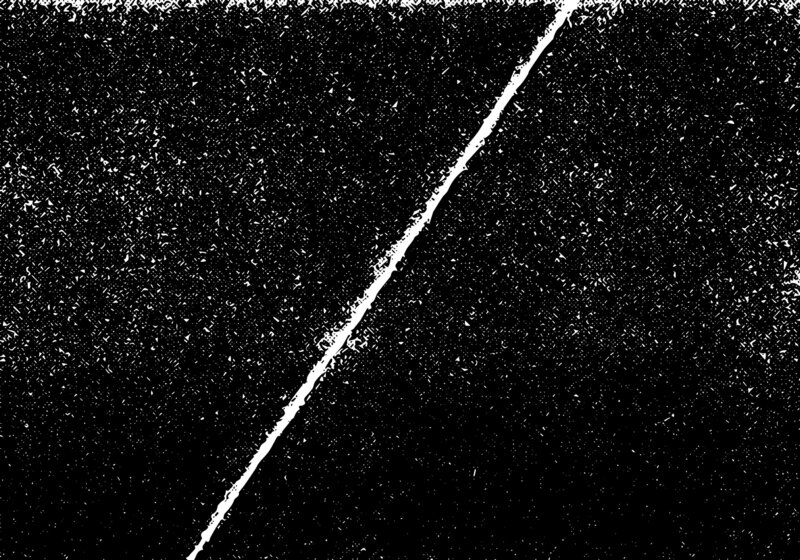
Public discussion of satellite brightness often conflates two distinct but related problems. The first is the satellite trail: a discrete bright streak crossing a telescope image, which is disruptive but localized. The second is aggregate diffuse brightening — a subtle, uniform increase in the overall optical glow of the night sky, sometimes called the satellite contribution to skyglow. These are separate phenomena with different implications, and the science on each is at a different stage of maturity.
On aggregate skyglow, the landmark study to date was published in 2023 by Miroslav Kocifaj and colleagues in Monthly Notices of the Royal Astronomical Society. Using atmospheric scattering models, the team projected that a full build-out of proposed mega-constellations — including Starlink, Amazon’s Project Kuiper, and others — could increase the overall optical brightness of the night sky by roughly 10 percent above natural background levels at mid-latitudes. A 10 percent increase may sound modest, but it would be sufficient to push thousands of currently designated dark-sky locations below the threshold for that classification under International Dark-Sky Association criteria.
It is important to state clearly what this finding is and what it is not. The 10 percent figure is a model projection based on proposed constellation sizes, not a direct observational measurement of current conditions. Some researchers argue the real-world effect at current satellite counts may be lower, depending on final orbital altitudes and the actual reflectivity of operational satellites. The uncertainty is genuine. What is not contested is the direction of the effect: more satellites mean more reflected light, and reflected light scatters in Earth’s atmosphere to brighten the sky background.
The institutional scientific consensus on the broader question is unambiguous. The International Astronomical Union, the American Astronomical Society, and the European Southern Observatory have all issued formal statements affirming that large satellite constellations pose a measurable and growing threat to both professional optical astronomy and the cultural heritage of a dark night sky. These are not fringe positions — they represent the considered judgment of the world’s leading astronomical organizations.
Professional Astronomy’s Concrete Losses: The Rubin Observatory Problem
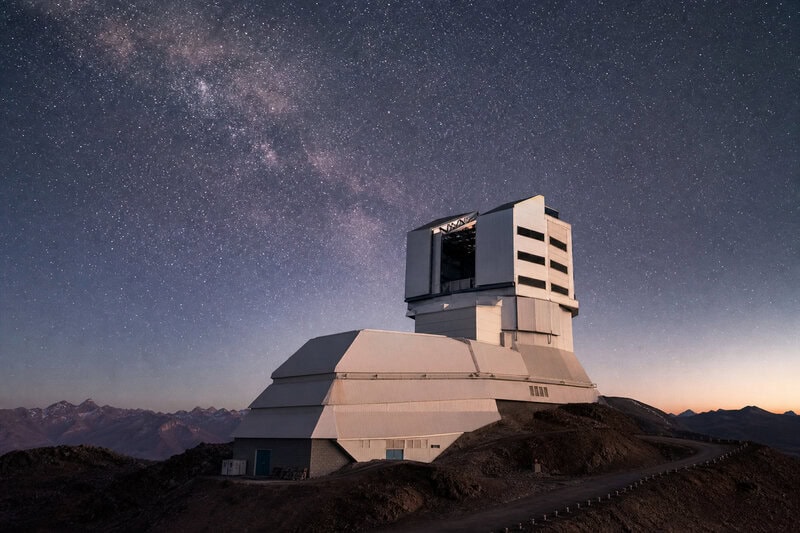
Abstract percentages become concrete when applied to specific scientific instruments. The Vera C. Rubin Observatory in Chile — designed to conduct the Legacy Survey of Space and Time (LSST), a decade-long all-sky survey intended to detect near-Earth asteroids, dark energy signatures, and transient phenomena — is projected by its own operations team to have between 30 and 40 percent of its twilight-hour images affected by satellite trails at current constellation sizes. For a survey whose scientific value depends on statistical completeness — finding all objects above a certain brightness threshold, not just most of them — that is a significant and quantifiable loss.
Twilight hours are disproportionately valuable to astronomers for reasons that compound the satellite problem. Many high-priority targets, including near-Earth objects that could pose impact hazards and fast-fading transient phenomena like optical counterparts to gravitational wave events, are best observed shortly after sunset or before sunrise. Those are exactly the windows when LEO satellites are most reflective. The overlap between scientific priority and satellite visibility is not coincidental — it follows directly from the geometry of low Earth orbit.
The Rubin Observatory team has developed algorithmic tools to identify and mask satellite trails in post-processing, and the U.S. National Science Foundation has funded related software research. However, the IAU CPS notes a fundamental limit to this approach: masking a satellite trail cannot recover the photons that were lost, and it cannot restore the statistical completeness of a survey designed to detect rare, faint objects that might appear in only one image. A masked image is not equivalent to an uncontaminated image — it is a smaller dataset with a gap where data once was.
The problem extends well beyond flagship observatories. A 2022 survey by the American Astronomical Society found that a majority of professional astronomers at universities and smaller research institutions reported satellite interference in their observational data. This is not a problem confined to a handful of elite facilities with billion-dollar budgets; it is distributed across the entire infrastructure of observational science.
Beyond Astronomy: Dark Skies as Ecological and Cultural Heritage
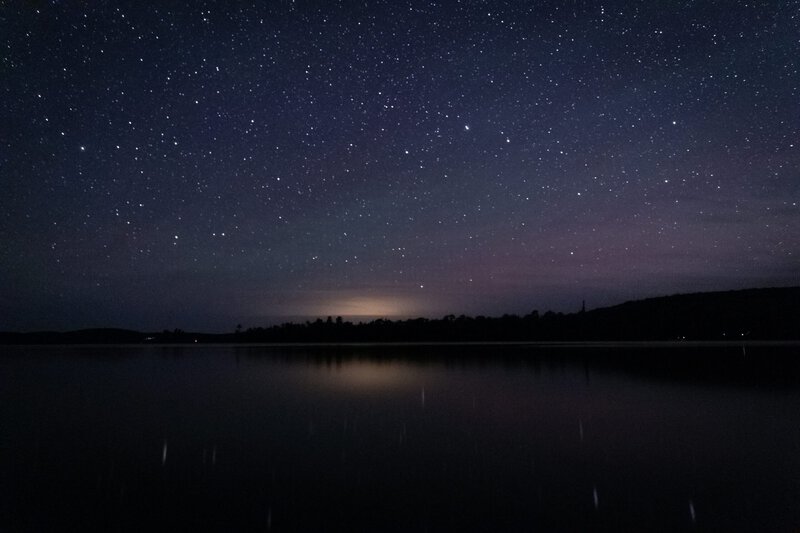
The consequences of a brighter night sky reach well beyond professional science. Light pollution from any source — whether ground-based streetlights or orbital reflectors — affects nocturnal wildlife, human circadian biology, and the cultural practices of Indigenous communities for whom the night sky carries navigational, ceremonial, and cosmological significance spanning millennia.
On the ecological dimension, a 2022 review published in Philosophical Transactions of the Royal Society B by Grubisic and colleagues documented that artificial light at night disrupts migration patterns in birds, sea turtle nesting behavior, and insect population dynamics. The authors framed satellite-contributed skyglow as one emerging variable within a broader ecological crisis of artificial light — a variable that, unlike a poorly aimed streetlight, cannot be switched off or redirected by local action.
The policy landscape has not kept pace with the technological reality. No binding international regulatory framework currently governs the brightness or number of satellites in low Earth orbit. The United Nations Committee on the Peaceful Uses of Outer Space (COPUOS) has held discussions on the issue, but as of mid-2025 has not adopted enforceable brightness or population standards for satellite constellations. The night sky is, in a precise legal sense, the only natural resource that is simultaneously a scientific instrument, an ecological environment, and a shared human inheritance — and the only one subject to no binding international regulation once an object achieves orbit.
What Comes Next: Scale, Research Gaps, and the Limits of Mitigation
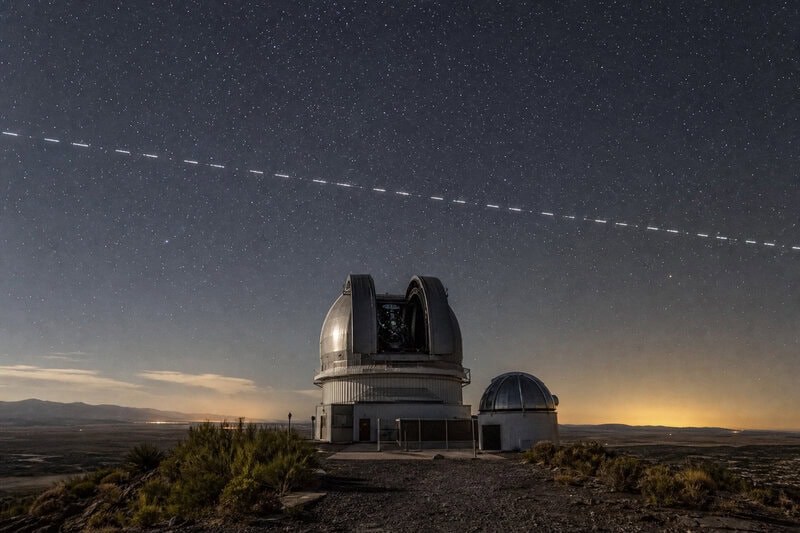
The Starlink 17-45 launch is not a plateau — it is one point on an accelerating curve. SpaceX holds FCC authorization for up to approximately 12,000 Starlink satellites and has applied for a second-generation system of up to 30,000. Amazon’s Project Kuiper, OneWeb, and China’s Guowang constellation each add thousands more to projected totals. The combined figure from proposed constellations, if fully deployed, would represent a transformation of near-Earth space without meaningful historical parallel.
The IAU CPS and the American Astronomical Society have identified three evidence-based interventions that would reduce, though not eliminate, the impact: lower orbital altitudes — which cause satellites to drop below the horizon faster after dusk, shrinking their window of solar illumination over dark ground — darker surface coatings, and operational dimming modes activated during the twilight windows when satellites are most reflective and most disruptive. None of these measures, researchers note, fully resolves the problem at projected constellation scales above roughly 10,000 total satellites. They are mitigations, not solutions.
What remains genuinely unknown is perhaps the most consequential gap. The cumulative skyglow effect of tens of thousands of satellites has not been directly measured at scale, because that scale does not yet exist. Researchers at institutions including the Universidad Complutense de Madrid and the NOIRLab national observatory network have called for a coordinated global sky-brightness monitoring campaign — a systematic, geographically distributed effort to measure actual changes in night-sky brightness as constellation populations grow. That campaign does not yet exist in systematic form, which means science is currently projecting well ahead of direct observation.
Every Falcon 9 launch like Starlink 17-45 is a legitimate technological achievement delivering real connectivity to real people in places that previously had none — and, simultaneously, a measurable incremental change to the shared optical environment of Earth’s entire surface, the full long-term consequences of which science is still racing to understand. How to balance those two realities is a question that orbital mechanics alone cannot answer, and one that regulators, astronomers, and the public have so far barely begun to seriously debate.