
When NASA’s Lucy spacecraft swept past asteroid 52246 Donaldjohanson in early 2025, mission scientists expected a relatively straightforward encounter with a lumpy, tumbling rock. Instead, they caught it wobbling in a rotational pattern that existing models had not predicted — a finding already forcing researchers to rethink what they know about how peanut-shaped asteroids move through space.
A Wobbling Peanut 170 Million Miles From Earth
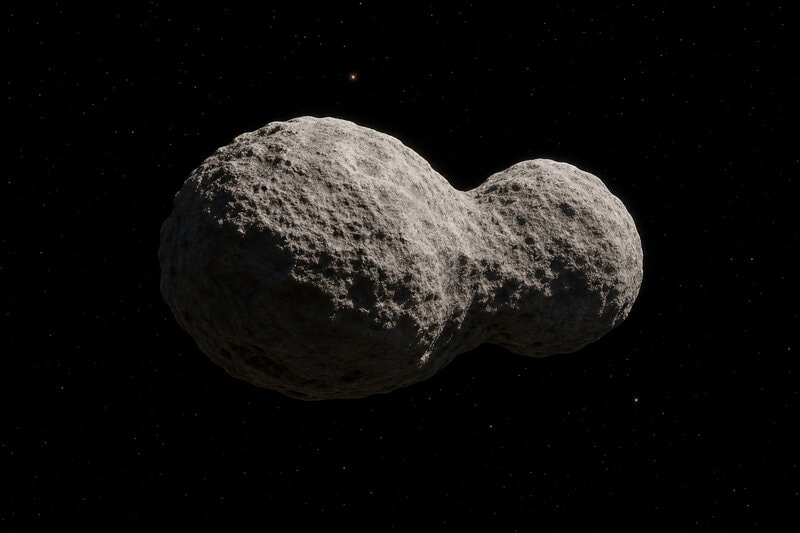
Donaldjohanson is a contact binary asteroid — a body formed when two separate lobes of rocky material press together under their own faint mutual gravity, effectively fusing into a single dumbbell- or peanut-shaped object. That distinctive silhouette appears to be driving the unexpected rotational behavior Lucy detected. Rather than spinning cleanly around a single axis the way a more symmetrical body would, Donaldjohanson wobbles: it exhibits what planetary scientists call non-principal-axis rotation, a complex, multi-axis tumbling that suggests its spin state has not fully settled into its most stable configuration.
The Southwest Research Institute (SwRI), which leads the Lucy mission, announced these findings as a landmark early result and described the flyby as providing “a taste of what is to come” as Lucy continues toward its primary scientific destinations: the Trojan asteroid swarms near Jupiter. The asteroid is named after paleoanthropologist Donald Johanson, the scientist who helped discover the famous early human ancestor fossil known as Lucy — the same name that inspired the spacecraft. Donaldjohanson carries its own scientific biography. According to SwRI researchers, the asteroid likely formed from the shattered remains of a much larger, carbon- and water-rich parent body that broke apart approximately 155 million years ago — well within the age of the dinosaurs on Earth.
What Is a Contact Binary — and Why Does Shape Matter?
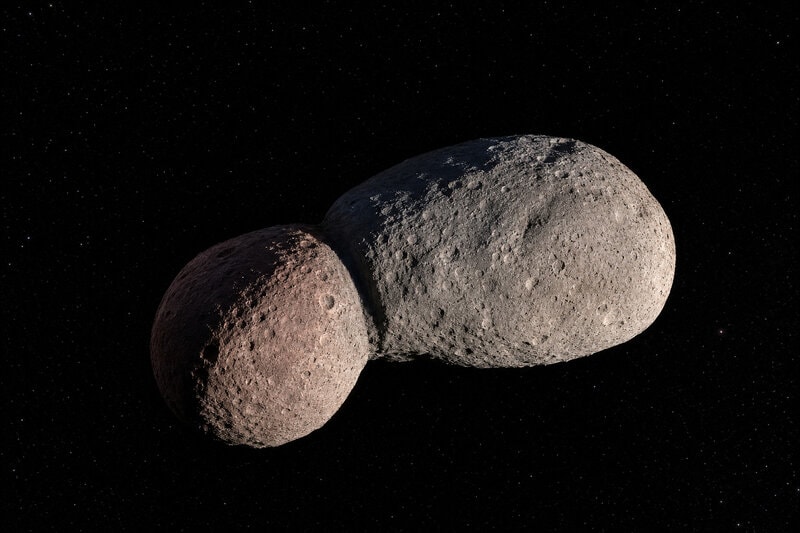
A contact binary asteroid forms when two separate bodies, drawn together by gravity over geological timescales, make permanent gentle contact and merge into a single object. Donaldjohanson fits this description, as do a scientifically significant fraction of known near-Earth and main-belt asteroids. Shape governs spin in ways that matter enormously to planetary scientists.
A roughly symmetrical body rotates cleanly around a single axis, dissipating any wobble relatively quickly through internal friction. A lopsided peanut, however, distributes mass unevenly across its structure, creating competing torques — twisting forces — that can sustain complex, multi-axis tumbling for far longer. Scientists distinguish between principal-axis rotation, the orderly spin that most asteroids settle into over time as internal energy dissipates, and excited or tumbling rotation, in which that damping process is incomplete. Donaldjohanson appears firmly in the excited category.
Understanding contact binary geometry is not merely an academic exercise. Many potentially hazardous asteroids are contact binaries, and accurate models of their rotational behavior are essential for predicting long-term trajectories and planning any future deflection strategies, should one ever be found on a collision course with Earth.
The Flyby That Changed the Calculation
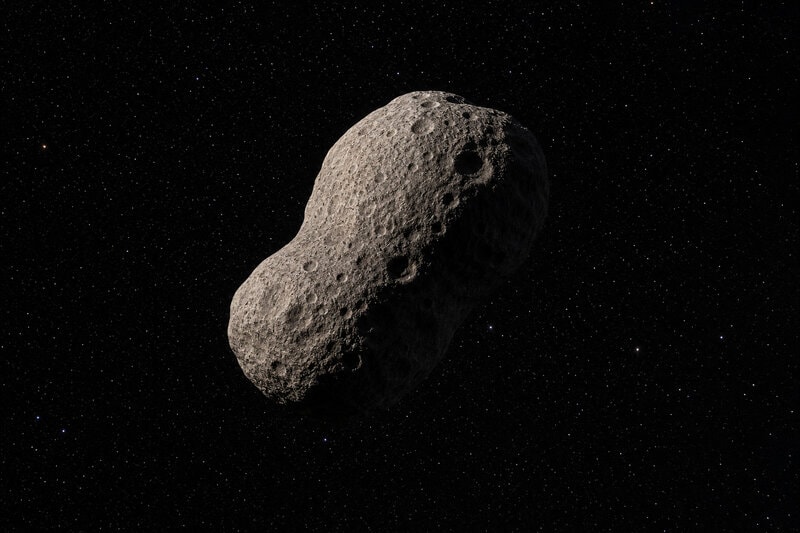
Lucy’s close approach to Donaldjohanson provided the first high-resolution images and detailed rotational data ever gathered for this object. The wobble measured by the spacecraft’s instruments did not match spin-state predictions that mission scientists had generated from ground-based observations — a discrepancy that immediately elevated the flyby from a calibration exercise to a genuine scientific discovery.
According to NASA’s reporting on the Lucy mission findings, the asteroid’s peanut shape alone could not fully account for the observed wobble under standard rotational-damping models. The SwRI-led team has proposed several possible explanations: an unusual internal mass distribution — meaning the two lobes may not be uniform in density — a relatively recent collision that jolted the asteroid into its current tumbling state, or the cumulative effect of solar radiation pressure known as the YORP effect. The YORP effect, named after the four scientists who identified its components, describes the way radiation pressure can gradually alter a small asteroid’s spin over millions of years by exerting an asymmetric push on an irregularly shaped surface.
Which mechanism is primarily responsible remains an open question. The detection of non-principal-axis rotation is an observational result reported by the SwRI-led team and is not scientifically contested; the underlying cause is where debate is likely to emerge as the wider planetary-science community examines the data.
Every measurement Lucy captured at Donaldjohanson is now being treated as a calibration benchmark. The spacecraft’s instruments, validated against a real and surprisingly complex target, are better prepared for the far more scientifically ambitious Trojan asteroid flybys ahead. As the SwRI press release distributed through EurekAlert framed it, Donaldjohanson was not the destination — it was the dress rehearsal.
A 155-Million-Year-Old Origin Story Written in Carbon and Water
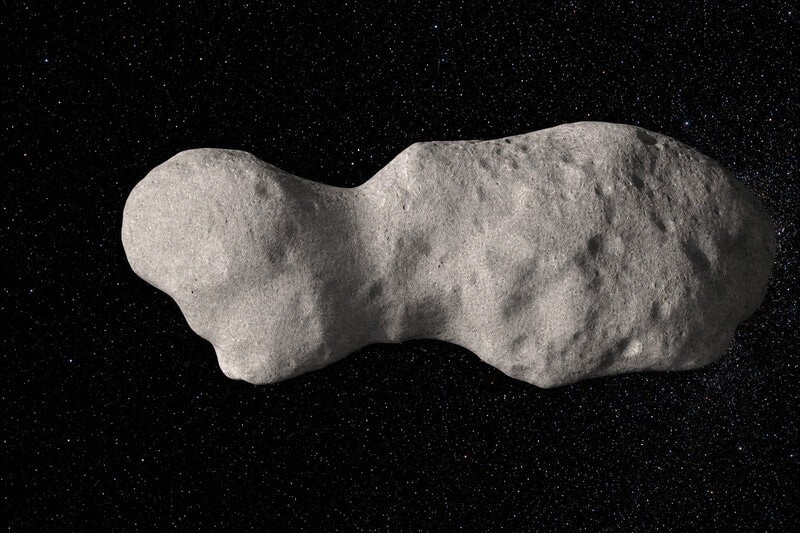
The origin story scientists have reconstructed for Donaldjohanson adds another layer of significance to the Lucy mission’s early findings. Spectral data and dynamical modeling — not direct sample analysis — suggest the asteroid formed when a larger, carbon- and water-rich parent body fragmented approximately 155 million years ago, scattering debris across the main asteroid belt. These inferences are best understood as well-supported scientific hypotheses rather than confirmed facts; only future sample-return missions or laboratory analysis of retrieved material could fully verify them.
Even so, the evidence that Donaldjohanson once harbored liquid water carries real weight. Water-bearing minerals on asteroids are chemical fingerprints of a process called aqueous alteration, in which liquid water once percolated through rock, potentially driving the kinds of organic chemistry that astrobiologists consider relevant to the molecules that preceded life. Carbon-rich, or carbonaceous, asteroids are among the most primitive objects in the solar system, preserving material from the earliest epoch of planetary formation largely unmodified by the heating and melting that transformed larger bodies like Earth and Mars.
Placing the parent body’s breakup at 155 million years ago is also a reminder that the solar system’s sculpting is an ongoing process. While Tyrannosaurus rex was still tens of millions of years in Earth’s future, a collision somewhere in the asteroid belt was quietly generating the fragments that would eventually fuse into the peanut-shaped body Lucy is now studying.
According to additional reporting on the findings, the combination of age, composition, and unexpected rotational behavior makes Donaldjohanson one of the more scientifically rich intermediate targets any planetary mission has encountered en route to its primary objective.
Lucy’s Broader Mission: Unlocking Jupiter’s Trojan Swarms
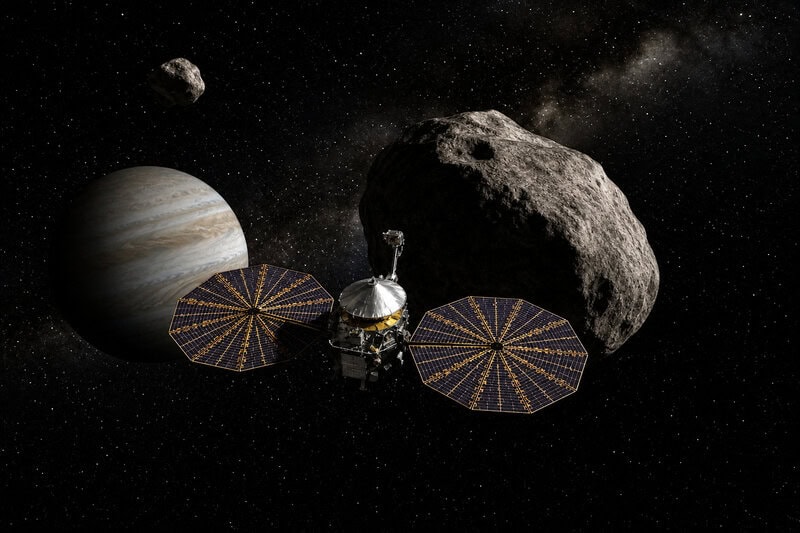
Lucy is a NASA Discovery-class mission managed by SwRI, with its principal investigator based at SwRI’s Boulder, Colorado, office. The spacecraft is ultimately bound for the Trojan asteroids — two vast swarms of primitive objects that lead and trail Jupiter in its orbit around the Sun, locked into gravitational equilibrium at the so-called L4 and L5 Lagrange points. The Trojans are believed to be relics of the early solar system, captured into stable orbital resonance with Jupiter billions of years ago. Studying them directly could reveal conditions that prevailed when the planets were still assembling from dust and gas.
Lucy is scheduled to fly by multiple Trojan asteroids beginning in 2027, making it the first spacecraft ever to visit these ancient bodies. Each target has been selected to maximize diversity in size, composition, and suspected history — a deliberate strategy designed to capture as much of the Trojans’ range as possible in a single grand tour. No telescope on Earth has resolved these objects in meaningful detail, so every close approach will be, in a genuine sense, a first look at an entirely new world.
The wobble data and water-mineral signatures gathered at Donaldjohanson are already informing how Lucy’s science team will approach those encounters. Knowing that a contact binary can maintain excited rotation longer than standard models predict changes the interpretive framework scientists will bring to surface texture analysis, mass distribution measurements, and spin-state studies when they reach Trojan objects that have been largely undisturbed since the solar system’s formation.
What This Discovery Means for Planetary Science and Planetary Defense
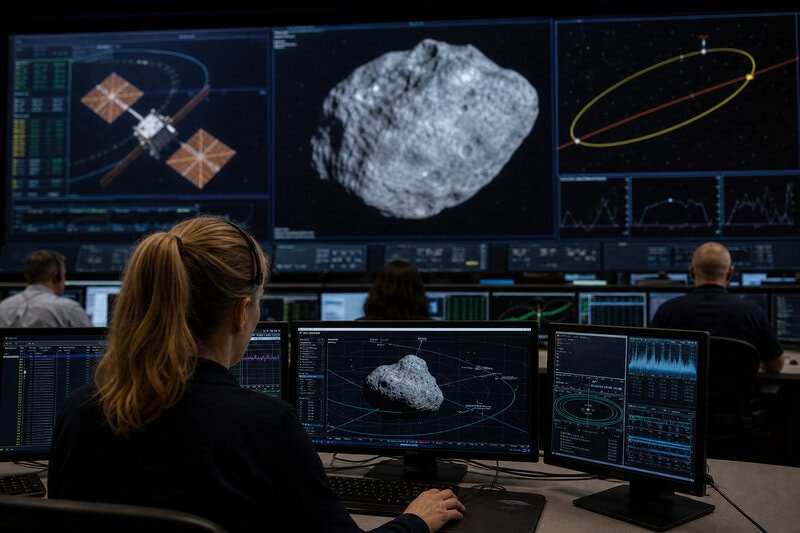
The broader implications of Lucy’s Donaldjohanson flyby extend well beyond the immediate findings. Every asteroid whose internal structure and spin state Lucy can characterize adds a data point to the population-level statistics that planetary defense scientists rely on when assessing how a given asteroid might behave on a collision course with Earth. Contact binaries present particular modeling challenges because their two-lobed mass distribution complicates predictions of how they would respond to a kinetic impactor or a gravitational tractor — the two most technically mature deflection strategies currently under study.
The confirmation that a main-belt asteroid retains mineralogical evidence of ancient water also strengthens the case that water — and by extension, carbon-based chemistry — was widely distributed across the early solar system, not confined to a narrow band close to the Sun. This has implications for understanding how Earth acquired its oceans and organic inventory, and for the broader astrobiological question of how commonly the building blocks of life may arise across planetary systems.
Whether Donaldjohanson’s wobble is representative of contact binary asteroids in general, or whether it reflects something peculiar to this object’s history, is an emerging research question. The SwRI team has raised the possibility that standard rotational-damping models may need revision for peanut-shaped contact binaries — a hypothesis that has not yet been independently confirmed or refuted, and that Lucy’s subsequent flybys may help resolve by providing comparative data from a diverse set of targets.
As the first NASA mission designed to visit multiple distinct asteroid targets in a single grand tour, Lucy is establishing a new template for how planetary science can be conducted efficiently across the solar system. Donaldjohanson’s surprising wobble is already proof that the mission will not simply confirm what scientists thought they knew — and the Trojan asteroids, ancient and unvisited, promise to be far more revealing still.