
Three of nature’s four fundamental forces slot neatly into a single mathematical framework — one of the most precisely tested theories in the history of science. Gravity, alone among the four, has refused to cooperate for more than a century, and that stubborn exception may be pointing physicists toward something genuinely new: a fifth fundamental force of nature that could rewrite the deepest rules of physics.
The Four Fundamental Forces: What They Are and What They Do
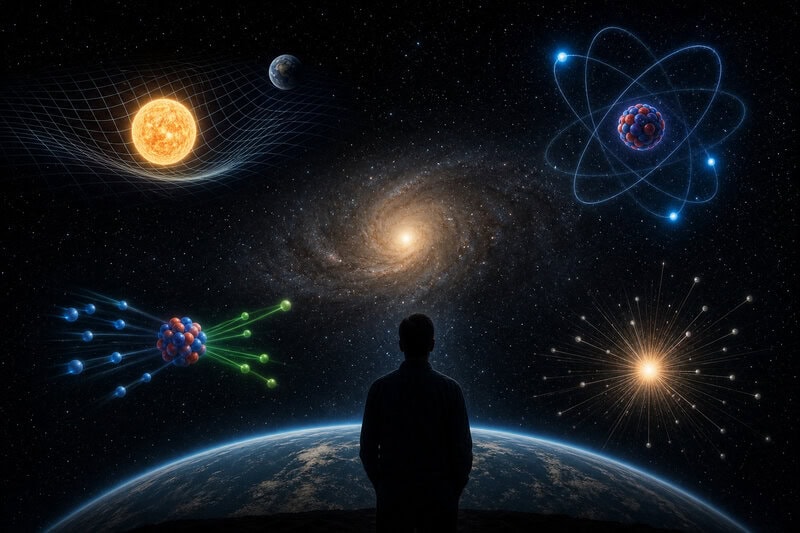
At the most basic level of physical reality, everything that happens — every collision, every chemical bond, every star that ignites — is governed by one of four fundamental interactions. As the European Space Agency explains, those four forces are gravity, electromagnetism, the weak interaction, and the strong interaction. Each operates on a distinct domain of nature, and together they account for every physical phenomenon scientists have ever observed and measured.
Gravity is the most familiar. It pulls us to the surface of the Earth, keeps planets in orbit around the Sun, and drives the formation of planets, stars and entire galaxies across cosmic time. Despite its outsized role in shaping the large-scale structure of the universe, gravity is by far the weakest of the four forces at the subatomic scale — a fact that turns out to be central to why it has proven so difficult to incorporate into modern physics.
Electromagnetism governs light, magnetism, and the behavior of electrically charged particles. It is the force responsible for chemistry, for the screens on which you are reading these words, and for virtually every electronic device in existence. The strong interaction operates at even smaller scales, binding quarks together inside protons and neutrons and holding atomic nuclei intact against the electrostatic repulsion of their positively charged protons. The weak interaction governs certain forms of radioactive decay and drives the nuclear fusion reactions that power the Sun — without it, stars could not shine.
Three of these four forces — electromagnetism, the weak interaction, and the strong interaction — are successfully described by the Standard Model of particle physics, a quantum field theory built over decades and confirmed by thousands of experiments. Each of these forces is carried by specific particles: photons carry electromagnetism, W and Z bosons carry the weak force, and gluons carry the strong force. Gravity has no such quantum description, and that omission is not a minor technical footnote — it is the central open problem in fundamental physics.
Why Quantum Gravity Is So Hard — and Why It Matters So Much
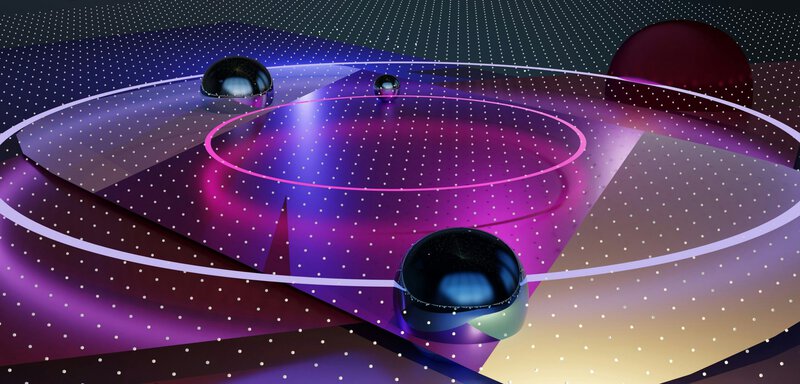
Quantum gravity is the term for any theoretical framework that would reconcile Einstein’s general theory of relativity with quantum mechanics. General relativity — confirmed repeatedly since its publication in 1915, most recently through the direct detection of gravitational waves by the LIGO collaboration in 2015 — describes gravity as the curvature of spacetime caused by mass and energy. Quantum mechanics, equally well-tested, governs the behavior of matter and energy at the smallest scales, where particles behave as probability distributions and measurements carry inherent, irreducible uncertainty.
The incompatibility between these two pillars of modern physics is as much mathematical as it is conceptual. General relativity treats spacetime as a smooth, continuous fabric that bends and stretches. Quantum mechanics insists that nature is fundamentally discrete and probabilistic at the smallest scales. When physicists attempt to apply quantum rules directly to gravity in the way that works for the other three forces, the equations produce nonsensical mathematical infinities — a clear signal that the framework is incomplete.
Most approaches to quantum gravity predict the existence of a particle called the graviton: a massless, spin-2 particle that would carry the gravitational force the way photons carry electromagnetism. No graviton has ever been detected. The gravitational force is so extraordinarily weak at the particle level that detecting an individual graviton would require a detector so massive and sensitive that it is, by most physicists’ estimates, physically unrealizable with any foreseeable technology. The graviton remains a theoretical necessity rather than an observed fact.
The stakes of solving this problem extend well beyond academic completeness. Without a working theory of quantum gravity, physicists cannot coherently describe the interior of black holes, the first instants after the Big Bang, or any regime where both extreme gravity and quantum effects are simultaneously significant. Those are precisely the conditions where the laws of nature are most likely to reveal themselves in their deepest form — and where a fifth force, if one exists, might first leave a detectable trace.
The Search for a Fifth Force: What the Evidence Actually Shows
No fifth fundamental force has been confirmed. The scientific consensus holds firmly to the four known interactions, backed by an enormous body of experimental data accumulated over more than half a century. But the Standard Model and general relativity together leave a growing list of phenomena that neither framework can explain, and that gap has generated serious, sustained scientific interest in the possibility that something is missing.
The most pressing motivation is dark matter — an undetected substance inferred from its gravitational effects on galaxies and galaxy clusters, which is estimated to make up roughly 27 percent of the universe’s total energy content. The four known forces offer no satisfying candidate particle or mechanism to account for it. Dark energy, the mysterious driver of the universe’s observed accelerating expansion, is similarly unaccounted for. So is the striking asymmetry between matter and antimatter in the observable universe — a disproportion the Standard Model cannot adequately explain.
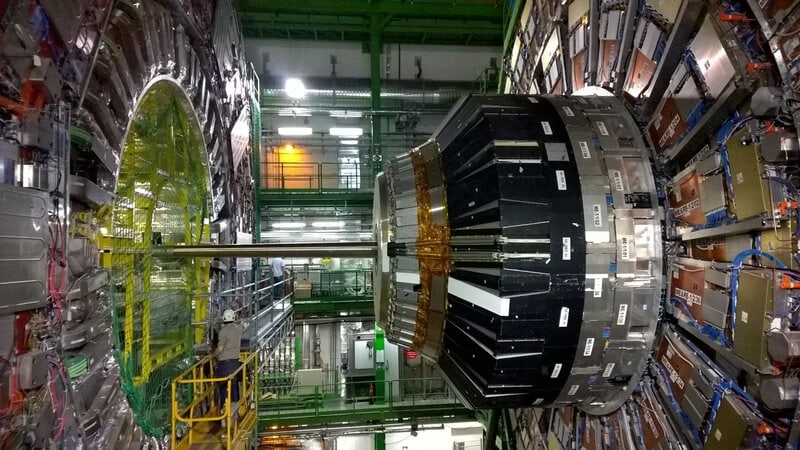
Physicists at facilities including CERN and Fermilab, as well as research groups conducting precision atomic measurements, actively test for deviations from predicted behavior that would signal an unknown interaction. Results to date are broadly consistent with the Standard Model. One anomaly that has attracted sustained attention is the muon g-2 experiment at Fermilab, which measures the magnetic moment of the muon with extraordinary precision. Early results produced values that differed from Standard Model predictions in ways some researchers interpreted as potential hints of new physics. However, a competing theoretical calculation published in 2021 using lattice quantum chromodynamics yielded a Standard Model prediction that reduced the apparent discrepancy significantly, and the scientific community has not reached consensus that the measurements represent evidence of a fifth force. The anomalies are real and actively studied; their meaning remains genuinely unresolved.
How a Quantum Gravity Framework Could Point to Something New

The connection between quantum gravity and a potential fifth force is not arbitrary. Scientists investigating quantum gravity think a successful new framework could offer concrete clues about a fifth fundamental force because any viable quantum gravity theory must make testable predictions — and some of those predictions involve interactions not accounted for by the four known forces.
The mechanism is conceptually straightforward even if the mathematics is not. Leading quantum gravity approaches — including string theory and loop quantum gravity — naturally generate additional fields or particles beyond those in the Standard Model. If any of these extra fields couple to ordinary matter, they would manifest as a new force: effectively a fifth fundamental interaction. Some string-theory-inspired models, for example, predict light scalar particles called moduli or dilatons that could mediate a new interaction at very short or very long distances and might simultaneously serve as dark matter candidates. This makes quantum gravity research and fifth-force searches complementary rather than separate endeavors.
It is important to be precise about what this means in practice. These are theoretical predictions at the frontier of physics, not established findings. Physicists use quantum gravity frameworks as a structured guide for where to look and what experimental signatures to expect — not as proof that a fifth force exists. The frameworks are valuable precisely because they generate specific, falsifiable predictions that experimentalists can test and, if necessary, rule out.
Beyond the Standard Model: The Bigger Picture
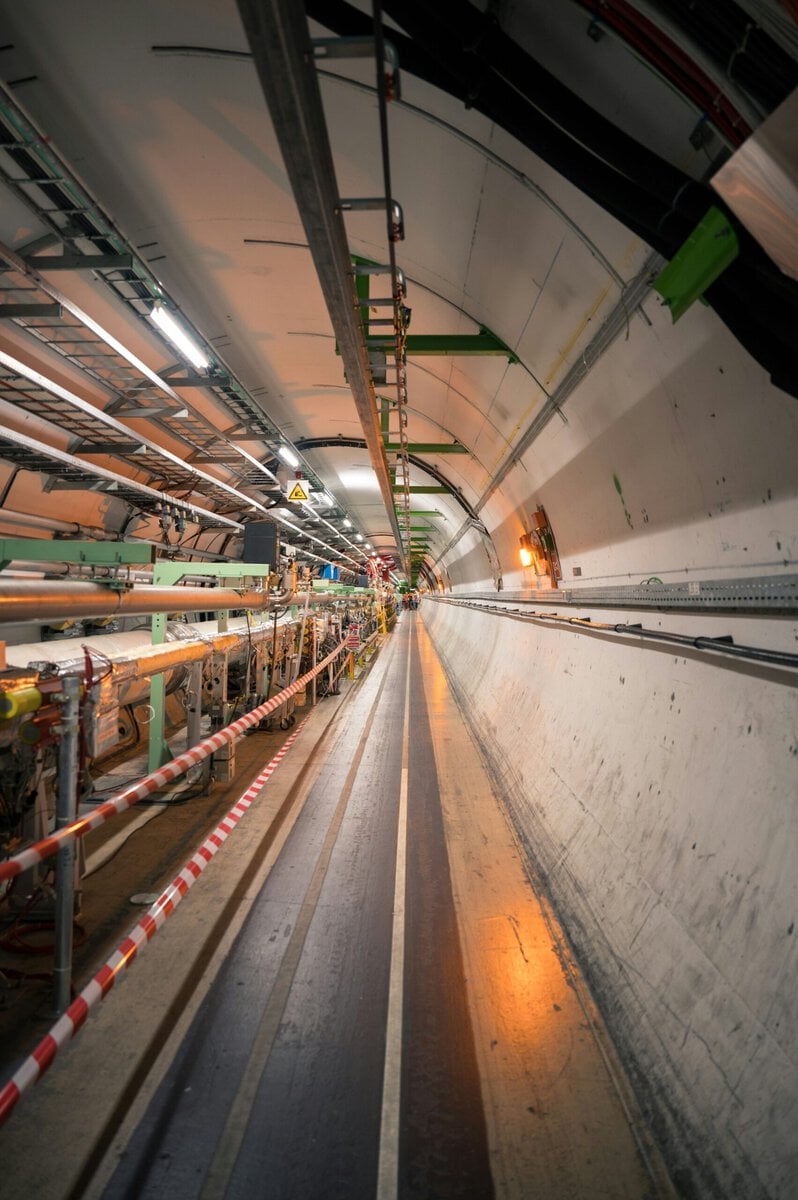
“Beyond Standard Model physics” refers to any theoretical or experimental work aimed at discovering phenomena the Standard Model cannot account for. It is one of the most active frontiers in contemporary science, spanning particle colliders, underground dark matter detectors, space-based observatories, and precision laboratory measurements conducted on tabletops.
The rarity of genuine progress in this domain is worth appreciating. The last time the known roster of fundamental forces fundamentally changed was in the mid-twentieth century, when the weak and strong interactions were formally distinguished, theoretically unified with electromagnetism in the electroweak framework, and incorporated into the Standard Model — work that earned multiple Nobel Prizes in Physics. A confirmed fifth force would represent the first major expansion of nature’s fundamental architecture in generations, with implications for every branch of physics and cosmology.
Progress requires both sides of the scientific enterprise working in concert. Theorists use quantum gravity frameworks to identify where new forces might hide and what their signatures would look like. Experimentalists design ever-more-sensitive instruments to test those predictions. As discussions within the physics community reflect, the field is in an unusual moment: the theoretical case for something beyond the Standard Model is compelling, while experimental confirmation remains elusive. That tension is not a sign of failure — it is how fundamental science advances.
What Comes Next: Experiments to Watch
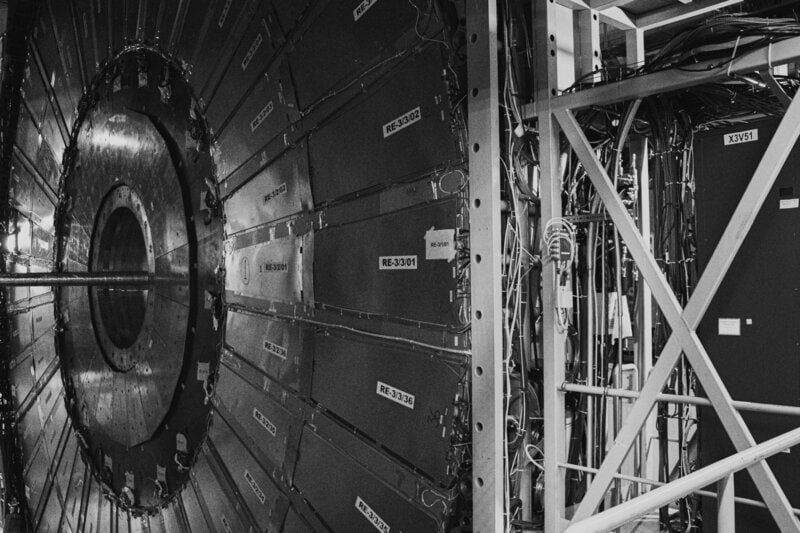
The near-term experimental landscape offers genuine reasons for optimism. The High-Luminosity Large Hadron Collider at CERN, currently undergoing upgrades scheduled for completion in the late 2020s, will deliver proton-proton collision data at an unprecedented rate, enabling searches for new particles and interactions at energies beyond previous runs. Next-generation dark matter detectors — including experiments using liquid xenon and germanium crystals deep underground, such as LUX-ZEPLIN and SuperCDMS — are designed to detect particles interacting through forces far weaker than any known interaction. The planned LISA space mission, a gravitational-wave observatory operating in space that the European Space Agency expects to launch in the 2030s, will probe gravitational physics in regimes impossible to access from the ground and could reveal deviations from general relativity that quantum gravity theories predict.
Each of these efforts is capable of either constraining quantum gravity models and fifth-force hypotheses or, if a genuine signal appears, confirming that something new is present. The absence of a signal is itself informative: it narrows the space of viable theories and forces the remaining candidates toward sharper, more testable predictions. Science advances in both directions.
The core insight driving this field remains as sharp as ever. The fact that gravity alone has resisted quantum description for more than a century is not a failure of physics — it is a signpost. The framework scientists eventually construct to reconcile gravity with quantum mechanics may carry within it the blueprint for an entirely new force of nature. The four fundamental forces built the universe as we know it, but the mathematics of quantum gravity increasingly suggests that the story of nature’s deepest rules is not yet finished.