
When Zendaya stepped in front of cameras at a London photocall for Christopher Nolan’s forthcoming film The Odyssey, the gold medallions swaying from her ears were not merely accessories — they were, by scholarly estimate, between 2,000 and 3,000 years old, forged in ancient Iran and connected to one of the most disputed archaeological finds of the twentieth century. Within hours, the image had travelled far beyond entertainment coverage, igniting a debate that archaeologists, legal scholars, and governments have been conducting — largely unheard — for decades: who owns the deep past, and what are the consequences when ancient artefacts become fashion statements?
The Ziwiye Treasure: What It Is and Why Its Origin Matters
The earrings worn by the actor were loaned by a Mayfair dealer and fashioned from gold medallions connected to what scholars call the Ziwiye treasure — a cache of gold, silver, and ivory objects reportedly unearthed in 1947 near the site of Ziwiye, in what is now Iranian Kurdistan. The assemblage reflects an extraordinary cultural crossroads: archaeologists associate it with Iron Age Mannaean, Scythian, and Assyrian influences, making it one of the most layered and contested archaeological groupings of the modern era. Its very richness is part of the problem.
Because the cache surfaced through the antiquities market rather than a controlled excavation, archaeologists have never been able to verify its precise stratigraphic context — the layer of soil and associated materials that give an object its datable, interpretable meaning. That gap is not a bureaucratic technicality. It is the difference between an object that can teach us about a vanished civilisation and one that can only be admired as a beautiful thing. Iran has consistently maintained that Ziwiye-connected objects form part of its national cultural heritage, and that pieces dispersed after 1947 left the country under circumstances that predate or circumvent modern legal protections.
The Mayfair loan matters beyond this single incident. Cultural property scholars argue that the legal movement of unprovenanced ancient objects through high-end private dealers perpetuates demand — regardless of whether any specific transaction is technically lawful. The prestige of the endpoint, in this case a global celebrity at a major film event, functions as a form of legitimisation that the private market actively seeks.
The Legal Landscape: What Cultural Property Law Actually Says
The primary international benchmark in this field is the 1970 UNESCO Convention on the Means of Prohibiting and Preventing the Illicit Import, Export and Transfer of Ownership of Cultural Property. Under this framework, objects with documented ownership histories predating 1970 occupy a legally distinct — and far less scrutinised — category than those surfacing after that date. Because the Ziwiye cache was reportedly discovered in 1947, many of its dispersed pieces exist in what cultural property scholars describe as a legal grey zone: not straightforwardly illegal to own or loan, but not clean by the contemporary ethical standards endorsed by bodies such as the Association for Research into Crimes against Art.
The United Kingdom’s own Dealing in Cultural Objects (Offences) Act 2003 criminalises trade in objects known to be tainted by theft or unlawful excavation — but enforcement depends heavily on provenance documentation that, for pre-1970 pieces, is frequently sparse or absent. This is not a minor loophole. It is a structural gap through which a significant volume of the ancient artefact market passes every year.
Critically, legal and ethical are not synonyms here. The American Alliance of Museums’ updated guidelines make explicit that an object being legally held does not resolve the separate ethical question of whether it should be displayed, loaned, or worn. The Zendaya incident collapsed that distinction in public view, presenting millions of onlookers with an image that was legally defensible and ethically contested simultaneously — and doing so without explanation.
What Archaeology Actually Says: Context Is Everything
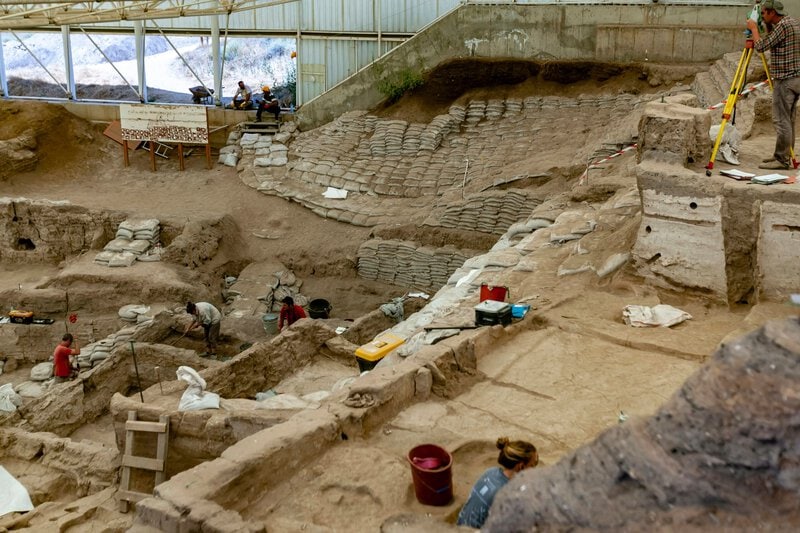
The scientific value of an ancient object is inseparable from its context. This is not a minority opinion: it represents the settled consensus of the discipline. Institutions that study portable antiquities consistently note that an unprovenanced object loses the stratigraphic, chemical, and spatial data that allow researchers to reconstruct past societies. When a gold medallion is removed from soil by an unrecorded hand and sold onward through private channels, it becomes what the Archaeological Institute of America’s position statement describes as an orphaned object — aesthetically intact but epistemologically diminished. Its beauty survives; its testimony does not.
There is also what researchers call the collector’s paradox. High market prices for ancient artefacts, driven partly by their display in prestigious contexts — including celebrity appearances — increase the financial incentive for looting at source sites. Research by Neil Brodie and colleagues, published in peer-reviewed cultural heritage journals, has documented this relationship, establishing that demand-side visibility is not a passive consequence of the market but an active driver of archaeological destruction.
The World Archaeological Congress has articulated a position that is not in serious dispute among professionals: using ancient artefacts as wearable fashion accessories, regardless of legal status, risks physical degradation through handling, environmental exposure, and chemical contact, while symbolically reducing objects of collective human heritage to personal adornment. Critics were pointed in their response: “No one has the right to use ancient artefacts” in this manner — a sentiment reflecting mainstream archaeological opinion even where the legal picture remains ambiguous.
The Repatriation Debate: Museums, Nations, and Moral Claims
The Zendaya controversy arrived inside a decade of intensifying pressure over cultural heritage repatriation — the return of the Benin Bronzes to Nigeria, ongoing Greek demands for the Parthenon Marbles, and agreements between Italy and major Western museums over looted antiquities. Each case tests different legal and moral arguments, and none has produced a universal template.
Two principal positions structure this debate. Retentionist institutions argue that centralised stewardship in large, well-resourced museums maximises global access and conservation standards. Source-nation advocates, supported by the International Council of Museums’ revised 2022 Code of Ethics, argue that cultural objects carry identity claims that transcend ownership law — that a Scythian gold medallion is not merely an object of aesthetic or historical interest, but a node in a living network of cultural memory that belongs, in some morally meaningful sense, to the communities from whose ground it came.
An emerging middle ground has begun to take shape. Institutions including the Smithsonian and the Humboldt Forum in Berlin have adopted shared heritage frameworks — long-term loans, joint research agreements, and digital repatriation initiatives — as practical alternatives to outright return. Critics argue, with some force, that these arrangements defer rather than resolve the core moral question. Iran has not filed a formal diplomatic request regarding the specific Ziwiye-linked pieces worn by Zendaya, but the incident has renewed academic calls for tighter due-diligence requirements on private dealer loans — a gap that existing cultural property law does not adequately address.
For context on the treaty landscape: the UNIDROIT Convention of 1995, which sets stricter return obligations than the UNESCO 1970 framework, had been ratified by only 48 states as of 2024. The repatriation debate, in other words, is nowhere near legal resolution at the international level.
Why Celebrity Moments Move Public Debate More Than Policy Papers
Research in science and policy communication consistently demonstrates that affective, image-driven events — a recognisable face, a glamorous setting, an ancient object — activate public engagement with abstract questions far more effectively than formal reports or academic position statements. The emotional and visual register of a single photograph can accomplish what years of scholarly publication cannot.
The same visibility that brought the Ziwiye treasure to millions of social-media feeds also flattened a structurally complex legal and archaeological debate into a false binary: condemnation of Zendaya personally versus dismissal of any concern at all. Neither position maps onto what the evidence actually shows. The structural incentives — dealer markets, inadequate pre-1970 due-diligence requirements, the prestige economy of celebrity loans — receded behind a single face and a single pair of earrings.
Zendaya did not purchase or commission the artefacts; she wore items provided for a promotional appearance. That distinction is meaningful and shifts significant moral weight toward the dealer, the stylist, and the production apparatus that assembled the look. Scholars of celebrity ethics note, however, that public figures with substantial cultural influence carry a responsibility of informed refusal — particularly when the objects in question carry known provenance disputes. The actor’s position in this chain is not equivalent to that of a collector or dealer, but it is not wholly neutral either.
The controversy produced at least one unambiguous benefit: it demonstrably increased public search interest in terms including “Ziwiye treasure,” “cultural heritage repatriation,” and “ancient artefact ownership.” Celebrity incidents of this kind, when followed by rigorous public explanation, can serve as genuine entry points for education on questions that deserve far wider understanding than specialist journals currently reach.
What Should Actually Happen: Settled Consensus and Remaining Questions
Some things in this debate are not genuinely contested. There is broad consensus among archaeologists, international law scholars, and museum ethics bodies that the unregulated private market in ancient artefacts causes measurable harm — to archaeological knowledge, to source communities, and to the long-term physical integrity of the objects themselves. On the question of market harm, the evidence is clear and the professional consensus is firm.
What remains genuinely disputed is the mechanism of remedy. Mandatory repatriation, stricter pre-1970 due-diligence standards, international tribunal adjudication, and market-side regulation each have serious advocates and serious critics, and no single framework commands universal adoption. The UNIDROIT Convention’s limited ratification record illustrates how difficult consensus becomes when national interests, institutional prestige, and legal tradition intersect.
The specific question the Zendaya case surfaces most sharply is one that existing cultural property law and museum ethics guidelines do not adequately answer: should private loans of ancient artefacts for commercial or promotional purposes — fashion shoots, film premieres, advertising campaigns — face the same ethical scrutiny as museum acquisitions? If so, who holds enforcement authority, and what does compliance look like for a dealer whose loan is measured in hours rather than decades?
That question remains open. The incident is, in miniature, a map of the entire ancient artefact ownership debate: legal grey zones inherited from a pre-1970 world, contested national claims that outpace formal diplomacy, a persistent gap between what the law permits and what the evidence recommends, and the remarkable power of a single image to make a very old argument feel urgently, uncomfortably new.