
For decades, physicists building theories of quantum gravity have been haunted by a quiet embarrassment: certain numbers inside their equations — continuous parameters that tune how the theory behaves — appeared to float freely, with nothing inside the mathematics itself demanding any particular value. New research from Kyushu University and collaborators, reported in June 2026, proposes a striking resolution to that problem, suggesting those seemingly untethered numbers may not be free at all.
The Parameter Problem That Has Haunted Physics for Decades
The discomfort has a name among theorists: fine-tuning arbitrariness. When a physical theory contains parameters that can be dialed to any value without breaking any internal rule, it raises an uncomfortable question — why does nature choose the values it does? Physicists generally regard such freedom as a sign that something deeper is missing, a hidden principle waiting to be found.
The Kyushu University research proposes a concrete answer, at least within a specific and well-controlled mathematical setting. The researchers showed that, under certain assumptions, continuous parameters in two-dimensional conformal field theories — a class of quantum field theories with a powerful symmetry — correspond to local operators already living inside the theory itself. In other words, what looked like an external dial turns out to be an internal feature the theory already possessed.
If the principle holds more broadly, it would mean that quantum gravity partly writes its own rulebook, constraining its parameters from within rather than requiring physicists to insert them by hand. That is an ambitious claim, and the researchers are careful to present it as an emerging result rather than an established consensus.
What Quantum Gravity Is Trying to Do
To appreciate why this matters, it helps to understand the central challenge. Quantum gravity is the long-sought theoretical framework that would reconcile general relativity — Einstein’s geometric description of gravity and spacetime — with quantum mechanics, the rules governing subatomic particles. No fully agreed-upon theory yet exists, and the search for one remains among the most consequential open problems in all of physics.
A key tool in that search is the AdS/CFT correspondence, a mathematical duality conjectured by physicist Juan Maldacena in 1997. The correspondence equates a theory of gravity in a higher-dimensional space — called the bulk — with a quantum field theory living on that bulk’s lower-dimensional boundary. That boundary theory is specifically a conformal field theory, or CFT: a quantum field theory with a special symmetry meaning it looks identical under rescaling of distances.
In two dimensions, conformal symmetry becomes exceptionally powerful. Unlike in three or four dimensions, where the conformal group is finite-dimensional, the two-dimensional conformal algebra is infinite-dimensional, giving theorists an unusually high degree of calculational control. This is precisely why two-dimensional CFTs serve as a favored laboratory for testing ideas about quantum gravity and spacetime — not because they directly describe the four-dimensional universe we inhabit, but because their tractability makes rigorous results achievable.
Within that laboratory, the troublesome continuous parameters are known as marginal coupling constants or moduli — numbers that can be varied continuously without breaking the theory’s conformal symmetry. Their origin and constraints have been a source of theoretical tension for decades, precisely because the symmetry alone does not fix their values.
The Core Finding: Parameters as Operators
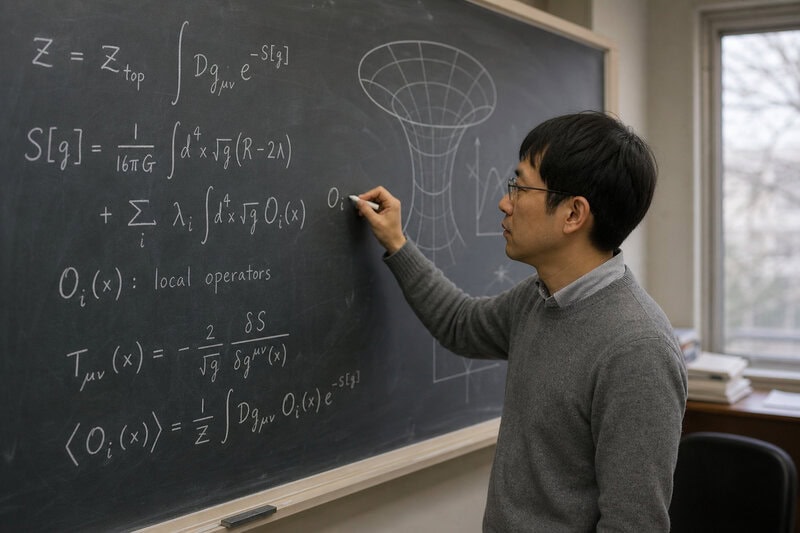
The central claim of the Kyushu University findings, as reported by Phys.org, is that those continuous parameters are not independent inputs. Instead, they arise from local operators within the theory — the same mathematical objects used to represent physical quantities such as energy density or field values at a specific point in spacetime.
A local operator in quantum field theory is, in essence, a precise mathematical instruction: evaluate this physical quantity here, at this location. Identifying parameters with such operators is significant because it ties what were formerly treated as external, freely chosen numbers to the theory’s internal, physical inventory. The parameters are no longer imported from outside; they are already present within the theory’s own structure.
The mechanism rests on a well-established feature of CFTs called the operator-state correspondence, which pairs every operator in the theory with a quantum state. The researchers exploit this correspondence to show that deforming a CFT by adding a marginal operator — one that preserves conformal symmetry — is mathematically equivalent to dialing a continuous parameter. The operator and the parameter are, in a precise sense, two descriptions of the same object viewed from different angles.
A useful analogy: think of a CFT as a musical instrument. Marginal operators are the tension knobs on a drum, and continuous parameters are the pitches those knobs produce. The Kyushu University result says the knob and the pitch are not separate things but two faces of the same physical object — you cannot adjust one without the other being fully determined.
Why This Matters for Quantum Gravity and Spacetime
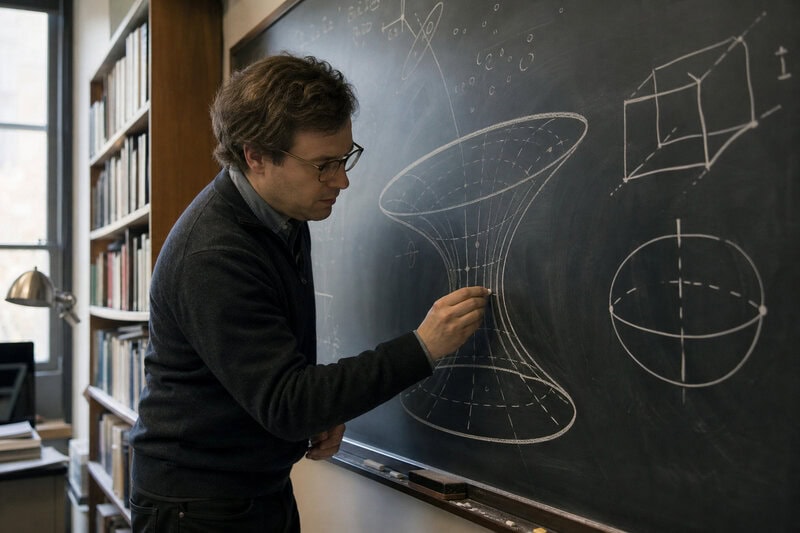
The implications extend in several directions. In the AdS/CFT framework, bulk spacetime geometry — including features like the shape and size of extra dimensions — is encoded in the boundary CFT’s parameters. If those parameters are fixed by internal operators rather than chosen freely, the geometry of spacetime itself becomes less arbitrary. The shape of the universe, at least in these tractable models, would be more self-determined than previously assumed.
The result also speaks directly to a long-standing worry in string theory. String theory predicts an enormous landscape of possible vacuum states — different versions of the universe with different physical laws — partly because continuous parameters appear freely adjustable. Internal constraints on those parameters could significantly reduce that landscape, adding new selection rules without requiring external input.
For researchers working on quantum gravity at the frontier, a recurring priority has been finding what are called consistency conditions: internal requirements a theory must satisfy that eliminate free parameters. The Kyushu University work offers a concrete, calculable example of such a condition, which is precisely the kind of foothold theorists have been searching for.
There is also a connection to the deeper question of how spacetime emerges from quantum mechanics. The finding suggests that at least some geometric data may be reconstructable from purely quantum-mechanical, local information — without specifying boundary conditions by hand. That is a meaningful step toward understanding how the classical, smooth spacetime of everyday experience could arise from an underlying quantum reality.
How Internal Consistency Constrains the Parameters
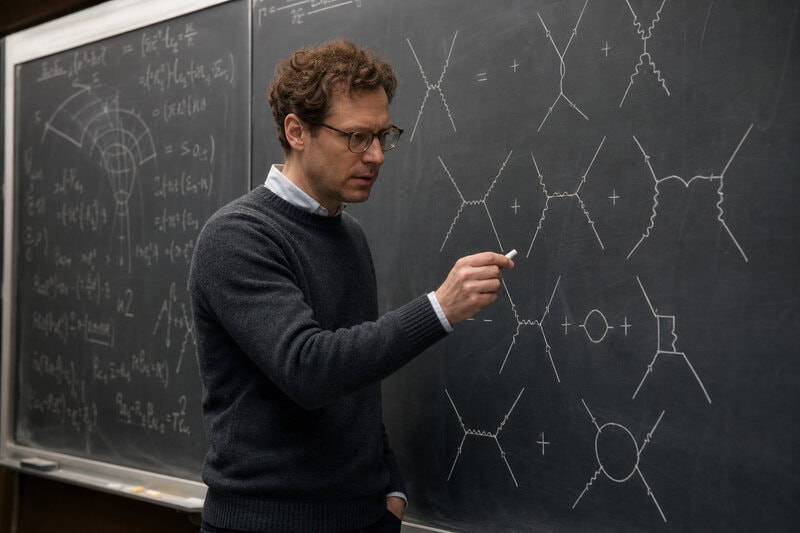
One of the defining technical obstacles in quantum gravity is that naive attempts to quantize general relativity produce calculations that diverge — they yield infinite results for physical quantities that should be finite. Those infinities are notoriously difficult to remove without introducing new free parameters, which then reintroduce the original problem.
The internal anchoring identified by the Kyushu University team offers a potential route around this cycle. Parameters tied to well-defined local operators inherit the constraints those operators must satisfy, including unitarity bounds — mathematical requirements that probabilities remain sensible and physical quantities remain finite. A parameter that is, in a rigorous sense, an operator cannot roam to values that would generate unchecked infinities, because the operator itself is governed by the theory’s internal consistency rules.
Technically, the researchers work within the operator spectrum of the CFT: the full catalogue of operators together with their scaling dimensions, which are numbers describing how each operator transforms under rescaling. Locating continuous parameters within that spectrum means they are subject to the same constraints as every other entry in the catalogue — constraints derived from symmetry, unitarity, and causality, not from external choices.
Caveats, Limits, and What Comes Next
The result is currently rigorous only in two-dimensional CFTs. That setting is valuable precisely because two-dimensional conformal symmetry is infinite-dimensional, providing exceptional calculational control unavailable in higher dimensions. Whether the correspondence between parameters and local operators survives in four-dimensional theories — the kind directly relevant to the universe we inhabit — remains an open and actively contested question that this research does not resolve.
The demonstration also rests on specific assumptions about the structure of the operator algebra, the mathematical rules governing how operators combine. Researchers in quantum gravity and quantum field theory will need to scrutinize whether those assumptions hold in more realistic models. Independent groups will likely test the claim using numerical bootstrap methods — computational techniques that systematically search for consistent CFT solutions — as well as by examining known exactly solvable models to verify that every continuous parameter does indeed have an operator counterpart.
It is also worth noting that the connection between marginal deformations and operators is, at some level, known in the existing literature on CFTs. The Kyushu University contribution is in making the correspondence precise and explicit within a quantum gravity context, and in drawing out its consequences for parameter determination. The novelty lies in the application and the rigorous formulation, not in inventing the correspondence from scratch.
If the principle generalizes to higher dimensions, it could reshape how physicists count and classify quantum gravity theories, effectively adding new internal selection rules to the model-building process. If it does not generalize, it would still represent a valuable and exact result within two-dimensional physics — a clean theorem in a domain where clean theorems are rare and often point the way to broader discoveries.
Toward a Theory That Determines Its Own Content
The deepest ambition of quantum gravity research is a theory that determines its own content — one where the laws, constants, and structure of spacetime are not inputs chosen by theorists but outputs derived from mathematical consistency alone. The Kyushu University finding is a small but concrete step in that direction.
The work aligns with a broader movement in theoretical physics sometimes called the bootstrap philosophy: the project of deriving the properties of quantum field theories and gravity purely from internal consistency requirements such as unitarity, causality, and symmetry, without freely adjustable parameters. By showing that continuous parameters correspond to local operators within the theory, the research reinforces the view that quantum gravity — at least in tractable two-dimensional models — is more tightly self-referential than previously assumed. The theory contains, in a precise mathematical sense, the seeds of its own parameter values.
A complete, experimentally tested theory of quantum gravity remains a distant goal, and no single paper closes that gap. But results like this one — precise, falsifiable within their stated domain, and grounded in well-defined mathematics — represent the kind of incremental progress that historically precedes conceptual breakthroughs in fundamental physics. The parameters that once seemed to float freely may, in the end, have been anchored all along.