
In the time it takes to blink, a dying star can unleash more energy than our Sun will produce across its entire ten-billion-year lifetime. For 22 years, NASA’s Neil Gehrels Swift Observatory existed for one reason: to catch those blinks — and what it found reshaped our understanding of the violent universe hiding behind the apparent stillness of the night sky.
A Mission Ends, Ungracefully
NASA has officially ended the science mission of the Swift Observatory, closing the book on one of the most productive space telescopes in history. The conclusion was neither planned nor clean. A failed private rescue attempt left the aging spacecraft in a decaying orbit less than 171 miles (275 kilometers) above Earth’s surface — too low for long-term stability, too far gone to save.
Over its remarkable run, Swift logged more than 1,000 gamma-ray burst detections and fundamentally changed how scientists observe, track, and interpret the most powerful events in the known universe. NASA’s retrospective on the mission describes a legacy that will continue generating discoveries long after the spacecraft goes dark.
What Swift Was Built to Do
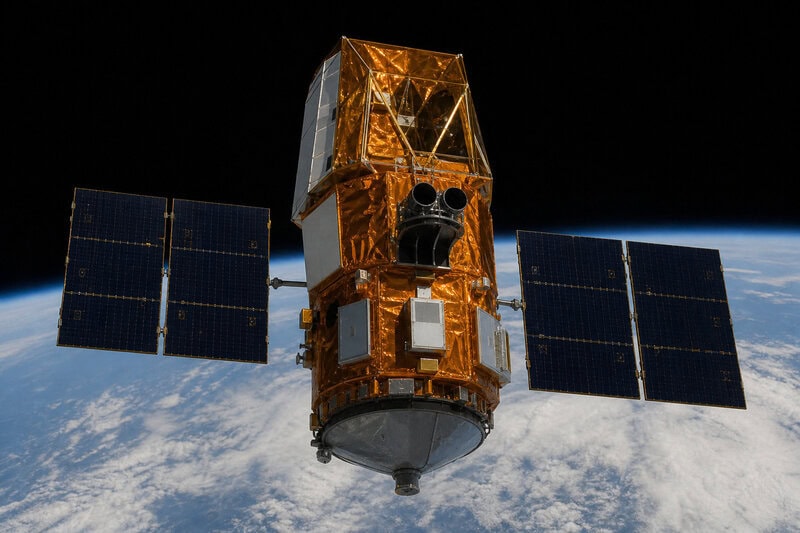
Launched in November 2004, Swift was engineered around a single obsession: catching gamma-ray bursts in real time. Gamma-ray bursts are the universe’s most energetic explosions — brief, blinding pulses of high-energy radiation that can outshine entire galaxies for a fleeting moment before vanishing. Before Swift, scientists routinely missed the critical opening minutes of these events, arriving only in time to study a fading afterglow.
Swift changed that entirely. The spacecraft carried three instruments working in concert: a Burst Alert Telescope to detect the initial flash, an X-ray Telescope, and an Ultraviolet/Optical Telescope. Together, they allowed simultaneous observation across multiple wavelengths. Crucially, Swift could autonomously repoint itself toward a burst within seconds of detection and immediately alert ground-based observatories worldwide — triggering a coordinated chain of follow-up observations that no previous mission had made possible.
That rapid-response architecture was not a convenience. It was the entire scientific strategy. Gamma-ray bursts are measured in seconds. A telescope that needed human input to slew and respond would have missed the very thing it was built to study.
1,000 Explosions: What Swift Actually Found
Over 22 years, Swift catalogued more than 1,000 gamma-ray bursts, each one adding another data point to an evolving map of the universe’s most violent behavior. The cumulative findings rewrote textbooks across multiple subfields of astrophysics.
- Short gamma-ray bursts decoded: Swift gathered key evidence confirming that short gamma-ray bursts — those lasting less than two seconds — are produced by collisions between neutron stars. Those same collisions send ripples through spacetime as gravitational waves, directly linking Swift’s optical discoveries to the emerging field of gravitational wave astronomy.
- A window to the early universe: The observatory captured light from some of the most distant gamma-ray bursts ever recorded — photons that had traveled for billions of years before reaching Swift’s detectors, offering a direct view of the cosmos in its earliest chapters.
- Breadth beyond explosions: Swift was never a single-purpose instrument. It studied supernovae, black holes, neutron stars, and comets within our own solar system, making it one of the most scientifically versatile platforms in the history of space-based astronomy.
Live Science’s coverage of the mission’s end underscores that Swift’s output was extraordinary not simply because of the volume of detections, but because of the depth and range of what those detections revealed.
The Science That Will Outlast the Spacecraft
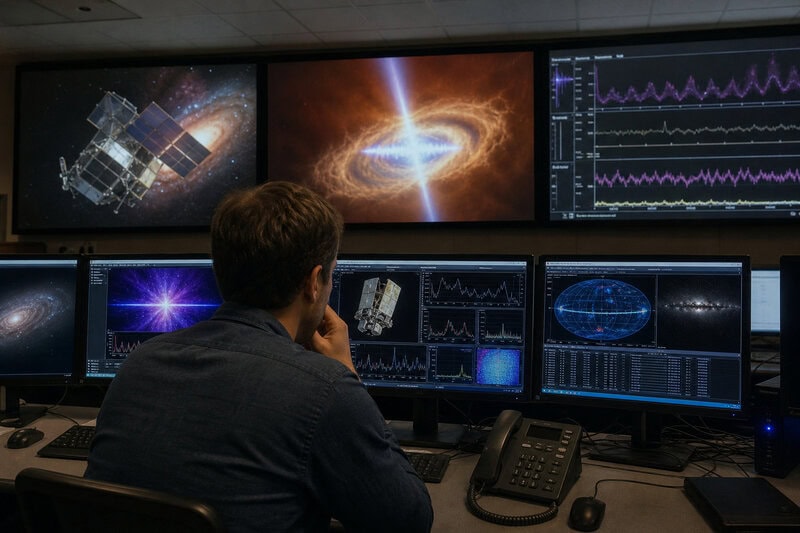
Swift’s hardware may be falling silent, but its scientific legacy is far from finished. The mission’s data archive continues to fuel new research and fresh discoveries — a testament to 22 years of unbroken observation. Astronomers are still mining its records for insights into phenomena that Swift itself may not have fully characterized during its operational life.
The observatory’s multi-wavelength, rapid-response model also established the template for modern time-domain astronomy: the study of how objects in space change, flare, and explode over time. When the first electromagnetic counterpart to a gravitational wave event was detected in 2017, Swift observations were part of the global network that pieced the picture together. Its automated alert system is now embedded in the standard operating procedures the international science community uses whenever something dramatic happens in the sky.
That influence on methodology may prove as durable as any individual discovery. Swift did not just answer questions — it demonstrated how to ask them faster.
The Decaying Orbit and a Failed Rescue
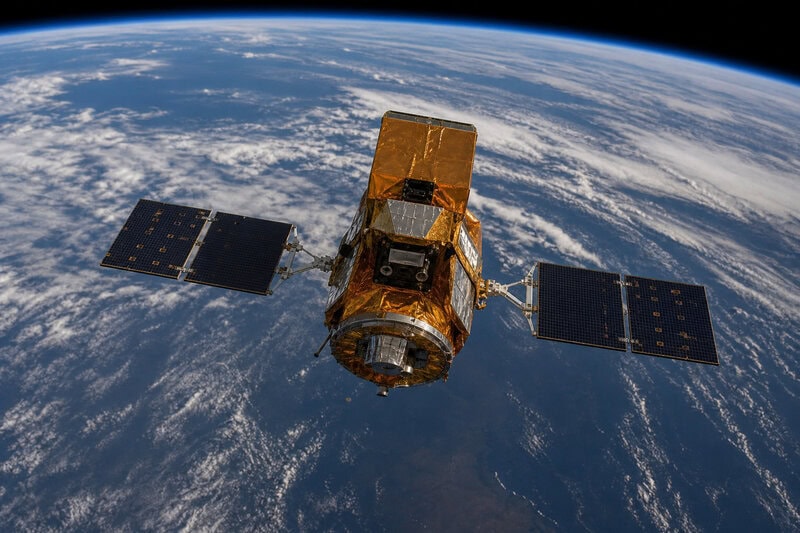
Every satellite in low Earth orbit faces the same slow fate: without periodic boosts, atmospheric drag gradually pulls it inward. For Swift, that process accelerated as the spacecraft aged and its altitude crept steadily downward.
NASA did not accept the outcome without a fight. In September 2025, the agency awarded a contract to U.S. company Katalyst Space for an ambitious rescue attempt — dispatching a private satellite to rendezvous with Swift and boost it into a more stable orbit. The plan represented a novel commercial approach to extending the life of an aging government asset, and its success would have set a precedent for future satellite servicing missions.
It did not work. According to reporting in Science magazine, the private spacecraft was unable to complete the rendezvous with Swift, leaving NASA with no viable path forward. The failure made the end of science operations inevitable.
Going Dark: What Happens to Swift Now
With science operations concluded and no rescue possible, Swift is in a slow, irreversible descent. As Space.com reports, the spacecraft is expected to re-enter Earth’s atmosphere and break apart — the standard end for satellites at these altitudes. The majority of Swift’s components will burn up during re-entry, and NASA will monitor the descent trajectory as it approaches.
The mission’s closure leaves a meaningful gap in NASA’s high-energy astrophysics program. No currently operational telescope combines Swift’s rapid-response gamma-ray detection capability with its multi-wavelength follow-up architecture in quite the same way. How the agency addresses that observational void in the years ahead remains an open question.
Swift’s Place in the Story of Cosmic Discovery
Few space telescopes in history have matched Swift’s combination of longevity, scientific breadth, and raw discovery rate. Over two decades, it catalogued more than a thousand cosmic explosions, contributed to landmark gravitational wave science, and delivered some of humanity’s clearest views of the universe’s earliest and most violent moments.
The observatory was renamed in 2018 to honor Neil Gehrels, the NASA scientist who championed the mission from its earliest stages and helped define the modern field of gamma-ray astronomy. His name now travels with the spacecraft on its final descent.
Swift proved that some of the most profound questions in astrophysics — how stars die, how black holes are born, what the young universe looked like — could be answered by building a telescope fast enough to catch the sky in the act. As it falls silent, astronomers are left with a richer, stranger, and far more explosive picture of the cosmos than existed before Swift ever opened its eyes.