
In December 2028, if engineering and politics align, a spacecraft called SR-1 Freedom is scheduled to leave Earth carrying not a chemical engine but a nuclear fission reactor. If it performs as designed, it could cut the journey to Mars from roughly eight months down to approximately four. That single number explains why NASA, after more than five decades of dormancy, is treating nuclear propulsion not as a curiosity but as the central infrastructure of its human Mars program.
A Nuclear-Powered Spacecraft Aimed at Mars in 2028
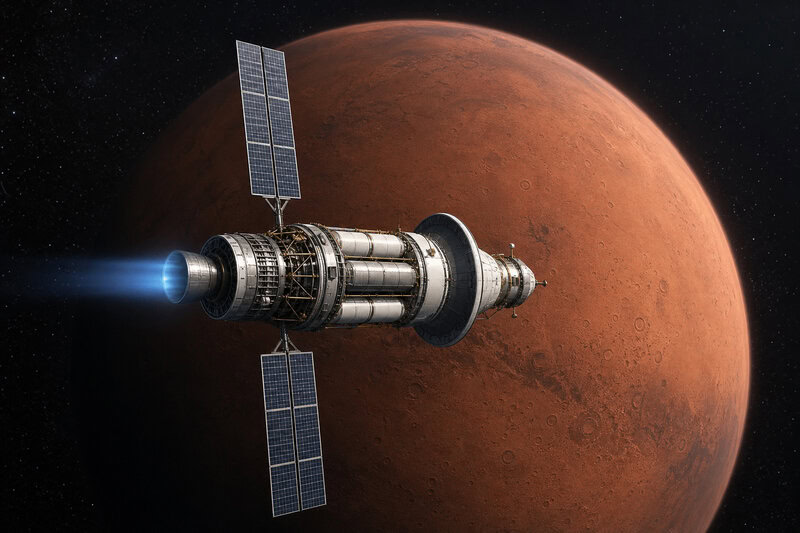
NASA plans to launch SR-1 Freedom — described by the agency as the first nuclear-powered interplanetary spacecraft — toward Mars in December 2028. The mission represents the most significant shift in deep-space propulsion strategy since the Apollo era. It is being developed under NASA’s Space Technology Mission Directorate as a core pillar of the agency’s Moon to Mars vision, which means it carries institutional weight, budget allocations, and programmatic expectations that a one-off technology demonstration typically does not.
NASA Administrator Jared Isaacman has publicly outlined a roadmap coupling nuclear propulsion with a lunar base and eventual crewed Mars missions. NASA’s plans for nuclear-powered Moon and Mars exploration signal institutional commitment well beyond a single demonstration flight. The agency states directly that nuclear propulsion will enable more rapid transits than any currently operational propulsion method — a claim grounded in decades of physics research and in hardware that was actually tested during the 1960s and early 1970s.
The December 2028 launch window is not arbitrary. Earth and Mars align favorably for efficient transit only roughly every 26 months, a rhythm dictated by orbital mechanics rather than engineering preference. NASA has targeted a window consistent with its broader Moon to Mars programmatic timeline, meaning the 2028 date reflects both physics and institutional planning.
Why Getting to Mars Faster Is a Life-or-Death Engineering Problem
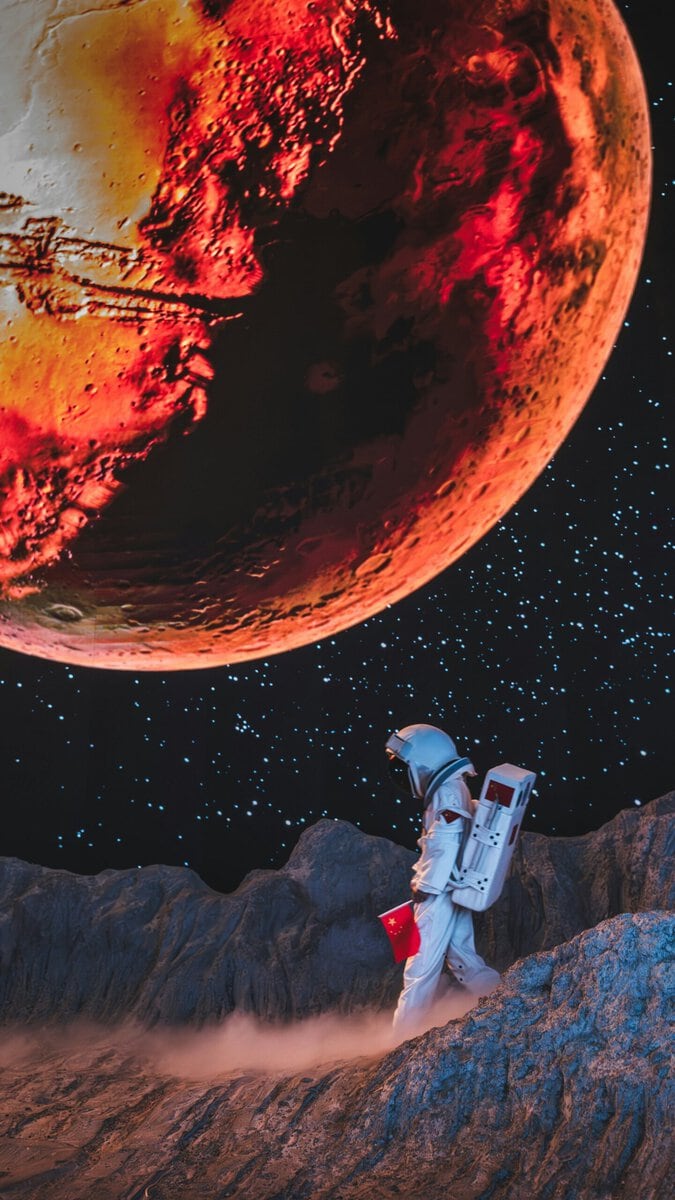
A conventional chemical rocket trip to Mars takes roughly seven to nine months one way. That transit time is not merely an inconvenience — it is a medical variable. Deep-space radiation, primarily galactic cosmic rays and solar energetic particles, penetrates spacecraft walls in ways that low-Earth-orbit missions largely avoid. The longer astronauts spend in transit, the higher their cumulative radiation dose and the greater their measurable lifetime cancer risk. NASA’s human research program has identified radiation exposure as one of the most critical risks for a crewed Mars mission.
Longer journeys compound every other resource requirement as well. More food, water, breathable air, and psychological support must be carried for each additional month in transit, and those mass additions drive launch costs upward in a near-linear relationship. Cutting transit time is therefore not an engineering vanity project. It is among the highest-leverage interventions available for making a crewed Mars mission both survivable and economically feasible.
What a Nuclear Thermal Rocket Actually Does — The Physics in Plain Language
A nuclear thermal rocket, commonly abbreviated NTR, works on a straightforward principle: a nuclear fission reactor heats a propellant — typically liquid hydrogen — to extreme temperatures. That superheated hydrogen is expelled through a nozzle, generating thrust by the same action-reaction mechanics that govern every rocket engine ever built. No combustion occurs inside the reactor. The reactor’s heat is the engine, and hydrogen is the working fluid.
This distinction matters for accurate public understanding: an NTR is not a nuclear explosive and bears no operational resemblance to a weapon. The fission process involved is the same fundamental one used in commercial electricity-generating plants, adapted here to produce heat for propulsion rather than steam for turbines.
The key performance metric separating NTR from chemical propulsion is specific impulse, abbreviated Isp. Specific impulse measures propellant efficiency in a way that is loosely analogous to fuel economy in a car — higher numbers mean more thrust extracted per unit of propellant consumed. Chemical rockets, including the powerful engines that launched Apollo and currently lift heavy payloads to orbit, achieve roughly 450 seconds of Isp. NTR designs are projected to reach 800 to 900 seconds of Isp, effectively doubling the work a given mass of propellant can accomplish.
That efficiency advantage translates directly into mission architecture. Higher Isp means engineers can choose a lighter spacecraft for the same mission, a faster spacecraft for the same mass, or — critically for Mars — a combination of both advantages in a trajectory that shaves months off transit time. The underlying physics is well-established and not speculative. What remains to be demonstrated is whether the engineering can be executed reliably in the actual space environment, which is precisely what SR-1 Freedom is designed to answer.
A Brief, Honest History: Why This Technology Stalled for 50 Years
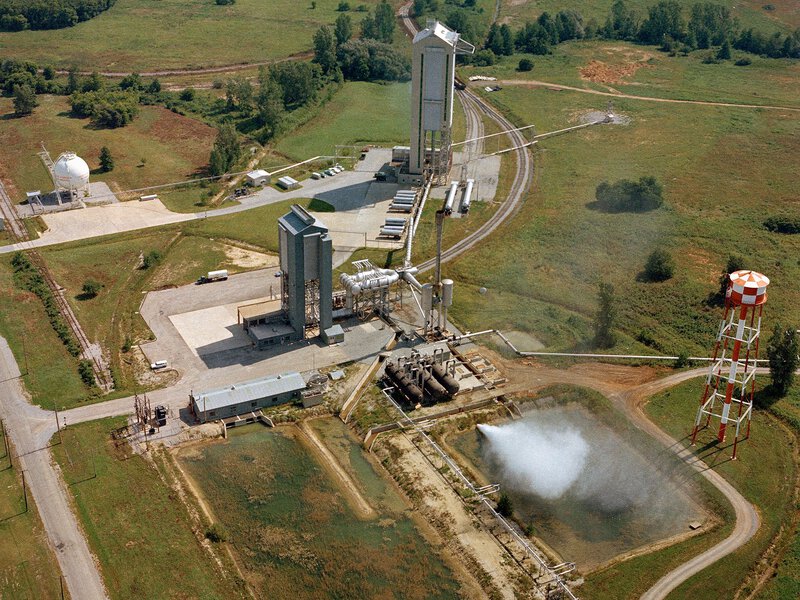
The concept of nuclear thermal propulsion is not new. NASA and the U.S. Atomic Energy Commission tested nuclear thermal rocket engines under the NERVA program — Nuclear Engine for Rocket Vehicle Application — from 1955 to 1972. Engineers successfully ran reactors at full power, and NERVA engines demonstrated specific impulse nearly twice that of contemporary chemical rockets. Program engineers believed a crewed Mars mission by the 1980s was technically achievable. The program was cancelled in 1972 as Apollo wound down and national funding priorities shifted — not because the physics failed to deliver.
For roughly five decades, nuclear propulsion remained a well-understood but politically dormant technology, persisting primarily in academic literature and occasional NASA feasibility studies rather than active hardware development. The institutional knowledge was preserved; the momentum was not.
The current revival reflects two converging pressures. The first is renewed geopolitical competition in space, which has restored political appetite for ambitious propulsion programs. The second is a growing recognition within NASA that chemical propulsion has reached practical limits for the transit times crewed Mars missions require — a position now reflected in the Space Technology Mission Directorate’s active budget allocations rather than just its strategic wish lists. NASA’s aim for a nuclear-powered Mars mission in 2028 represents the first time since NERVA that this technology has moved from concept to funded, scheduled hardware development.
What Remains Contested, Uncertain, or Unproven
Honest reporting on SR-1 Freedom requires clearly distinguishing what is established from what is aspirational. Several significant uncertainties remain as of early 2025.
- Performance specifications: Detailed performance figures for SR-1 Freedom’s reactor and propulsion system have not been fully disclosed in peer-reviewed literature. Projections about trip-time reductions should be understood as engineering targets, not guaranteed outcomes. Independent verification of those targets is not yet possible from public data alone.
- Regulatory complexity: Launching a nuclear fission reactor from Earth involves safety and environmental review processes substantially more complex than those governing the radioisotope power systems NASA has successfully flown on missions such as Cassini and the Mars Science Laboratory. A full fission reactor represents a different regulatory category, and that approval process was not complete as of early 2025.
- Competing propulsion approaches: Some aerospace engineers and independent analysts argue that advances in solar electric propulsion — which involves far less regulatory and logistical complexity than nuclear systems — may offer a competitive alternative for cargo precursor missions to Mars, even if not for crewed transit. That technical and policy debate has not been resolved.
- The gap between demonstrator and crewed vehicle: SR-1 Freedom is an uncrewed technology demonstrator. The path from its 2028 flight to a crewed nuclear-propelled Mars mission involves multiple additional technology readiness milestones, sustained multi-administration funding, and political continuity that no institution, including NASA, can guarantee today.
- Budget and schedule risk: Large NASA programs have historically experienced cost growth and schedule delays. SR-1 Freedom is scheduled and funded as of early 2025, but the 2028 launch date should be understood as a current target rather than a fixed commitment.
NASA’s nuclear-powered path to Mars is a credible, funded, and scheduled program — but it is a first step in a long sequence, not a completed achievement. Readers should weigh both the genuine significance of the program and the real distance remaining between a 2028 demonstrator and astronauts standing on Martian soil.
What a Successful Test Would Actually Change
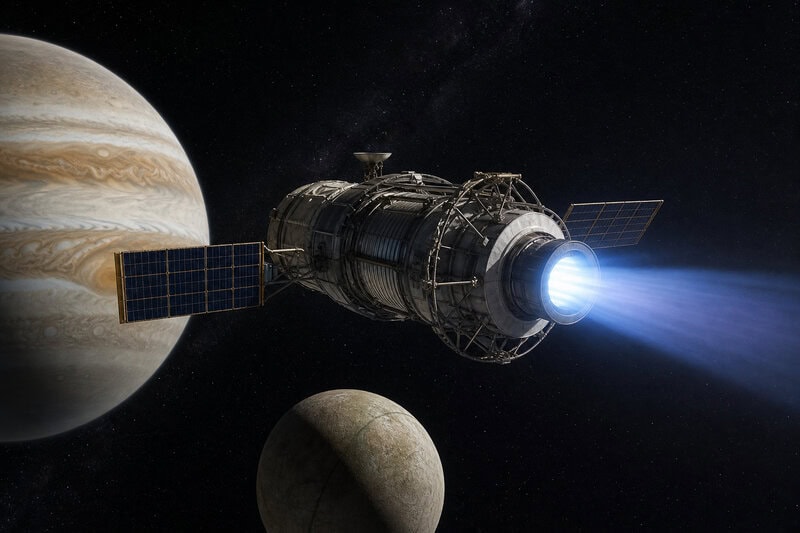
A validated in-space nuclear propulsion system would not only accelerate Mars timelines but would fundamentally expand the practical envelope for the entire outer solar system. Missions to Jupiter’s moons and beyond, which currently require transit times measured in years, become substantially more feasible within human operational lifespans when propulsion efficiency doubles. The implications reach well past Mars.
For Mars specifically, NASA’s Moon to Mars framework identifies rapid transit as essential to crew safety and mission economics. SR-1 Freedom is the first physical step in converting that framework from a strategic document into engineering reality. The mission would also generate flight data on long-duration fission reactor performance in the actual space radiation environment — data that does not exist today and cannot be adequately replicated in ground-based testing. It can only be created by flying the hardware.
If SR-1 Freedom performs as designed, the era of nuclear-powered deep-space exploration would no longer belong entirely to the future tense. It would have a verified, dated first chapter — and the physics that for fifty years filled textbooks and feasibility studies would have proven itself across the roughly 140 million miles separating two planets at a favorable alignment.