
Picture an astronaut doubled over in pain in the cramped medical bay of a deep-space vessel, 140 million miles from the nearest surgeon, with no doctor on board and a radio signal that takes up to 24 minutes just to reach Earth — let alone carry a response back. It is the kind of emergency no mission planner wants to imagine, and precisely the one that NASA and Google are now engineering a solution for.
The Medical Gap That Deep Space Exposes
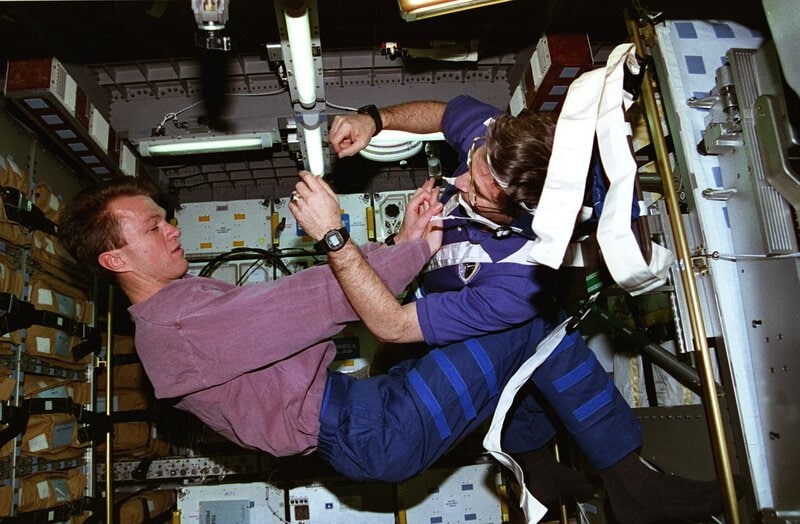
Human spaceflight has always carried medical risk, but low-Earth orbit missions — including those aboard the International Space Station — have operated with a crucial safety net: Earth is close enough that medical evacuation, while difficult, is at least conceivable, and real-time voice guidance from flight surgeons on the ground remains reliably available. A Mars mission strips both of those options away entirely.
The one-way communication delay between Earth and a Mars-bound spacecraft can stretch to 24 minutes, meaning a round-trip exchange — a crew member describing symptoms, a doctor responding — could consume nearly an hour. In a genuine medical emergency, that delay is not an inconvenience. It is potentially fatal. This logistical reality has driven NASA and Google Public Sector, the government-focused arm of Google Cloud, to begin testing what could become one of the most consequential technologies in the history of human spaceflight.
What NASA and Google Are Actually Building
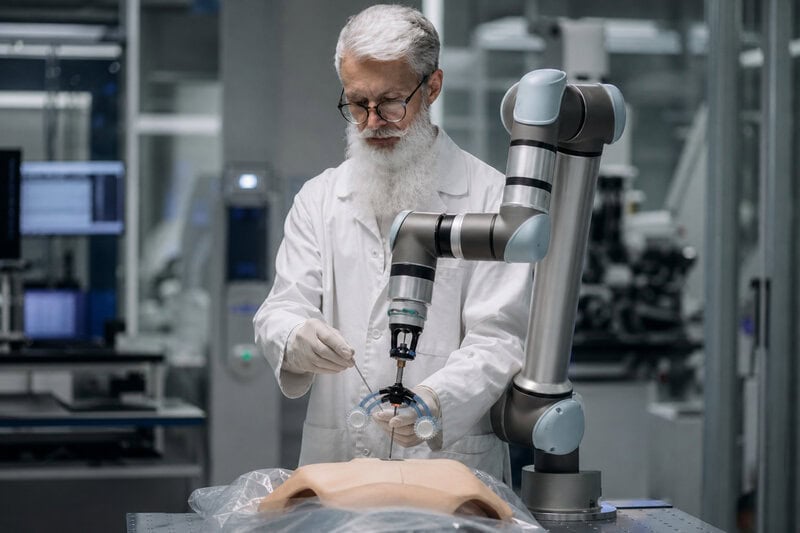
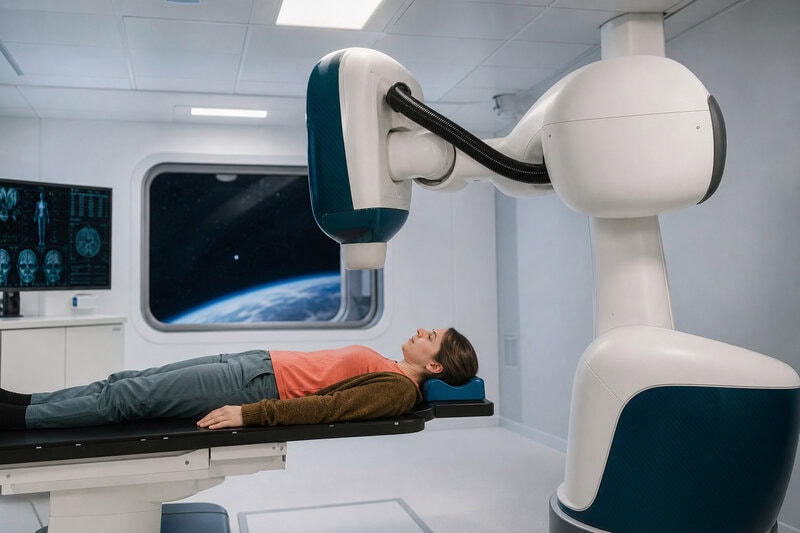
The two organizations are developing and testing an AI-powered robotic system designed to serve as a medical and clinical assistant for astronauts on deep space missions. The emphasis on “assistant” is deliberate. NASA and Google describe the system not as a fully autonomous surgical robot capable of independently performing operations, but as an intelligent helper — one that augments what astronauts can do for themselves and each other when no physician is present.
In early demonstrations, the robotic system showed it could locate and physically move medical equipment for astronauts. That capability sounds modest, but it represents a meaningful step toward functional space-based care. Finding the right instrument in an emergency, positioning it correctly, and doing so without human error under extreme stress is genuinely difficult. An AI system that can handle that logistics layer provides real value.
The project is explicitly framed as a proof-of-concept, not a finished product. The collaboration is targeting future Moon and Mars missions, where crew members will operate so far from Earth that timely ground intervention is physically impossible. Beyond medical support, the system is also intended to assist with routine logistics and operational tasks aboard a spacecraft, making it a multipurpose crew asset rather than a single-purpose medical device.
Why This Is Harder Than It Sounds
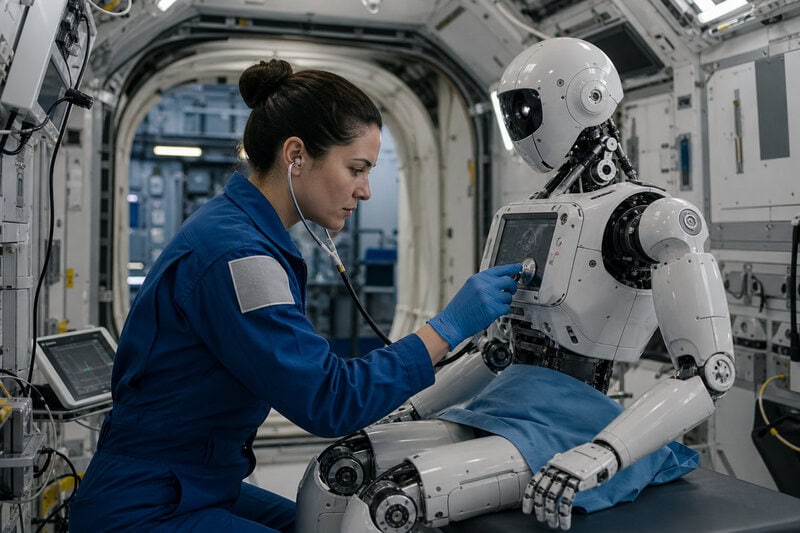
The phrase “AI medical robot” carries obvious science-fiction associations, and it is worth being precise about what this system is and is not. The goal is human-AI collaboration in a high-stakes environment, not the removal of human judgment from the decision loop. An astronaut crew member would remain the decision-maker; the AI system would supply the support, equipment, guidance, and procedural assistance that a trained medical professional might otherwise provide.
That design philosophy reflects both technical reality and ethical responsibility. Fully autonomous robotic surgery in a remote, uncontrolled environment remains extraordinarily complex, and the margin for error in space is effectively zero. Building a reliable, intelligent first responder — one that can meaningfully assist crew members through medical procedures and crises — is the achievable, high-value target this project is pursuing.
The engineering challenges are severe. One of the project’s central goals is demonstrating that AI algorithms can operate reliably in the harsh environment of deep space, where radiation levels far exceed anything experienced in low-Earth orbit and extreme temperature swings can degrade electronics and corrupt software. Unlike a terrestrial AI deployment, a space-based medical robot cannot be rebooted by a technician, patched remotely, or replaced if it fails at a critical moment. It must work — consistently and correctly — every single time.
Radiation in deep space is a well-documented and serious threat to both human biology and sensitive computing hardware. Designing AI systems that remain stable and trustworthy under those conditions is one of the non-negotiable requirements the proof-of-concept phase is specifically designed to stress-test. That challenge alone distinguishes this project from virtually any comparable AI deployment on Earth.
The Communication Blackout Is the Core Design Driver
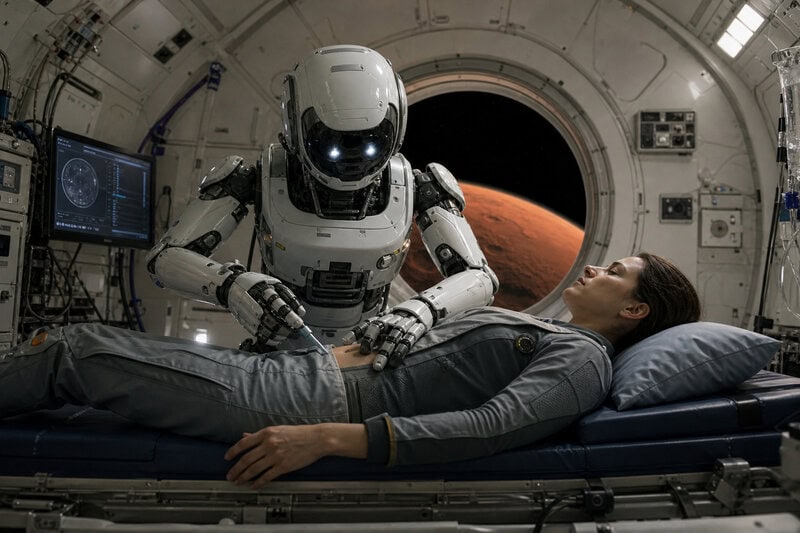
Understanding why autonomy is essential here requires sitting with the communication delay problem in concrete terms. On a lunar mission, the signal lag between Earth and the spacecraft runs roughly 1.3 seconds — fast enough for genuine back-and-forth with flight surgeons on the ground. Mars presents a fundamentally different situation. A crew member in distress cannot wait 48 minutes for a question-and-answer cycle with a physician who is 140 million miles away.
This is why autonomy is not a feature of the system — it is the entire point. The robot’s capacity to function intelligently during a communication blackout is arguably the most consequential capability the project is working to establish. Every other technical achievement in the proof-of-concept is in service of that single operational requirement: when the crew needs medical help and Earth cannot provide it in time, something on board must be able to respond.
That requirement also clarifies the scope of the engineering problem. The system is not being designed for convenience or efficiency in routine situations. It is being designed to perform under the worst-case scenario — a medical emergency, mid-mission, with no outside assistance available and no margin for failure.
The Broader Implications — In Space and on Earth
If this technology matures into reliable capability, the implications extend well beyond any single mission. For NASA’s long-range planning, a proven AI medical assistant would fundamentally reshape how the agency approaches crew health and safety protocols for missions beyond the Moon. Future iterations could evolve from equipment-moving assistants toward more sophisticated diagnostic and procedural support as both AI capabilities and the field of space medicine advance in parallel.
The potential ripple effects on Earth are also worth considering. Autonomous medical AI engineered to function in the most extreme and resource-scarce environment humans have ever attempted to inhabit could eventually inform emergency care in remote terrestrial settings — disaster zones where hospitals are unreachable, polar research stations, or underserved regions where trained medical personnel are simply unavailable. Space-derived engineering solutions have a well-established history of finding useful applications much closer to home.
The timeline pressure is real. NASA’s Artemis program is actively targeting crewed lunar missions this decade, and Mars remains a documented long-range agency objective. This technology does not have generations to mature. The NASA-Google Public Sector partnership signals that deep space health care is now a serious, funded engineering priority — not a theoretical problem deferred to future generations.
The robotic system demonstrated in this proof-of-concept is not ready to replace a surgeon, and no one involved is claiming it is. But on the way to Mars, that may not be the standard that matters most. A reliable, intelligent presence during a medical crisis — capable of locating equipment, guiding crew through procedures, and operating without any real-time connection to Earth — may be exactly sufficient to save a life that would otherwise be lost. That is a specific, solvable problem. NASA and Google have started solving it.