
In a single photographic instant — no rotating parts, no sequential exposures, no waiting — a new solar telescope instrument has captured a complete map of the sun’s magnetic field from one snapshot of polarized light. That achievement, realized by the Solar Imaging Metasurface Polarimeter (SIMPol), represents one of the first times a nanoscale optical chip has been successfully deployed inside real astronomical instrumentation. It signals a genuine threshold moment for both solar science and the broader field of flat optics.
Why Mapping the Sun’s Magnetic Field Demands Speed

The sun’s magnetic field is not a passive backdrop. It drives solar flares, coronal mass ejections, and the broader patterns of space weather that can disable satellites, corrupt GPS signals, and knock out power grids across entire continents. The faster and more accurately scientists can map that field, the more warning time engineers and forecasters have to protect critical infrastructure.
Conventional solar polarimeters — the instruments that measure the polarization of sunlight to infer magnetic structure — have historically imposed an uncomfortable tradeoff: speed versus mechanical simplicity. SIMPol, developed by researchers at UC San Diego and described by the team in their own words, was built explicitly to dissolve that tradeoff.
Solar magnetic mapping is the foundational data layer for space weather prediction, and the quality of that data depends entirely on how faithfully an instrument can freeze a moment in the sun’s turbulent atmosphere. SIMPol’s snapshot capability addresses exactly that fidelity problem — and it does so using a component thinner than a human hair.
What a Metasurface Actually Is
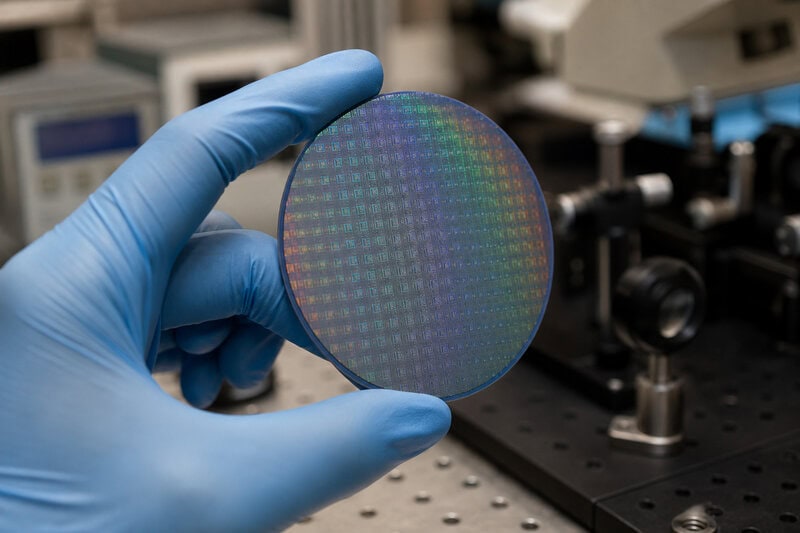
A metasurface is an engineered, wafer-thin layer of nanoscale structures — typically etched into materials such as silicon or titanium dioxide — that manipulates light in ways conventional glass optics cannot, all within a thickness smaller than the width of a human hair. Where a traditional lens bends light by exploiting the curved geometry of glass, a metasurface works differently: arrays of nanoscale pillars or fins, each precisely sized and oriented, impose controlled shifts in the phase, amplitude, and polarization of individual light waves as they pass through. The result is that a single flat chip can perform optical functions that would otherwise require stacks of waveplates, beam-splitters, and rotating mechanical elements.
This distinction matters enormously for practical instrumentation. Every additional optical component in a telescope is a potential point of failure, a contributor to system mass, and a source of alignment error. As IEEE Spectrum has reported on the SIMPol development, metasurface optics offer a route to replacing complex, multi-element optical trains with a single passive chip — a proposition especially attractive for spacecraft, where mass budgets are counted in grams and mechanical servicing after launch is impossible.
Miniaturization through flat optics is frequently discussed as a transformative application for metasurfaces across fields from medical imaging to augmented reality. What makes SIMPol significant is that it moves beyond laboratory proof of concept: the metasurface has been integrated into a functioning solar telescope and produced scientifically meaningful results.
The Core Problem Conventional Polarimeters Could Not Fully Solve
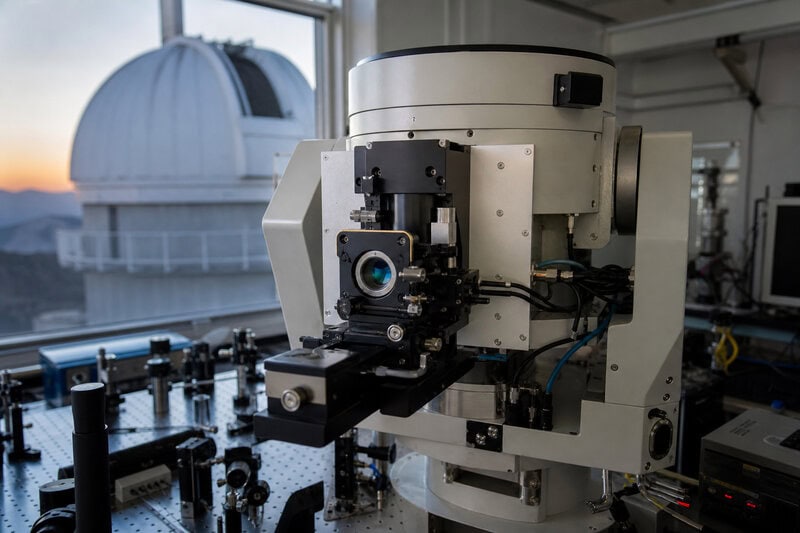
To understand why SIMPol matters, it helps to understand what solar polarimetry actually measures. The sun’s magnetic field leaves a subtle but detectable imprint on the polarization of the light it emits — a quantum-mechanical phenomenon called the Zeeman effect, in which magnetic fields cause atomic spectral lines to split and become polarized in characteristic ways. By measuring the precise polarization state of sunlight, scientists can reconstruct the strength and orientation of magnetic fields across the solar surface without ever touching them.
The difficulty lies in how polarization is measured. A complete description of a light beam’s polarization state — expressed mathematically as the four Stokes parameters — requires sampling the beam in multiple polarization configurations. Traditional polarimeters achieve this by rotating optical elements, typically waveplates, through a sequence of positions and recording a separate image at each position. Only after cycling through all positions can the Stokes parameters be calculated.
That sequential process introduces a problem called temporal crosstalk: because the sun’s atmosphere is dynamic and can change measurably between the first and last exposures in a sequence, measurements from different positions do not strictly describe the same instant in time. The reconstructed magnetic map becomes a composite of slightly different solar states — a smear rather than a snapshot. Faster rotating optics can reduce the smear but add mechanical complexity, vibration sensitivity, and power consumption. For a small satellite or CubeSat platform, those penalties can be prohibitive.
How the Metasurface Solves It: Polarization Split by Design
SIMPol’s metasurface eliminates the sequential measurement problem by encoding multiple polarization states spatially — across different regions of a single detector — within one simultaneous exposure. The nanoscale architecture of the chip is patterned so that light arriving in different polarization states is steered to distinct, non-overlapping zones on the detector. The analogy, loosely, is how a glass prism separates white light into its constituent colors, but applied to polarization rather than wavelength.
Because all polarization channels are recorded at the same instant, the full set of Stokes parameters can be reconstructed from a single frame. There is no waiting, no mechanical cycling, and no temporal crosstalk. The peer-reviewed work published in Science Advances describes this approach as snapshot imaging polarimetry enabled by metasurface optics, and identifies it as one of the first successful deployments of a metasurface within astronomical instrumentation operating on an actual solar telescope.
The scientific payoff is direct. Solar flares and emerging active regions evolve on timescales of seconds. A snapshot polarimeter can track their development frame by frame without the ambiguity that moving-part delays introduce into magnetic field reconstruction. SIMPol does not see farther into space in the traditional angular-resolution sense; it sees the sun’s magnetic architecture more faithfully in time — capturing a genuine moment rather than a blurred average across several exposures.
The Case for Space: Mass, Reliability, and New Platforms
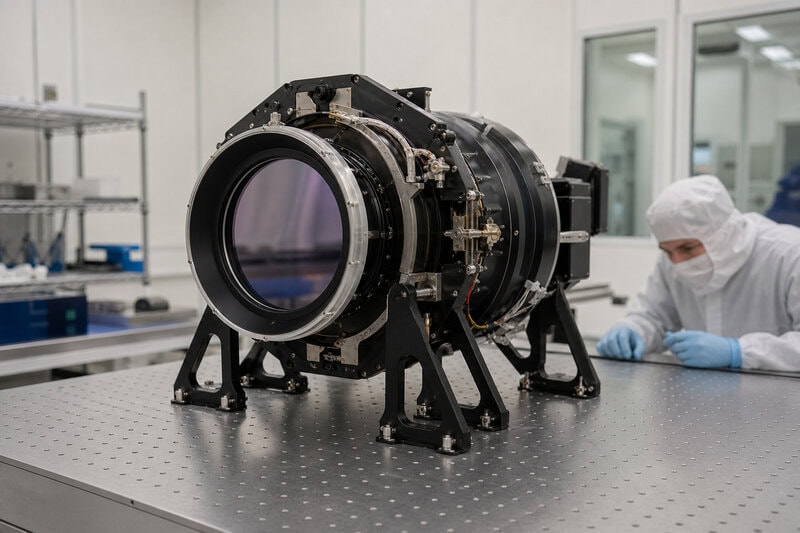
Eliminating motorized waveplates and beam-splitter assemblies does more than improve data quality. It directly reduces the mass and mechanical complexity of the instrument — two variables that dominate spacecraft design decisions. On a mission where every component must survive launch vibration, radiation exposure, and thermal cycling between extreme temperatures, a passive optical chip with no moving parts is inherently more reliable than a motorized optical assembly.
Reporting by The Engineer on the SIMPol project notes that reducing spacecraft complexity and cost is an explicitly stated design motivation of the development team — not an external projection. That framing matters: the instrument was not merely optimized for scientific performance and then reconsidered for space applications; it was conceived from the outset with spacecraft constraints in mind.
The implications extend to platforms that have historically been excluded from high-quality polarimetric science. CubeSats and small satellites operate under strict volume, mass, and power budgets that have made conventional polarimeters impractical. A metasurface-based instrument that consolidates equivalent functions into a chip-scale form factor changes that calculus entirely. It opens the possibility of deploying capable solar monitors on low-cost platforms in large numbers — a constellation approach to space weather monitoring that would have been technically infeasible with conventional optics.
One important caveat must be stated plainly. Long-duration space qualification of metasurface chips — verifying that nanoscale structures etched into silicon or titanium dioxide survive years of radiation bombardment and thermal cycling in orbit — remains an open engineering challenge. Ground-based and suborbital demonstrations are necessary precursors to full orbital deployment, and SIMPol’s current achievements, while significant, are early steps in that qualification process. Full technical documentation available through eScholarship provides detail on the instrument’s current capabilities and the work that remains ahead.
A Threshold Moment for Flat Optics in Astronomy
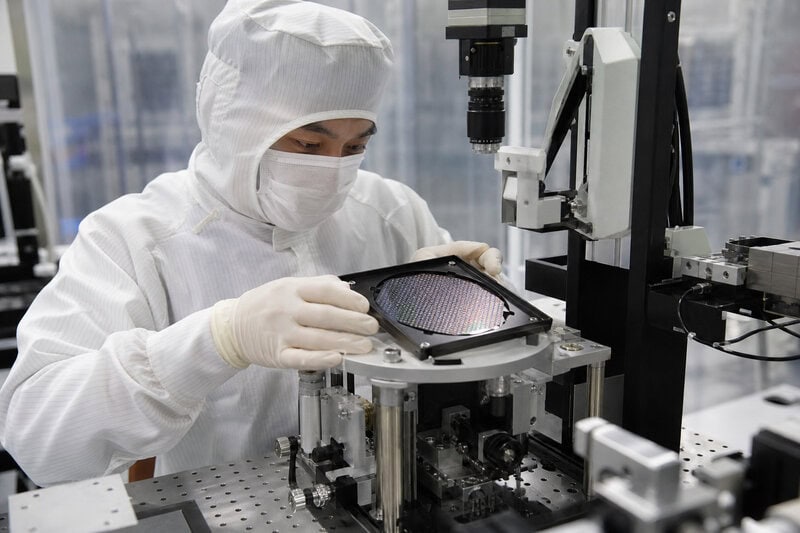
SIMPol sits within a larger trajectory that nanophotonics researchers have been anticipating for years. Metasurfaces have been demonstrated in laboratory settings performing functions across a remarkable range of optical tasks, from achromatic focusing to holographic projection. Translating those demonstrations into working scientific instruments has proven harder, because real telescopes impose demands — wavelength range, throughput efficiency, environmental stability — that benchtop experiments do not. SIMPol’s integration into a functioning solar telescope represents concrete evidence that the transition from laboratory to instrument is actively underway.
The same snapshot polarimetry principle that SIMPol applies to solar magnetic mapping has potential relevance elsewhere in observational astronomy. Characterizing the atmospheres of exoplanets, mapping magnetic fields on distant stars, and suppressing starlight in high-contrast coronagraphs all depend on multi-component optical systems that flat optics could, in principle, simplify. Each application would require independent validation at the relevant wavelengths and telescope scales — they remain prospective, not demonstrated. But SIMPol establishes that the underlying approach is not merely theoretical.
Manufacturing tolerances at nanoscale remain demanding, and efficiency losses relative to conventional glass optics are an active area of research rather than a solved problem. Optica, the professional society for optics and photonics, highlighted the SIMPol result as a meaningful advance while the community continues to work through these engineering challenges. The honest summary is that metasurface solar telescope science has cleared an important bar — deployment in a real instrument producing real data — while substantial work remains between that milestone and routine operational use.
In a field where optical components have been ground from glass for centuries, a lithographically patterned chip performing equivalent or superior functions inside a working solar telescope is a genuine inflection point. The sun will keep generating magnetic storms regardless of how scientists measure them. But with instruments like SIMPol, the measurements themselves are becoming faster, lighter, and more faithful to what the sun is actually doing in any given moment — and that, ultimately, is what better space weather forecasting requires.