
Around 240 BCE, a librarian in Alexandria calculated Earth’s circumference to within roughly 2% of the value used by NASA today — using nothing more than a stick, a well in the Egyptian desert, and the angle of sunlight. That single act of geometric reasoning, performed more than two millennia before the first aircraft left the ground, set humanity on an intellectual trajectory that would eventually end with bootprints on the Moon.
The Number That Changed Everything

The librarian in question was Eratosthenes of Cyrene, chief scholar at the great Library of Alexandria and one of the most consequential scientific minds of the ancient world. His result — roughly 40,000 kilometers for Earth’s total circumference — stands as one of the most astonishing acts of applied mathematics in human history. Historians of science at institutions including the Library of Congress cite the ancient Greek astronomical tradition he belonged to as the foundational layer beneath all modern space science.
The calculation’s deeper significance goes beyond geography. If a person standing on the ground can measure a planet using shadows and geometry, then the cosmos is not an impenetrable mystery — it is a system of rules waiting to be read. That conviction, first systematically established by Greek thinkers, is the same conviction that powered the Apollo program roughly 2,200 years later.
A Cosmos Governed by Reason: The Greek Intellectual Revolution

Long before telescopes or modern astronomy existed, ancient Greek thinkers envisioned a cosmos that was structured, knowable, and governed by principles that human reason could uncover. This was not a minor philosophical preference. It was a working hypothesis that generated real, testable predictions about the physical world — a decisive break from the mythological cosmologies that preceded it across the ancient Near East and Mediterranean.
Greek astronomers plotted the wandering paths of planets across the night sky with enough precision to distinguish them reliably from the fixed stars. Mars, with its distinctly reddish color and noticeably erratic motion compared to other celestial wanderers, drew particular attention. Long before any lander touched Martian soil, ancient observers tracked its retrograde loops with enough regularity to incorporate them into predictive models — and associated it with deities of fire, war and destruction — a level of systematic observation that moved well beyond religious storytelling.
Crucially, this was not mythology dressed in astronomical language. The Greeks applied observational data and logical inference — the core methodology we now call the scientific method — to build predictive models of celestial behavior. The Library of Congress collections document how these Greek astronomical ideas and models formed the conceptual bedrock that later European and Islamic scientists explicitly built upon. The chain of inheritance is direct, documented, and unbroken.
Eratosthenes and the Geometry of a Planet
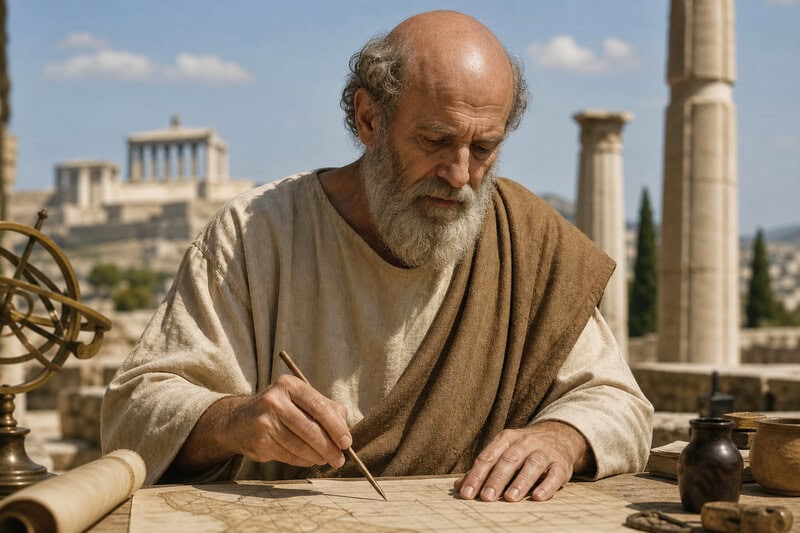
The mechanism behind Eratosthenes’s calculation is elegant in its simplicity. He knew that at noon on the summer solstice, sunlight fell straight to the bottom of a well in Syene (modern Aswan, Egypt), meaning the Sun was directly overhead at that location. On that same day in Alexandria, a vertical stick cast a measurable shadow equivalent to an angle of approximately 7.2 degrees. Because the Sun’s rays arrive at Earth essentially in parallel, and because Earth is a sphere, that angular difference represents the separation between the two cities — roughly one-fiftieth of a full 360-degree circle. Multiplying the known ground distance between Syene and Alexandria by 50 yielded Earth’s circumference.
The method is so logically airtight that it is routinely cited in histories of science as an early triumph of the scientific method applied directly to planetary measurement. Its importance is not simply historical. By demonstrating that the universe obeys geometric rules measurable from Earth’s surface, Eratosthenes established a crucial precedent: space exploration is ultimately a matter of engineering rather than imagination. The ancient Greeks used this approach to surpass all other ancient civilizations in their understanding of Earth’s shape and dimensions — and in doing so, they handed every subsequent generation a template for how to interrogate the physical world.
Aristarchus and the First Heliocentric Model
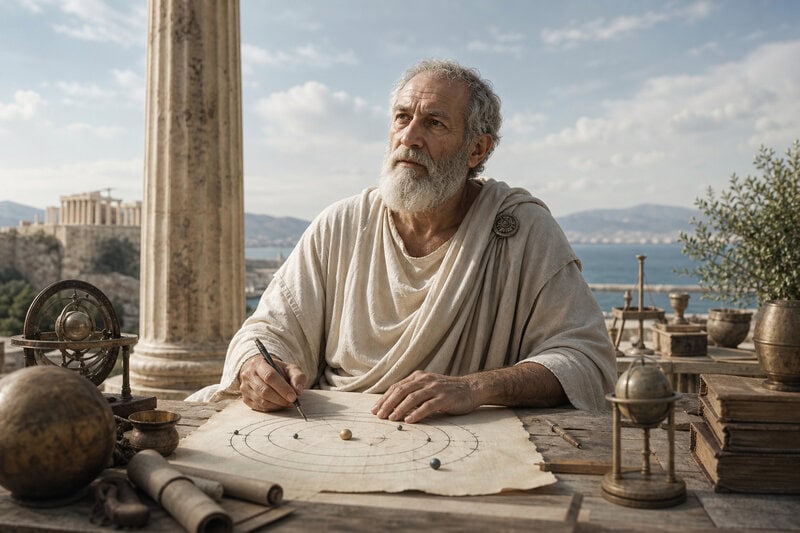
Nearly a century before Eratosthenes, Aristarchus of Samos proposed around 270 BCE that Earth orbits the Sun rather than the other way around. This heliocentric model would not be widely accepted in the Western scientific tradition until Nicolaus Copernicus restated it roughly 1,800 years later. The delay was not due to any flaw in Aristarchus’s core argument, but to the overwhelming institutional authority of the Earth-centered model that Ptolemy would later codify in the second century CE — a model that fit observational data well enough, with sufficient mathematical adjustments, to resist challenge for over a millennium.
Aristarchus also used the geometry of lunar eclipses and the timing of lunar phases to estimate the relative distances of the Moon and Sun from Earth. His specific numbers were a significant underestimate by modern standards, but the method was structurally sound — a genuine attempt at cosmic distance measurement using observation and geometry rather than revelation or mythology.
His heliocentric proposal is attested in the writings of Archimedes and later Plutarch, making it one of the best-documented intellectual achievements of antiquity. Its practical legacy is concrete: NASA and ESA mission planners work in a heliocentric reference frame every time they calculate spacecraft trajectories. The mathematical architecture guiding interplanetary probes today traces directly to the intellectual leap Aristarchus made on the island of Samos more than two millennia ago.
Hipparchus, Star Catalogues, and the Machinery of Prediction
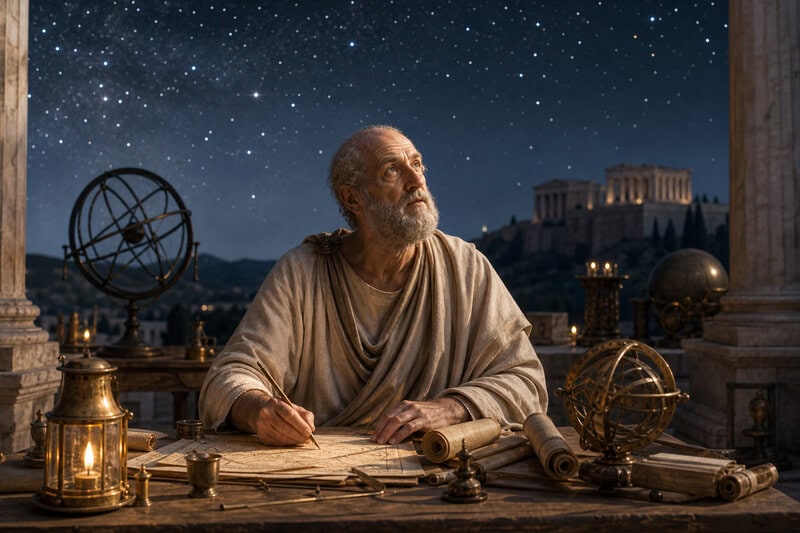
Around 129 BCE, Hipparchus of Nicaea compiled one of history’s first systematic star catalogues, recording approximately 850 stars with precise positional coordinates. He also discovered the precession of the equinoxes — the slow, roughly 26,000-year wobble of Earth’s rotational axis relative to the fixed stars — a phenomenon with direct implications for long-duration orbital mechanics and the calibration of celestial navigation systems. Both contributions illustrate a consistent pattern: ancient Greek contributions to astronomy were not philosophical abstractions but quantitative, testable, and practically exportable tools.
By treating the sky as a measurable coordinate system rather than a painted backdrop for myth, Hipparchus introduced the intellectual infrastructure — magnitude scales for star brightness, celestial coordinate grids, predictive astronomical tables — that every modern space telescope and planetary probe still depends on in recognizable form. His work transformed astronomy from a descriptive practice into a predictive one. That transformation is arguably the single most important conceptual step between ancient stargazing and modern space navigation, because prediction is what separates science from observation, and engineering from guesswork.
The Antikythera Mechanism: An Analog Computer for the Cosmos
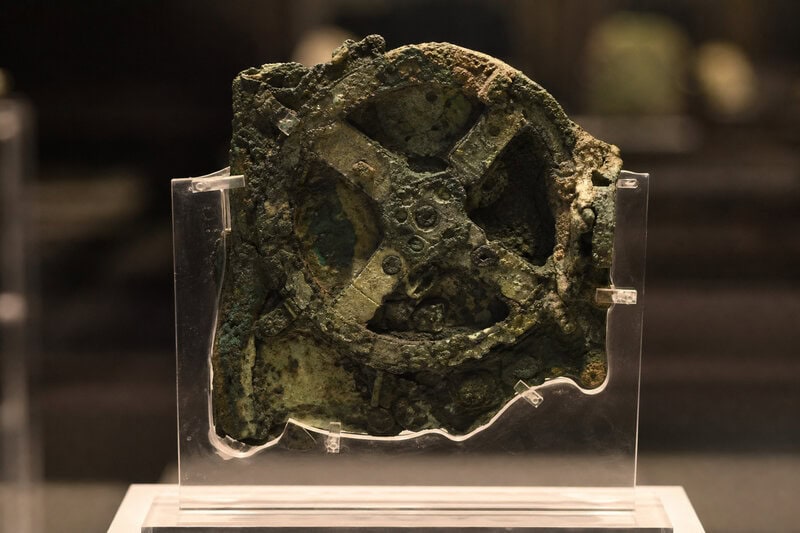
No surviving artifact makes the technological ambition of ancient Greek astronomy more tangible than the Antikythera Mechanism. Recovered from a first-century BCE shipwreck off the Greek island of Antikythera, this corroded bronze device contained dozens of interlocking gears engineered to predict the positions of the Sun and Moon, forecast solar and lunar eclipses, and track the cycles of the known planets. It functioned, in essence, as an analog astronomical computer — the most sophisticated scientific instrument to survive from antiquity.
Research conducted by the Antikythera Mechanism Research Project, involving teams from Cardiff University, the University of Athens, and the National Archaeological Museum in Athens, confirmed that the device encoded the 19-year Metonic cycle and the 223-month Saros eclipse cycle with engineering precision that would not be matched in Europe for over a thousand years. The gearing required to achieve this was comparable in concept to that found in precision clockwork that would not appear in the Western world until the medieval period.
The mechanism is significant not merely as an engineering curiosity but as evidence that Greek astronomy was never purely theoretical. Practitioners built physical instruments to automate celestial prediction — devices designed to be used, carried, and consulted under real navigational and calendrical pressure. That impulse, to embed astronomical knowledge in reliable, repeatable machinery, is a direct conceptual ancestor of the onboard computers that guide interplanetary missions today.
From Athenian Rooftops to Rocket Trajectories: The Unbroken Line
The essential structure of what ancient Greek astronomers proposed has been confirmed in full by modern science: a sun-centered solar system, a spherical Earth of measurable size, stellar positions expressible as coordinates, and celestial mechanics governed by predictable geometric rules. These were not lucky guesses. They were the products of a rigorous methodology — observe, measure, model, test — applied consistently over centuries and transmitted carefully across generations.
The chain of intellectual inheritance connecting ancient Greek astronomy to modern space exploration is direct and well-documented. Greek texts preserved and extended by Islamic scholars during the medieval period were retranslated into Latin, inspiring Copernicus, then Kepler, then Newton. Newton’s laws of motion and universal gravitation — built on Kepler’s planetary laws, which were built on Copernican heliocentrism, which Copernicus explicitly credited to Aristarchus — are the same equations used to calculate every orbital insertion burn performed by a modern spacecraft. The lineage is not metaphorical. It is mathematical.
When NASA’s Mars Science Laboratory mission launched the Curiosity rover in 2011, its trajectory was computed in a heliocentric coordinate framework: the same conceptual architecture that Aristarchus sketched on papyrus roughly 2,270 years earlier. When engineers at the Jet Propulsion Laboratory open a mission planning tool and specify a launch window, they are solving a problem first framed in ancient Greece. The Greeks did not build rockets. They built something arguably more durable — a methodology and a worldview that made rockets not just conceivable but, given enough time and accumulated knowledge, inevitable.
The number Eratosthenes calculated with a stick and a shadow still echoes in every mission briefing, every launch window calculation, and every planetary orbit that human ingenuity has dared to plot. It remains a reminder that the distance between a well in ancient Aswan and the surface of Mars is, at its core, a problem in geometry — and that the Greeks were the first civilization to prove that geometry, rigorously applied, was enough to reach the stars.