
Every second, particle physics experiments at facilities like Fermilab generate data volumes that would overwhelm a conventional research library. For decades, the hard truth has been that some of the most consequential signals in that torrent of information almost certainly went unseen — not because the detectors failed, but because no human team could move fast enough to look. That bottleneck, long accepted as an unavoidable cost of doing science at the frontier, is now the direct target of a coordinated national effort backed by the U.S. Department of Energy.
The Data Problem at the Heart of Modern Physics
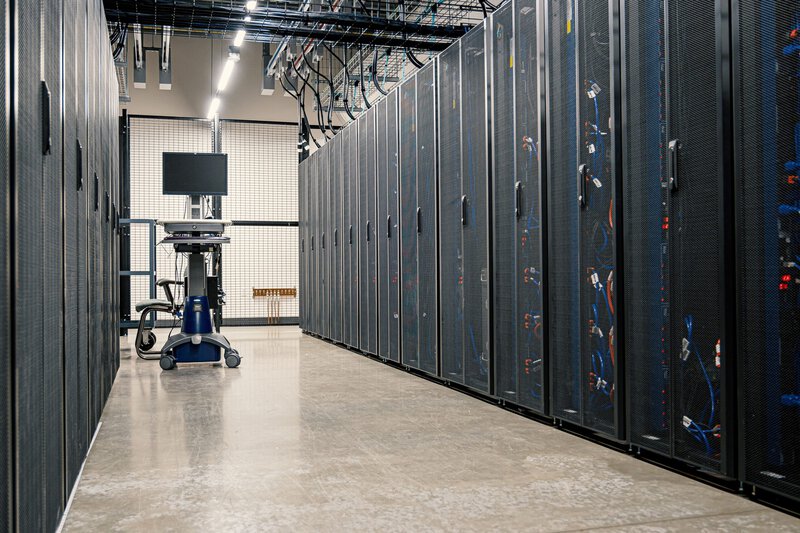
Modern particle physics experiments produce petabytes of raw collision data each year. The instruments generating that data are extraordinary by any measure: sensitive enough to detect the fleeting signatures of subatomic phenomena that exist for only a fraction of a second before decaying into other particles. But sensitivity alone is not discovery. A detector that captures everything still requires a system capable of sorting signal from noise at comparable speed, and for most of the history of experimental physics, that sorting has depended on human researchers working through manageable data samples rather than complete datasets.
The consequence is a genuine scientific risk. An anomalous data signature — the kind that might indicate a previously unknown particle, an unexpected force, or a crack in the Standard Model of particle physics — can be statistically buried in billions of ordinary collision records. Miss it in the initial pass, and there is no guarantee it surfaces again. The instruments are powerful enough to see new physics; the question has increasingly become whether the surrounding data infrastructure is powerful enough to let researchers actually find it.
Fermilab is directly addressing this bottleneck through its Fermi Data Platform, a centralized, AI-compatible storage and data management system built to support the U.S. Department of Energy’s Genesis Mission — a national initiative designed to integrate artificial intelligence into the full arc of scientific discovery.
What the DOE Genesis Mission Is — and What It Is Not
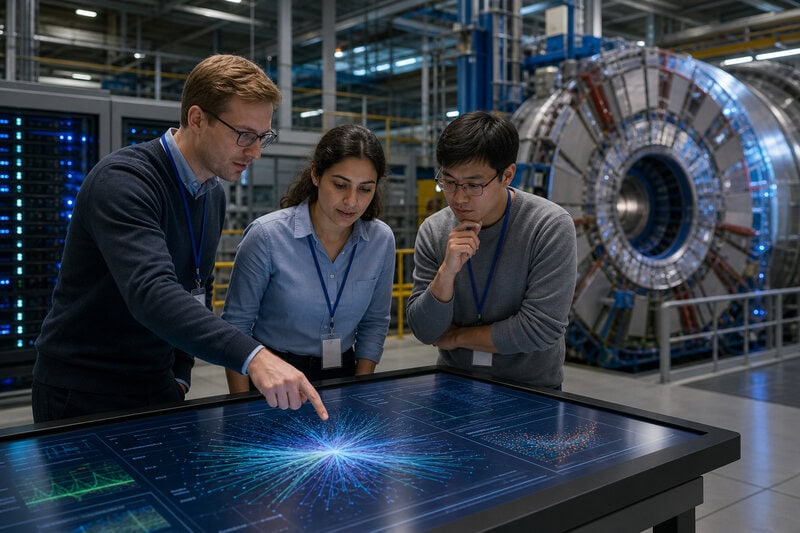
The Genesis Mission is best understood as a structural commitment rather than a single experiment. Coordinated by the U.S. Department of Energy, it is a national effort to systematically embed artificial intelligence into the scientific workflow across multiple research disciplines — not just high-energy physics, but also materials science, climate modeling, and other fields where large datasets have historically outpaced human analytical capacity.
The mission’s ambition is substantial. Genesis aims to integrate AI at every stage of the research process: from the moment raw data enters a storage system, through pattern recognition and anomaly detection, and ultimately into hypothesis generation. Rather than treating AI as a supplementary tool applied after the fact, the Genesis framework positions it as a core component of how federally funded science is conducted from the outset.
It is worth being precise about what is settled and what is not. DOE leadership’s broad support for AI-augmented discovery is well established, and the institutional investment in infrastructure — including at Fermilab — is documented and underway. However, the specific performance benchmarks Genesis aims to achieve, and the timelines by which those benchmarks will be evaluated, remain active areas of development. The mission’s ultimate contribution to scientific knowledge will be measured in peer-reviewed discoveries, and that accounting will take years to complete.
Inside the Fermi Data Platform: Infrastructure as Scientific Tool
The Fermi Data Platform is Fermilab’s answer to a deceptively simple question: how do you build a storage system that an AI can actually use? According to Fermilab’s own reporting on the initiative, the platform functions as the centralized backbone that receives, organizes, indexes, and serves experimental data to computational models at the speed and scale those models require.
The architectural distinction from traditional storage systems is meaningful. Conventional data management infrastructure was designed around human-directed retrieval: a researcher identifies a specific dataset, submits a query, and waits for the system to respond. That workflow, adequate for the pace of human analysis, creates a rate-limiting friction when AI models need to autonomously sample, iterate across, and learn from massive datasets without constant human mediation. The Fermi Data Platform is engineered to remove that friction — to make data accessible to algorithms in a way that traditional systems were never built to support.
A useful analogy: if an AI model is a researcher, the Fermi Data Platform is the library system. Without well-catalogued shelves, fast retrieval, and a cataloguing logic designed around the researcher’s actual workflow, even the most capable analyst wastes the majority of their time simply locating materials. The platform does not perform discovery itself; it removes the logistical obstacle that previously prevented AI models from doing their work efficiently.
As described in HPCwire’s coverage of the initiative, the platform is positioned as a key component of the storage infrastructure enabling the Genesis Mission — a supporting architecture rather than the discovery engine itself, but one whose quality directly determines what the discovery engine can accomplish.
How AI-Driven Discovery Actually Works in Particle Physics
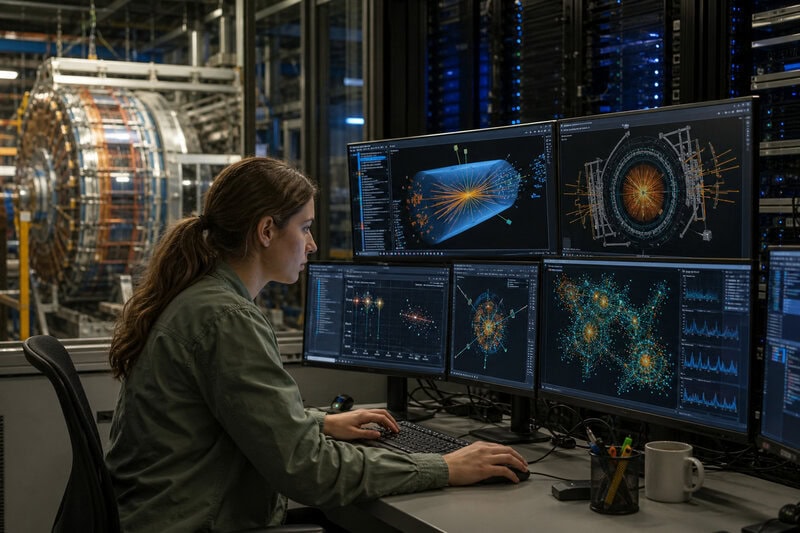
Understanding why storage infrastructure matters requires a clear picture of how AI-driven discovery functions in practice. Machine learning models — particularly anomaly-detection algorithms and neural networks trained on known physics signatures — are deployed to scan collision records for patterns that deviate from established expectation. When a model flags an event as statistically unusual, it surfaces that event for human physicists to scrutinize more closely.
The critical word in that description is “surfaces.” AI in this context is not replacing physicists’ interpretive expertise or their judgment about what constitutes genuine new physics versus a detector artifact or a statistical fluke. It is acting as a first-pass filter across datasets far too large for any human team to examine event by event. The value proposition is one of triage: directing human attention to the fraction of data most likely to be scientifically significant, rather than sampling arbitrarily from an unmanageably large pool.
That value proposition is, however, contingent on the speed and completeness of data access. An AI model that must wait hours between dataset queries because the underlying storage system cannot serve data at the required rate is not a functional discovery accelerator — it is an expensive bottleneck swap. The Fermi Data Platform addresses this dependency directly, making AI-driven pattern recognition a practical tool rather than a theoretical one.
It is also important to name the limits of the approach. AI models trained on known physics are well-equipped to find more of what has already been found, but they may be blind to phenomena so genuinely novel that they share no pattern with existing data. This is a real epistemological challenge — one that storage infrastructure improvements cannot resolve, and one the broader particle physics community continues to actively debate. Additionally, the scientific community has not yet converged on standardized protocols for auditing AI-flagged discoveries, meaning findings surfaced through platforms like the Fermi Data Platform will face rigorous additional scrutiny before achieving consensus acceptance.
Fermilab’s Role and the Broader Stakes
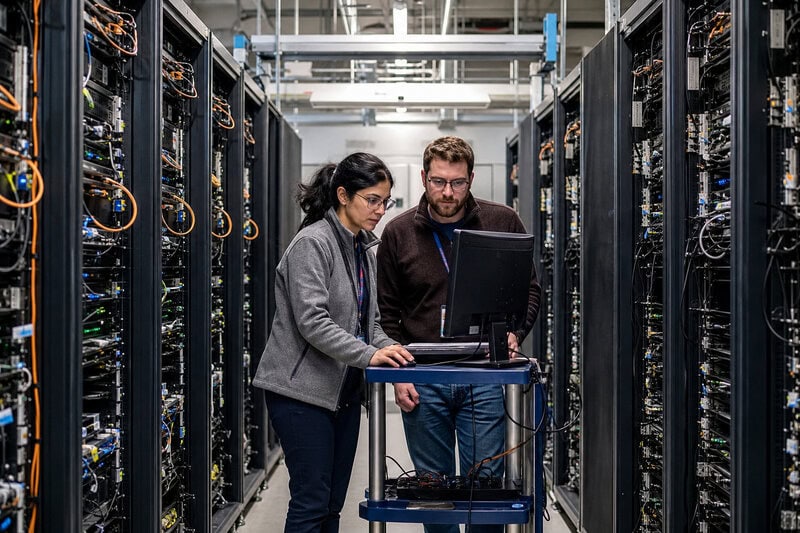
Operated by the Fermi Research Alliance for the Department of Energy, Fermilab is the United States’ premier particle physics laboratory, and its infrastructure decisions carry weight well beyond its own campus in Batavia, Illinois. Researchers at universities and laboratories across the country rely on Fermilab’s computing and data resources, meaning that improvements to the Fermi Data Platform propagate outward through a substantial portion of the American physics research community.
Reporting on the initiative describes the platform as designed to serve researchers from across scientific disciplines — a scope that, if realized, would extend the investment’s value far beyond high-energy physics. That said, available reporting does not specify which non-physics disciplines are currently active users of the platform, and that claim should be treated as reflecting the platform’s intended reach rather than its confirmed present-day user base.
By anchoring Genesis Mission infrastructure at Fermilab, the Department of Energy is signaling a preference for centralized, AI-ready data management over the discipline-by-discipline patchwork systems that have historically characterized federally funded research computing. This is a structural bet on a particular model of scientific infrastructure — one that, if it proves effective, DOE has the institutional capacity to replicate at other national laboratories.
The history of physics offers a relevant precedent. Signals that were theoretically accessible in existing data have repeatedly been found only after new analytical techniques made the search tractable. The move from analog to digital data recording in the late twentieth century is one such transition; AI-augmented discovery may represent another of comparable magnitude — though that comparison will only hold if reproducibility standards develop in step with the technology.
What Comes Next, and Why Caution Is Warranted
The genuine opportunity here is significant. If AI models can reliably and reproducibly surface rare physics signals from complete experimental datasets — rather than from the sampled subsets that have historically been tractable for human analysis — the pace of experimental discovery could accelerate in ways that compress timelines historically measured in decades.
The limitations are equally real. AI-driven discovery in physics is an emerging methodology, not a proven one at scale. The reproducibility challenges that have affected AI applications in other scientific domains — where models learn statistical patterns that mimic genuine effects without reflecting underlying physical reality — apply here as well. Infrastructure improvements make the approach more feasible; they do not make it immune to the fundamental challenges of scientific inference from complex data.
Fermilab’s Fermi Data Platform represents a deliberate institutional bet that the next generation of physics discoveries will be found not with bigger detectors alone, but with smarter data infrastructure that allows AI to perform pattern-matching work at a scale no human team could match. As of mid-2026, the Genesis Mission and the Fermi Data Platform are active and operational. Whether they ultimately produce peer-reviewed discoveries that would not have been made through conventional methods — the only metric that will finally matter — remains an open, and genuinely consequential, empirical question.