
Four and a quarter light-years away—roughly 25 trillion miles—a rocky world slightly larger than Earth completes a full orbit around its star in just 11.2 days, sitting within a habitable zone where liquid water could theoretically exist on its surface, while simultaneously enduring stellar flares far more violent than anything our Sun routinely produces. That world is Proxima Centauri b, the closest confirmed exoplanet to Earth, and it has confounded virtually every expectation scientists held about what a neighboring planet would look like.
The Cosmic Neighborhood: Mapping Exoplanets Near Our Solar System
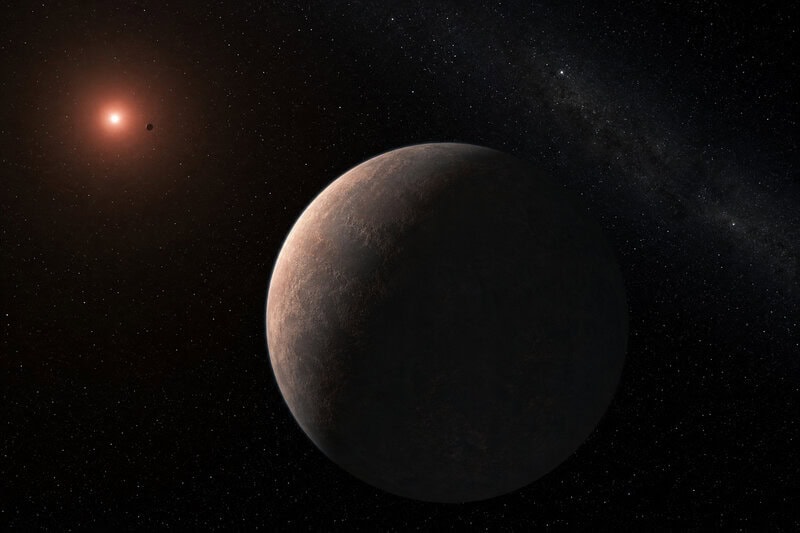
An exoplanet is any planet orbiting a star other than our Sun. NASA’s Exoplanet Archive now catalogs more than 5,700 confirmed exoplanets, and NASA has noted that planets likely outnumber stars in the Milky Way—a statistical reality that makes the search for nearby worlds not just compelling but mathematically reasonable. Among those thousands of confirmed worlds, the ones orbiting stars closest to our own solar system command special scientific attention, because proximity determines how well we can study them.
The two primary detection methods—radial velocity, which measures the subtle wobble a planet’s gravity induces in its host star, and transit photometry, which detects the faint dimming of starlight as a planet crosses the stellar disk—both grow less reliable as distance increases. Nearby planetary systems therefore offer the clearest signals and, eventually, the most realistic targets for direct observation. That is precisely why Proxima Centauri, sitting just 4.25 light-years from Earth, has become one of the most intensively studied objects in modern astronomy.
To appreciate how close that is on a galactic scale, consider this analogy: if the entire Milky Way were compressed to the size of North America, Proxima Centauri would sit roughly one city block from our Sun. It is, in the most literal astronomical sense, the house next door. And according to the list of nearest confirmed exoplanets, all known planets in that system orbit at approximately 4.22 light-years—making this single red-dwarf system the closest multi-planet neighborhood to our own.
Beyond Proxima: Other Stars With Close Exoplanets
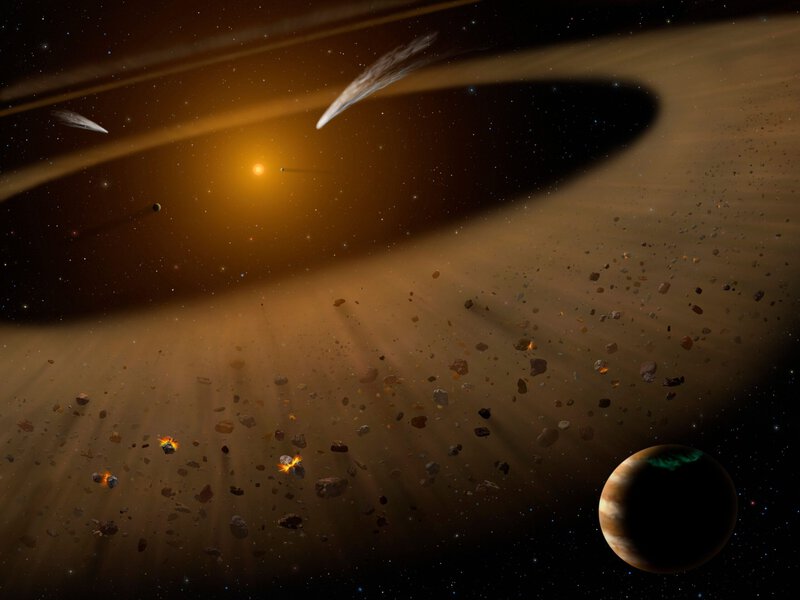
While the Proxima Centauri system dominates headlines, it is not the only nearby stellar neighborhood hosting confirmed exoplanets. The nearest known exoplanets by distance include worlds orbiting a diverse range of host stars, each presenting its own scientific puzzles.
Epsilon Eridani, a young Sun-like star approximately 10.5 light-years away, hosts a confirmed gas giant, Epsilon Eridani b, in a highly elliptical orbit. Its proximity and its Sun-like host make it a reference point for understanding how planetary systems around stars similar to our own evolve over time.
Wolf 1061, a red dwarf roughly 14 light-years away, hosts three confirmed planets, including Wolf 1061c, which sits near the inner edge of the star’s habitable zone. Its short orbital period and relatively well-constrained mass have made it a target of ongoing atmospheric modeling work.
Tau Ceti, at approximately 11.9 light-years, has long attracted interest because of its resemblance to the Sun. Multiple planet candidates have been proposed through radial velocity surveys, though the signals remain contested because the star hosts a dense debris disk that complicates detection. Tau Ceti’s story illustrates how proximity alone does not guarantee easy answers.
Together, these systems underscore a central finding of the exoplanet era: planet formation is the rule, not the exception, and our immediate galactic neighborhood is far more densely populated with worlds than astronomers assumed even two decades ago. The nearest terrestrial exoplanets span a remarkable range of environments, host star types, and orbital configurations.
Meet the Proxima Centauri System: Three Worlds, Three Puzzles
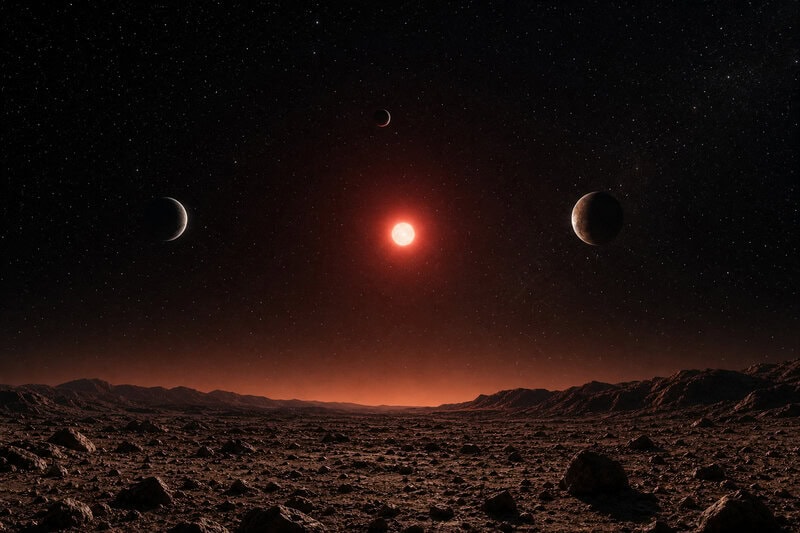
Proxima Centauri hosts at least three known exoplanets, each strange in its own right, and together they constitute a miniature laboratory for understanding planetary diversity at our galactic doorstep.
Proxima Centauri b was confirmed in 2016 by a team led by astronomer Guillem Anglada-Escudé, with results published in the journal Nature. It has a minimum mass of approximately 1.07 times that of Earth and completes one orbit every 11.2 Earth days. Crucially, that orbit places it within the star’s habitable zone—the band of orbital distances at which liquid water could theoretically persist on a rocky surface. It remains the closest potentially habitable exoplanet ever discovered, and its existence is broadly accepted by the scientific community.
Proxima Centauri c is a super-Earth or possible mini-Neptune orbiting well beyond the habitable zone at roughly 1.49 AU—where 1 AU equals the average Earth-Sun distance. It was reported as a strong candidate by Damasso and colleagues in a 2020 paper published in Science Advances. Its large orbital distance from a dim red dwarf makes it an intensely cold world, almost certainly unsuitable for surface life as we understand it, but scientifically valuable for understanding how planetary systems form around small stars.
Proxima Centauri d is the most recently announced and currently the least certain of the trio. Reported by Suárez Mascareño and colleagues in 2022 in Astronomy & Astrophysics, it carries a minimum mass of roughly 0.26 Earth masses—potentially making it less massive than Earth—and orbits extremely close to the star. It is classified as a strong candidate rather than a fully confirmed planet, and its orbital parameters continue to be refined using the ESPRESSO spectrograph at the European Southern Observatory’s Very Large Telescope in Chile.
The distinction between “confirmed” and “strong candidate” matters scientifically. Planet b’s existence is consensus science; planets c and d are high-confidence findings whose precise characteristics remain under active investigation. Treating all three with equal certainty would misrepresent where the science actually stands.
The Habitability Question: Promising and Problematic in Equal Measure
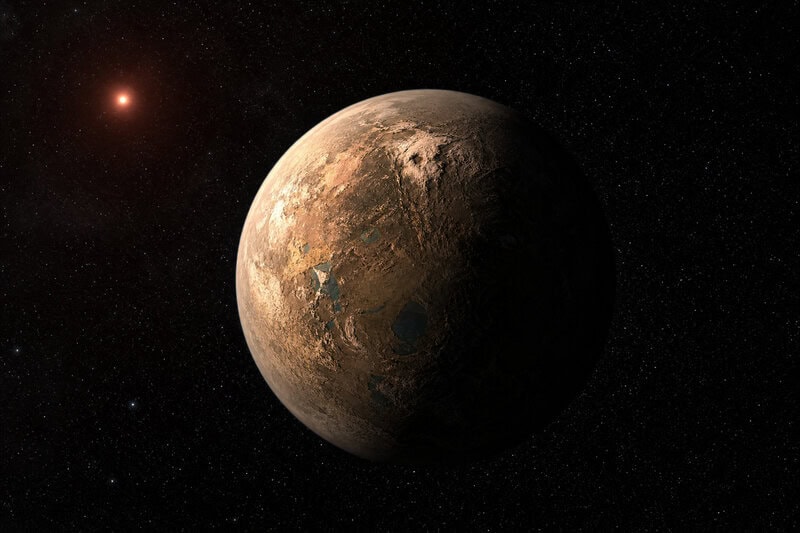
The case for Proxima Centauri b’s habitability rests on two pillars: orbital position and probable composition. The Anglada-Escudé team’s 2016 analysis placed the planet firmly within the habitable zone, and its minimum mass is consistent with a rocky, terrestrial body rather than a gas-dominated one. On those two metrics alone, it is the most Earth-like world known to orbit the nearest star to our Sun—a description that, a decade ago, astronomers might have assumed would never apply to a red-dwarf system.
The case against is equally serious. Proxima Centauri is an M-dwarf star, a class known for producing energetic ultraviolet and X-ray flares with far greater frequency and, in some events, greater intensity than those of our Sun. A 2018 study by MacGregor and colleagues, published in The Astrophysical Journal Letters, detected a particularly powerful flare from Proxima Centauri. For a planet orbiting as closely as Proxima b does—completing a year in just 11 days—such events are not rare catastrophes but routine environmental conditions.
The atmosphere problem compounds the flare problem. A 2017 modeling study by Garraffo and colleagues, also published in The Astrophysical Journal Letters, estimated that the stellar wind pressure experienced by Proxima b is approximately 2,000 times greater than the solar wind pressure Earth endures. Under those conditions, an unshielded atmosphere could be gradually eroded over geological timescales, leaving the surface exposed to radiation levels hostile to life as we know it.
Yet the counterargument deserves equal weight. Researchers including Sarah Rugheimer, then at Oxford, published modeling work in 2015 in Astrobiology demonstrating that scenarios in which Proxima b retains a dense atmosphere or hosts a global ocean are not physically ruled out. A sufficiently thick atmosphere or a deep liquid ocean could buffer radiation and maintain surface conditions compatible with life. Habitability for Proxima b is not confirmed—but it is not excluded either, and that ambiguity is precisely what makes it the most scientifically debated address in the galaxy.
Tidal Locking and the Alien Climates of Close-Orbiting Worlds

One of the most disorienting features of Proxima b’s environment follows directly from its short orbital period. Because it orbits so close to its star, gravitational forces almost certainly keep one hemisphere in permanent daylight and the other in permanent night—a phenomenon called tidal locking, the same process that causes our Moon to always show Earth the same face.
A tidally locked world is not automatically a dead world. Climate models published by Turbet and colleagues in 2016 in Astronomy & Astrophysics suggest that even a thin atmosphere could redistribute heat from the sun-baked dayside to the frozen nightside, potentially sustaining a habitable terminator zone—the ring of perpetual twilight circling the boundary between the two hemispheres. Wind-driven heat transport and ocean circulation, if water exists, could further moderate temperatures across the planet.
The sensory experience of that environment would be profoundly alien. The star would appear larger in the sky than our Sun appears from Earth, yet because Proxima Centauri is a red dwarf, most of its energy arrives in near-infrared wavelengths rather than visible light. Any photosynthetic organisms that evolved there would almost certainly rely on pigments radically different from the chlorophyll found in Earth plants—possibly dark-pigmented molecules capable of harvesting the dim, reddish light available to them.
These scenarios are model-dependent projections, not observations. No instrument currently operating can directly measure the atmosphere of Proxima b, or confirm whether it has one at all. The models are scientifically plausible and worth taking seriously; they are not evidence of life or even of confirmed habitability.
Can We Ever Study These Worlds Up Close?
The honest answer is: not soon, but progress is real and accelerating. Breakthrough Starshot, an initiative announced in 2016 by the Breakthrough Initiatives foundation, proposes launching gram-scale probes propelled by powerful ground-based lasers to roughly 20 percent of the speed of light—a velocity that could allow them to reach the Proxima Centauri system in approximately 20 years. The concept is grounded in legitimate physics, but the initiative remains in early feasibility research, and no mission has been approved or funded at the level required to build such a system.
More immediate progress will come from observatories already built or nearly ready. The James Webb Space Telescope is capable of atmospheric spectroscopy—reading the chemical fingerprints of a planet’s atmosphere from the wavelengths of starlight filtered through it—for worlds that transit their host stars. Whether Proxima b transits Proxima Centauri from Earth’s vantage point remains unconfirmed, but establishing that would open an extraordinary analytical window. ESA’s PLATO mission, planned for launch in the mid-2020s, is designed to find and characterize Earth-sized planets around nearby stars and could contribute meaningfully to that effort.
Perhaps most consequentially, the Extremely Large Telescope currently under construction in Chile by the European Southern Observatory, expected to achieve first light around 2028, is being equipped with high-contrast imaging instruments specifically designed to detect reflected starlight from nearby exoplanets. The Proxima system, given its proximity, is among the most plausible targets for this technique. Even in optimistic scenarios, meaningful atmospheric characterization of Proxima b is unlikely before the 2030s. The search for the nearest Earth-like planet is as much an engineering challenge as a scientific one, and patience is a prerequisite.
Why the Nearest Exoplanets Reframe Everything
The discovery that rocky, potentially habitable worlds exist even among our nearest stellar neighbors carries profound statistical implications. If planets—including those in or near habitable zones—form around small, volatile red dwarf stars, which constitute roughly 70 percent of all stars in the Milky Way, then the likelihood that habitable-zone candidates are extraordinarily common throughout the galaxy grows considerably stronger. Proxima b’s existence is not just interesting in isolation; it is a data point in a much larger argument about the prevalence of worlds where life might plausibly arise.
The Proxima system also forces a productive rethinking of what “Earth-like” actually means. A planet with the right surface temperature but punishing radiation, or the right mass but an uncertain magnetic field, or the right orbital position but a host star that behaves nothing like the Sun—these worlds challenge the assumption that Earth’s specific combination of traits is the only viable template for a living planet. Expanding that definition is not scientific looseness; it is scientific maturity.
Perhaps most valuably, the contested habitability of Proxima Centauri b is generating a new generation of models covering atmospheric retention under stellar wind bombardment, radiation biology under high-UV environments, and climate dynamics on tidally locked surfaces. Those models will sharpen how scientists evaluate every future exoplanet candidate identified by JWST, PLATO, and the Extremely Large Telescope. The nearest exoplanets to Earth are not a disappointment—they are a stress test for our assumptions, and science is rising to meet that test by asking better questions, building sharper tools, and refusing to settle for easy answers.