
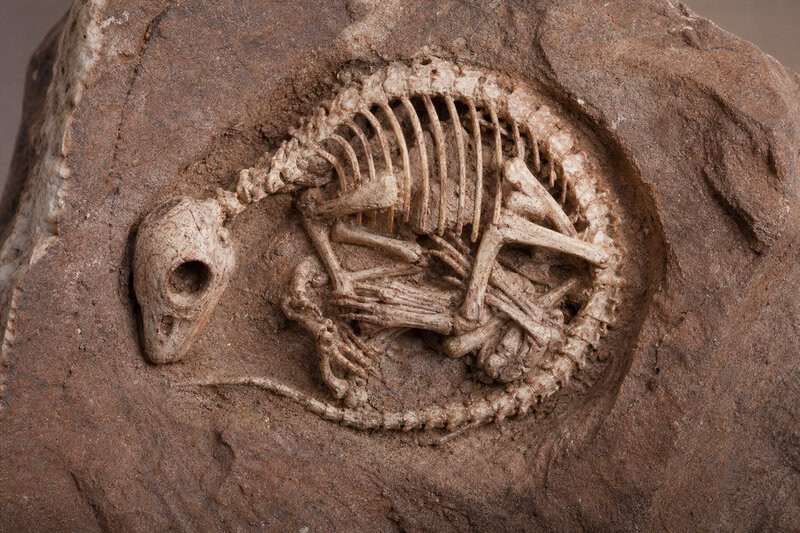
A single fossilized skeleton, pulled from Triassic rock dating back 236 million years, may have just overturned one of paleontology’s most durable assumptions: that the ancestors of mammals were, without exception, egg-layers. The animal in question, Chiniquodon theotonicus, was a dog-sized carnivore that prowled a world still dominated by the earliest dinosaurs — and according to a study published in August 2026, microscopic patterns in its fossilized bones suggest it may have carried its young internally rather than depositing them in a shell.
What Is Chiniquodon theotonicus, and Why Does It Matter?
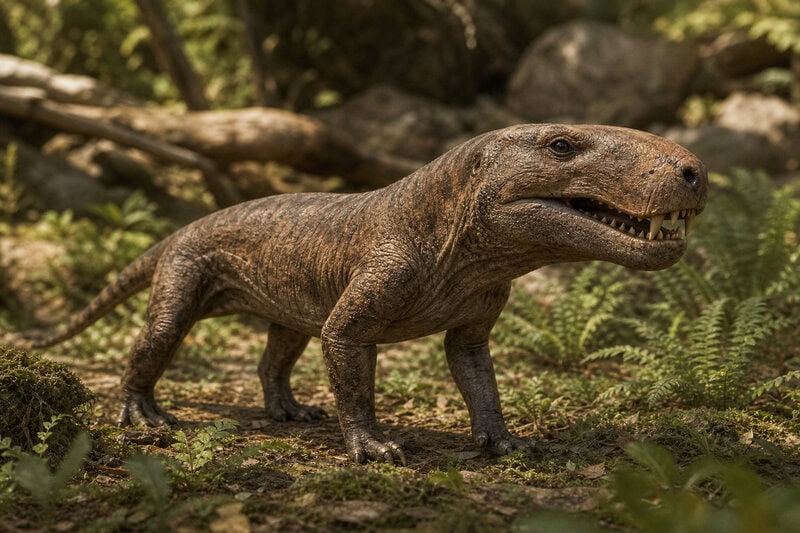
Chiniquodon theotonicus was a cynodont — a group of Triassic animals that occupied an evolutionary position directly on the branch leading to true mammals. They were not mammals themselves; they were mammal ancestors, exhibiting a mosaic of reptilian and proto-mammalian traits. Chiniquodon theotonicus was roughly the size of a modern domestic dog, almost certainly carnivorous, and possessed differentiated teeth — incisors, canines, and cheek teeth — a hallmark feature of the mammalian body plan already taking shape hundreds of millions of years before humans would walk the Earth.
This lineage matters enormously because the oldest confirmed true mammal fossils date to approximately 225 million years ago. Chiniquodon theotonicus predates those animals by roughly 11 million years, placing it in a critical transitional window. Understanding how this creature reproduced is therefore not a narrow question about one extinct species — it is a question about the deep evolutionary roots of a biological strategy that would eventually define the entire mammalian class, including every human being alive today.
Triassic mammal fossil discoveries of this caliber are rare and scientifically precious for a straightforward reason: soft tissue almost never survives fossilization. Researchers studying the reproductive biology of extinct animals must work almost entirely from hard structures — bones, teeth, skulls — reconstructing physiology from structural proxies rather than direct evidence. That constraint makes the analytical method used in this study both valuable and, as skeptics will note, inherently limited.
How Far-Reaching Is the Potential Revision?
If the interpretation holds, the known origin of live birth in the lineage leading to modern mammals would be pushed back by at least 90 to 95 million years — one of the largest single revisions to this particular evolutionary timeline in the history of paleontology. For context, when Chiniquodon theotonicus was alive, the first dinosaurs were only just beginning to diversify across the supercontinent Pangaea. Before this study, the scientific consensus placed the earliest strong fossil evidence for live birth in the mammalian lineage considerably later — evidence drawn from specimens where embryos or anatomical features associated with viviparity were more directly preserved.
It is worth being precise about what a revision of this scale means and what it does not mean. Live birth is not a single evolutionary invention that happened once and spread. It has evolved independently multiple times across vertebrate history, appearing in fish, lizards, snakes, and mammals through separate evolutionary pathways. What this fossil potentially documents is not the origin of live birth across all life, but specifically the emergence of this strategy within the particular lineage that would eventually produce every living mammal, from the blue whale to the shrew to the human being.
What remains unknown is equally important. The study does not establish whether live birth was widespread among cynodonts as a group, or whether it was a trait peculiar to Chiniquodon theotonicus — perhaps an evolutionary experiment that appeared and disappeared before being reinvented later. Only additional fossil discoveries across the Triassic record will begin to answer that question.
The Evidence: What Bone Growth Rings Reveal About Reproduction
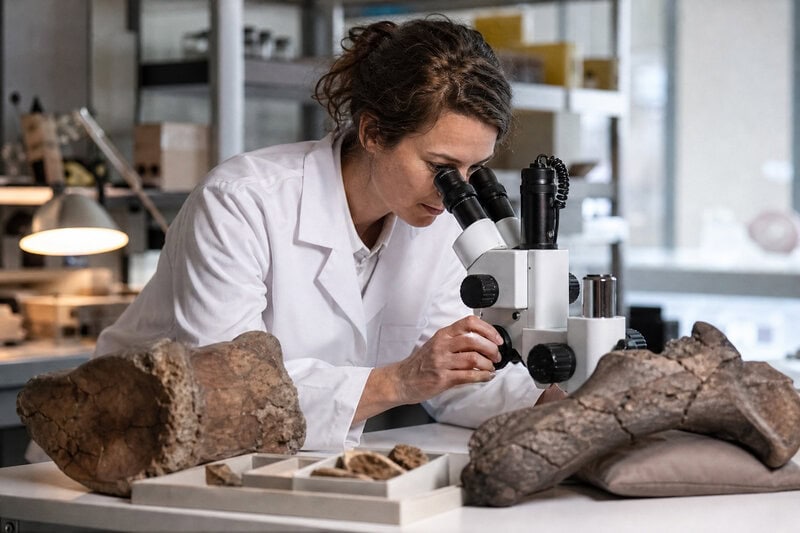
The core of the argument rests on a discipline called osteohistology — the study of bone tissue structure under a microscope. Just as the rings inside a tree trunk record annual cycles of growth and dormancy, fossilized bone contains microscopic features called lines of arrested growth, or LAGs, that reflect an animal’s developmental pace and the biological events that interrupted it. Crucially, the spacing, frequency, and pattern of these lines can differ in telling ways between species that lay eggs and species that gestate live young, because the energetic demands of internal gestation leave a measurable signature on bone tissue.
According to reporting by Live Science on the August 2026 findings, researchers analyzed the microscopic bone structure of Chiniquodon theotonicus and identified growth-ring patterns that did not match what is typically observed in egg-laying species. Instead, those patterns more closely resembled what is seen in animals that invest significant energy in carrying young internally. The researchers interpreted this as indirect evidence of viviparity — live birth — in a pre-mammalian cynodont.
The interpretive leap here must be acknowledged honestly and directly. Bone growth rings are indirect evidence. They do not show a fetus. They do not show a placenta. They do not show an embryo preserved within the body cavity. What they show is a pattern of tissue development that, in living animals studied today, correlates with certain reproductive strategies. Applying that correlation to a 236-million-year-old creature involves assumptions that careful scientists will want to test rigorously before treating the conclusion as established.
It is worth being explicit about what is established versus what is under scrutiny. The age of the fossil at 236 million years, the species identification as Chiniquodon theotonicus, the bone-ring analysis as a valid scientific method, and the observation that the patterns differ from those typical of egg-laying species — these are established elements of the study. The interpretation of those patterns as evidence of live birth is the contested claim, and that distinction matters for anyone following this story as it develops.
Why the Egg-Laying Assumption Was So Durable
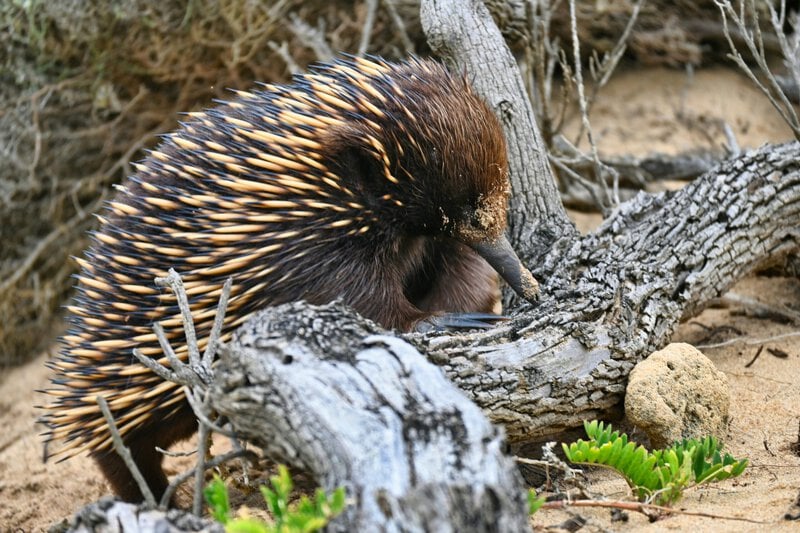
To understand why this finding is genuinely disruptive rather than merely surprising, it helps to understand why scientists so confidently assumed the opposite for so long. The assumption that early mammal ancestors laid eggs is not arbitrary. It is grounded in the living evidence provided by monotremes — the platypus and the echidnas — which are the most ancient surviving branch of the mammalian family tree and which do, in fact, lay eggs. If the oldest living mammals lay eggs, the logical inference is that egg-laying was the ancestral mammalian condition, with live birth evolving later as a derived trait.
The fossil record reinforced this view by default. Because direct evidence of soft-tissue reproduction almost never survives, scientists working on the question of when mammals evolved live birth had little to go on beyond the monotreme model and a handful of Cretaceous specimens. The egg-laying baseline was not blind assumption — it was a reasonable starting point given the available data. What the Chiniquodon theotonicus finding challenges is not the logic of that reasoning, but the premise that the available data was sufficient.
The broader debate over mammalian reproductive evolution — when placentation arose, when lactation began, when live birth first appeared — has been contested terrain for decades. This fossil adds a significant new data point to an argument that was already active and unresolved, rather than introducing controversy into a field that was previously at peace.
How Scientists Are Reacting — and What Would Strengthen the Case
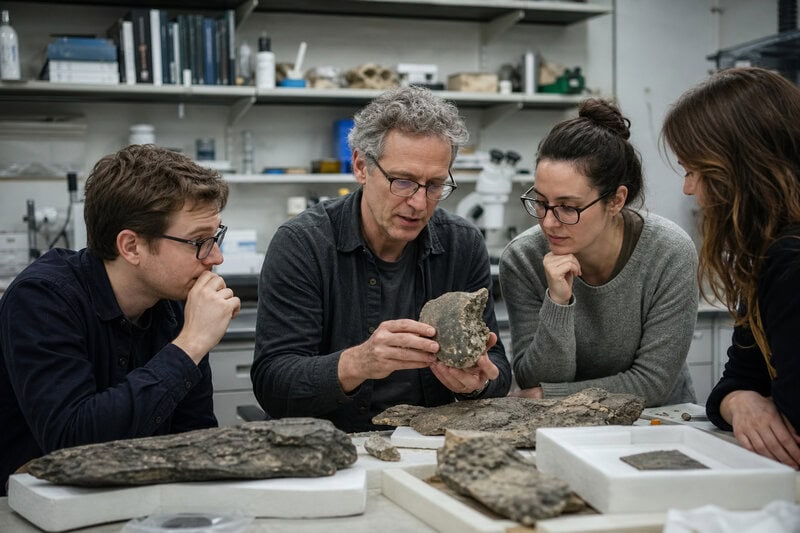
The research, published in August 2026 and covered by Frontiers Science News, represents the scientific community’s current best interpretation of indirect but carefully gathered evidence. It is not settled fact. The authors themselves, and independent researchers reviewing the work, frame this as a compelling hypothesis grounded in a specific analytical method — one that invites scrutiny precisely because its implications are so far-reaching.
Researchers who find the osteohistological evidence persuasive argue that this is precisely the kind of unexpected discovery that science needs: a finding that forces a productive re-examination of long-held assumptions and opens new lines of inquiry across the broader Triassic fossil record. The methodology itself — applying osteohistology to questions of reproductive mode in pre-mammalian animals — represents a genuine advance in what can be extracted from ancient bone.
Skeptics, however, are likely to raise a straightforward concern: inferring reproductive biology from bone microstructure alone is a significant extrapolation, and the patterns observed could potentially have alternative explanations unrelated to viviparity. Environmental stress, disease, seasonal variation in food availability, or other physiological disruptions can also leave signatures in bone growth patterns. Without corroborating evidence — additional specimens with similar bone patterns, or ideally, related cynodont fossils with embryos preserved in the body cavity — the conclusion remains a hypothesis, not an established finding.
As Science News reported in its coverage of the study, the finding would push the origin point of live birth in the mammalian lineage to approximately 236 million years ago — a revision of at least 90 to 95 million years. That scale of revision is precisely what makes both the excitement and the caution from the scientific community understandable.
Why This Discovery Matters Beyond Paleontology
The evolutionary innovation potentially documented in this fossil is the same biological strategy that underlies human pregnancy. Every aspect of human gestation — internal development, placentation, the intimate physiological relationship between mother and offspring — traces its deep history to some point along the evolutionary branch that Chiniquodon theotonicus occupied 236 million years ago. If that history begins earlier than anyone previously demonstrated, it changes the story of our own biology in a fundamental way.
The methodological implications are also significant. This research demonstrates that osteohistology can be applied to questions of reproductive mode in fossils far older than those previously attempted, potentially opening similar lines of inquiry across the entire Triassic cynodont record. Other cynodont species, and other Triassic animals on the edges of the mammalian branch, may now be candidates for similar analysis — and those future studies will either corroborate or complicate what this specimen suggests.
There is a broader lesson here about how science works that deserves to be stated plainly. The willingness to revisit a consensus — even one as logically grounded as the egg-laying assumption — when new evidence demands it is not a sign of scientific instability. It is science functioning exactly as it should. A single fossil, analyzed with a method that did not exist in its current form a generation ago, has introduced a question that the field will now spend years answering. With vast stretches of Triassic fossil beds still unexplored and unstudied, Chiniquodon theotonicus may turn out to be not the answer to the question of when live birth began in the mammalian lineage, but the beginning of a far longer, stranger, and more surprising investigation.