Scientists have achieved a metrological gain of 19.20 ± 0.20 decibels beyond the standard quantum limit — a precision ceiling that classical physics imposes on every measurement instrument from atomic clocks to gravitational-wave detectors — using just 500 entangled photons inside a superconducting chip. That figure is not a rounding artifact or a narrow laboratory curiosity: a gain near 19 dB translates to roughly 80 times greater sensitivity than the best classical probe carrying the same energy, representing one of the largest quantum sensing advantages ever measured experimentally at this photon number.
What the Standard Quantum Limit Actually Is
The standard quantum limit (SQL) is the fundamental precision ceiling imposed by quantum shot noise when N independent, unentangled particles are used as measurement probes. Because unentangled particles behave statistically like coin flips, uncertainty shrinks only as 1/√N — doubling sensitivity requires quadrupling the number of probe particles, and the returns diminish fast. Every precision instrument humanity relies on, from MRI machines to the atomic clocks inside GPS satellites to the LIGO interferometers that detect gravitational waves, eventually runs into this wall.
Quantum mechanics does, in principle, permit a steeper scaling. The Heisenberg limit — the ultimate quantum bound — allows uncertainty to shrink as 1/N, a qualitatively faster improvement. Reaching it requires entanglement among all N probe particles simultaneously, a condition that becomes exponentially harder to engineer as N grows. For decades, demonstrations of Heisenberg-limited or near-Heisenberg-limited sensing were confined to tiny systems of a handful of particles.
The SQL is not disputed science. It is a well-verified consequence of quantum measurement theory, and no experiment has falsified it. What the new research demonstrates is that the SQL can be beaten systematically, reproducibly, and at photon numbers large enough to matter for real applications — a distinction the field has been working toward for years.
The Key Ingredient: Fock States and Why Photon Number Matters
The probe states at the heart of this experiment are called Fock states, or number states. A Fock state is a quantum state of light containing an exact, definite number of photons — the conceptual opposite of a laser beam, which carries a Poisson-distributed photon count whose fuzziness contributes directly to shot noise. Because a Fock state’s photon number is precisely known, it can encode and retrieve phase or displacement information with far less noise, making it a near-ideal metrological probe.
Generating large Fock states is extraordinarily difficult in practice. Prior landmark work demonstrated efficient generation of Fock states approaching 100 photons inside a superconducting microwave cavity, marking what was then the frontier of large-N quantum sensing. The new experiment pushes that frontier to N = 500 mean photons while preserving the entanglement structure needed to beat the SQL. That is not an incremental nudge: it is a five-fold scaling advance that moves large-Fock-state sensing from proof-of-concept territory into a regime where practical applications become discussable.
The Mechanism: How Fock-Space Confocal Focusing Works
The technique is called confocal focusing in Fock space, and the name is deliberate. A confocal microscope tightens a laser beam to a diffraction-limited point in physical space, concentrating light energy where it is most informative. This experiment applies an analogous idea in an abstract mathematical space — the space of photon number states — concentrating quantum probability amplitude into a sharply peaked distribution rather than spreading it broadly across many possible photon numbers.
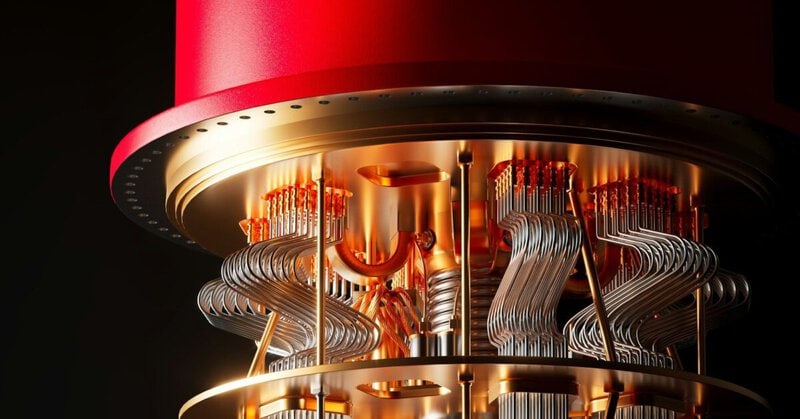
The hardware is a superconducting circuit quantum electrodynamics (QED) platform: a chip-based microwave cavity coupled to artificial atoms known as transmon qubits. This is the same fundamental architecture used by IBM, Google, and other organizations building quantum computers, which means the sensing and computing research communities are, unusually, advancing on identical hardware. Carefully shaped microwave pulses sculpt the quantum state inside the cavity, building up the desired Fock-space distribution without allowing decoherence — the leakage of quantum information into the environment — to destroy the entanglement before measurement.
The sensing task chosen to demonstrate the technique is displacement sensing: the probe state is prepared, injected into a system, picks up a tiny displacement signal analogous to a mirror nudged by a passing gravitational wave, and is then measured. The sharper the Fock-space focus — the more tightly peaked the photon-number distribution — the more sensitively the displacement registers in the measurement outcome. The full experimental details and theoretical framework are reported in the primary research paper published in Nature, with an accessible preprint available as a detailed HTML document on arXiv.
What remains contested is the question of scalability beyond the demonstrated range. The team’s theoretical framework predicts that the approach should extend to even larger N, and the design is intended to degrade gracefully — partial focusing still yields partial gain, rather than collapsing entirely when imperfections arise. Independent experimental verification at N greater than 500, or in non-microwave domains such as optical or atomic systems, has not yet been published as of this writing.
The Result in Context: What 19.20 dB Actually Signals
The small error bar on the headline figure — ±0.20 dB — is itself meaningful. It indicates that the measurement of the measurement is precise, ruling out instrumental artifacts and strengthening confidence in the claimed gain. A result reported with sloppy error bars could mask systematic errors; this one does not.
Previous demonstrations of SQL-beating quantum sensors have typically achieved gains of a few decibels, often using small photon numbers or narrow operating windows that made real-world applicability distant. A gain near 19 dB at 500 photons represents a qualitative shift in what is experimentally accessible, not merely a quantitative extension of prior work. The full bibliographic record of the study situates it within the broader quantum metrology literature, where it stands as one of the largest experimentally measured quantum advantages at this photon number.
It is important to distinguish what has been demonstrated from what has been projected. The 19.20 dB gain is an experimentally measured, peer-reviewed result. The broader assertion that this framework will translate directly into deployable sensing instruments — medical scanners, gravitational-wave detectors, navigation systems — is a reasonable scientific projection grounded in the data, but it is not yet a demonstrated engineering outcome. The gap between a laboratory record and a fielded technology is real, and it deserves clear acknowledgment.
Why It Matters: Connections Across Quantum Sensing
The most immediate connection is to gravitational-wave detection. Facilities such as LIGO already inject squeezed light — a related but distinct quantum resource — to push their interferometers past the SQL. Fock-state confocal focusing could offer a complementary route to even greater sensitivity without proportionally increasing laser power, which carries its own engineering costs and risks of disturbing the systems being measured.
The medical imaging angle is more speculative but worth noting. Quantum-enhanced sensing that operates at low photon numbers without sacrificing precision could, in principle, enable biological imaging with reduced radiation dose. However, experts in the field caution that adapting microwave-domain superconducting results to optical frequencies — the domain relevant to most biomedical imaging — requires substantial additional research. The physics is related; the engineering challenges are largely distinct.
The quantum computing synergy may be the most practically significant near-term consequence. Because the superconducting circuit QED platform is the same architecture driving leading quantum computing programs worldwide, advances in fabrication, control electronics, and error mitigation developed for computing will flow directly into sensing, and vice versa. That alignment of research roadmaps is rare in physics and accelerates both fields simultaneously.
Open Questions and the Road to Deployment
The nearest-term research challenge is demonstrating comparable Fock-space confocal gains in optical or atomic systems, where decoherence is faster and state preparation is considerably harder. Until that translation is achieved, sensing applications outside superconducting chips operating at millikelvin temperatures remain distant.
- Heisenberg scaling at larger N: Whether the 1/N sensitivity scaling can be maintained as N grows well beyond 500 — or whether practical decoherence will impose a softer ceiling — is an open and actively studied question in the quantum sensing community.
- Benchmarking standards: Quantum-enhanced sensing results are currently reported in diverse metrics — decibel gain, quantum Fisher information, phase sensitivity — making rigorous cross-study comparison difficult. The field needs agreed standardized benchmarks before commercial or scientific deployment can be properly assessed.
- Environmental noise: Real-world sensing environments outside cryogenic laboratory conditions introduce noise sources that controlled experiments suppress. How gracefully confocal Fock-space focusing degrades under those conditions remains to be characterized experimentally.
None of these open questions diminish what has been achieved. A metrological gain of 19.20 dB at 500 photons is not a promise of a quantum sensing revolution tomorrow. It is rigorous experimental proof that such a revolution has a credible, hardware-compatible path — and that path, as of this result, just became measurably shorter.