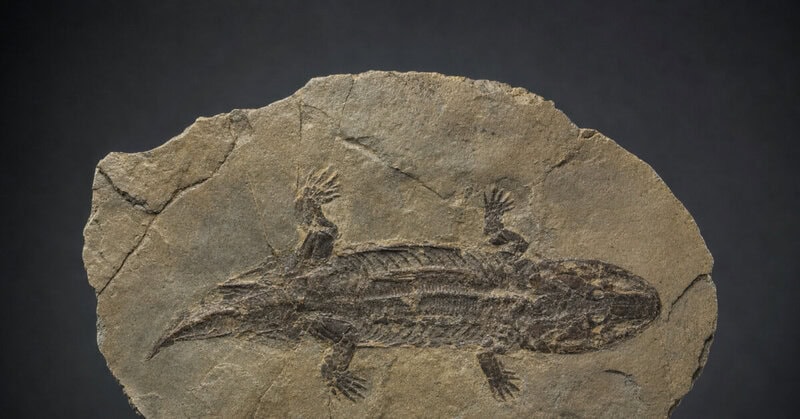
For more than 30 years, a palm-sized fossil nicknamed “Lizzie” sat in museum collections celebrated as one of the world’s oldest known reptiles — until advanced X-ray imaging revealed that scientists had been fundamentally wrong about what they were looking at. The creature that crawled across a Scottish landscape roughly 345 million years ago was not a reptile at all, and the correction is now reshaping scientific understanding of one of the most pivotal transitions in the history of animal life.
A Case of Mistaken Identity 345 Million Years in the Making
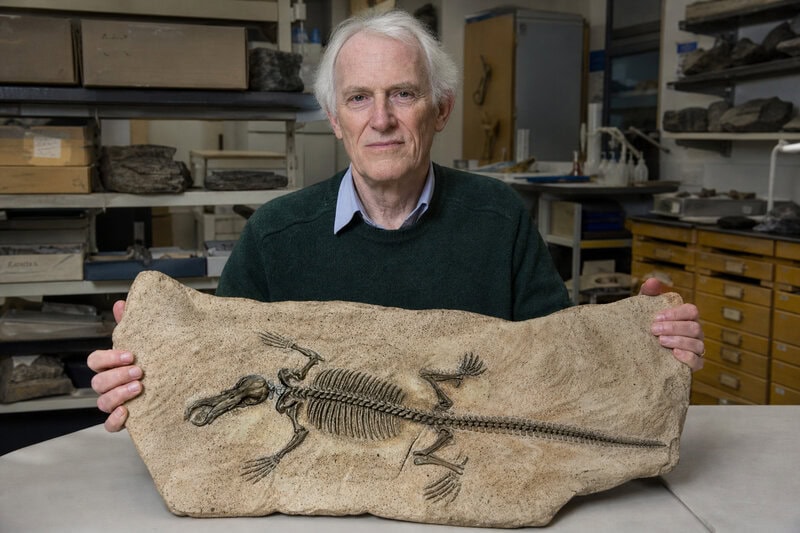
Westlothiana lizziae — “Lizzie” to researchers and enthusiasts alike — was unearthed in Scotland in 1984. Dating to approximately 345 million years ago, the fossil belongs to the Early Carboniferous period, a transformative chapter in Earth’s history when the planet’s first extensive forests were spreading and vertebrates were beginning to experiment, tentatively, with life on land. When paleontologists first examined Lizzie’s articulated limbs, claw-tipped digits, and lizard-like body proportions, the conclusion seemed straightforward: here was an early amniote, or at minimum a proto-reptile sitting near the base of the lineage that would eventually produce reptiles, birds, and mammals.
That conclusion was not careless. Lizzie’s skeletal proportions genuinely mimicked those of early reptiles, and without the ability to examine internal structures non-destructively, scientists worked from what the rock surface revealed. The features that made Lizzie look so convincingly reptilian were also, it turns out, the features that obscured the anatomical evidence telling a completely different evolutionary story.
According to EurekAlert’s coverage of the reclassification, Lizzie’s status as a landmark fossil — long described as a contender for the world’s oldest reptile — has now been formally overturned. The stakes of that correction extend well beyond a single specimen: the reclassification is forcing scientists to revisit assumptions about which anatomical innovations appeared first as vertebrates made their transition from water to land.
The Fossil and Its Long Scientific Legacy
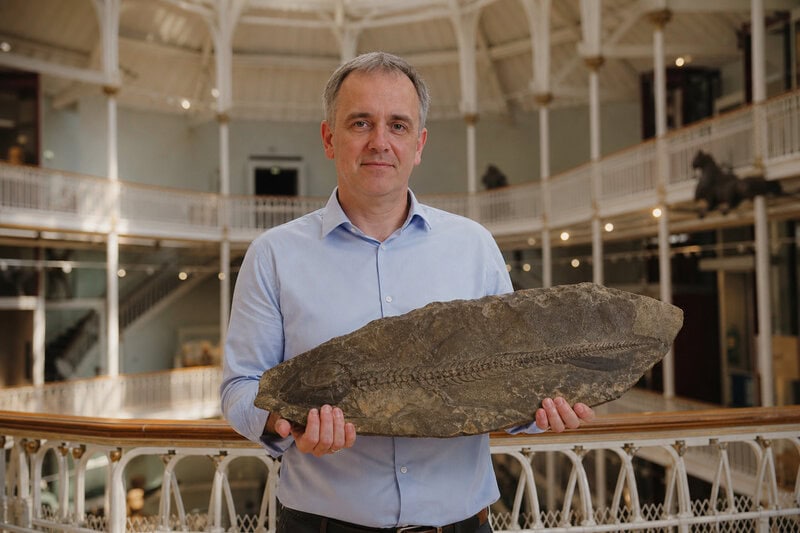
The National Museums Scotland, which holds the Westlothiana lizziae specimen, describes Lizzie as one of the most scientifically significant fossils ever recovered from Scottish soil. At roughly 345 million years old, she predates the first dinosaurs by approximately 100 million years and lived during an era when the biological boundary between aquatic and terrestrial life was still being drawn.
Upon discovery, Lizzie’s lizard-like build and claw-tipped digits placed her, in the eyes of researchers, firmly within or very near the amniote lineage — the group defined by a key reproductive innovation, the amniotic egg, that allowed vertebrates to reproduce away from standing water. That classification, sustained for decades, made Lizzie a cornerstone specimen in discussions about early tetrapod evolution — the study of four-limbed vertebrates and their origins. The misidentification was not a footnote; it shaped scientific models of the water-to-land transition for a generation of researchers.
What made the error so durable was precisely the quality of the deception. The surface of the fossil, as visible to the naked eye and standard imaging of the era, presented a coherent and plausible reptilian anatomy. The features that contradicted that reading were hidden within the stone itself, inaccessible without technology that did not yet exist — or had not yet been applied to this specimen.
The Technology That Changed Everything
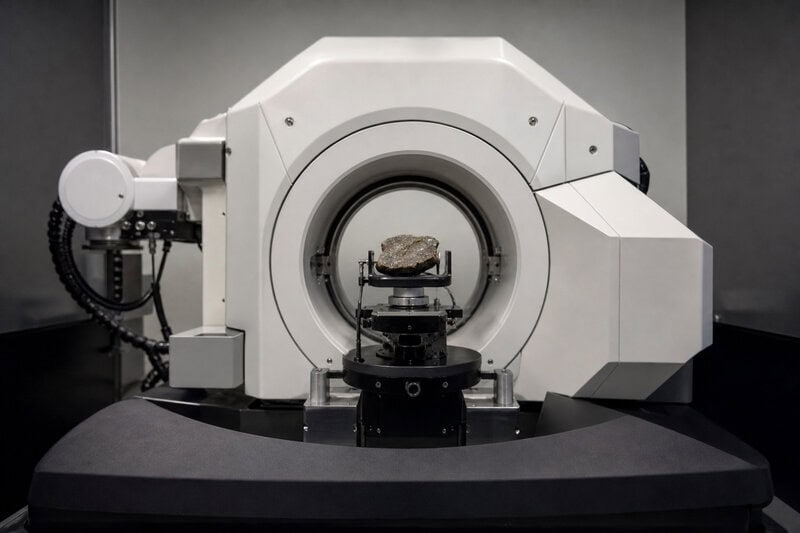
The correction came through high-resolution X-ray micro-computed tomography, commonly called micro-CT scanning. The technique works by passing X-rays through a specimen at multiple angles and assembling the data into a detailed three-dimensional model of internal structures — all without physically cutting, sectioning, or otherwise damaging the original fossil. It applies the same basic principle as a medical CT scan, but at a resolution fine enough to resolve individual anatomical features preserved inside ancient rock.
When researchers applied micro-CT scanning to Lizzie, the results were unambiguous. As Discover Magazine reports in its coverage of the new analysis, the scans revealed hidden gill structures and fish-like teeth — anatomical features that are fundamentally incompatible with reptile biology and that had been completely invisible to earlier examination. Gills are a defining characteristic of aquatic vertebrates; their presence in a specimen long classified as a land-adapted amniote constitutes strong evidence of a very different evolutionary identity.
These internal features indicate that Lizzie belonged to a far more ancient and water-dependent lineage than previously thought — not an early conqueror of dry land. The discovery is a methodological landmark as much as a biological one: it demonstrates that decades-old specimens, some sitting in museum storage for generations, can yield entirely new and transformative data when re-examined with modern imaging tools.
Reading the Wrong Anatomy: How the Misidentification Happened
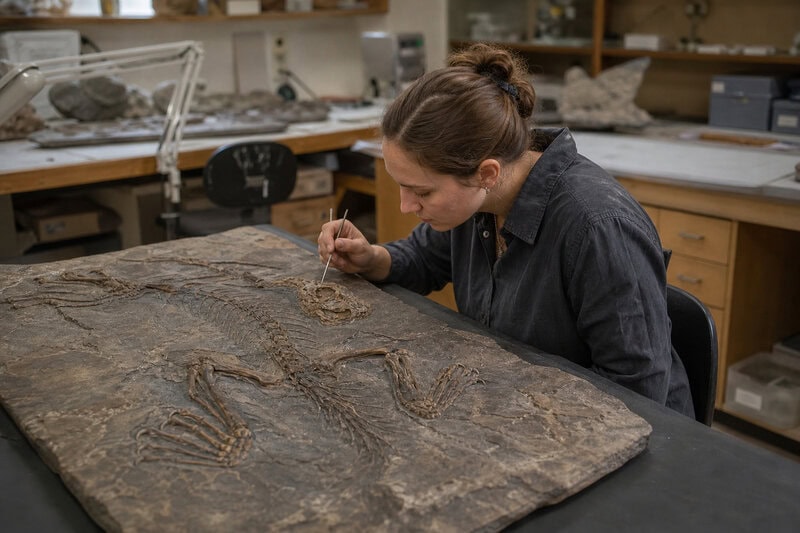
The core error, as it is now understood, involved misreading the significance of Lizzie’s visible skeletal features. Her claw-like digits and limb proportions were interpreted through the framework of early reptile anatomy — a reasonable inference given what could be seen — but those same surface features can appear in vertebrates at various points along the evolutionary spectrum. Without the internal anatomical evidence now revealed by micro-CT scanning, the surface reading was both logical and wrong.
Lizzie is what paleontologists call a transitional fossil: an organism that displays traits associated with both an ancestral group and a descendant group. Transitional fossils occupy an inherently ambiguous zone, and that ambiguity is precisely what made correct identification so difficult for so long. The lizard-like exterior masked a fish-like interior, and for three decades the exterior was all that science could reliably examine.
It is now well-established, based on the new imaging evidence, that Westlothiana lizziae is not a reptile and should not be classified as an early amniote. The precise placement of Lizzie within the vertebrate family tree — exactly where on the branch she sits relative to other early tetrapods — remains an area of active scientific discussion, as detailed coverage from Moneycontrol notes. What is not in dispute is that the previous classification was incorrect and that the correction carries real consequences for evolutionary science.
It is worth stating plainly: this kind of revision is not a failure of scientific rigor. It is a corrected hypothesis — which is exactly how science is supposed to work. The researchers who originally classified Lizzie as an early reptile drew the most reasonable conclusion available from the evidence they could access. The researchers who corrected that classification did so by generating new evidence. Both steps are part of the same process.
Why the Carboniferous Period Makes This Especially Significant
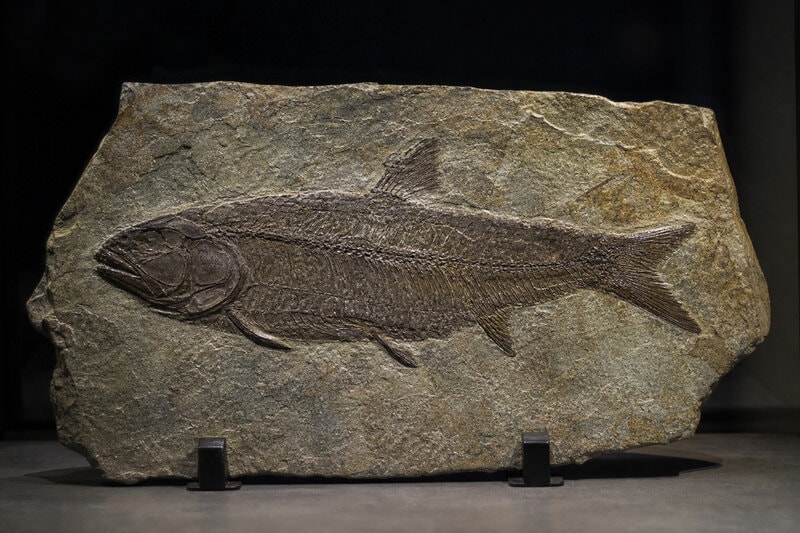
The Carboniferous period, spanning roughly 359 to 299 million years ago, was one of the most consequential eras in the history of vertebrate life. Atmospheric oxygen levels were exceptionally high, dense forests were sequestering carbon on a planetary scale, and aquatic animals were diversifying into the first creatures capable of sustained, reproductively independent life on land. The transition from water to land — sometimes called the terrestrial conquest — is among the most studied and most debated topics in evolutionary biology.
At approximately 345 million years ago, Lizzie lived right at the heart of this transition period, at a moment when the biological distinction between fish, amphibian, and early reptile was blurry and the fossil record is frustratingly sparse. Each new specimen from this era, and each re-analysis of existing specimens, has the potential to shift the picture meaningfully. By removing Westlothiana lizziae from the reptile lineage, scientists must now revise assumptions about which anatomical innovations appeared first, and in what sequence, as vertebrates adapted to terrestrial environments.
As the Times of India reports in its examination of the discovery, the reclassification changes the timeline and body-plan assumptions used to model the water-to-land transition. Researchers acknowledge that the fossil record from this period remains incomplete enough that individual specimens carry unusual scientific weight — which is precisely why getting Lizzie’s classification right matters so much.
Broader Implications: What Lizzie’s Story Tells Us About Paleontology Today
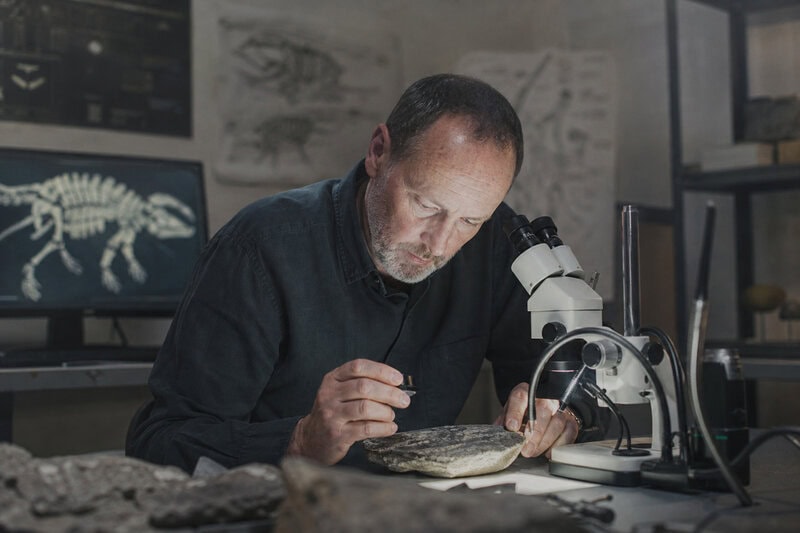
Lizzie is not an isolated case. The history of paleontology includes multiple high-profile reclassifications driven by improved imaging and analytical techniques. Debates over early bird evolution, the relationships between dinosaur lineages, and the identity of key hominid fossils have all been substantially revised as technology improved. The pattern is consistent: specimens studied for decades can still harbor fundamental surprises when examined with new methods.
The practical implication is significant. Museum collections around the world contain thousands of specimens catalogued under classifications assigned before micro-CT scanning, synchrotron imaging, and advanced computational analysis were available. The answers to longstanding questions in evolutionary biology may already exist in those collections — preserved inside fossils sitting in labeled drawers — waiting for the right technology and the right researcher to look again.
For early tetrapod evolution specifically, Lizzie’s reclassification removes a data point that had anchored certain assumptions about the timeline and anatomy of the water-to-land transition. Researchers will need to conduct further analysis of Westlothiana lizziae and contemporaneous Carboniferous fossils before a revised consensus can be firmly established. That process is ongoing, and the picture will continue to change as more specimens are re-examined with modern tools.
Science Corrects Itself — and That Is the Point
The story of Westlothiana lizziae is not a scandal but a demonstration: a 345-million-year-old fossil misidentified for decades ultimately became more scientifically valuable after the correction than it was before it. The error produced three decades of model-building; the correction is now producing better models. That is not irony — it is the scientific method functioning as intended.
Every ancient fossil reclassified represents not a failure of past scientists but a success of the ongoing scientific process, in which new tools and new scrutiny are always welcome and no conclusion is permanently beyond revision. The researchers who first identified Lizzie as a reptile advanced the field with what they had. The researchers who corrected that identification advanced it further.
Lizzie herself — a creature that picked its way across a Scottish landscape nearly 100 million years before the first dinosaurs walked the Earth — now occupies a more honest and, in many ways, more fascinating place in the story of life on this planet. She is not an early land conqueror. She is a vivid illustration of how complicated, gradual, and messy that conquest actually was.
If a fossil this closely studied, this celebrated, and this central to its field could conceal its true identity for more than 30 years, the question follows naturally: how many other specimens in the world’s museum collections are waiting to be properly understood?