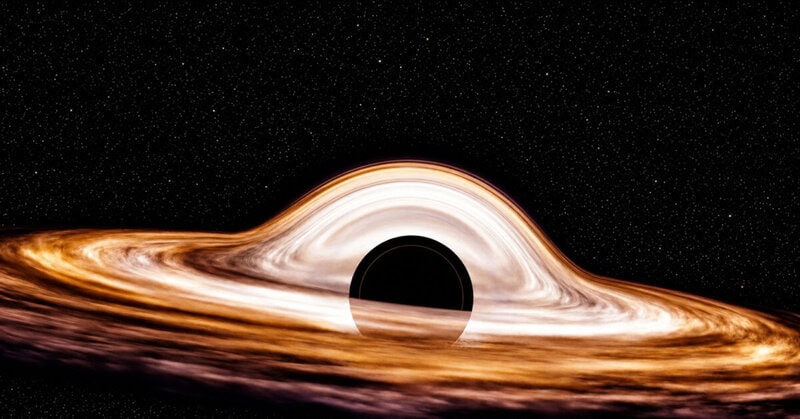
The black hole sitting at the center of galaxy M87 contains the mass of 6.5 billion suns — a figure so extreme that Albert Einstein, whose own equations mathematically allowed for such objects, privately doubted anything so violent could actually exist in nature. Now, an independent team of Australian scientists has confirmed that the first image of a black hole ever captured is authentic, verifying that Einstein’s geometry of curved spacetime governs the universe even at its most extreme edge.
What the 2019 Image Actually Showed — and Why Scientists Needed to Check It Again
When the Event Horizon Telescope (EHT) Collaboration unveiled its landmark photograph in April 2019, the world saw a fuzzy, asymmetric orange ring surrounding a dark central region. That dark region has a precise scientific name: the shadow, the zone where gravity is so overwhelming that light itself cannot escape and reach a distant observer. The image was immediately historic. It was also immediately scrutinized.
The EHT is not a conventional telescope. It is a planet-spanning network of radio observatories — from Hawaii to the South Pole — synchronized to function as a single Earth-sized dish, using a technique called very-long-baseline interferometry (VLBI). Because the final image is computationally reconstructed from sparse radio signal data rather than captured on a single sensor, a legitimate scientific question arose after the 2019 release: was the bright ring a true astrophysical structure, or was it an artifact introduced by the imaging algorithm itself? The EHT Collaboration published its original findings across six papers in The Astrophysical Journal Letters in April 2019, establishing the baseline result that subsequent researchers have worked to independently evaluate.
That question is not a fringe objection. Algorithmic artifacts are a recognized risk in any field that reconstructs images from incomplete data, from medical MRI scans to radio astronomy. For the first black hole image to serve as rigorous empirical evidence rather than a compelling illustration, it needed to survive independent scrutiny — scrutiny conducted by researchers with no stake in the original result and using methods entirely separate from the original imaging pipeline.
Einstein’s Prediction — and His Own Ambivalence About It
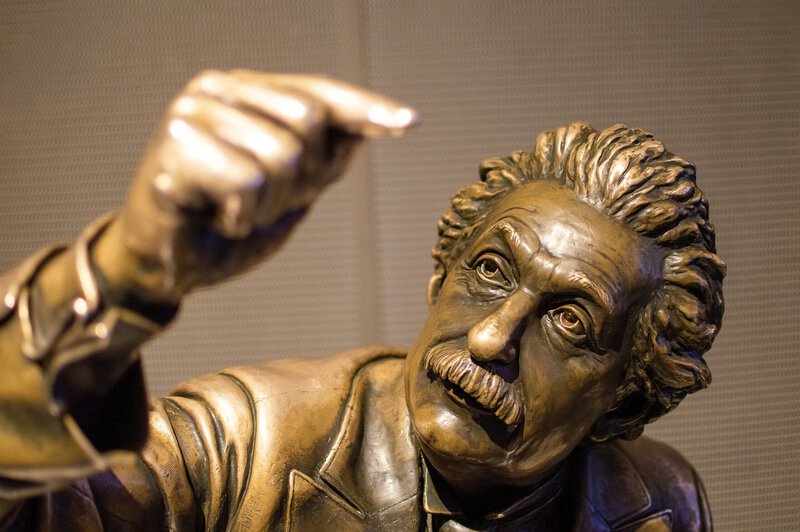
To understand why the independent verification matters, it helps to understand what general relativity actually predicted and why the prediction was so unsettling even to its author. Einstein’s 1915 theory describes gravity not as a force pulling objects together but as the curvature of spacetime caused by the presence of mass — the more mass concentrated in a region, the more severely spacetime bends around it. The mathematics of that theory, when pushed to their logical extreme, allows for a point of infinite curvature: a region where gravity becomes so intense that the escape velocity exceeds the speed of light, making departure physically impossible.
Einstein himself was troubled by this implication. In a 1939 paper, he argued that what were then called “Schwarzschild singularities” — the objects now known as black holes — could not actually form in nature, suggesting the physics of real stellar systems would prevent matter from ever collapsing to such an extreme state. History has not been kind to that reservation. Observational astronomy has since identified black holes ranging from stellar-mass remnants a few times the mass of the sun to supermassive giants billions of times more massive, like the one at the heart of M87.
General relativity makes specific, numerical predictions about what a black hole should look like from the outside. It predicts a bright ring of photons — light bent into a near-circular orbit by extreme gravity — with a precise relationship between the ring’s diameter and the black hole’s mass. It predicts a shadow approximately 2.6 times the Schwarzschild radius, the theoretical boundary of a black hole named for the physicist Karl Schwarzschild, who derived it from Einstein’s equations in 1916. These are not vague qualitative forecasts; they are testable mathematical proportions. The significance of the M87 image, and of its subsequent verification, is that the observed features match those proportions.
How the Australian Team Conducted Its Independent Verification
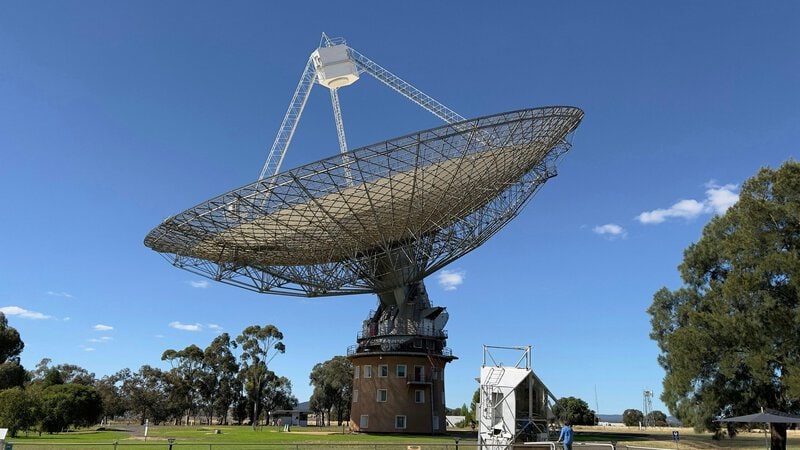
The independent validation was conducted by a team of Australian researchers who deliberately approached the problem as an external check rather than a replication of the EHT’s original method. The team used an analytical framework distinct from the EHT’s imaging pipeline, testing whether the raw radio interferometry data collected from M87 was statistically consistent with a black hole shadow as predicted by general relativity — without relying on the same computational image-reconstruction approach the original team used.
This distinction is critical. If two entirely different methodologies applied to the same underlying data both point to the same physical structure, the probability that the structure is an algorithmic artifact collapses dramatically. The Australian team’s key finding was that the bright photon ring and the central shadow visible in the 2019 image are real astrophysical features of the M87 system. As the New York Sun reported in its coverage of the independent study, the confirmation lends direct support to Einstein’s theory by demonstrating the image reflects genuine physics rather than a byproduct of data processing.
Independent replication is the foundational standard of empirical science. A single team’s result, however rigorous, represents one pathway through data that is inherently noisy and computationally demanding. A second team, using different tools, arriving at the same physical conclusion, transforms that result from a compelling single-team observation into cross-validated evidence. That is precisely what the Australian verification delivers for the first black hole image.
What ‘Verifying Einstein’ Actually Means — and What It Doesn’t
Precision matters in describing what this verification does and does not establish. The confirmation supports Einstein’s general relativity specifically in what physicists call the strong-field regime — the domain immediately surrounding a black hole, where gravity is incomparably more intense than anything encountered in ordinary astrophysical settings. This is meaningfully different from the well-established weak-field tests of general relativity, such as the small but measurable corrections that must be applied to GPS satellite clocks to keep them synchronized with ground-based receivers. Those corrections have been routine for decades. Testing relativity at the edge of a black hole is a different category of challenge entirely.
At the same time, the M87 verification does not prove general relativity is the final, complete description of gravity. Alternative theories of gravity exist — some proposed specifically to address tensions between general relativity and quantum mechanics — and while the M87 image is inconsistent with many of them, it does not eliminate all alternatives. The verified image is one data point, albeit an extraordinary one. Scientific consensus is built from converging evidence across multiple independent observations, and the M87 result now contributes robustly to that accumulation.
The 2022 EHT image of Sagittarius A* (Sgr A*), the supermassive black hole at the center of the Milky Way, provides meaningful complementary evidence. Sgr A* is structurally different from M87’s black hole — roughly 1,500 times less massive and far more dynamically variable — yet its image similarly displays features consistent with general relativistic predictions. The fact that two structurally distinct black holes in different galactic environments both conform to Einstein’s equations broadens the empirical foundation considerably.
The boundary of the claim can be stated precisely: the Australian verification confirms the M87 image is physically real and consistent with general relativity. It does not prove general relativity is complete, nor does it guarantee that no future observation will require revision of the theory.
Why This Result Extends Well Beyond One Photograph
For over a century, general relativity was tested almost exclusively in gravitational environments far milder than those surrounding black holes. The M87 verification is among the most extreme-environment tests of Einstein’s theory ever conducted using direct imaging, and that extremity is scientifically valuable precisely because it is where alternative theories of gravity are most likely to diverge from Einstein’s predictions.
The practical stakes extend further. Gravitational wave observatories — the LIGO and Virgo detectors — routinely record signals from colliding black holes and neutron stars, interpreting those signals entirely through the mathematical framework of general relativity. The reliability of those interpretations depends on relativity being correct in the strong-field regime. Black hole imaging verification and gravitational wave astronomy are therefore not parallel but convergent: each strengthens confidence in the theoretical scaffolding the other depends upon.
The independent confirmation carries particular weight because the original 2019 EHT image became one of the most widely distributed scientific images in modern history. Its independent verification transforms that cultural moment into a durable, citable scientific result — the difference between a photograph that inspired wonder and evidence that withstands methodological scrutiny.
The EHT Collaboration continues to refine its observational techniques and expand its network of participating radio telescopes. Future higher-resolution images are expected to place tighter constraints on the precise geometry of black hole shadows, testing general relativity with increasing precision. Each new image will either continue to confirm Einstein’s predictions or — in the scenario that most excites theoretical physicists — reveal the first measurable deviation from them.
The Bottom Line: A Century-Old Equation Holds at the Edge of Spacetime
An independent team of Australian researchers has confirmed that the 2019 Event Horizon Telescope image of the M87 supermassive black hole is authentic, and that its features match the predictions of Einstein’s general relativity to a degree that cannot be attributed to chance or computational artifact. The verification closes a critical scientific loop: what began as a historic first photograph has become cross-validated empirical evidence for a theory that reshaped humanity’s understanding of gravity, space, and time.
The irony embedded in that result is difficult to overstate. Einstein’s equations produced the prediction of black holes before he was willing to believe the prediction. His ambivalence, documented in his own published work, did not alter the mathematics. The first image of a black hole, now independently verified, confirms that those equations were more reliable than their creator was prepared to admit.
The first image of a black hole is no longer just a photograph — it is independently verified empirical evidence that Einstein’s geometry of curved spacetime governs the universe even at its most extreme. As telescopes sharpen and the catalog of black hole images grows, the question physicists are quietly watching for is not whether the next image will confirm Einstein again, but whether it will, at last, show them something his equations did not anticipate.