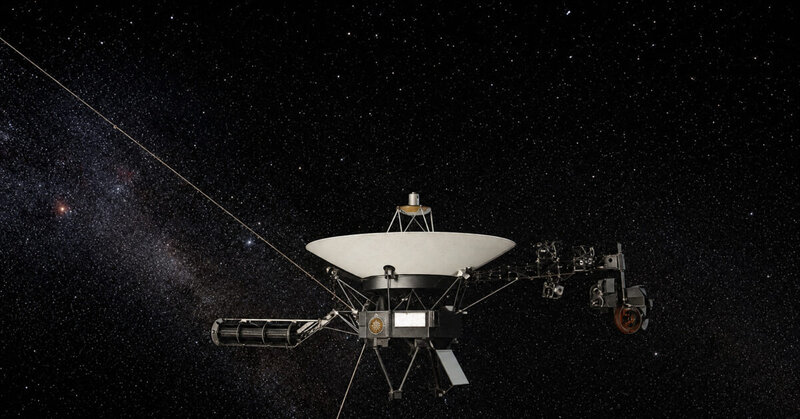
On a quiet day in 2025, a radio signal left Earth traveling at the speed of light — 186,000 miles per second — and took a full 24 hours to reach its destination. That destination was Voyager 1, now more than 16 billion miles (25.9 billion kilometers) away, making it the most distant human-made object ever built, according to NASA. The spacecraft that was designed to last five years has been flying for nearly five decades, and it is still talking.
The Mission That Was Never Supposed to Go This Far
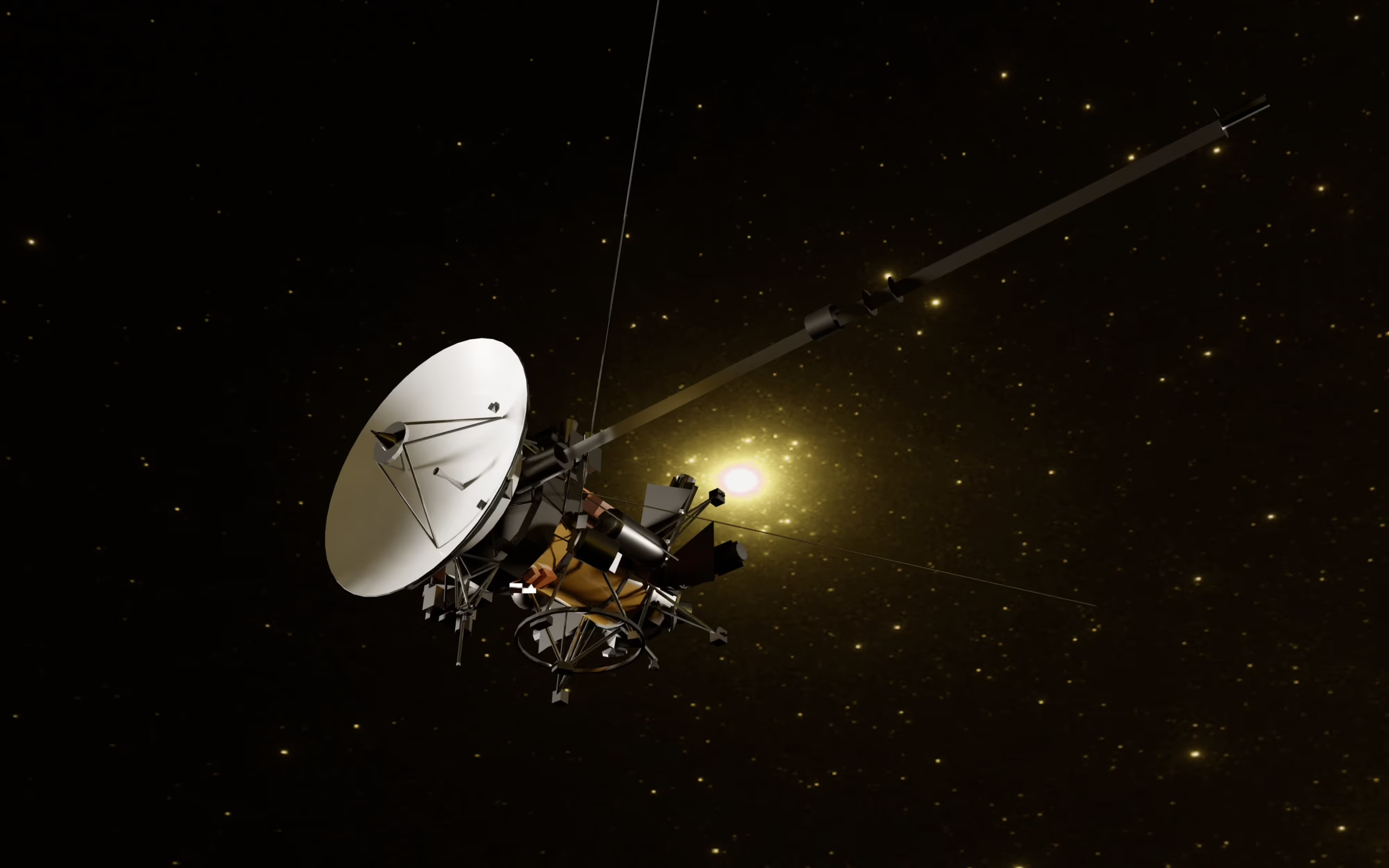
When NASA launched Voyager 1 on September 5, 1977, the primary goal was straightforward and time-limited: exploit a rare alignment of the outer planets — one that occurs only once every 175 years — to conduct a “Grand Tour” flyby of Jupiter and Saturn. The mission’s design life was roughly four to five years. Engineers built the spacecraft to survive long enough to send back close-up images of two gas giants and then, in the conventional logic of mission planning, fade into silence.
The twin Voyager probes took different paths after Saturn. Voyager 2 swung onward to Uranus and Neptune, completing the only close flybys of those worlds in history. Voyager 1, by contrast, used Saturn’s large moon Titan for a gravity assist — a maneuver that traded a continued planetary tour for a steep upward trajectory out of the flat plane of the solar system and, ultimately, out into interstellar space. That gravitational slingshot was a one-way commitment: once Voyager 1 arced above the ecliptic plane, there was no path back to the remaining planets.
What followed was an institutional decision as much as a scientific one. NASA’s Jet Propulsion Laboratory (JPL) formally established the Voyager Interstellar Mission (VIM) in 1990, dedicating resources to track both probes as they moved toward the outermost boundary of the Sun’s influence. As of 2025, Voyager 1 has been operational for nearly 50 years, making it NASA’s longest-running active deep-space mission. That longevity is not luck — it is the product of redundant engineering, nuclear power, and a ground team that has spent decades solving problems no textbook anticipated.
What “Interstellar Space” Actually Means — and Why It Matters
To understand why Voyager 1’s current position is significant, it helps to understand what it crossed to get there. The Sun does not simply end at a fixed boundary — it fills a vast region of space with a continuous outflow of charged particles called the solar wind. This outflow inflates a protective bubble known as the heliosphere. The outer edge of that bubble, where the pressure of the solar wind finally balances the pressure of interstellar gas pushing back, is called the heliopause.
In 2013, NASA confirmed — based on data published in the journal Science by Donald Gurnett and colleagues at the University of Iowa — that Voyager 1 had crossed the heliopause and entered interstellar space, becoming the first human-made object ever to do so. The key measurement was electron density: plasma wave instruments aboard the spacecraft detected a sharp increase in the density of electrons surrounding it, consistent with the denser interstellar medium rather than the thinner solar wind environment.
A common misconception deserves direct attention: “interstellar space” does not mean Voyager 1 has left the solar system in a gravitational sense. The Sun’s gravity extends much farther than the heliosphere. The Oort Cloud — a vast, distant reservoir of comets still gravitationally bound to the Sun — is thought to extend perhaps 100,000 astronomical units (AU) outward. Voyager 1 has covered approximately 160 AU. It will not truly escape the Sun’s gravitational reach for tens of thousands of years. What it has left is the Sun’s magnetic and particle environment — which is itself a profound and well-defined scientific boundary, and the one NASA uses when it describes Voyager 1 as having entered interstellar space.
The scientific value of that crossing is ongoing. Before Voyager 1, the interstellar medium — the gas, dust, and magnetic fields that fill the space between stars — could only be studied remotely from Earth. Voyager 1 is now providing direct, in-situ measurements of that environment for the first time in human history. Understanding what a light-day of distance means for that data transmission is itself a remarkable exercise in scale — one that reframes every figure in this story.
The Power Source That Made Everything Possible
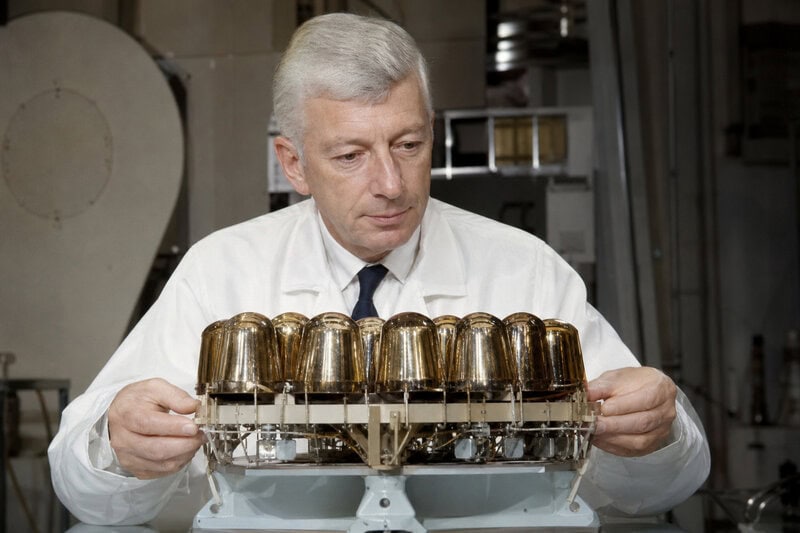
At Voyager 1’s current distance, sunlight is roughly 23 billion times weaker than at Earth’s surface. Solar panels of any practical size would generate essentially no usable electricity. The engineers who designed the Voyager spacecraft in the early 1970s knew this, and they chose a different approach: Radioisotope Thermoelectric Generators, or RTGs.
RTGs work by converting heat from the natural radioactive decay of plutonium-238 directly into electricity, using devices called thermocouples. There are no moving parts. There is no need for sunlight. The process is entirely self-contained and continuous. Plutonium-238 has a half-life of approximately 87.7 years, meaning the RTGs lose roughly 1.4 percent of their electrical output per year — a slow, predictable decline that engineers have been able to plan around with unusual precision.
Planning around it has meant making hard choices. As power output has declined over the decades, JPL engineers have progressively shut down heaters, instruments, and subsystems no longer considered essential, redirecting the remaining electricity to the science instruments and communication systems that matter most. By the mid-2020s, Voyager 1’s RTGs produce approximately 40 percent less power than they did at launch, according to NASA JPL. The mission team expects to keep at least a few science instruments operating into the late 2020s before the power budget drops below the threshold needed to run even a single sensor reliably.
It is worth pausing on what that engineering constraint actually represents: a spacecraft launched when the pocket calculator was a novelty is still being actively managed for scientific output in 2025, with its power decline understood precisely enough to schedule instrument shutdowns years in advance. That is not routine mission management. It is something closer to open-ended problem solving conducted in slow motion across half a century.
How Engineers Communicate Across 16 Billion Miles

The physical feat of maintaining contact with Voyager 1 is, in its own way, as impressive as the spacecraft’s survival. The signal Voyager 1 transmits arrives at Earth at a power level far below a billionth of a billionth of a watt. Detecting it at all requires NASA’s Deep Space Network (DSN) — a global array of large radio dish antennas located in Goldstone, California; Madrid, Spain; and Canberra, Australia. The DSN’s largest dishes measure 70 meters (230 feet) across, and even they are operating near the limits of what radio detection technology can achieve at this range.
The 24-hour one-way signal travel time creates a profound operational constraint: real-time control is impossible. When engineers send a command today, they will not receive any response for 48 hours — 24 hours for the signal to arrive, and 24 more hours for Voyager 1’s reply to travel back. Every instruction must be carefully planned and sequenced in advance. If something goes wrong aboard the spacecraft, its onboard fault-protection software must act autonomously, because ground controllers will not even know the problem exists for a full day.
That constraint became dramatically real in late 2023, when Voyager 1 began transmitting garbled engineering data — readable signals, but containing gibberish where coherent information should have been. JPL engineers spent months diagnosing the problem across the communication lag, methodically ruling out possibilities. They eventually traced the fault to a corrupted memory chip in one of the spacecraft’s three computers, known as the Flight Data System. The repair they devised — redistributing the affected code across other memory locations — was executed successfully in 2024, per NASA JPL announcements. It was, in essence, a software patch delivered to a 1970s computer 16 billion miles away. It worked.
The hardware constraints make every such fix a feat of institutional archaeology. Voyager 1 carries approximately 69.63 kilobytes of memory — less storage than a single low-resolution photograph on a modern smartphone. Its computers run on a programming architecture that is decades obsolete. Engineers who work on the spacecraft today must learn systems that predate most of their careers, thinking in the logic of a computing era that has otherwise largely disappeared. The 48-hour round-trip communication delay means that uncertainty compounds at every step: a wrong diagnosis, a flawed command sequence, or an unanticipated interaction between systems cannot be caught and corrected quickly. Every intervention is a considered bet placed across interstellar distances.
What Voyager 1 Is Still Teaching Us — and What Remains Unsettled

Some of what Voyager 1 has revealed is well-established scientific consensus. Its plasma wave instruments have provided the first direct measurements of electron density in the local interstellar medium, confirming theoretical models of heliopause structure that had been built from indirect observations over many decades. These findings have been reported in multiple peer-reviewed studies in journals including Nature Astronomy and Science.
Other questions remain genuinely open. The exact shape of the heliosphere — whether it has a comet-like tail streaming behind the Sun’s motion through the galaxy, or whether it is more symmetrical and roughly spherical — is still scientifically debated. Voyager 1 travels in a single direction, sampling one narrow corridor of the boundary region. Its measurements cannot, by themselves, tell scientists what the heliosphere looks like from other angles or at other points on its surface.
Some researchers have also proposed, based on anomalies in cosmic-ray and magnetic-field data near the heliopause crossing, that the boundary is more dynamic and variable than classic steady-state models predicted — that it fluctuates rather than sitting at a fixed position. This interpretation is an active area of research, not yet settled consensus. It illustrates something important about the mission: even after nearly 50 years, Voyager 1 is still generating new questions, not simply confirming old answers.
Beyond the heliosphere itself, the mission has acquired an unexpected relevance to exoplanet science. Every star with planets creates its own version of a heliosphere, called an astrosphere. Understanding the structure of our own astrosphere in detail — which Voyager 1 is uniquely enabling — gives astrophysicists a calibration point for modeling the protective particle environments around other stars and, by extension, the habitability conditions around distant planets. No one working on the mission in 1977 could have articulated that goal. It emerged from the data.
What Comes Next — and Why the End Will Still Be a Beginning
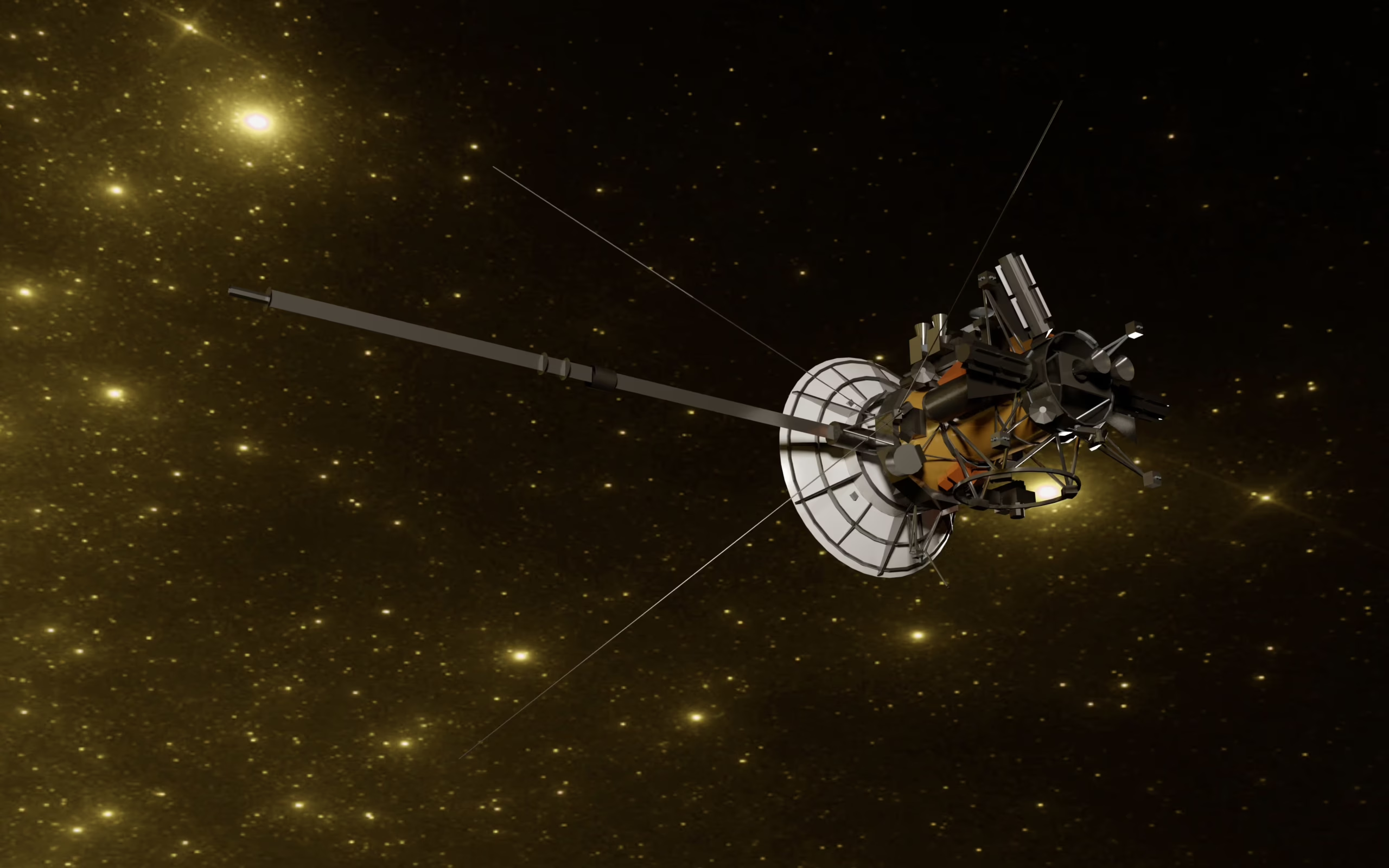
The practical end of Voyager 1 as a scientific instrument is approaching. NASA JPL estimates the spacecraft will lose the ability to operate any science instrument sometime in the late 2020s, as RTG power drops below the minimum threshold required even for a single sensor. After that, the transmitter itself will eventually fall silent — though the exact timing depends on how the power budget holds as the decade progresses.
The spacecraft, however, will not stop. Traveling at approximately 38,000 miles per hour (about 17 kilometers per second), Voyager 1 will continue drifting outward through interstellar space indefinitely. According to NASA trajectory calculations, it will make its closest approach to another star — passing within about 1.6 light-years of Gliese 445, a dim red dwarf in the constellation Camelopardalis — in approximately 40,000 years. By any human measure, it is gone.
Aboard the spacecraft is an artifact that has nothing to do with science instruments or power budgets: a gold-plated copper phonograph record, one of two carried by the twin Voyagers. Curated by a committee chaired by the astronomer Carl Sagan, the Golden Record contains sounds, music, and images representing Earth — greetings in dozens of languages, the sound of rain and surf, Bach and Chuck Berry. It is not a scientific instrument. It is a cultural artifact, and its physical survival timescale is measured in billions of years. Whether it will ever be found is not a scientific question. That it exists, traveling outward forever, is a fact.
Voyager 1 at one light-day from Earth is less a spacecraft now than a proof of concept — evidence that human engineering, sustained institutional attention, and the willingness to keep learning can extend a five-year mission into a half-century journey toward the stars. The signal takes a full day to arrive. Engineers are still listening.