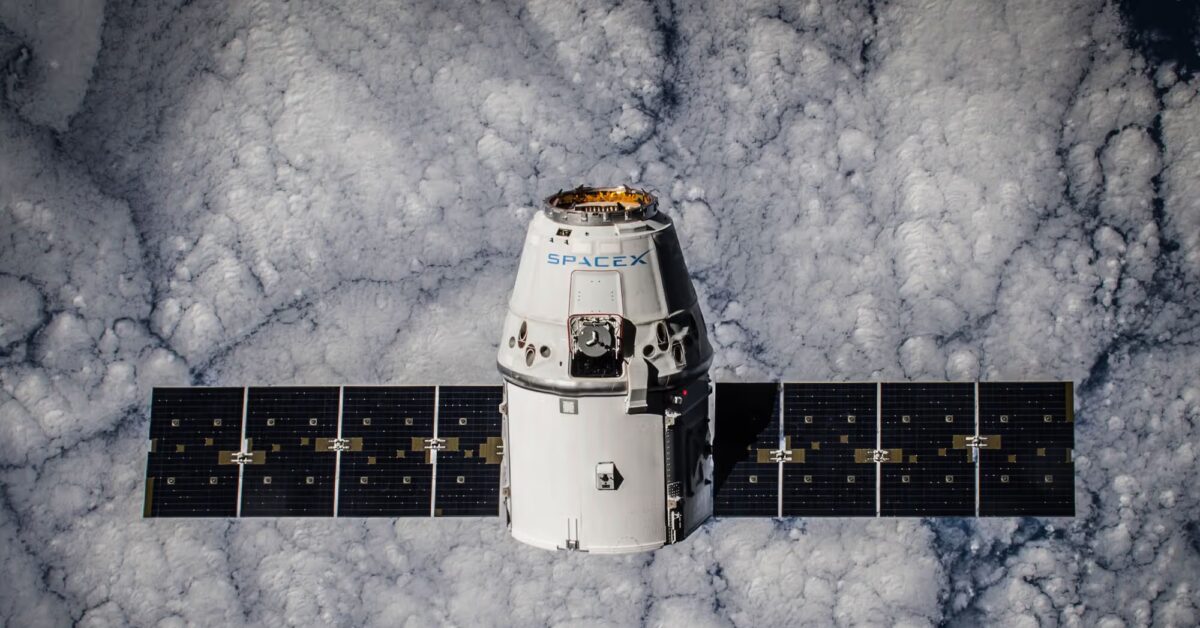
On May 25, 2025, a SpaceX Dragon cargo capsule undocked from the International Space Station and began falling toward Earth at roughly 17,500 mph — carrying thousands of pounds of scientific experiments and supplies through temperatures exceeding 3,000°F before splashing down in the Pacific Ocean off the California coast, completing one of the most thermodynamically violent events humans routinely engineer.
A Fireball Carrying Thousands of Pounds of Science
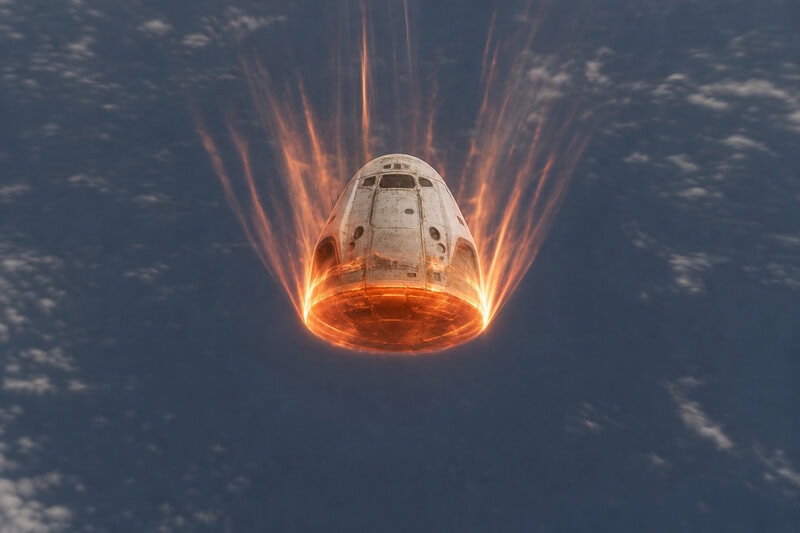
The Dragon capsule had spent weeks berthed at the station after delivering more than 6,300 pounds (2,860 kilograms) of food, scientific gear, and other supplies to the crew. The return trip subjects the vehicle to conditions that would destroy almost any other human-made object. Yet the splashdown — documented by NASA’s space station program office — concluded without incident, as it has across dozens of Dragon missions before it.
What follows is a physics-first account of how that happens: from the moment the thrusters fired over the Pacific to the moment recovery crews pulled the capsule from the water, each mechanism in the sequence explained in the order it occurs.
The Deorbit Burn: Giving Up Speed on Purpose

The return begins not with a dramatic plunge but with a subtle slowdown. Dragon’s Draco thrusters fire in a retrograde burn — meaning in the direction opposite to travel — shedding roughly 300 mph of orbital velocity. That reduction sounds modest against a background speed of approximately 17,500 mph, but it is enough to fundamentally reshape the capsule’s orbit.
An object in low-Earth orbit at roughly 250 miles altitude is not simply moving fast — it is moving fast enough that the curve of Earth’s surface falls away beneath it at the same rate it falls. Reducing that speed by even 1 to 2 percent changes the orbit’s geometry dramatically, dropping the capsule’s perigee — its lowest orbital point — into the upper atmosphere, where air resistance will do the rest of the work.
The precision required at this stage is unforgiving. SpaceX’s flight software must target an atmospheric entry corridor typically no more than one to three degrees wide. Enter too steeply and the capsule generates lethal deceleration forces and catastrophic heating. Enter too shallowly and the vehicle skips off the upper atmosphere like a flat stone on water, bouncing back into space on an uncontrolled trajectory. The burn duration, thrust angle, and timing are all calculated in advance and executed autonomously, with the software continuously monitoring capsule attitude — its orientation in space — and correcting for any drift that could shift the entry angle outside the survivable window.
Reentry: When Air Becomes a Wall
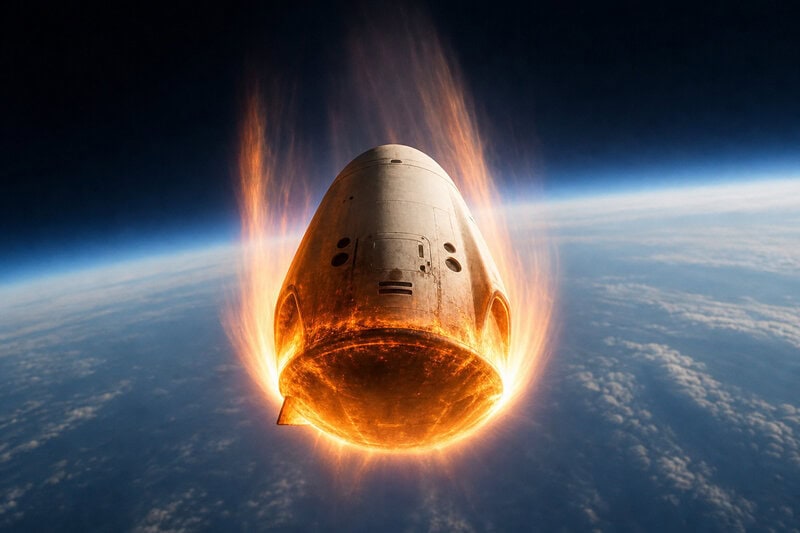
At approximately 400,000 feet altitude, Dragon reaches what engineers call Entry Interface — the point where the atmosphere is dense enough to begin meaningfully decelerating the vehicle. This is the start of the most physically intense phase of the return, and it rests on a piece of physics that most people get wrong.
The capsule is not primarily heated by friction with air molecules. It is heated by compression. At 17,500 mph, air molecules in front of the blunt heat shield cannot move out of the way fast enough. They pile up and compress into a superheated plasma — a bow shock — that reaches temperatures exceeding 3,000°F. The energy source is the conversion of the vehicle’s kinetic energy into thermal energy through rapid gas compression, not surface abrasion.
Dragon’s PICA-X heat shield is engineered specifically for this environment. PICA-X stands for Phenolic Impregnated Carbon Ablator — a material SpaceX developed from NASA’s original PICA formula. It works through controlled ablation: the outermost layer of the heat shield vaporizes under extreme heat, and that phase-change process carries thermal energy away from the structure rather than conducting it inward toward the capsule and its cargo. The surface literally sacrifices itself to keep the interior survivable.
One counterintuitive detail worth noting: peak heating and peak deceleration do not occur at the same moment. The capsule experiences its highest temperatures slightly before it reaches maximum g-load. Cargo Dragon missions typically experience peak deceleration in the range of 4 to 8g — far below what a crewed reentry would require mission planners to minimize, but still a significant structural and packaging challenge for sensitive scientific hardware.
The Plasma Blackout: Why Dragon Goes Silent
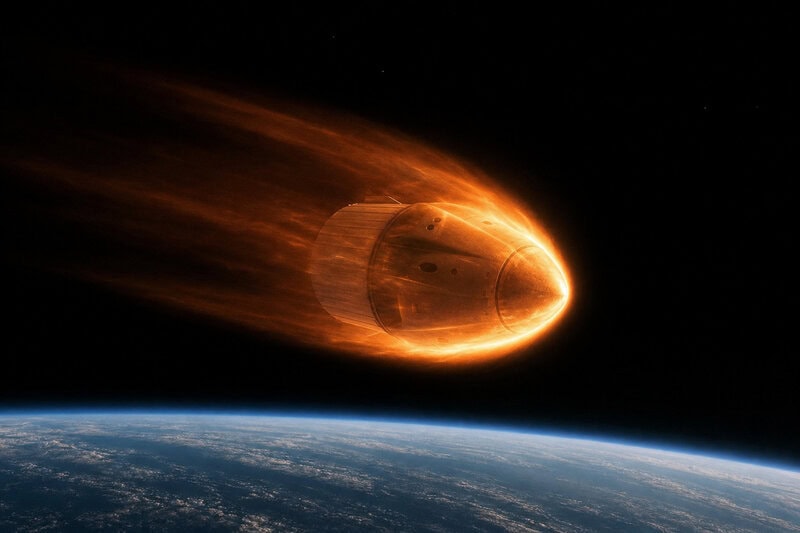
During peak reentry, something operationally significant happens: Dragon goes silent. The superheated plasma surrounding the capsule forms an electrically conductive sheath that absorbs and reflects radio waves, severing all communication between the vehicle and mission controllers for several minutes. This is known as a communications blackout, and it is a predictable, well-characterized phenomenon rather than a sign of trouble.
The plasma layer forms because the extreme temperatures strip electrons from air molecules, creating an ionized medium. Signal frequencies below approximately 10 GHz cannot penetrate this layer, which covers the radio bands Dragon uses for telemetry and communication with ground teams.
Mission controllers monitor all available data right up to the moment of blackout and resume contact once the capsule has slowed enough for the plasma to dissipate — typically at around 100,000 feet altitude. Throughout the blackout period, Dragon’s onboard computers continue to manage the vehicle’s attitude and monitor system health autonomously. The capsule does not need ground contact to survive reentry; it simply needs its software to keep it properly oriented until the air slows it into a range where parachutes can take over.
Parachute Sequence: Four Stages of Controlled Falling
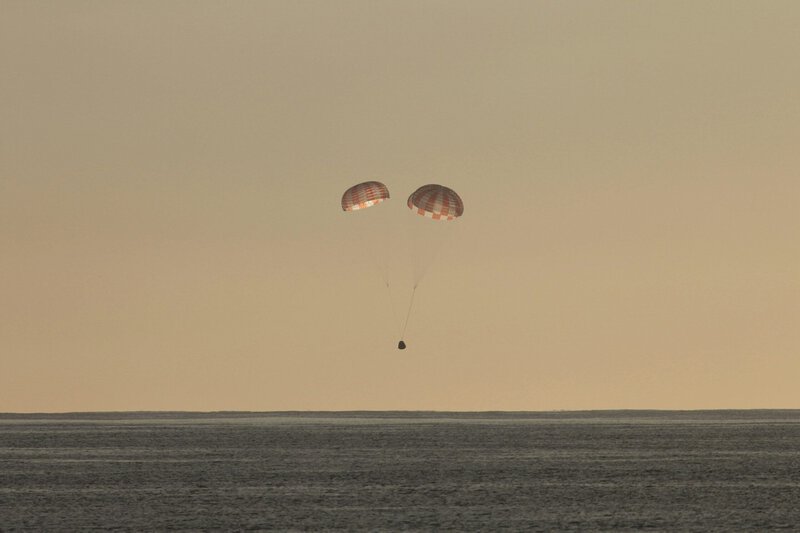
Once Dragon decelerates to subsonic speeds — below roughly 760 mph — a staged parachute sequence begins. The sequence has four distinct events, and the order matters.
- Drogue deployment: Two small drogue parachutes deploy first. Their primary job is stabilization. A capsule tumbling at high subsonic speed could prevent the main parachutes from inflating correctly, so the drogues arrest rotation and orient the vehicle before the main canopies are released.
- Main parachute deployment: Three large main parachutes follow, each expanding to roughly 116 feet in diameter. Together, they slow the capsule to a terminal velocity of approximately 15 to 16 mph at splashdown.
That final figure — 15 to 16 mph — represents a deceleration factor of more than 1,000 times across the full entry, descent, and landing sequence, from orbital speed to water impact.
SpaceX has validated this sequence across dozens of Dragon missions. The system is also designed with single-failure redundancy: Dragon can land safely even if one of the three main parachutes fails to deploy, a standard NASA required for the Commercial Crew Program that applies to cargo variants as well. As reporting on the CRS-35 mission return confirmed, the parachute sequence performed nominally throughout the descent.
Splashdown and Recovery: Engineering the Ocean Landing
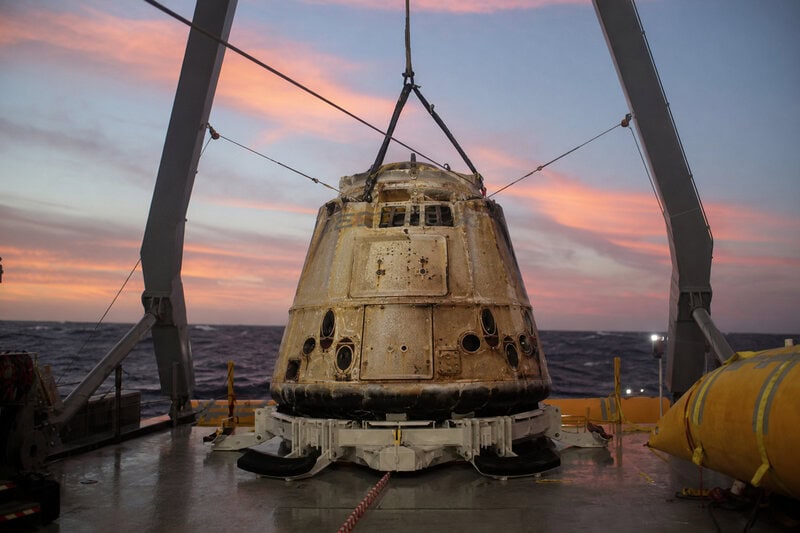
Dragon’s target zone off the California coast is not arbitrary. The ISS orbits at an inclination of approximately 51.6 degrees to the equator, and the geometry of a deorbit from that orbit naturally directs the capsule’s reentry trajectory toward the eastern Pacific. This routing minimizes the flight path over populated land areas — a constraint that shapes recovery planning from the moment a mission launches.
At water impact, the residual velocity of 15 to 16 mph is absorbed partly by the ocean surface and partly by the capsule’s structural design. SpaceX engineers the pressure vessel and internal cargo restraint systems to withstand splashdown loads, protecting both sensitive hardware and biological samples that may have spent weeks growing, changing, or reacting in microgravity.
Recovery speed is itself a scientific requirement. SpaceX pre-positions recovery vessels — typically including a fast boat and a larger recovery ship — in the target zone before reentry even begins. Some biological payloads, including cell cultures and protein crystal experiments, begin degrading within hours of returning to Earth’s gravity. The science cargo aboard each mission represents the output of experiments conducted over weeks in microgravity; getting those samples to researchers’ labs quickly is as mission-critical as surviving reentry.
Details of the recovery operation were confirmed in coverage of the capsule’s departure from the station, which noted the pre-positioning of recovery assets ahead of the splashdown window.
What Dragon’s Return Reveals About the Future of Reentry
Dragon’s reentry architecture — blunt body heat shield, staged parachutes, ocean landing — descends directly from the design philosophy NASA validated with the Apollo program in the 1960s. SpaceX has refined the materials and the software, but it has not fundamentally reinvented the approach. That is a deliberate engineering choice: in a domain where the consequences of failure are total, proven architecture carries enormous value.
Emerging reentry concepts — including lifting-body vehicles capable of runway landings and metallic thermal protection systems under study by NASA and commercial partners — promise greater landing precision and faster vehicle turnaround. But none has yet matched the operational cadence Dragon has demonstrated, and Dragon’s reliability record serves as the benchmark against which newer concepts must be measured.
The growing mass of returning science cargo is itself reshaping how researchers design ISS experiments. Dragon now routinely returns more experiment mass than any previous uncrewed spacecraft, and that reliable return capability makes longitudinal studies and sample-return science economically viable in ways they were not before. When an experiment requires samples collected at multiple time points over months — and those samples must be analyzed in a terrestrial laboratory — the existence of a dependable return vehicle is not a logistical convenience. It is what makes the science possible.
Each Dragon splashdown also generates reentry environment data — heat flux measurements, plasma behavior observations, parachute load recordings — that feeds back into NASA’s Entry, Descent, and Landing research databases. Every mission is simultaneously a cargo delivery, a science return, and a continuing aerothermodynamics experiment. The fireball over the ocean, in that sense, is never entirely finished producing data.