
Look up at the sky on a clear day and you’re not actually seeing the sky at all — you’re watching a live performance of scattered starlight, filtered through miles of invisible gas, interpreted by biology that evolved to see it a certain way. The blue overhead is not a property of the air. It’s a trick of physics, and once you understand it, you’ll never look at a clear day the same way again.
The Sky Has No Color of Its Own
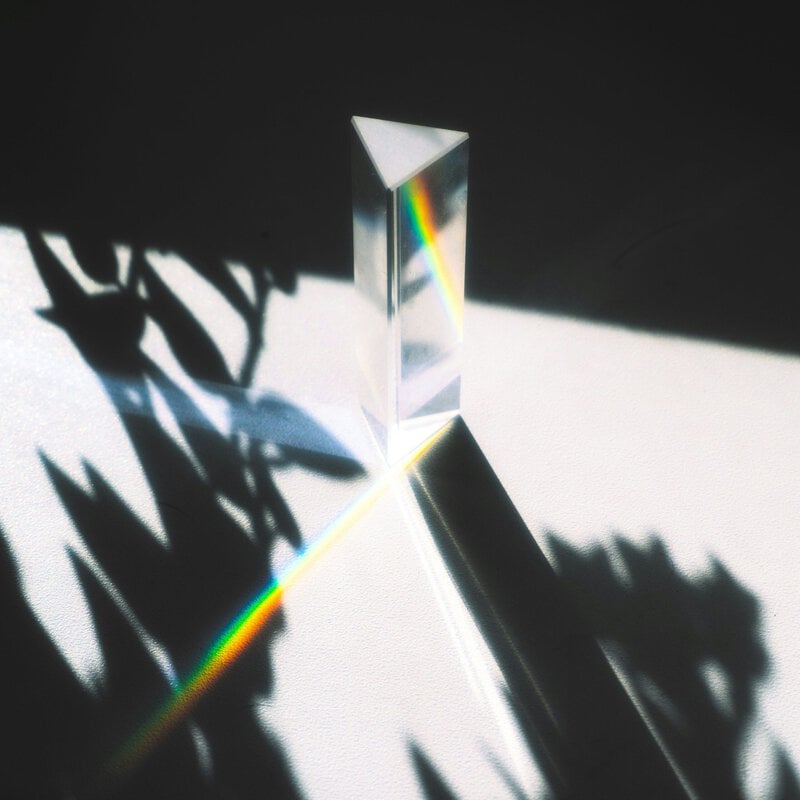
The atmosphere is, at its core, transparent. It’s mostly nitrogen and oxygen — colorless gases that you can see straight through, like a pane of glass with nothing painted on it. If the sky had an intrinsic color the way a wall has a color, it would look the same at noon, at sunrise, and from the surface of every planet with air. It doesn’t, because it can’t. What we call “the blue sky” is really a light show produced by our nearest star bouncing off gas molecules far overhead.
This reframing matters. When you look up, you’re not looking at the sky — you’re looking at scattered sunlight. The atmosphere is the stage; the Sun is the source; and your eyes are the audience. Understanding that chain is the key to everything that follows.
Sunlight Looks White, But It Contains Every Color at Once

Sunlight appears white or pale yellow, but that appearance compresses the full visible spectrum — red, orange, yellow, green, blue, and violet all traveling together in a single beam. When that full-spectrum light enters Earth’s atmosphere, it doesn’t pass through cleanly. It collides with gas molecules and gets redirected in every direction.
The “size” that determines how light bounces is wavelength. Each color in the spectrum has a different wavelength, and those differences turn out to matter enormously once light enters a medium filled with tiny molecules. Shorter wavelengths interact with air molecules very differently from longer ones — and that difference is what colors the sky.
Rayleigh Scattering: Why Short Wavelengths Take the Scenic Route
The mechanism behind the blue sky has a name: Rayleigh scattering. When light encounters molecules that are much smaller than its wavelength — which describes virtually every gas molecule in our atmosphere — shorter wavelengths scatter far more intensely than longer ones. The relationship is steep: scattering efficiency scales with the inverse fourth power of wavelength, meaning that even a modest decrease in wavelength produces a dramatic increase in scattering.
To put that in concrete terms: blue light scatters more than red light across the sky. That scattered blue light arrives at your eyes from every point overhead, painting the entire dome of the sky in a uniform hue. NASA’s Space Place explains it plainly: a clear, cloudless daytime sky is blue because molecules in the air scatter blue light from the Sun more than they scatter red light.
Red and orange light, carrying longer wavelengths, largely pass straight through the atmosphere with minimal deflection. They’re not lost — they’re just traveling in a straight line toward the horizon, which turns out to be critical for what happens at sunset.
So Why Isn’t the Sky Violet?
This is where the story gets genuinely interesting. Violet light has an even shorter wavelength than blue, which means Rayleigh scattering should scatter it even more intensely. By the pure physics of scattering alone, the sky ought to look violet. It doesn’t — and three separate factors conspire to explain why.
- The Sun emits more blue than violet. The Sun’s energy output is not equal across all wavelengths. It produces significantly more energy as blue light than as violet light, so there’s simply less violet available to scatter in the first place.
- The upper atmosphere absorbs some violet light. A portion of incoming violet wavelengths is absorbed by Earth’s upper atmosphere before it ever reaches the altitudes where we’d see it scattered toward us.
- Human eyes are poorly equipped to see violet. Our cone cells — the receptors that detect color — are far more sensitive to blue than to violet. Even the violet light that does scatter registers weakly in our visual system. As NOAA’s NESDIS notes, the sky looks blue rather than violet in large part because human eyes are simply more sensitive to blue light.
Biology is part of the equation. A creature with different photoreceptors might look up and see a violet sky on the same clear day. The sky’s apparent color is partly a fact about the Sun and atmosphere, and partly a fact about us.
Why Sunsets Flip the Script to Red and Orange
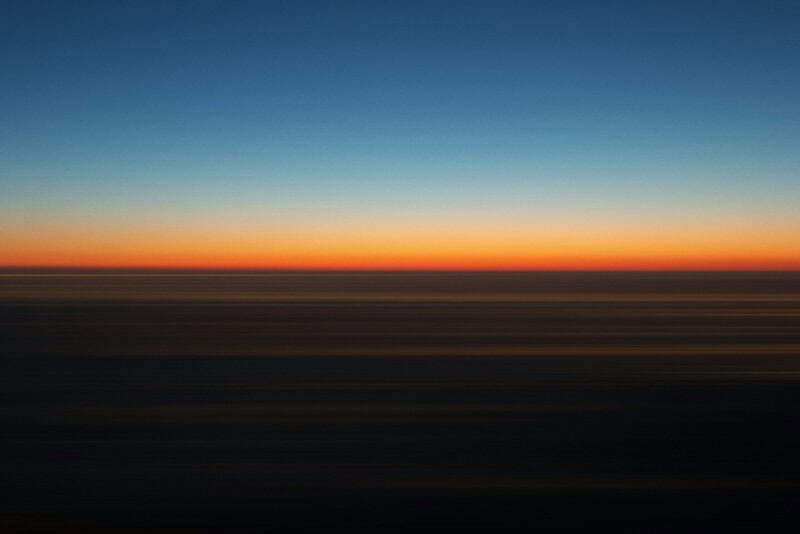
The same physics that explains blue noon skies also explains why sunsets are red and orange — and the explanation reveals something elegant about how the whole system works.
At sunset, sunlight arrives at a sharp angle, cutting horizontally through the atmosphere instead of plunging straight down. That means sunlight has to travel through a dramatically longer column of air to reach your eyes — many times more atmosphere than it crosses at noon. Over that extended path, virtually all the blue and violet light scatters away long before it arrives at your location. The only wavelengths that survive the long journey intact are the ones that resist scattering most: red and orange.
The same Sun. The same atmosphere. The same physics. Just a different angle — and a completely different palette floods the horizon. The Royal Observatory Greenwich describes how everything changes when the path through the atmosphere lengthens at low sun angles.
Pollution and dust add extra scattering particles to the mix, which is why sunsets over cities or in the wake of wildfires often burn with especially vivid reds. More particles means more blue scattered away, leaving an even more saturated warm remainder. Large volcanic eruptions can inject sulfur dioxide into the stratosphere, producing particles that scatter light for months and generate unusually intense red sunsets on a global scale — a phenomenon observed after the 1991 eruption of Mount Pinatubo.
Clouds, White Light, and a Different Kind of Scattering
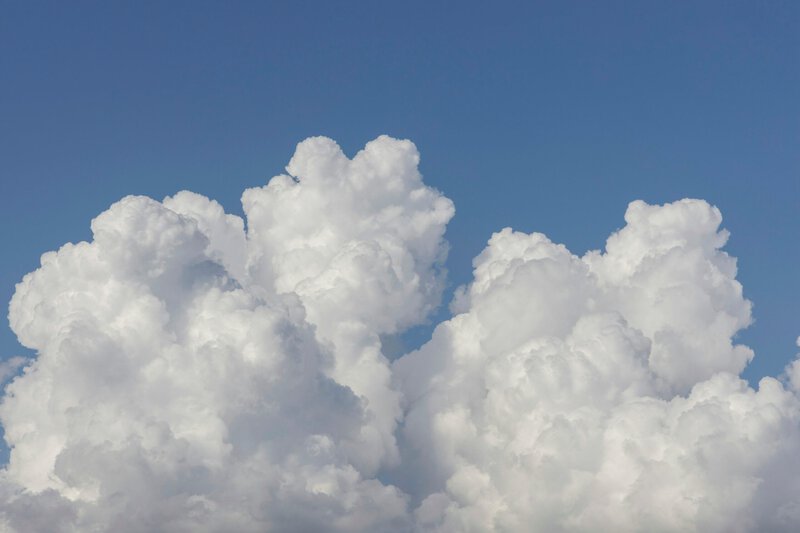
It’s worth pausing on clouds, because they seem to contradict everything above. Clouds are made of water droplets and ice crystals — particles far larger than gas molecules. When light hits particles that are comparable to or larger than its own wavelength, a different process takes over: Mie scattering. Unlike Rayleigh scattering, Mie scattering affects all wavelengths nearly equally. Every color bounces in every direction with roughly the same intensity, and the result is white — which is why clouds appear white against the blue sky. The same principle makes fog white and milk white. The scattering mechanism changes with particle size, and so does the color of the result.
You’re Watching Starlight Pinball
Step back and consider what’s actually happening every time you glance up at a clear sky. Each photon of blue light reaching your eye began its life at the Sun’s surface roughly 93 million miles away. It crossed the vacuum of space in about eight minutes, entered Earth’s atmosphere, and then collided with a molecule of nitrogen or oxygen miles above your head, ricocheting sideways — and happened to redirect toward you. You are catching stray starlight that lost the straight-line race.
The sky is, in effect, a real-time display of which wavelengths bounced sideways instead of continuing forward. The physics FAQ maintained at UC Riverside offers a thorough breakdown of this scattering geometry for readers who want the mathematical detail.
The Moon provides a perfect control case. It has no atmosphere, which means no Rayleigh scattering. Stand on the lunar surface with the Sun blazing directly overhead and the sky is not blue — it is pitch black, crowded with stars at high noon. Remove the scattering medium, remove the color. The blue sky is not inevitable. It is atmospheric.
Other Worlds, Same Physics
Mars shows what happens when you keep the physics but change the ingredients. The Martian atmosphere is thin and laden with fine rust-colored dust particles. During the day, that dust scatters light in ways that give the sky a butterscotch or pinkish-tan appearance. Near sunset, however, the extended path through the dusty atmosphere scatters away the longer wavelengths, and the Martian sky briefly shifts toward blue around the sun — the inverse of what happens on Earth. Same Rayleigh and Mie principles, different particles, inverted result.
On a planet with a denser atmosphere rich in different gases, the sky might appear another color entirely. The color of a planet’s sky is a direct readout of its atmospheric composition, particle load, and the spectrum of its host star. It is, in that sense, a diagnostic tool — which is part of why planetary scientists pay close attention to sky color when analyzing data from probes and rovers.
The Takeaway: Ordinary Air Is a Color Filter at Planetary Scale
The blue sky is not a backdrop. It is an active optical event — a continuous interaction between solar energy, molecular physics, and human biology happening simultaneously across an entire planetary atmosphere. It runs every clear day without interruption, powered by a star, and costs nothing to observe.
What makes the sky blue is not a simple answer. It’s the intersection of a star’s emission spectrum, the quantum behavior of gas molecules, the geometry of a planet’s rotation, and the evolutionary history of human vision. That the answer resolves into something as quiet and familiar as a clear afternoon is, in its own way, remarkable.