
California deputies recently found themselves in an unlikely situation: tracking down a stolen green dinosaur, only to discover it in a Stockton yard with a bag pulled over its distinctive head. It is exactly as absurd as it sounds — and it opens a surprisingly deep window into one of America’s most enduring, most contested, and most scientifically complicated brand icons.
The Crime: A Bagged Brontosaurus in Stockton
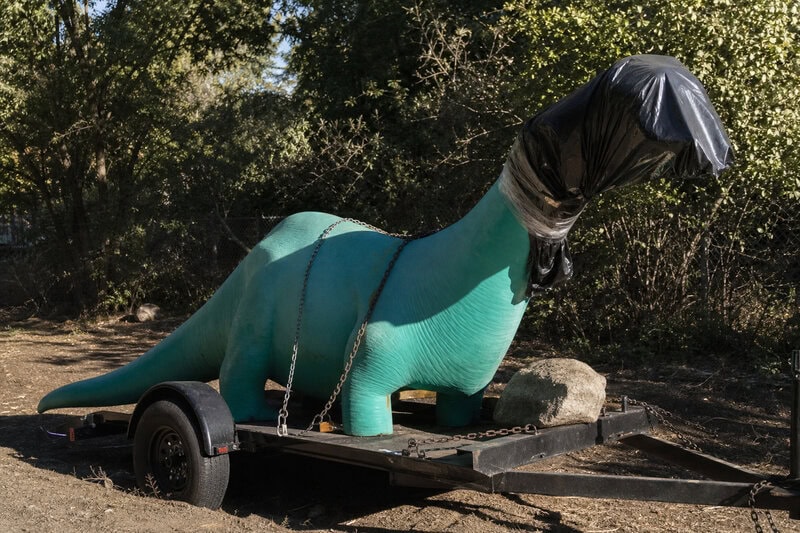
The theft began at a Sinclair gas station in San Joaquin County, California, where the station’s signature green dinosaur statue went missing. Investigators traced the stolen figure to Stockton, where deputies located it with a bag covering its head — apparently an attempt to conceal the most recognizable part of a very recognizable object.
Deputies removed the bag, confirmed the dinosaur’s identity, and successfully recovered the statue. A suspect was arrested in connection with the theft. Coverage of the recovery spread quickly, in part because the image of a bagged dinosaur being liberated by law enforcement is genuinely difficult to look away from. Local reporting on the Stockton recovery captured something the crime itself unintentionally illustrated: these statues matter to people.
But the strangeness of the scene raises a real question: why does a gas station dinosaur inspire enough attachment — or notoriety — to be stolen in the first place? The answer involves nearly a century of American branding, a Victorian-era scientific feud, and a 2015 research paper that quietly vindicated one of history’s most stubborn corporate decisions.
Dino: The Sinclair Brontosaurus and Its Place in American Branding

Sinclair Oil has used a green Brontosaurus as its mascot since 1930, when the company began associating its petroleum products with the prehistoric era. The logic was straightforward, if somewhat romanticized: oil comes from ancient organic material laid down millions of years ago, during the age of dinosaurs. The Brontosaurus became the visual shorthand for that idea.
What started as print advertising evolved into something far more physical and lasting. Fiberglass statues, inflatable parade versions, and illuminated signage featuring the green dinosaur became fixtures at Sinclair stations across the country. The mascot — eventually named Dino — became one of the most recognized petroleum brand logos in American history.
The cultural peak arguably came at the 1964 World’s Fair in New York, where Sinclair sponsored an exhibit featuring life-size dinosaur models. For an entire generation of American families, the Sinclair Brontosaurus became inseparable from the experience of the road trip, the highway stop, and mid-century American life. That emotional imprint explains why these statues, decades later, still carry genuine sentimental and monetary weight.
Did the Brontosaurus Even Exist? The Science Behind the Name
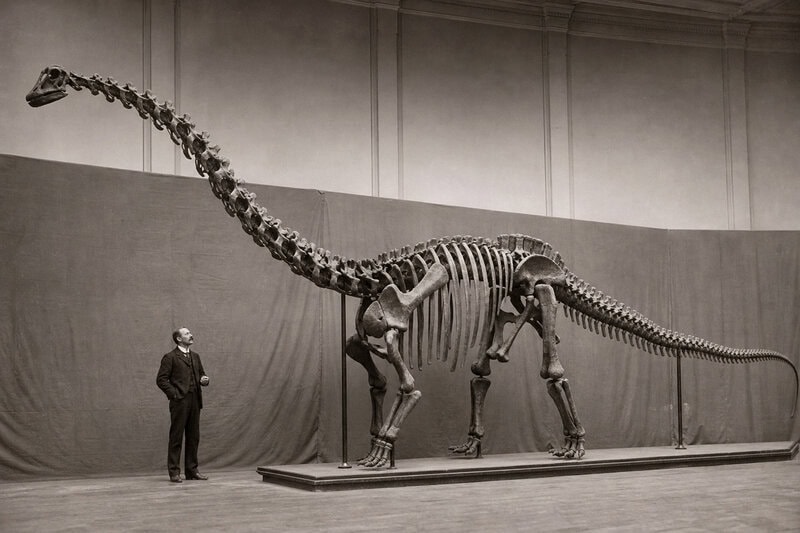
Here is where the Sinclair dinosaur story takes a genuinely strange turn. For most of the twentieth century, the scientific consensus held that the Brontosaurus did not exist as its own species. The name was officially considered a mistake, and the animal was reclassified under the name Apatosaurus as far back as 1903.
Sinclair kept using “Brontosaurus” in its branding for decades regardless, which meant the company’s most famous symbol was, by scientific standards, doubly extinct: an extinct animal with an extinct name. The Brontosaurus versus Apatosaurus question was essentially settled in the scientific community — until it wasn’t.
In 2015, a comprehensive study by paleontologists Emanuel Tschopp, Octávio Mateus, and Roger Benson applied detailed statistical analysis to hundreds of skeletal features across multiple sauropod specimens. Their conclusion: Brontosaurus and Apatosaurus were distinct enough to justify reinstating Brontosaurus as a valid genus name. The study was widely accepted within paleontology, though some specialists continue to debate the finer taxonomic points.
The upshot is remarkable. Sinclair’s century of stubbornness — keeping a name that science had discarded — turned out to be accidentally correct. The dinosaur on those station signs is no longer just nostalgia. It is, once again, a real animal with a scientifically defensible name.
The Bone Wars: Where the Original Confusion Came From
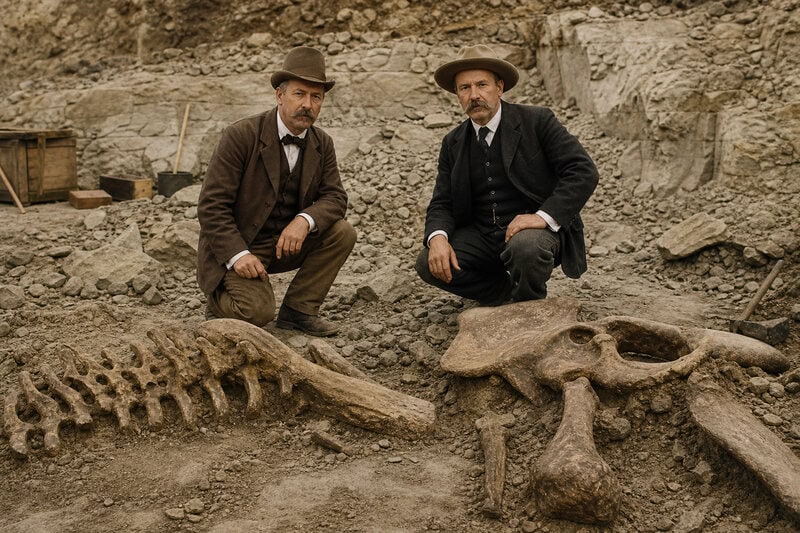
The initial mix-up traces directly to one of the most colorful episodes in the history of science: the Bone Wars of the late nineteenth century. Rival paleontologists Othniel Charles Marsh and Edward Drinker Cope engaged in a frenzied, often reckless race to discover and name new dinosaur species, motivated by competition, ego, and institutional prestige. Their methods included bribery, espionage, and the deliberate destruction of fossil sites to prevent the other from benefiting.
Marsh named Apatosaurus in 1877 and then named Brontosaurus in 1879 from a separate specimen. Later scientists examined both and determined that the two belonged to the same genus. Under the rules governing biological nomenclature, the earlier name takes priority — so Apatosaurus prevailed, and Brontosaurus was retired.
The 2015 study revisited that determination with modern analytical tools and found sufficient skeletal differences to justify treating them as separate genera after all. For general audiences, the practical takeaway is straightforward: Brontosaurus is back, and the name on those recovered green statues is scientifically defensible in a way it was not for most of the twentieth century.
Why People Steal — and Treasure — a Gas Station Dinosaur
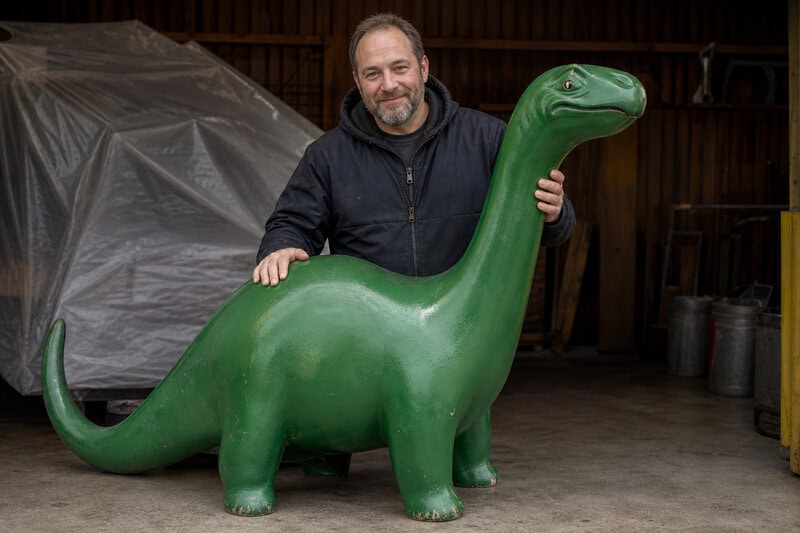
Sinclair station dinosaurs, whether large fiberglass statues or vintage signage, have become legitimate collector items. Some examples fetch significant sums at auction and in private sales, driven by their association with mid-century roadside Americana — the Route 66 aesthetic, the family road trip, the era when gas stations were landmarks rather than interchangeable pit stops.
Theft of roadside Americana is a documented and recurring phenomenon. Iconic objects — vintage gas globes, branded signage, figural statues — are repeatedly targeted because their cultural and resale value can far exceed what anyone might expect from a piece of corporate property. The San Joaquin theft fits that pattern precisely. Someone looked at a green fiberglass dinosaur and saw not a gas station fixture but a trophy, an artifact, or a resalable piece of American mythology.
The bagged-head concealment strategy adds its own layer of unintentional comedy. It suggests the thief understood, at some level, that the head was the giveaway — that a headless green dinosaur torso might pass unnoticed, while that unmistakable long neck and blunt snout would not. The plan did not work.
One Bagged Dinosaur, A Century of American Mythology
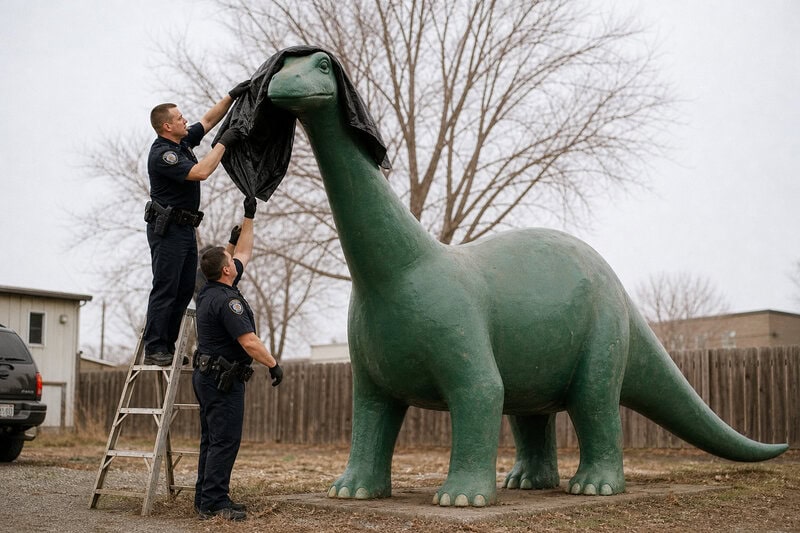
The image that closed this particular case — deputies in a Stockton yard, pulling a bag off the head of a green dinosaur — is undeniably comic. But it also points to something genuine. The Sinclair Brontosaurus has outlasted scientific consensus, corporate mergers, and now at least one attempted theft — a remarkable record for a creature that has been biologically extinct for roughly 66 million years.
The dinosaur’s backstory is a genuinely unlikely American story: a name declared scientifically dead in 1903, kept alive by one company’s branding instincts for over a century, and then restored to legitimacy by a 2015 research paper. Corporate stubbornness met scientific revision, and the stubborn corporation turned out to be right.
So when California deputies recovered that bagged green dinosaur and confirmed its identity in a Stockton yard, they were doing something slightly more than closing a minor theft case. They were returning a piece of American iconography — one that has survived extinction twice over — back to where it belongs.