
Two sounds define the edge of human ambition: the sharp, tearing shriek of an F-16 in afterburner and the slow, chest-compressing thunder of a rocket leaving Earth. At Kennedy Space Center in November 2026, both sounds share the same sky — and the physics behind them are closer than most people realize.
What Is MAX POWER — and Why Kennedy Space Center?
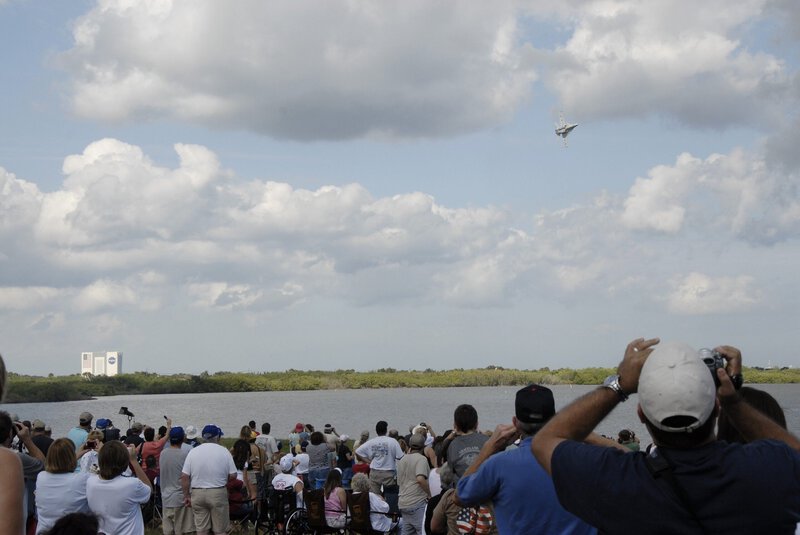
The MAX POWER tech expo and air show, running November 6-8, 2026, at NASA’s Kennedy Space Center, is not an ordinary weekend event. It operates simultaneously as a technology expo, a full-scale air show, and a celebration of the entire arc of human flight. NASA astronauts are present throughout the event, alongside aerospace organizations representing both atmospheric and space-bound disciplines.
The U.S. Air Force Thunderbirds — the precision flight demonstration team that has defined American airshow excellence for decades — are performing their final show of the 2026 season here, at the Shuttle Landing Facility: the very strip of concrete where Space Shuttle orbiters once rolled to a stop after surviving reentry from orbit. It is a rare closing performance for the Thunderbirds’ 2026 season, and the choice of venue is deliberate. The Shuttle Landing Facility’s runway stretches 15,000 feet — roughly three miles — originally engineered to handle a 100-ton spacecraft gliding in unpowered from low Earth orbit, with no second chances and no go-around. That is not a runway built for ordinary purposes.
On November 8 at 2:30 p.m., an astronaut-led parade winds through the event grounds, featuring off-Earth rovers, special characters, and a marching band. The NASA Freedom Team flies alongside the Thunderbirds in a joint demonstration that makes the event’s central theme visible from the ground: atmospheric flight and space exploration are not separate traditions. They are one continuous story.
Two Kinds of Thrust, One Set of Laws

Strip away the differences in scale, altitude, and destination, and every vehicle at MAX POWER is obeying the same law: Newton’s Third Law of Motion. For every action, there is an equal and opposite reaction. Both jet engines and rocket engines are classified as reaction engines — they produce thrust by accelerating a mass of exhaust gas to high velocity and expelling it rearward.
The critical engineering difference is the oxidizer, the chemical that allows fuel to combust. An F-16 Fighting Falcon’s jet engine draws oxygen directly from the surrounding atmosphere. A rocket engine carries its own oxidizer in onboard tanks, which is why rockets can operate in the vacuum of space where there is no air to breathe. The physics are identical; the operating environment is not.
Simple numbers help build intuition. An F-16 in full afterburner produces roughly 29,000 pounds of thrust for a vehicle weighing around 20,000 pounds fully loaded. A large orbital rocket generates thrust measured in millions of pounds. The metric engineers use to evaluate both is the same: thrust-to-weight ratio. A vehicle whose engines produce more thrust than the vehicle weighs can accelerate vertically — which is why rocket engineers obsess over achieving a ratio above 1:1 at liftoff, and why high-performance Thunderbirds maneuvers demand a ratio approaching that same threshold.
How the Thunderbirds Fly So Fast — and So Precisely
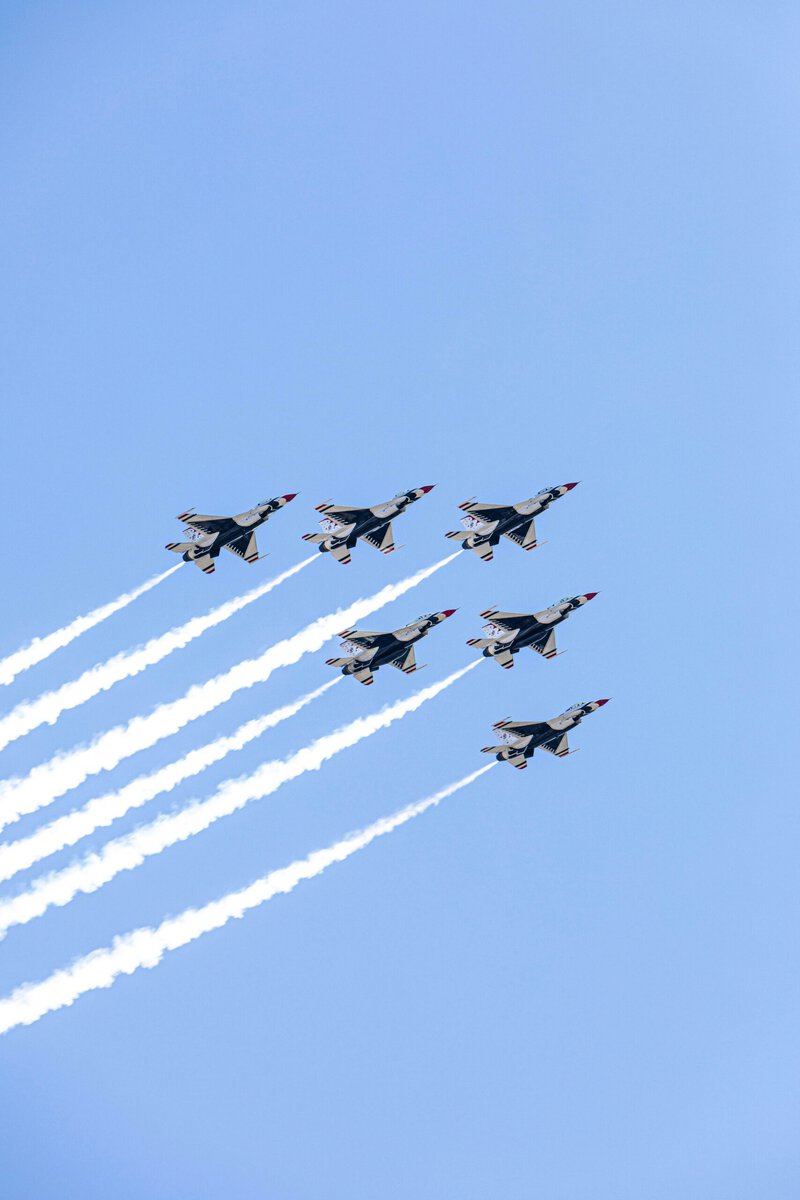
The F-16’s afterburner injects raw fuel directly into the exhaust stream behind the turbine, igniting it for a dramatic surge of additional thrust. This enables the aircraft to exceed 1,500 mph at altitude, though airshow demonstration passes are flown at carefully controlled lower speeds designed for crowd safety and precision. The speed the crowd sees is not the aircraft’s limit — it is the pilot’s deliberate choice.
What makes formation flying genuinely difficult is not raw speed but the management of relative motion. During a six-ship formation pass, each pilot is simultaneously processing airspeed, altitude, closure rate with adjacent aircraft, and control surface feedback — all in real time, with tolerances measured in feet. This is not reflexive flying. It is applied physics performed under physiological stress, requiring the same kind of disciplined spatial awareness that orbital rendezvous demands: managing relative velocity, closure rate, and position accuracy when docking one spacecraft to another.
The Shuttle Landing Facility’s flat, unobstructed expanse gives the Thunderbirds the ideal environment to demonstrate these high-energy maneuvers — the same wide geometry that once guided orbiters descending at roughly seven times the glide angle of a commercial airliner.
Where Jets and Rockets Diverge — and Why It Matters
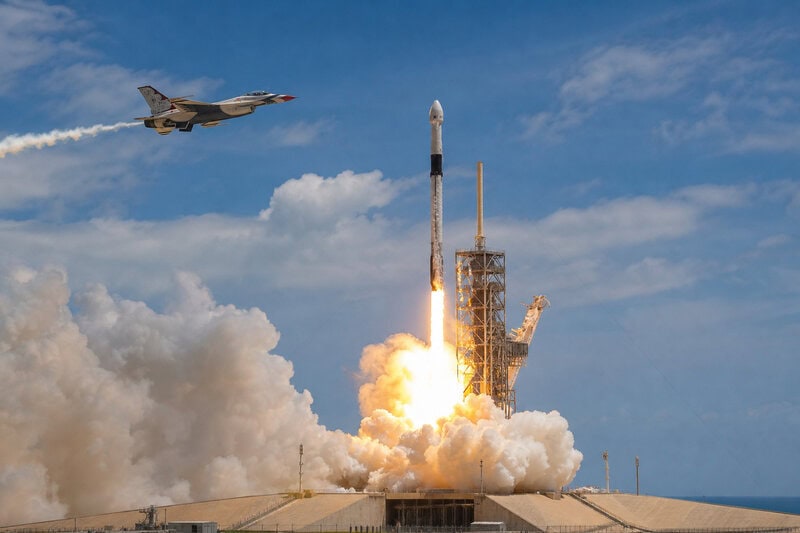
The clean boundary between atmospheric and space flight is the oxidizer question, but it manifests in a more visceral engineering reality: dynamic pressure, commonly abbreviated as max-q. During a rocket’s ascent, aerodynamic stress on the vehicle increases as it accelerates through the lower atmosphere, peaks at max-q, and then decreases as the atmosphere thins. That peak structural load is the rocket equivalent of the extreme forces a Thunderbird pilot experiences during a high-G pull — the moment when the vehicle is simultaneously moving fastest through the densest air it will encounter.
Standing on the Shuttle Landing Facility, it is possible to trace the full arc of this physics in a single landmark. The shuttles that touched down on that runway had survived max-q on the way up, then endured reentry heating exceeding 3,000 degrees Fahrenheit on the way down, and finally settled into the same low-altitude aerodynamic regime the Thunderbirds exploit during every demonstration pass. Watching a Thunderbird cross that runway is watching the final chapter of a physical story those orbiters wrote in full.
The Human Element: Astronauts, Pilots, and the Same Mental Edge

The NASA astronaut presence at MAX POWER is not ceremonial. Many NASA astronauts carry military aviation backgrounds, having spent careers managing complex, high-performance systems under physiological and cognitive stress. The astronaut-led parade on November 8 is, in this light, a gathering of people who have experienced both worlds — the cockpit and the capsule — and who understand that the boundary between atmospheric and space flight is a continuum rather than a wall.
The NASA Freedom Team’s flyover alongside the Thunderbirds makes that continuum visible in real time: two expressions of the same underlying physics, sharing the same airspace over America’s spaceport.
Why This Event Is Worth Your Attention

NASA’s MAX POWER event is one of the genuinely rare public occasions where aerospace physics at multiple scales can be observed in a single weekend, at a single location that embodies the history of that physics. The Thunderbirds’ final performance of the 2026 season happens not at a typical airfield but at a runway built for spacecraft, surrounded by the infrastructure of active launch operations, in the company of the people who fly both jets and rockets for a living.
The shriek of an afterburner and the thunder of a launch are not unrelated phenomena competing for your attention. They are two frequencies of the same human impulse — to push something backward fast enough to go somewhere extraordinary. The airshow runs November 7-8 at Kennedy Space Center. As the Thunderbirds’ closing performance of the season, it is both a final note and an open invitation: look up, ask why, and consider what comes next.