
At the bottom of some of the Moon’s deepest craters near the south pole, sunlight has not touched the ground in billions of years. NASA is about to send a robot straight into that ancient darkness — and what it finds there could reshape the future of human spaceflight.
A Robot Built for the Moon’s Most Extreme Corner
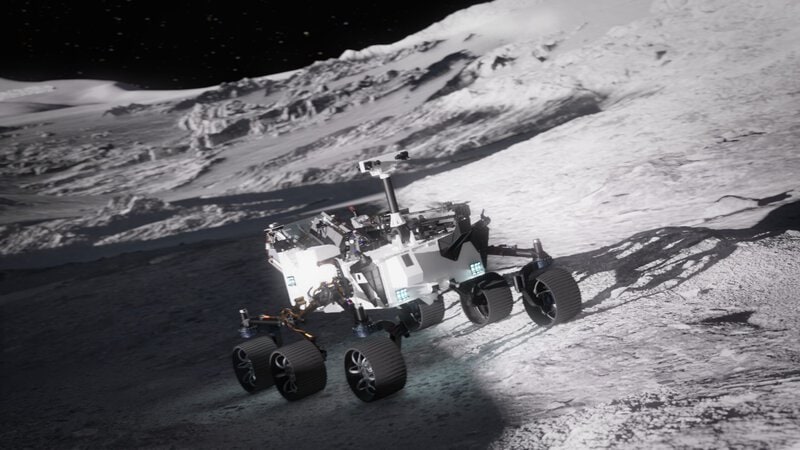
NASA’s newly revealed lunar rover is named PROMISE, short for Polar Rover for Observation, Mapping, and In-Situ Exploration. Its mission is singular and consequential: to venture into the permanently shadowed craters of the lunar south pole and search for water ice that orbital spacecraft have long suggested is hiding there. If that ice exists in exploitable quantities, it could be extracted and converted into rocket propellant and drinking water — effectively turning the Moon into a fueling station for missions pushing deeper into the solar system.
The mission is managed by NASA’s Jet Propulsion Laboratory (JPL) in Southern California, a division of Caltech, with a planned launch window opening in late 2028 and an 18-month primary mission. No rover has ever operated inside a permanently shadowed region. PROMISE is designed specifically to change that.
What PROMISE Is — and Where It Comes From

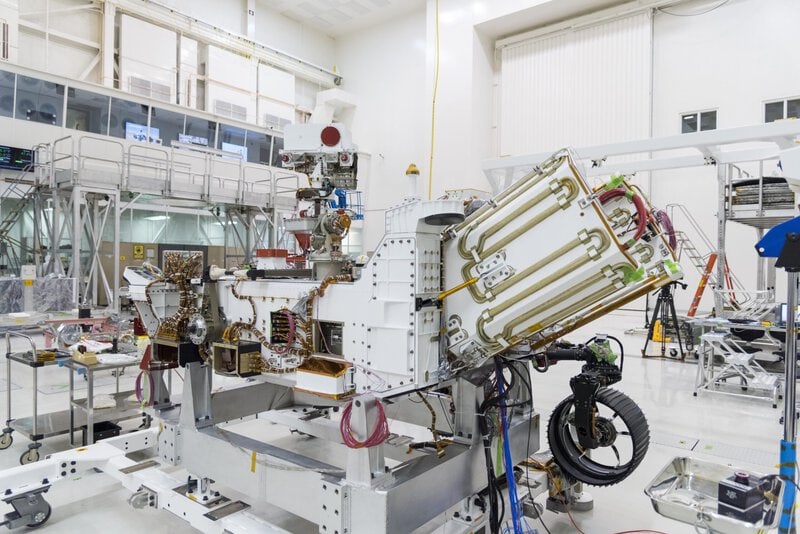
Rather than designing a lunar rover from scratch, JPL is adapting an engineering copy of a Mars rover that was already built and tested on Earth. This is not a shortcut born of complacency. It is a deliberate strategy to apply proven, Mars-class hardware to a completely different world, compressing development timelines and drawing on decades of accumulated engineering knowledge from the Curiosity and Perseverance programs.
The decision carries real tradeoffs. Mars rovers are built to withstand radiation, survive thermal extremes, and operate autonomously over long communication delays — capabilities that translate well to the lunar south pole. But the Moon presents its own distinct challenges, including micrometeorite exposure, fine abrasive regolith, and the specific mechanical demands of crater terrain, all of which require engineering adaptations beyond a simple hardware transfer. What JPL is building is best understood as a Mars-heritage vehicle substantially reworked for a lunar environment it was never originally intended to enter.
For a detailed look at the rover’s design and systems, NASA’s official PROMISE mission page outlines the core architecture and mission objectives.
How PROMISE Gets to the Moon
Getting to the lunar south pole is itself a formidable challenge. PROMISE will ride to the lunar surface aboard a Blue Origin lander, marking a significant commercial partnership within NASA’s broader lunar strategy. The rover must survive the transit from Earth, then a powered descent toward one of the most topographically rugged regions on the Moon.
The south pole landing zone is scientifically prime precisely because of the conditions that make it operationally treacherous. Extreme terrain, perpetual shadow, and temperatures that can plunge to around minus 250 degrees Celsius define an environment that has defeated every rover ever sent to the Moon — because no rover has been designed to work there. The combination of Blue Origin’s commercial lander and JPL’s nuclear-powered rover represents one of the more ambitious pairings in NASA’s current lunar program.
Scientific American’s coverage of the PROMISE announcement examines how this mission reflects a broader convergence of commercial launch capability and scientific ambition in NASA’s current lunar strategy.
Why Nuclear Power Is Not Optional Here
The core engineering challenge of exploring permanently shadowed regions is straightforward and unforgiving: there is no sunlight. Solar panels are useless. Batteries that cannot be recharged drain quickly in extreme cold. For decades, this physical reality meant that the most scientifically interesting parts of the Moon were also the most inaccessible to robotic explorers.
PROMISE addresses this with a radioisotope power source — a nuclear power system that generates electricity from the heat produced by radioactive decay. It requires no sunlight and operates continuously regardless of lighting conditions or temperature. This is the same proven approach that powers Curiosity and Perseverance on Mars, where dust storms can reduce solar input for months at a time.
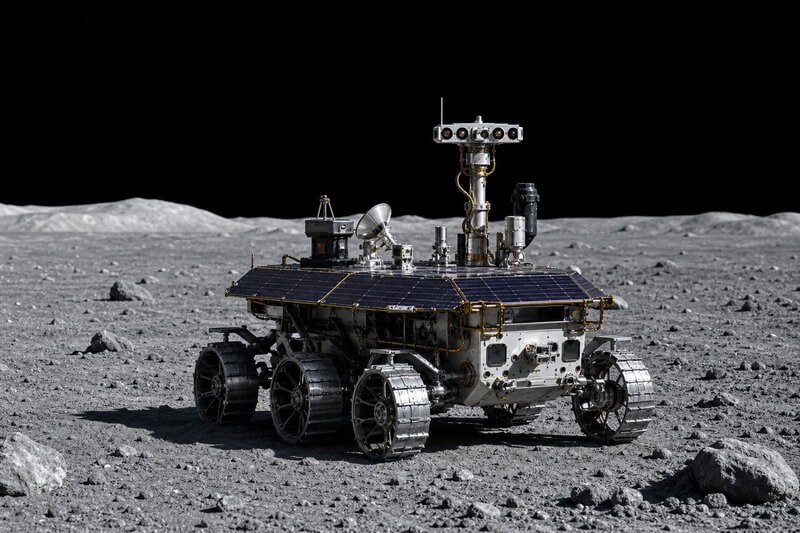
The contrast with solar-dependent predecessors is instructive. China’s Yutu rovers must enter a dormant state during the lunar night because their solar panels generate no power in darkness, and both Yutu missions operated in sunlit equatorial terrain by design. PROMISE is built specifically to go where they cannot — into the permanent night of shadowed craters — and to sustain operations once it arrives. Without nuclear power, the science case for this mission collapses entirely.
NASA’s overview video of PROMISE’s nuclear-powered design walks through the core systems that make south pole operations possible.
The Science Target: Water Ice at the Lunar South Pole
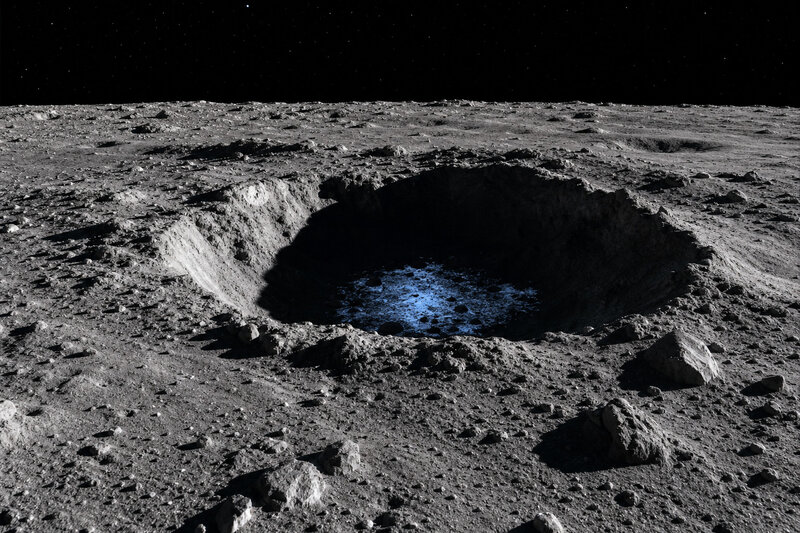
The scientific case for water ice at the lunar south pole has been building for years. Orbital data from missions including the Lunar Reconnaissance Orbiter and the LCROSS impactor experiment strongly suggest that water ice is locked inside permanently shadowed craters. But orbital observation and remote sensing can only go so far. No rover has ever directly confirmed water ice at the surface using instruments deployed in the actual shadowed terrain.
That is precisely what the “In-Situ Exploration” portion of PROMISE’s name refers to. This rover will not map from orbit or observe from a distance — it will physically investigate the terrain, deploying instruments directly into the environment where water ice is predicted to exist. The 18-month primary mission duration gives scientists an unprecedented sustained window into a region that has remained entirely unexplored at the surface level.
Confirmed, accessible water ice deposits would represent more than a scientific finding. They would constitute a practical resource foundation for sustained human presence — the raw material for drinking water and rocket propellant that could be produced on the Moon rather than launched from Earth at enormous cost and logistical complexity.
BBC Science Focus provides additional context on what PROMISE’s instruments are designed to detect and why surface confirmation matters where orbital data alone cannot settle the question.
PROMISE Within the Artemis Program
The PROMISE mission does not exist in isolation. It sits squarely within NASA’s Artemis program, which aims to return astronauts to the Moon and develop the infrastructure needed to eventually extend human reach toward Mars. Robotic scouts like PROMISE are a deliberate part of that strategy — they go first, assess conditions, and reduce the unknowns that human missions cannot afford to discover after the fact.
Confirming and characterizing water ice deposits is a prerequisite for any serious in-situ resource utilization (ISRU) program — the technical discipline of learning to live off local resources in space rather than hauling every consumable from Earth. Before astronauts can drink lunar water or fuel a rocket with propellant made from lunar ice, a robotic mission has to verify the ice is accessible and characterize how it is distributed. That is PROMISE’s foundational role in the larger architecture.
The mission also arrives at a moment when the Moon has acquired significant geopolitical weight alongside its scientific importance. Multiple nations and commercial operators are pursuing lunar south pole access, and the data PROMISE returns will have implications that extend well beyond any single agency’s planning horizon. The Planetary Society’s analysis of the PROMISE mission examines where it fits within the broader landscape of lunar investment, budget tradeoffs, and scientific prioritization.
What Comes Next — and Why the Answer Matters
The roadmap from here runs through late 2028: launch, transit to the Moon, Blue Origin lander delivery, south pole touchdown, and then 18 months of nuclear-powered exploration in a darkness that has persisted since the early solar system. The question PROMISE is fundamentally designed to answer is whether there is enough accessible water ice at the lunar south pole to support a sustained human presence.
If the answer is yes, it reframes the Moon entirely — not a destination to be visited briefly and left, but a waystation with resources capable of supporting the next leg of a much longer journey. If the answer is more complicated, as planetary science often demands, the data PROMISE returns will still define the terms of every subsequent mission to this terrain for years to come.
In a region that has never once seen sunlight, a machine built on Mars heritage may finally illuminate one of the solar system’s most consequential open questions. Space.com’s reporting on PROMISE traces the full arc from the rover’s Mars origins to its lunar mission objectives. PROMISE is the robot tasked with finding out.