
For decades, a permanent human settlement on the Moon lived in the realm of concept art and congressional wishful thinking. That era is quietly ending. NASA has awarded contracts to Arrow Science and Technology, Blue Origin, and Impulse Space to integrate and transport cargo for a lunar base — and with those awards, a blueprint that once existed only on paper is beginning to acquire a supply chain.
The Moon Just Got a Shipping Address
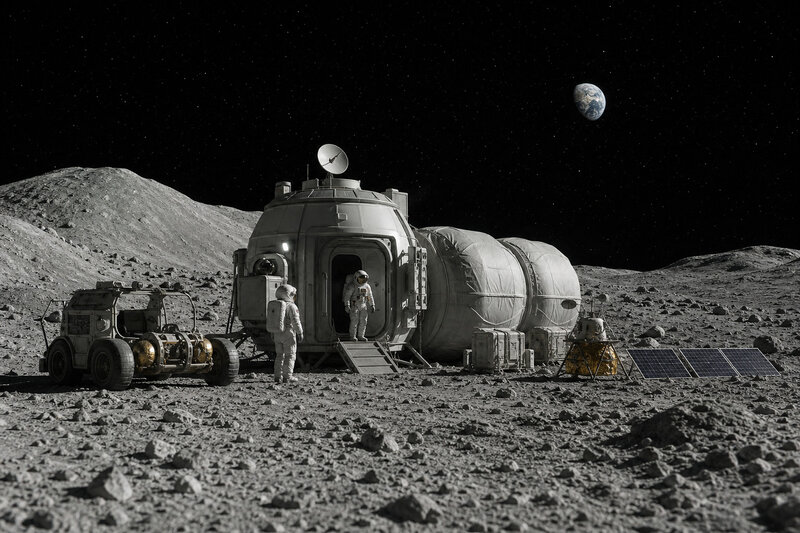
The significance of these awards is easy to underestimate because they don’t carry the drama of a rocket launch or an astronaut photograph. But procurement is where ambition becomes architecture. NASA’s Moon Base transportation, technology, and science awards represent the moment a vision document acquires a delivery schedule. Lunar base plans now have a logistics layer — vendors, milestones, and hardware moving toward an actual destination on the surface.
These are not feasibility studies or early-stage research grants. They are operational awards structured to move real cargo to and around the lunar surface. The question driving the space community is no longer whether humans will return to stay, but how the infrastructure gets assembled and on what timeline.
What NASA Actually Awarded — and Why It Matters

The suite of contracts deliberately bundles transportation, technology, and science projects together. That bundling reflects a strategic choice. Rather than building infrastructure first and worrying about science later — the way a highway gets paved before anyone considers what will travel on it — NASA is designing discovery and construction to evolve in parallel from the outset.
Each awarded partner brings a distinct capability:
- Arrow Science and Technology contributes systems integration expertise, helping coordinate the complex handoffs between launch, transit, and surface delivery.
- Blue Origin brings lunar lander experience from its role in the Artemis program, positioning it as a natural anchor for heavy payload delivery to the surface.
- Impulse Space specializes in last-mile orbital logistics — precision cargo delivery to specific surface sites, a capability that becomes critical when hardware must land within reach of an evolving outpost.
The structure draws comparisons to early International Space Station logistics contracts: unglamorous in isolation, but foundational to everything that follows. Distributing work across multiple competing vendors is deliberate, giving NASA both leverage and resilience across its supply pipeline — no single contractor failure can collapse the program.
Getting There: The Unique Demands of Lunar Logistics
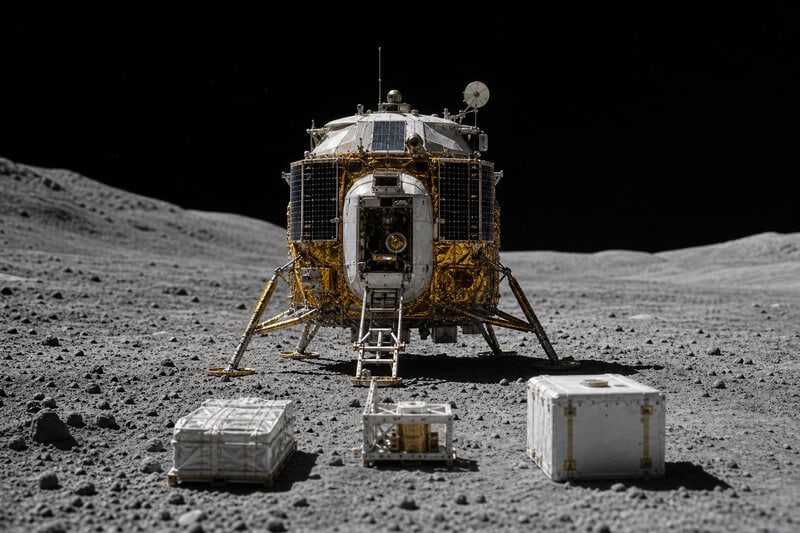
Lunar transportation must solve a problem unlike anything terrestrial logistics has faced. The Moon offers no atmosphere for aerobraking, no port infrastructure, and temperature swings that can exceed 500 degrees Fahrenheit between lunar day and night. Every delivery is a precision engineering event with almost no margin for error.
Impulse Space’s last-mile orbital delivery model addresses one of the most persistent gaps in lunar logistics: moving cargo from a transfer orbit down to a specific site on the surface reliably and affordably. Blue Origin’s lander experience covers the heavy-lift end of that equation. Together, they give NASA a spectrum of delivery options rather than dependence on a single architecture — an important safeguard given how much early outpost construction will depend on the right hardware arriving at the right coordinates.
The economics matter enormously. Every ton delivered efficiently to the lunar surface reduces the cost and compressed timeline for establishing a permanent outpost. Early in-situ resource utilization — ISRU, the practice of manufacturing usable materials from lunar regolith and water ice rather than shipping everything from Earth — depends entirely on getting the right equipment to the right location first. No equipment delivery, no on-site manufacturing. No on-site manufacturing, no sustainable human presence.
Moving Around Once You’re There: Rovers and Surface Mobility

Reaching the Moon is only the beginning of the infrastructure challenge. NASA and its partners are developing a full suite of mobility systems to support sustained human presence on the surface — a circulatory network that transforms a landing site into a functioning outpost.
The VIPER rover is a cornerstone of that mobility strategy. Designed to map water-ice deposits near the lunar south pole, VIPER’s data will directly shape where permanent crew infrastructure gets positioned, since those ice deposits are the raw material for drinking water, breathable oxygen, and rocket propellant manufactured on-site. NASA’s development of Moon Base rovers and lunar terrain vehicles extends beyond robotic scouts to pressurized crew rovers capable of multi-day traverses across the terrain — the difference between a campsite and a functioning settlement.
Astronauts confined to a tight landing radius cannot conduct sustained science, cannot respond to emergencies distributed across a spread-out base, and cannot systematically explore the geology that makes the lunar south pole scientifically irreplaceable. Mobility is not a convenience; it is a prerequisite for permanence.
The Science Agenda: Why Humans Need to Stay, Not Just Visit
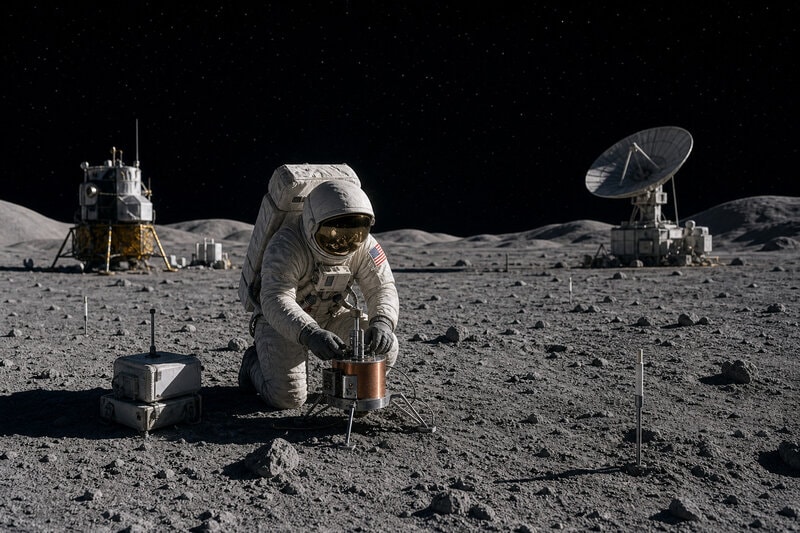
Permanent lunar settlement science has a fundamental requirement that short Apollo-style missions cannot satisfy: time. Many of the most valuable observations — long-baseline seismology to map the lunar interior, radio astronomy conducted on the far side where Earth’s electromagnetic interference cannot reach, biological studies examining how human physiology adapts to sustained low gravity — demand a stable, continuously inhabited base, not a sprint to the surface and back.
The lunar south pole holds some of the solar system’s oldest unaltered material. Permanently shadowed craters have preserved a record of early planetary formation that the geological activity of Earth has long since erased. Extracting that record properly requires repeated visits, evolving instrumentation, and the kind of iterative fieldwork that only a resident crew can provide over months and years, not hours.
The science projects awarded alongside the transportation and technology contracts are intended to run concurrently with construction — ensuring that discovery is built into the program from the beginning rather than deferred until infrastructure is complete.
How NASA Plans to Build a Moon Base: The Artemis Framework

Understanding NASA’s approach means seeing the Artemis program not as a single mission with a flag-planting finish line, but as a generational construction program spanning the 2020s and 2030s. The Artemis lunar outpost is designed to be modular and expandable, with early phases prioritizing power systems, communications infrastructure, and ISRU capability before crew quarters and science facilities scale up.
The newly awarded contracts slot directly into this framework. They fund the logistics layer — the supply chain, the orbital delivery precision, the surface mobility — that makes the broader construction schedule achievable rather than aspirational. Community discussion around the awards reflects widespread recognition that this logistics layer is where permanent settlement either succeeds or stalls. Getting the science right matters. Getting cargo there reliably is what makes the science possible.
What Still Has to Go Right
These awards mark a genuine transition from planning to procurement, but the path from signed contracts to a sustained crew on another world remains long and conditional. Political continuity, consistent NASA appropriations, and committed international partners will prove as decisive as any lander design or rover specification. Space programs have been derailed by budget cycles before, and ambition written into one administration’s roadmap has been cancelled by the next.
The commercial structure embedded in these contracts is deliberately engineered to reduce that vulnerability. Multiple competing vendors, fixed performance milestones, and incentive mechanisms mean no single political cycle controls the entire supply chain and no single vendor failure collapses the program. The architecture is designed to absorb disruption in ways that government-only programs historically have not been.
If the schedule holds and the funding follows, the late 2020s could see the first semi-permanent human outpost established on another world. These contracts will not make headlines the way a crewed landing will. But they are the unglamorous, essential first brick — and without them, everything else remains science fiction.