
On the morning of November 4, 2026, a 1,450-kilogram NASA spacecraft tore through Earth’s atmosphere over the jungles of North Sumatra — and the world barely noticed. That quiet ending says a great deal about how space debris reentry actually works, and why a falling satellite is far less dangerous than it sounds.
A 3,200-Pound Spacecraft Fell From Orbit — Here Is What Happened
At 7:39 a.m. EST on November 4, 2026, the U.S. Space Force confirmed that NASA’s Neil Gehrels Swift Observatory had reentered Earth’s atmosphere near 3 degrees north latitude and 99 degrees east longitude — a coordinate placing the event over the sparsely populated jungle terrain and coastal waters of North Sumatra, Indonesia. The spacecraft weighed roughly 3,200 pounds at launch, making this one of the larger uncontrolled reentries in recent years.
There were no injuries. No damage reports. No dramatic footage circulating on social media. Just a fiery end to a 22-year mission that fundamentally reshaped humanity’s understanding of the most violent events in the observable universe. The uneventful outcome is not a matter of luck — it reflects the physics of atmospheric reentry and the statistics of space debris risk in ways worth understanding clearly.
What Was Swift, and Why Did It Matter?
Launched in November 2004, the Neil Gehrels Swift Observatory was NASA’s premier gamma-ray burst hunter. It was engineered to detect and pinpoint the universe’s most powerful known explosions within seconds of their occurrence — faster than any predecessor instrument. Over nearly 22 years in orbit, Swift catalogued thousands of gamma-ray bursts and helped astronomers probe the environments of black holes, neutron stars, and the electromagnetic counterpart of a historic gravitational wave detection.
Its orbital decay was always inevitable. Satellites operating in low Earth orbit experience continuous atmospheric drag from the outermost layers of Earth’s atmosphere, which gradually lowers their altitude until reentry occurs. NASA decommissioned Swift as that process reached its conclusion. With no onboard propellant remaining, a controlled deorbit burn into a designated remote ocean zone was not possible. NASA’s pre-reentry communications made clear that engineers had been tracking the spacecraft’s decaying orbit closely in the days leading up to the event.
The Final Plunge: What Atmospheric Reentry Actually Looks Like

Popular imagination tends to picture a satellite falling from space the way a stone drops from a bridge — sudden and straight down. The reality is far more gradual. Orbital decay unfolds over months or years, with the spacecraft spiraling imperceptibly lower on each successive pass around Earth. The final atmospheric dive, when it comes, plays out over roughly 30 to 60 minutes of real time.
As Swift hit the upper atmosphere, it was traveling at approximately 17,500 miles per hour. At those velocities, air molecules cannot move out of the way fast enough to allow smooth passage. The resulting compression — not friction in the conventional sense — generates temperatures exceeding 1,600 degrees Celsius (nearly 3,000 degrees Fahrenheit) around the spacecraft’s surface. Aluminum structural panels, copper wiring, plastic insulation, and solar array materials reach their melting or combustion points within minutes and vaporize almost completely.
The reentry ground track — the narrow corridor of sky beneath which any surviving debris could fall — stretched hundreds of kilometers long. The confirmed reentry point placed that corridor over open water and unpopulated jungle, keeping risk to people on the ground extremely low. Pre-reentry coverage of Swift’s final hours noted that agencies had been monitoring its trajectory closely as the window narrowed.
The Physics of Burning Up: What Survives and What Does Not
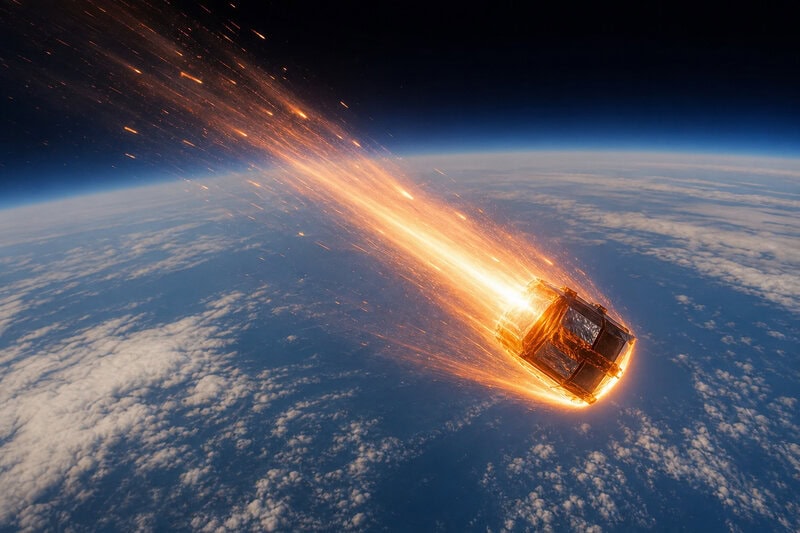
Not every component of a reentering satellite disappears in the fireball. The behavior of individual parts depends heavily on material composition, density, and geometry. The breakdown generally works as follows:
- What burns completely: Thin sheet aluminum, solar panels, circuit boards, plastic components, and most wiring reach their destruction threshold quickly and disintegrate in the upper atmosphere.
- What might survive: Dense, high-melting-point components — titanium propellant tanks, reaction wheel housings, stainless steel fasteners, and certain optical mirror mounts — are the parts most likely to survive to lower altitudes as fragments.
- How much gets through: For a spacecraft of Swift’s mass, engineers generally estimate that somewhere between 10 and 40 percent of original mass could theoretically survive to lower altitudes, though much of that continues to fragment and ablate before any ground impact.
This survivability question is precisely why the aerospace engineering community has increasingly focused on what is called “design for demise” — building future satellites from materials specifically chosen to burn up more completely, reducing the mass that survives reentry and lowering the statistical risk for people on the ground.
Space Debris Reentry Risk: Why the Odds Are Very Small

The numbers behind reentry risk are genuinely reassuring. Earth’s surface is approximately 70 percent ocean. Of the remaining land, enormous portions are desert, boreal forest, arctic tundra, or mountain wilderness where human population density approaches zero. Statistically, the vast majority of any debris field lands where nobody is present.
Aerospace safety analysts apply a standard risk threshold: a reentry is considered acceptable if the probability of injuring any single person anywhere on Earth is less than 1 in 10,000. Swift’s reentry geometry, combined with the low-population trajectory over Sumatra and surrounding waters, fell well within that parameter.
Perhaps the most striking data point: in the entire history of the Space Age, spanning thousands of reentries of rocket bodies, defunct satellites, and mission hardware, not one confirmed human fatality has been attributed to falling space debris. That is a remarkable safety record, and it is not accidental — it reflects careful orbital planning, international tracking infrastructure, and the mathematical improbability of debris intersecting a person across an open landscape.
A more practical concern during reentry events is debris intersecting commercial aviation corridors. This is why agencies issue NOTAMs — Notices to Air Missions — before predicted reentry windows, allowing flight dispatchers to route aircraft away from the projected ground track when possible.
Why Engineers Cannot Always Choose Where Satellites Land
A controlled reentry — the kind that guides a spacecraft safely into a remote stretch of the South Pacific — requires a functioning propulsion system capable of executing a precise deorbit burn at exactly the right moment. Swift exhausted its usable propellant during its operational life, leaving engineers with no mechanism to steer the spacecraft toward a targeted impact zone.
Predicting exactly when and where an uncontrolled reentry will occur is also genuinely difficult. Atmospheric density at orbital altitudes is not constant — it expands and contracts with solar activity, changing the drag force on a spacecraft in ways that compound over time. Even the best tracking models carry uncertainty windows of hours, which translate to ground track uncertainty spanning thousands of kilometers. The U.S. Space Force’s confirmation of Swift’s reentry location came after the event, not before.
Swift technically met the international guideline — commonly called the 25-year rule — recommending that satellites in low Earth orbit complete their deorbit within 25 years of mission end. But the broader regulatory landscape is tightening. New guidelines from NASA and the European Space Agency are pushing toward controlled reentries for any spacecraft exceeding roughly 250 kilograms — lessons being written into the next generation of mission designs before those spacecraft ever leave the launch pad.
What Swift’s End Tells Us About the Future of Space Safety
The satellite population in low Earth orbit is growing faster than at any point in the Space Age. With large commercial constellations fielding thousands of spacecraft, the raw number of reentry events will increase significantly over the coming decades. Swift’s reentry is a useful case study in what a well-managed, if uncontrolled, reentry looks like: an aging spacecraft with a long operational history, gradual and well-tracked orbital decay, public notification issued in advance, and a benign outcome over a low-population zone.
The engineering community is responding with renewed urgency. Design for demise is moving from an aspirational principle to a concrete requirement in mission planning. Materials science, thermal modeling, and international coordination on reentry prediction are all advancing in parallel.
As for Swift itself — the spacecraft that spent nearly 22 years watching the universe’s most violent explosions — its scientific legacy will outlast its hardware by generations. The data it collected continues to shape astrophysics research on gamma-ray bursts, black hole jets, and neutron star mergers. Whatever fragments survived the fireball now rest somewhere beneath the canopy of the Sumatran jungle or on the floor of the surrounding ocean, while the science they enabled continues to illuminate the cosmos.