
In September 2024, nine ancient Yemeni artifacts — among them a bronze vessel dated to the 3rd century BCE and a marble head of a man from the late 2nd century CE — were quietly scheduled for auction in the United Kingdom, according to Yemen Press Agency. Almost simultaneously, a rare artifact bearing a bovine head in high relief appeared at a Spanish auction house whose sale documents openly acknowledged its ancient Yemeni origin. Together, those two episodes force a deceptively simple question into the open: were these objects looted, or merely lost to history? The answer shapes whether they can ever come home — and who bears responsibility if they do not.
Why Pre-Islamic Yemen Produced Such Extraordinary Art

Between roughly 900 BCE and 600 CE, the kingdoms of Saba (the biblical Sheba), Qataban, Hadramawt, and Himyar ruled the southwestern corner of the Arabian Peninsula. Their wealth derived from controlling the frankincense and myrrh trade — the single most lucrative long-distance commerce of the ancient world — and that wealth funded monumental temples, sophisticated bronze casting, and an elaborate tradition of stone portraiture now grouped under the scholarly umbrella of pre-Islamic Yemeni civilization. These kingdoms remain among the least studied of any comparably influential ancient cultures, partly because a decade of ongoing conflict has made systematic fieldwork nearly impossible.
South Arabian sculptors developed a strikingly distinctive visual language: frontal, wide-eyed heads in alabaster and bronze, with stylized curling hair, closed lips, and an almost modernist geometric calm. The Royal Collection Trust holds a premier example in the al-Nakhlat al-Hamra Head, a bronze portrait of a young man described by the Trust as having “regularly curled hair around a centre parting, wide open eyes, and a closed mouth.” Those formal qualities recur across the South Arabian tradition and allow researchers today to identify probable Yemeni origin even in objects that arrive on the market without documentation.
Because these kingdoms sat at the intersection of African, Mediterranean, and South Asian trade networks, their artifacts carry both high archaeological information density — encoding evidence of trade routes, religious practice, and social hierarchy — and high commercial value. That combination makes ancient Yemeni antiquities acutely vulnerable to looting: a single well-preserved bronze head can command prices that dwarf a local worker’s annual income, creating an incentive structure that conflict only intensifies.
How War Dismantled Site Protection

Yemen’s civil war, which escalated sharply after 2015, effectively dismantled the institutional infrastructure — border controls, site guards, museum security — that had previously impeded large-scale removal of objects from archaeological sites. The pattern is not unique to Yemen; archaeologists and heritage organizations have documented the same systemic collapse during conflicts in Iraq, Syria, Libya, and Mali. Satellite imagery analysis by institutions including the American Schools of Oriental Research recorded visible surface disturbance at dozens of Yemeni heritage sites during the conflict period, providing remote evidence of organized digging that ground-level inspectors could not safely verify in person.
The international market for looted antiquities does not operate through a single visible channel. It functions through a chain of intermediaries — local diggers, regional brokers, transit dealers in neighboring countries, and finally reputable auction houses or galleries in Europe and North America — each step adding distance, paperwork, and plausible deniability between an object and its point of origin. By the time a pre-Islamic Yemeni head reaches a London or Madrid saleroom, it may carry documentation that is technically accurate at each link of the chain while remaining collectively misleading about how it left the ground.
Demand is a structural driver that discussions focused on supply often underweight. Ancient Yemeni antiquities remain comparatively underpriced relative to Egyptian or Mesopotamian equivalents of similar age and quality, making them attractive to collectors seeking value in a crowded market. That price differential incentivizes supply from conflict zones, creating a feedback loop that neither export controls nor auction-house policies have yet broken.
Yemen has been a state party to the 1970 UNESCO Convention on the Means of Prohibiting the Illicit Import, Export and Transfer of Ownership of Cultural Property since 1984 — the benchmark date after which most major institutions refuse to acquire objects lacking documented legal export. Enforcing the convention, however, requires ownership and excavation records that a decade of war has largely erased or rendered inaccessible, leaving the legal standard intact in theory while undermining it in practice.
The Evidence Trail: What Due Diligence Actually Looks Like — and Where It Fails

Auction houses operating in the United Kingdom and European Union are legally required to conduct provenance research before sale, meaning they must trace an object’s documented ownership history. Critics argue the standard is effectively unenforceable for objects originating in countries with destroyed or inaccessible state records — precisely the situation Yemen presents. When an exporting country cannot produce the paperwork that would prove an object left illegally, the legal burden shifts in ways that favor sellers.
The practical consequences of that gap are visible in recent reporting. According to Hyperallergic, a Yemeni researcher identified dozens of unlabeled artifacts of probable Yemeni origin slated for sale at a British auction house — objects identifiable by style and material to a trained eye, but not legally provable as Yemeni to the threshold required to halt a sale. Without a label, a prior publication record, or an export license, stylistic recognition alone is rarely sufficient to compel withdrawal from auction.
The scale of the documented problem is growing. Yemen’s Antiquities Authority has formally identified 28 allegedly looted Yemeni artifacts currently held in overseas collections, flagged through a combination of stylistic analysis, comparison with pre-war museum inventories, and intelligence gathered from researchers monitoring the international market. That figure almost certainly understates the true total, since it reflects only what can be identified and tracked with severely limited institutional resources during an active conflict.
The al-Nakhlat al-Hamra Head in the Royal Collection Trust represents a separate, older category of case: an object acquired before modern legal frameworks existed, whose presence abroad is documented and stable but whose repatriation status remains contested under evolving international norms. Its situation illustrates that the looting crisis is not a single, uniform problem but a layered one — colonial-era acquisitions, Cold War-period sales, and conflict-era removals each require different legal and diplomatic approaches.
The Science of Attribution: How Researchers Identify Yemeni Artifacts
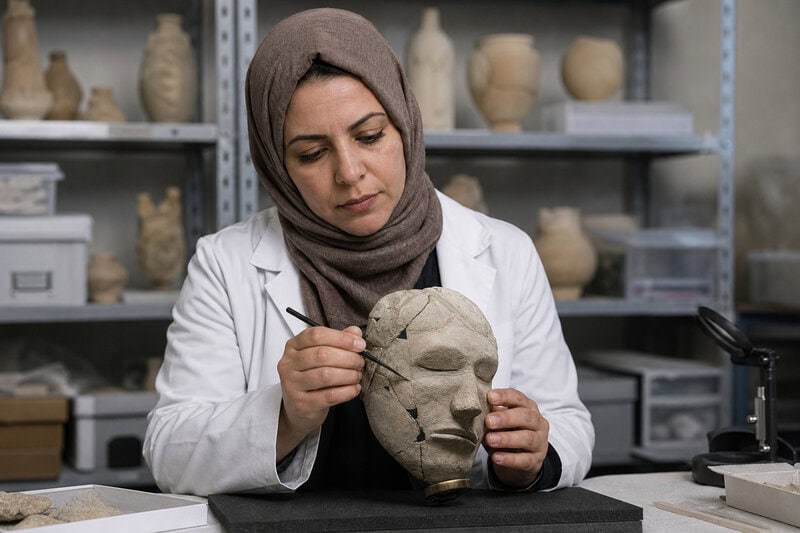
Identifying an object as Yemeni in origin involves several distinct evidentiary layers that experts are careful not to conflate. Stylistic analysis — comparing iconographic features such as the frontal eye convention, the treatment of hair, and facial proportion against documented examples — remains the primary tool for attributing unprovenanced objects to the South Arabian tradition. It can establish that an object is consistent with a particular artistic tradition, but it cannot by itself prove a specific site of origin.
Isotopic analysis of stone, which measures the chemical signature of quarry sources, and metallurgical fingerprinting of bronzes, which identifies the ore mix used in casting, are emerging scientific methods that can in some cases narrow an object’s geographic origin to a specific region or even a specific quarry. Such data can be admissible in legal proceedings in ways that stylistic judgment alone typically cannot. The convergence of stylistic attribution, provenance documentation, and isotopic or metallurgical data is what builds a case strong enough to compel return — and the absence of any one layer weakens the whole.
The 28 objects identified by Yemen’s Antiquities Authority relied on exactly this hybrid approach: humanistic scholarship combined with investigative monitoring of the commercial market. That model — trained eyes watching auction catalogues and comparing objects against pre-war inventories — is currently one of the most effective tools available to source countries with limited forensic budgets, and its results, while significant, are almost certainly incomplete.
A Rare Win: The Metropolitan Museum Repatriation and What It Signals

In September 2024, The Art Newspaper reported that the Metropolitan Museum of Art announced it would study and catalogue 14 ancient sculptures — including bronze and stone pieces — recently repatriated to Yemen, treating the return not as a closing of the books but as the beginning of a scholarly collaboration. Yemen’s Antiquities Authority, the body formally tasked with protecting the country’s movable heritage, coordinated the return — a signal that institutional capacity, though severely strained by years of conflict, retains the legitimacy to negotiate with major Western museums.
The Met’s approach is notable because it decouples two questions that institutions have historically conflated: whether an object should be returned, which is an ethical and legal question, and whether it can still generate knowledge, which is a scientific one. By answering both affirmatively and pairing repatriation with joint documentation, the museum offers a template that repatriation advocates argue is replicable — one that serves the source country’s heritage record and the institution’s scholarly reputation simultaneously, reducing the zero-sum framing that has historically stalled negotiations.
Whether that template spreads depends on both institutional will and legal architecture. Advocates for reform point to three pressure points where change is achievable without waiting for a new international treaty: stricter auction-house due-diligence standards enforceable under national law; expanded use of the INTERPOL Works of Art unit’s stolen-objects database; and bilateral cultural property agreements between Yemen and major market countries that would create clear legal pathways for return before objects disappear into private collections.
Why It Matters Beyond the Auction Room
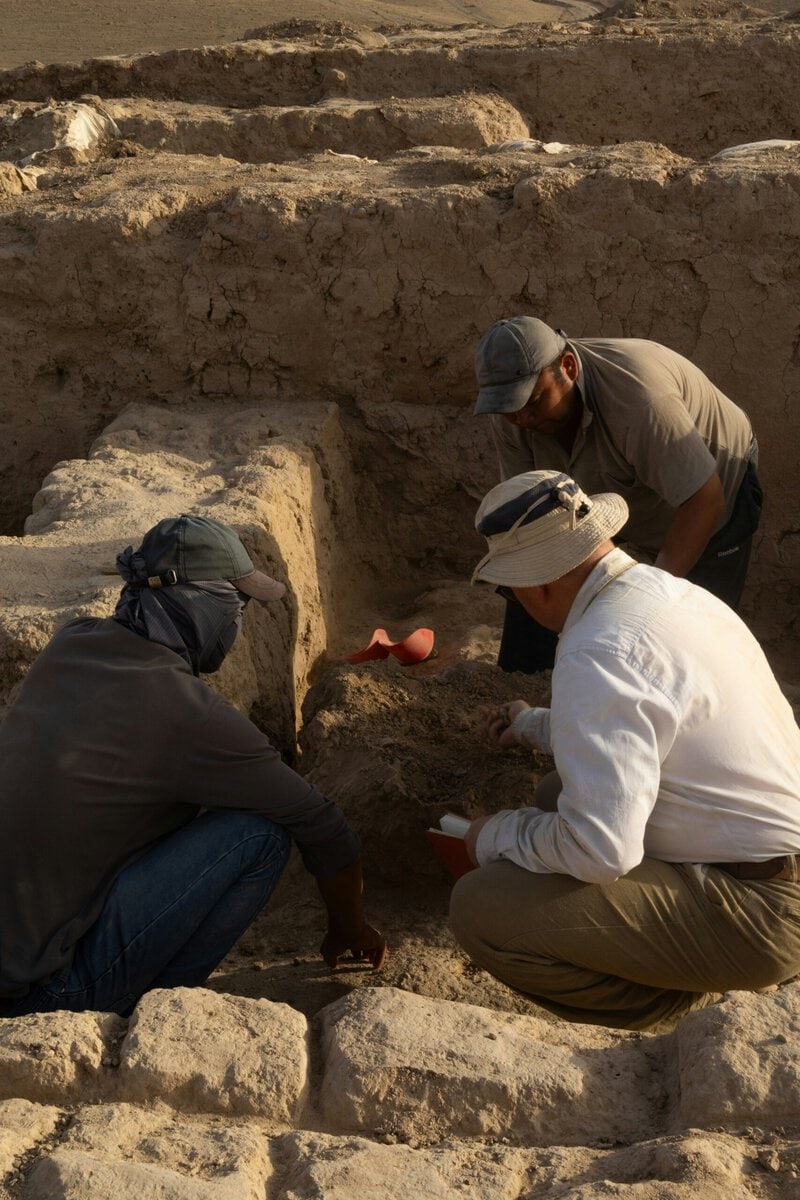
Every ancient Yemeni artifact that passes through an auction house without documentation represents a permanent loss of archaeological context — the spatial, stratigraphic, and associative data that would allow researchers to reconstruct ancient trade patterns, religious practices, and social organization in one of the ancient world’s most consequential but least understood civilizations. No laboratory test, however sophisticated, can fully recover what a careful excavation record would have provided at the moment of discovery.
The stakes extend beyond scholarship. For Yemeni communities whose collective identity is partly anchored in pre-Islamic heritage, the dispersal of material culture into private collections abroad is experienced as a form of cultural dispossession layered on top of ongoing physical destruction — a double erasure of both the present and the deep past. That dimension of the crisis rarely surfaces in art-market reporting, which tends to frame repatriation as a dispute between institutions rather than a matter of living consequence for the people whose history is at stake.
The reappearance of ancient Yemeni heads and bronzes at auction in the United Kingdom and Spain in 2024 is not, in the end, a story primarily about art or antiquity. It is a stress test of the international systems designed to distinguish legitimate scholarship and collecting from the laundering of conflict plunder. By that measure, the test is ongoing, the outcome is unresolved, and the objects keep appearing on the market while the systems designed to stop them work — imperfectly, and often too late — to catch up.