
On March 31, 2025, at 21:46 EDT, a SpaceX Falcon 9 rocket lifted four civilians into an orbit that crossed directly over Earth’s North and South Poles — a trajectory no crewed spacecraft had ever flown in more than six decades of human spaceflight. The mission, named Fram2, did not merely set a record. It exposed a fundamental question that the entire history of government space programs had quietly answered by avoidance: why had no one ever sent humans on this route before?
The Orbit No Government Program Ever Flew

The four crew members — Chun Wang, Jannicke Mikkelsen, Rabea Rogge, and Eric Philips — were all first-time space travelers, yet they accomplished something career astronauts never had. The National Space Society formally recognized Fram2 and SpaceX for completing the first-ever crewed orbital mission over Earth’s poles — a milestone that had eluded NASA, the Soviet Union, and every government space program that followed across more than half a century of human spaceflight.
The mission’s name is a deliberate historical signal. The original Fram was the Norwegian exploration vessel that carried Roald Amundsen toward the South Pole in 1910. By invoking that name, the crew positioned itself within a tradition of going where no one had gone before — not as metaphor, but as literal orbital geography. The mission was understood within the spaceflight community as a genuine expansion of the operational envelope of human exploration, not a publicity exercise.
Chun Wang, the cryptocurrency entrepreneur who financed and organized the mission, chose both the name and the crew with that framing explicitly in mind. Mikkelsen, a Norwegian filmmaker, served as the mission’s cinematographer. Rogge, a German robotics researcher, and Philips, an Australian polar expedition guide with experience leading traverses on both the Arctic and Antarctic ice sheets, completed a crew assembled as much for its relevance to the polar theme as for its technical roles.
Polar vs. Equatorial Orbit: The Geometry That Defines Everything
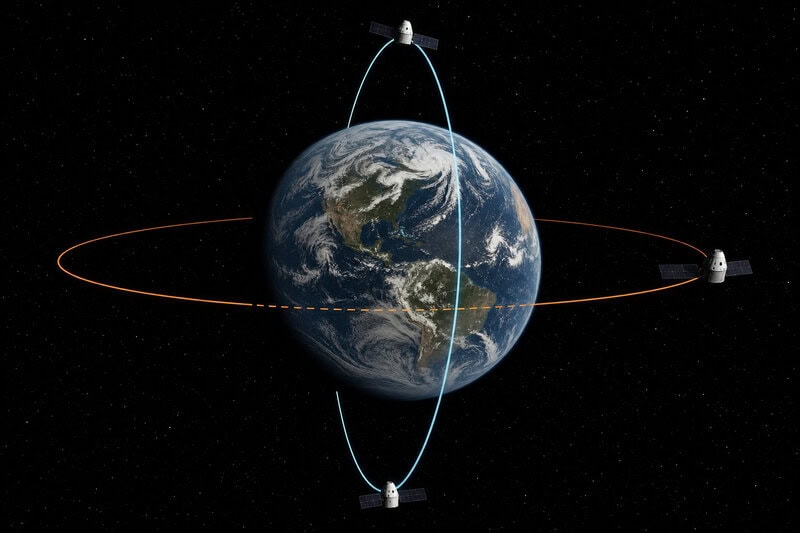
To understand why Fram2 matters, it helps to understand what an orbit’s inclination actually means. Inclination is the angle between a spacecraft’s orbital plane and Earth’s equator. A 0-degree inclination is a purely equatorial orbit, circling the planet’s middle in a constant band. A 90-degree inclination — what Fram2 flew — is a true polar orbit, crossing both poles on every single pass. Most crewed missions, including every International Space Station expedition, fly at inclinations between 28 and 51.6 degrees. That keeps crews within a latitude band where launch energy costs are lower and radiation exposure is more manageable.
Because Earth rotates beneath a polar orbit, a spacecraft at 90-degree inclination eventually passes over every point on the planet’s surface. This geometry is why agencies routinely use polar orbits for Earth-observing satellites — full planetary coverage is built into the physics. But that same geometry carries sharp cost and safety penalties for crewed vehicles, penalties that, until Fram2, had always outweighed the perceived benefits for government programs.
The Energy Penalty: Why Polar Orbits Cost So Much More to Fly
Every rocket launching eastward from a low-latitude pad receives a free velocity contribution from Earth’s rotation — roughly 465 meters per second at the equator. A polar orbit sacrifices that bonus entirely. Because the spacecraft must travel perpendicular to Earth’s spin rather than with it, the rocket must supply all of its own orbital velocity independently. For a heavy crewed vehicle in the Apollo era or early Shuttle program, losing that rotational assist translated directly into greater required fuel mass, compressed payload capacity, and higher per-kilogram costs at a time when government space budgets were already under sustained political pressure.
Changing inclination mid-mission requires a maneuver called a plane change — an extraordinarily fuel-expensive burn that is impractical for most crewed vehicles operating in low Earth orbit. The initial launch direction is, for practical purposes, permanent. SpaceX’s reusable Falcon 9 and Dragon architecture dramatically lowered the per-launch cost structure that made this energy trade-off prohibitive for earlier programs. That is one concrete reason a privately financed mission in 2025 could absorb an energy penalty that Apollo-era agencies consistently chose not to pay.
The Radiation Reality: Polar Cusps and Elevated Dose Rates
The energy cost alone does not fully explain six decades of avoidance. Radiation risk is the other half of the equation. Earth’s magnetosphere deflects most high-energy charged particles away from mid-latitudes, but it funnels them toward the poles through regions known as the polar cusps — two roughly funnel-shaped zones near 75 to 80 degrees latitude where energetic particles have a more direct path to low altitudes. A spacecraft in polar orbit passes through these cusps on every revolution of the planet.
The Van Allen radiation belts, first mapped by Explorer 1 in 1958 and extensively characterized by NASA’s Van Allen Probes mission between 2012 and 2019, are densest at mid-latitudes. Equatorial and low-inclination missions fly comfortably beneath the most intense portions of these belts. Polar orbits clip their edges repeatedly, raising the baseline radiation dose rate compared with an ISS-inclination mission of equivalent duration. NASA’s Human Research Program has historically cited accumulated radiation dose as a primary constraint on mission planning, and a polar orbit structurally elevates that constraint on every pass.
Fram2 carried dosimetry instruments specifically to measure crew radiation exposure along the polar trajectory. Because no crewed mission had ever flown this route, published data on human radiation response in a true polar orbit was essentially nonexistent before 2025. The crew’s health and physiological adaptation data — drawn from four first-time space travelers rather than career astronauts with complex prior-exposure histories — represents a relatively clean population sample for studying how the human body responds to this specific environment. That data is expected to contribute to the emerging scientific literature on polar-orbit human health effects and will be a necessary input for any future operator planning longer-duration crewed polar flights.
Why NASA and the Soviets Never Went: Cold War Constraints Beyond Physics
Physics and economics explain most of the story, but geopolitics accounts for the rest. A crewed spacecraft in a polar orbit traces a ground track that crosses the sovereign territory of every nation on Earth, including adversaries. During the Cold War, that raised both diplomatic and national-security sensitivities that an equatorial or mid-inclination orbit largely avoided. The US Air Force operated polar-orbiting reconnaissance satellites — the Corona program, declassified in 1995, flew polar orbits beginning in 1959 — but keeping crewed polar missions off the manifest maintained an institutional separation between military surveillance infrastructure and civilian human spaceflight programs.
Soviet engineers faced analogous pressures. Baikonur Cosmodrome sits at approximately 45.6 degrees north latitude, making high-inclination launches operationally complex. Spent rocket stages from polar launches would have fallen over populated Siberian territory — a debris hazard the Soviets managed for robotic missions through careful range planning but consistently avoided for crewed vehicles. Space policy historian Asif Siddiqi of Fordham University has argued in published work that both superpowers’ human spaceflight programs were shaped as much by geopolitical signaling and institutional rivalry as by engineering logic. Polar crewed flight never rose to a priority level that justified its combined cost, radiation risk, and political friction simultaneously.
The result was a six-decade gap — not a technical barrier, but a sustained choice. No engineering obstacle prevented a crewed polar mission in 1970 or 1990 or 2010. The obstacle was always a cost-benefit calculation made by institutions operating under Cold War politics, limited reusability, and fixed budget ceilings.
What Fram2 Actually Saw — and Measured

Flying over both poles on every orbit, the Fram2 crew became the first humans to observe polar mesospheric clouds, aurora australis, and the Antarctic ice sheet with uninterrupted naked-eye access from low Earth orbit across the full duration of a mission. That is a qualitative observational first even in an era of sophisticated robotic Earth-observation satellites, because no instrument fully replicates the adaptive, context-aware observation a trained or observationally briefed human performs in real time — particularly when the observer can redirect attention based on what they are actually seeing.
The mission carried a suite of scientific instruments aimed at characterizing the near-polar space environment from a crewed platform, addressing a data gap that robotic satellites cannot fully close. Human physiological response to the radiation and microgravity environment in polar orbit is itself a key scientific variable — one that requires human subjects in the actual environment to measure directly. The first humans in true polar orbit provided that foundational data point for the first time in the history of spaceflight.
What Comes Next: A New Lane in Human Spaceflight
Fram2’s success establishes a proof-of-concept that commercial crewed polar missions are operationally viable with current hardware. That opens a route — practically and commercially — to future Earth-observation science missions, polar-trajectory research flights, or crew delivery to polar-orbiting platforms that do not yet exist but are now more plausible to design around. The radiation dosimetry and human health data collected on this mission will serve as necessary baseline inputs for any future operator planning longer-duration polar crewed flights, elevating this four-person flight from a one-off achievement to a foundational data point in the emerging architecture of polar human spaceflight.
NASA’s ongoing Commercial Crew program and its evolving relationship with private operators suggests the agency may eventually leverage privately proven polar-orbit experience rather than develop it internally — a pattern already visible in cargo resupply and low-Earth-orbit crew transport, where SpaceX and Northrop Grumman demonstrated operational capability before NASA incorporated it into agency planning.
The deeper implication of Fram2 is structural. When a four-person all-civilian crew can accomplish in 2025 what 60 years of superpower competition never prioritized, it signals that the boundary between what is physically possible and what anyone chose to fund has shifted in a durable way. The polar orbit was always there. The physics were always permissive. What changed was the cost structure, the institutional incentives, and the willingness of a privately financed crew to accept the trade-offs that government programs consistently declined. That combination — reusable rockets, private capital, and freedom from Cold War political constraints — is what finally flew the route that no government ever did.