
On July 30, 2026, inside the same Florida facility where Apollo capsules were once readied for the Moon, technicians completed a milestone that no American space program had reached in more than half a century: they bolted together the crew module and service module of the Orion spacecraft destined to carry astronauts to the lunar surface on Artemis III. The physical joining of those two components transformed a collection of separately tested hardware into a single vehicle capable of doing something no crewed American spacecraft has been certified to do since 1972 — survive the brutal physics of returning from the Moon.
What Just Happened at Kennedy Space Center
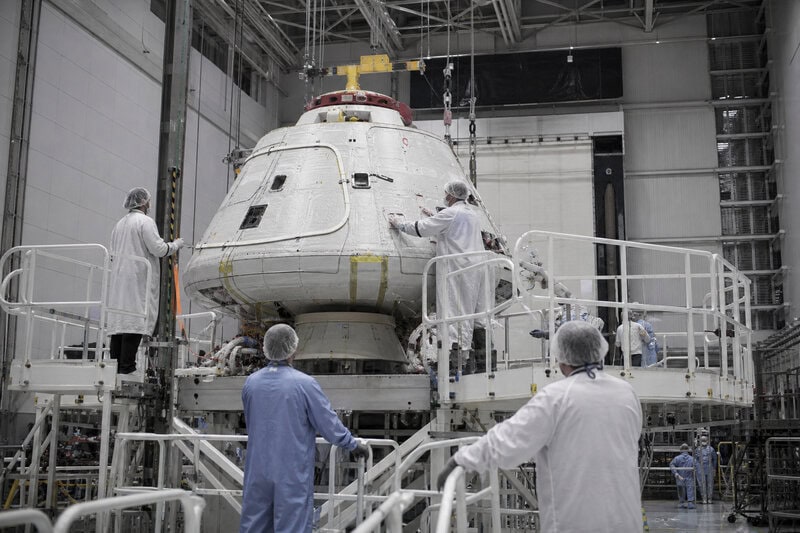
The integration event took place inside the Neil Armstrong Operations and Checkout Building at Kennedy Space Center, a controlled clean-room facility that processed Apollo capsules decades ago and remains one of the few spaces in the world sized and environmentally controlled for large deep-space vehicles. It is the natural home for the NASA Orion spacecraft’s most consequential assembly step.
Orion is built in two distinct modules that are manufactured and tested separately before being united. The crew module — a cone-shaped pressurized cabin built by Lockheed Martin — houses the astronauts during their journey to lunar orbit and back. The service module, contributed by the European Space Agency, surrounds and supports the crew module, supplying main propulsion, electrical power from solar arrays, and the life-support consumables the crew will depend on throughout the mission. The two are assembled separately because each requires its own specialized testing environment and because shipping constraints make independent transport more practical.
Joining them is far more than a mechanical act. Once mated, the combined stack can undergo joint systems testing — a verification process confirming that power, data, and fluid lines crossing the module interface all function as a unified vehicle rather than two cooperative but independent machines. NASA’s Artemis III Orion crew and service modules being joined marks the point at which engineers can begin validating the spacecraft as a whole — a prerequisite for every integration step that follows.
Artemis III is NASA’s planned crewed lunar surface landing targeting the Moon’s south polar region. Orion will serve as the crew’s primary transport vehicle to and from lunar orbit, where it will rendezvous with a separately developed Human Landing System before astronauts descend to the surface.
Why Orion Exists as a Distinct Vehicle
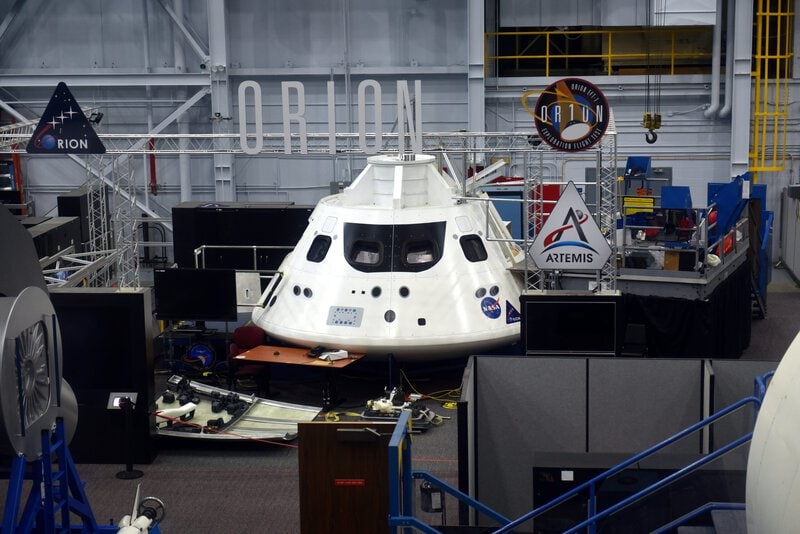
The most fundamental reason Orion is not simply an upgraded version of spacecraft already flying to the International Space Station is physics. A vehicle returning from the Moon does not re-enter Earth’s atmosphere the way a low-Earth-orbit vehicle does.
Orion will hit the upper atmosphere at roughly 11 kilometers per second — approximately 25,000 miles per hour — because it is decelerating from a translunar trajectory. A vehicle returning from the International Space Station travels at approximately 7.8 kilometers per second at re-entry. That difference in speed determines how much energy the atmosphere must absorb and therefore how much heat the spacecraft’s protective shield must withstand.
According to NASA’s Orion program documentation, aerodynamic compression heats the shock layer in front of the heat shield to approximately 2,760 degrees Celsius — roughly 5,000 degrees Fahrenheit — during a lunar-return entry. No crewed American spacecraft since Apollo has been required to survive those conditions. NASA’s Crew Dragon and Boeing’s Starliner are both certified for low-Earth-orbit returns at significantly lower entry velocities. This single engineering requirement — surviving lunar-return heating — drives many of Orion’s most distinctive and expensive design choices, beginning with its heat shield.
The Heat Shield: Critical Component, Complicated History
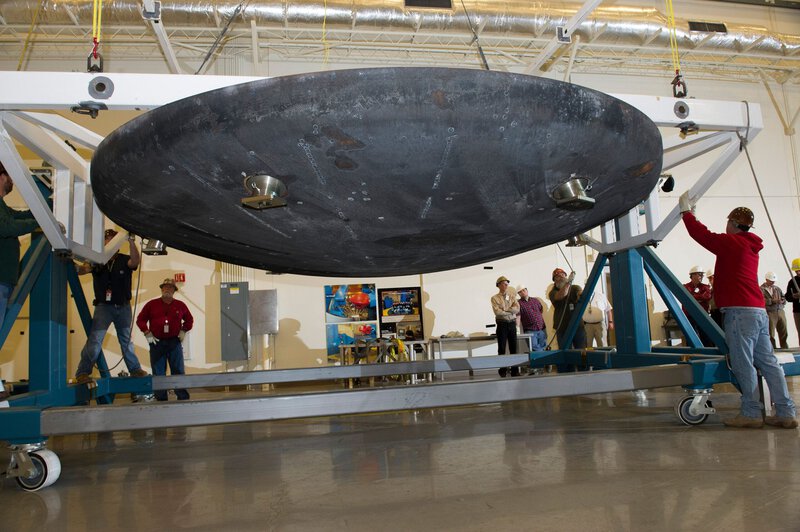
Orion’s heat shield uses Avcoat, an ablative material with direct heritage to the Apollo program. Ablative heat shields work by intentionally charring and eroding in a controlled way, carrying thermal energy away from the vehicle rather than conducting it inward toward the crew. NASA has specified that the material is applied as a monolithic block — a single contiguous mass rather than individual tiles — to reduce the risk of gaps or edges that could become failure points during peak heating.
The heat shield’s history grew more complicated after Artemis I, the uncrewed test flight completed in December 2022. Engineers subsequently discovered unexpected charring patterns and ablator loss that exceeded pre-flight predictions. NASA publicly confirmed the anomaly and indicated that investigation and resolution were required before the shield could be certified for crewed flight. This was an identified problem, not a closed one.
NASA’s analysis led to modifications in the heat shield manufacturing process applied to the Artemis II and Artemis III vehicles. As of mid-2026, the agency has stated confidence in the redesigned approach, but full certification will depend on data gathered after Artemis II — the crewed lunar flyby mission that precedes Artemis III. After carrying the Artemis II crew on that proving flight, Orion’s redesigned heat shield will provide the most direct real-world evidence of whether the manufacturing changes resolved the anomaly observed after Artemis I. That finding should be understood as an emerging one, not settled fact.
One practical design feature is worth noting: the heat shield is a discrete, replaceable component attached to the base of the crew module. Engineers can inspect and swap it between missions without disassembling the capsule itself — a deliberate choice for a vehicle intended to support multiple missions over time.
Radiation: The Hazard That Doesn’t Show Up on Camera
Heat is the most visually dramatic threat Orion must survive, but radiation may be the more complex long-term challenge. Beyond the protection of Earth’s magnetosphere — the magnetic field that deflects much of the Sun’s energetic output — astronauts are exposed to galactic cosmic rays, high-energy particles originating from outside the solar system, and to solar particle events, sudden bursts of high-energy protons the Sun can release with limited warning.
Low-Earth-orbit missions aboard the International Space Station take place largely inside the magnetosphere, which provides meaningful shielding. A translunar mission aboard Orion lacks that protection for most of the journey. NASA’s Human Research Program has established that a trans-lunar mission of Orion’s planned duration could expose the crew to radiation doses approaching agency career limits, depending on where solar activity falls in its roughly 11-year cycle at the time of flight.
Orion addresses this through a dedicated crew shelter — a volume within the capsule where water bags and equipment are deliberately arranged to provide additional shielding during a solar particle event. This passive approach is supplemented by active monitoring: flight surgeons and mission planners will track space weather in real time throughout the mission. A severe solar event during transit is a genuine operational risk that mission rules address but cannot eliminate. This is a risk-management posture, not a solved problem, and it represents one of the clearest differences between the operational environment Orion must handle and the environment faced by vehicles that never leave Earth’s magnetic protection.
What Integration Means for the Path Ahead

With the crew and service modules now joined, the Artemis III Orion stack faces a defined sequence of program gates before it can fly. Combined systems testing must verify the integrated vehicle’s performance across every interface. The stack must then be transported to the Vehicle Assembly Building, where it will be mated to the Space Launch System — the heavy-lift rocket designed to give Orion the energy needed to escape Earth’s gravity on a translunar trajectory. After stacking, the combined vehicle rolls out to Launch Complex 39B at Kennedy Space Center for final launch preparations.
Artemis III also carries external dependencies that introduce schedule variables beyond Orion’s own readiness. The mission architecture requires SpaceX’s Starship, in its Human Landing System configuration, to be available and verified for crew use at the Moon. Depending on the final mission design, the Lunar Gateway — a small space station being assembled in lunar orbit — may also factor into the rendezvous plan. These elements are on parallel development tracks, and their readiness will influence when Artemis III can realistically launch. NASA has a documented history of adjusting Artemis timelines as technical reviews are completed, and no firm launch date should be treated as confirmed until the agency formally announces one following its standard review processes.
Why the Design Philosophy Matters Beyond This Mission

Orion is intentionally engineered for survivability rather than optimized for cost efficiency or rapid reusability. That philosophy reflects deliberate decisions by NASA and Lockheed Martin rooted in the lessons of the Space Shuttle Columbia and Challenger accidents — both of which demonstrated the catastrophic consequences of accepting unresolved risks in crewed spaceflight. The result is a spacecraft whose every major system reflects a conservative, redundancy-favoring approach suited to missions where a quick return to Earth is not an option and where rescue is impossible.
The heritage-based Avcoat heat shield, the launch abort system — described by NASA as the most powerful ever flown on a crewed vehicle — and the passive radiation shelter all embody this philosophy. So does the decision to manufacture the crew and service modules at separate facilities and join them only after each has been independently verified. None of these choices represent the cheapest or fastest path to flight. They reflect a considered judgment that on a mission to the Moon, reliability matters more than efficiency.
Commercial crew vehicles serve low Earth orbit efficiently and reliably. Orion fills a mission niche — deep space, long duration, high-energy re-entry — that no currently operational crewed vehicle is certified to handle. The July 30, 2026 integration event is therefore not merely a manufacturing milestone. It is the moment the only spacecraft currently designed and partially certified to carry humans to the Moon and back became, physically, one vehicle — and the Artemis program’s most ambitious goal moved measurably closer to the launch pad.