
The largest structures in the cosmos — vast filaments and galaxy clusters stretching hundreds of millions of light-years — are forming more slowly than the Standard Model of cosmology predicts, and one of the most compelling explanations is deeply strange: dark matter may be interacting with itself through a force physicists have never detected. If that hypothesis is correct, it would not merely fill a gap in our knowledge. It would require rewriting the foundations of particle physics.
The Universe Is Clumping Wrong

Two separate classes of observation are pointing at the same uncomfortable conclusion. On small scales, the dense central regions of galaxies look smoother and flatter than computer simulations expect. On the largest scales, surveys measuring the clumpiness of matter across billions of light-years consistently find less structure than the cosmic microwave background — the faint afterglow of the Big Bang — predicts there should be. These are not measurement errors. They are persistent, reproducible discrepancies that have resisted explanation for decades.
The tension between weak-lensing surveys and CMB predictions, known as the S8 tension, is measured at roughly 2 to 3 sigma across independent datasets including the Dark Energy Survey and the KiDS collaboration. That level of discrepancy is statistically significant and taken seriously by the cosmology community, though it has not yet reached the 5-sigma threshold physicists conventionally require to claim a discovery. The gap is nonetheless wide enough that leading research institutions now treat a hidden dark force as a serious, testable hypothesis rather than a mathematical curiosity.
According to recent analysis reported by Science Daily, a hidden force could pull dark matter together on small scales while simultaneously — and counterintuitively — slowing the growth of the Universe’s largest structures. That dual behavior is precisely what makes the hypothesis attractive: a single new physical ingredient could explain anomalies operating at two entirely different cosmic scales.
What Dark Matter Is — and Why the Standard Story Falls Short
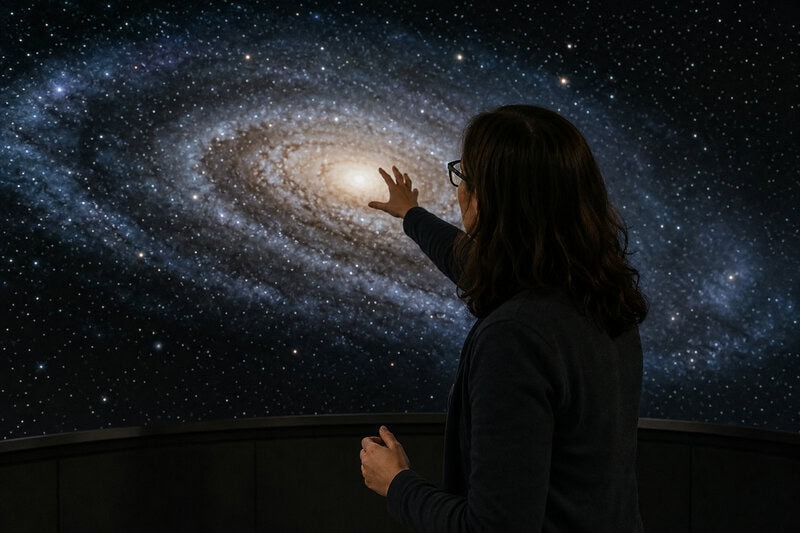
Dark matter is the name physicists give to the unseen mass that accounts for roughly 27 percent of the Universe’s total energy content. It neither emits nor absorbs light, yet its gravitational fingerprint is unmistakable: it governs the rotation curves of galaxies, bends light around galaxy clusters through gravitational lensing, and provides the scaffolding on which the large-scale structure of the Universe is built. A detailed overview from Caltech’s science magazine explains how these gravitational signatures have been confirmed across independent observational methods, leaving little scientific doubt that dark matter exists even as its fundamental nature remains entirely unknown.
The leading candidate for decades has been the WIMP — the Weakly Interacting Massive Particle — which would interact with ordinary matter only through gravity and the weak nuclear force. Yet no direct-detection experiment, including extraordinarily sensitive underground detectors designed specifically to catch WIMPs, has found one. That persistent silence has pushed the field increasingly toward alternatives.
Standard cold dark matter models predict that galaxy centers should contain dense, sharply peaked concentrations of matter called cusps. Observations consistently reveal flatter, smoother distributions called cores. Astronomers call this the core-cusp problem. A related puzzle, the missing satellites problem, concerns the large discrepancy between the number of small dwarf galaxies orbiting the Milky Way that simulations predict and the far smaller number astronomers actually observe. Both anomalies are structural, both are well-documented, and neither has a clean solution within the framework of purely gravitational, non-interacting dark matter.
The Concept of a Hidden Dark Force
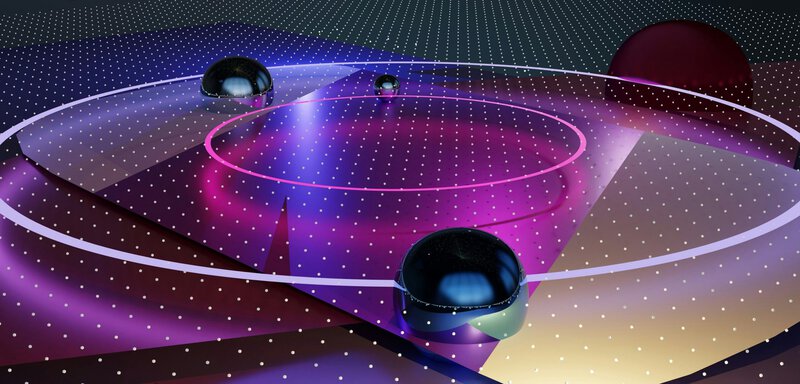
Dark matter self-interaction is the hypothesis that dark matter particles exert a force on one another beyond gravity — analogous to how electrically charged particles push and pull each other through electromagnetism — mediated by as-yet-undiscovered force-carrying particles. As The Debrief reports, physicists are now actively searching for evidence of exactly this kind of hidden interaction, treating it as one of the most promising frontiers in fundamental physics.
Researchers have formally examined the possibility that dark matter may arise from a hidden sector — a shadow realm of particles and interactions that couples to ordinary matter only very weakly, or not at all. The leading proposed force-carrier in this hidden sector is the dark photon: a particle analogous to the ordinary photon that mediates electromagnetism, but one that interacts only among dark sector particles. Dark photons may be massless or carry a small mass, and they would be effectively invisible to conventional particle detectors while still leaving measurable imprints on the distribution of matter across the Universe.
A particularly striking theoretical proposal, described in research covered by Phys.org, places dark matter in a hidden extra dimension alongside a dark photon force-carrier — a geometric solution that would naturally explain why the dark sector has remained invisible to particle colliders while still shaping the large-scale architecture of the cosmos.
The foundational theoretical framework for dark matter arising from hidden forces has been developed in peer-reviewed literature over the past decade. A seminal paper archived in the NASA Astrophysics Data System laid out formally how dark matter could emerge from a hidden sector governed by its own force, establishing the theoretical machinery that subsequent experimental searches have used as their target.
How a Secret Force Would Reshape the Universe

If dark matter particles interact through a hidden force, the consequences cascade through cosmic structure at every scale. On the scale of individual galaxies, the force would cause dark matter particles to scatter off one another during collisions — a process called self-scattering — transferring energy from the dense core outward and smoothing the sharp cusp into the flatter core that telescopes observe. This is not a subtle effect; the smoothing would be significant and directly measurable in the internal structure of dwarf galaxies, which contain relatively few ordinary stars and are therefore among the cleanest laboratories for studying dark matter in isolation.
On the largest scales, the same interaction acts as a brake on the growth of structure. A hidden force that limits the clustering of dark matter would slow the assembly of galaxy clusters and cosmic filaments, reducing the overall clumpiness of the Universe in a way that matches what lensing surveys measure — and that CMB-based predictions overshoot. The same new physics that addresses galaxy-scale anomalies would therefore leave a detectable signature in next-generation surveys.
A critical theoretical requirement is that the force must be velocity-dependent: stronger at the low relative speeds found inside small dwarf galaxies and weaker at the high speeds inside massive galaxy clusters. Without this velocity dependence, self-interacting dark matter models that resolve the core-cusp problem in dwarf galaxies tend to over-scatter particles inside massive clusters, destroying structures that are clearly observed to exist. The need for velocity dependence gives theorists a precise and demanding target, constraining the allowed properties of the dark force-carrier to a specific range of masses and coupling strengths.
The Portal Particle: A Bridge Between Dark and Visible Worlds
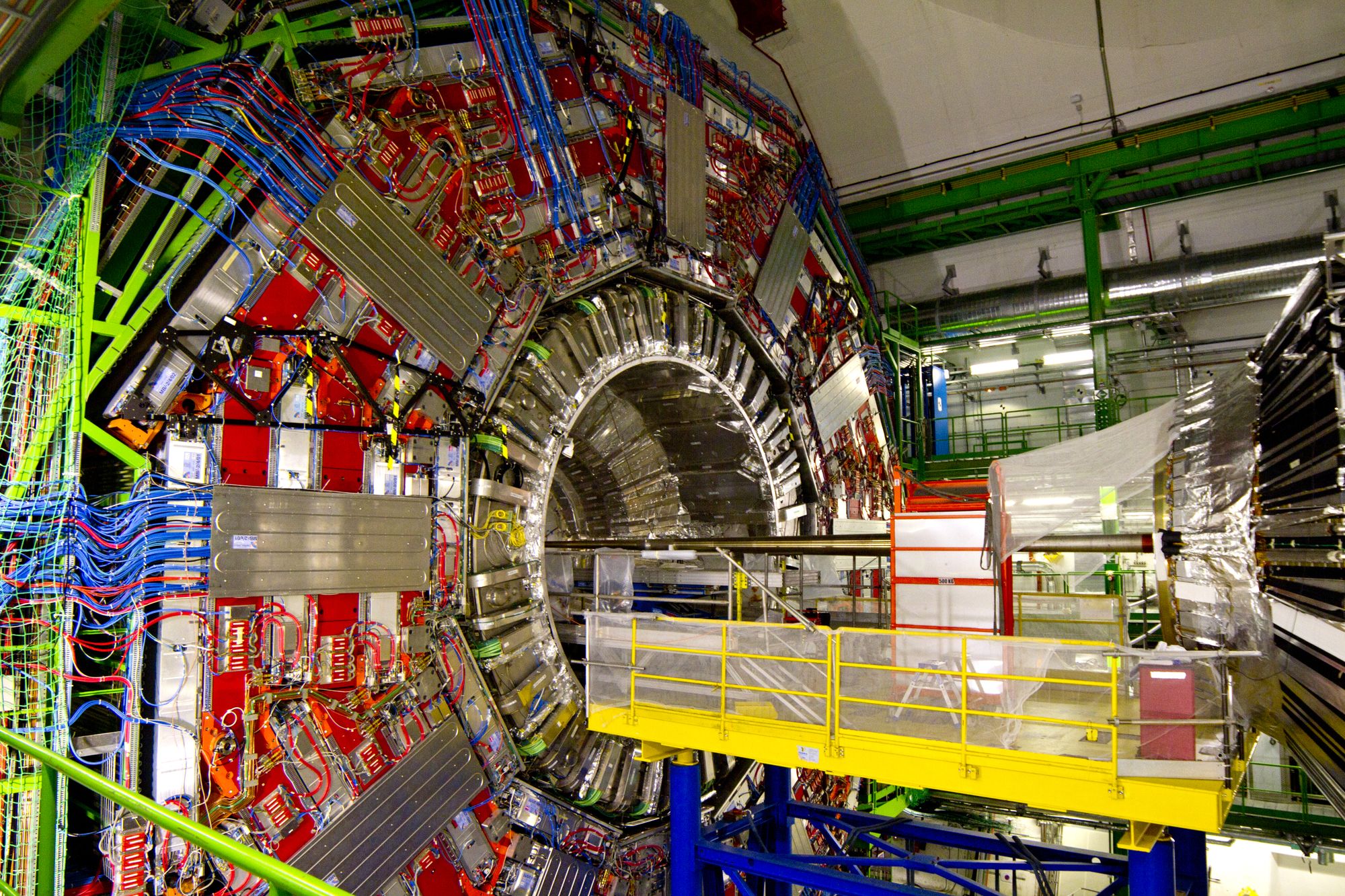
For the hidden-force hypothesis to be experimentally testable — as opposed to merely theoretically appealing — there must be some coupling between the dark sector and ordinary matter, however faint. Most hidden-sector models require at least one portal particle: a mediator that bridges the two sectors at a small but non-zero rate, providing the only experimental window into the dark force.
These portal particles would produce specific, predictable signatures in particle colliders. CERN’s CMS experiment is actively searching for exactly these signatures — resonances decaying to pairs of quarks in proton-proton collision data — making this one of the most concrete near-term experimental tests of the hypothesis. The search covers a mass range where theoretical models specifically predict the portal particle could appear, and the CMS detector’s sensitivity is sufficient to either find or meaningfully exclude large portions of the predicted parameter space.
Complementary searches for the dark photon itself are underway at electron-positron colliders including Belle II in Japan and at fixed-target experiments at Jefferson Lab in Virginia. These experiments scan a mass range from a few MeV to several GeV, sweeping through the territory where theory suggests the force-carrier could hide. A positive signal at any of these facilities would not merely confirm the existence of dark matter interactions — it would reveal the architecture of an entirely new sector of physics, potentially including its own hierarchy of forces and a rich family of dark particles interacting in ways that have shaped every galaxy in the observable Universe.
Where the Evidence Stands: Consensus Versus Contested Terrain

It is established scientific consensus that dark matter exists and that standard models leave several structural puzzles unsolved. It is an emerging but genuinely contested hypothesis that a hidden self-interaction force is the correct solution. The scientific community is divided on this, and that division is intellectually honest: the evidence is intriguing but not conclusive, and alternative explanations remain viable.
The most important alternative is baryonic feedback — the turbulent, energetic behavior of ordinary matter including gas heating, supernova explosions, and radiation pressure from newly formed stars. These processes can redistribute matter in galaxy centers, smoothing cusps into cores and suppressing the formation of small satellite galaxies without requiring any new fundamental force. Critics of the self-interacting dark matter hypothesis correctly note that baryonic physics can reproduce many of the same structural effects, and that distinguishing between the two explanations requires precise measurements of systems where baryonic effects are well-understood and minimal — conditions that current data do not always satisfy.
The hidden-force hypothesis is neither confirmed nor dismissed. What the field needs — and what the next decade of observations and collider experiments will begin to provide — is precision data at a scale that can definitively separate new dark physics from complex but conventional astrophysics.
The Tests That Will Decide
The Euclid space telescope, launched in 2023 and now mapping billions of galaxies across cosmic history, will measure the growth rate of large-scale structure with enough precision to either sharpen or substantially resolve the S8 tension. Its results will directly constrain how strongly dark matter can self-interact across cosmic time, providing one of the most powerful tests of the hidden-force hypothesis available this decade.
The Vera Rubin Observatory’s Legacy Survey of Space and Time, beginning full operations in Chile, will complement Euclid by mapping weak gravitational lensing across the southern sky in unprecedented detail. Together, these surveys will build a picture of cosmic structure growth accurate enough to detect the subtle braking effect that a hidden dark force would impose on the assembly of the Universe’s largest structures.
At CERN, the High-Luminosity LHC upgrade planned for the late 2020s will increase proton-proton collision rates significantly, giving the CMS and ATLAS detectors greater sensitivity to portal-particle resonances. The specific signature of a hidden sector — a resonance decaying to quark pairs at a mass scale theory predicts — is a well-defined experimental target, and the upgraded collider will probe it with a thoroughness the current LHC cannot match.
If a dark photon or portal particle is discovered, theorists would face the immediate and extraordinary task of mapping the full architecture of a new sector of physics — one with its own forces, its own particles, and perhaps its own complex interactions that have silently shaped every galaxy in the observable Universe. If all searches return null results within the next decade, the hidden dark force hypothesis will face severe pressure, pushing the field toward alternatives including ultra-light axion dark matter, primordial black holes, or fundamental revisions to gravitational theory. Either outcome will be consequential. The question of what dark matter is — and whether it carries its own secret force — remains the defining unsolved problem of twenty-first century physics, and the experiments now running will begin to answer it within years, not generations.