
In 2024, a standard, unmodified 4G LTE smartphone received a call connected through a satellite orbiting roughly 700 kilometers overhead — not through a specialized handset, not through a ground relay tower, but directly from a spacecraft moving at approximately 27,000 kilometers per hour. That demonstration by AST SpaceMobile using its BlueBird satellites marked an engineering threshold that many telecommunications researchers had long considered theoretically implausible, and it has since repositioned the company — and space connectivity stocks broadly — at the center of one of the most consequential commercialization debates in the satellite industry.
What ‘Direct-to-Cell’ Actually Means — and Why It’s Hard

Direct-to-cell (D2C) satellite technology is precisely what its name suggests: a satellite in orbit acts as a cell tower, communicating directly with ordinary smartphones without requiring specialized hardware on the ground or in the user’s hand. In standard telecom terminology, the satellite emulates an eNodeB — the base station unit in a 4G LTE network — or a gNodeB, its 5G equivalent, broadcasting on the same licensed spectrum bands that terrestrial carriers already use. A phone on the ground sees the satellite as simply another tower and connects accordingly.
The fundamental physics obstacle is called free-space path loss. Radio signal strength diminishes with the square of the distance it travels, which means a satellite 700 km overhead must deliver a usable signal to a smartphone antenna designed to communicate with a tower perhaps 300 meters away. Closing that gap requires one of three things: enormous transmit power, a very large antenna aperture, or both. The engineering tradeoffs between those options define the competitive landscape of every company pursuing this market.
Spectrum licensing adds a layer of complexity that rivals the engineering itself. D2C operators must coordinate with terrestrial mobile network operators (MNOs) in every country they serve to ensure their satellite transmissions do not interfere with existing ground-based cellular infrastructure. This regulatory reality has shaped AST SpaceMobile’s entire business model: rather than competing with carriers, the company has structured partnerships with established MNOs — including AT&T, Verizon, and Vodafone — using spectrum already licensed to those carriers. The satellite provides wholesale capacity; the carrier manages the customer relationship.
The Phased-Array Antenna: The Hardware That Makes It Possible
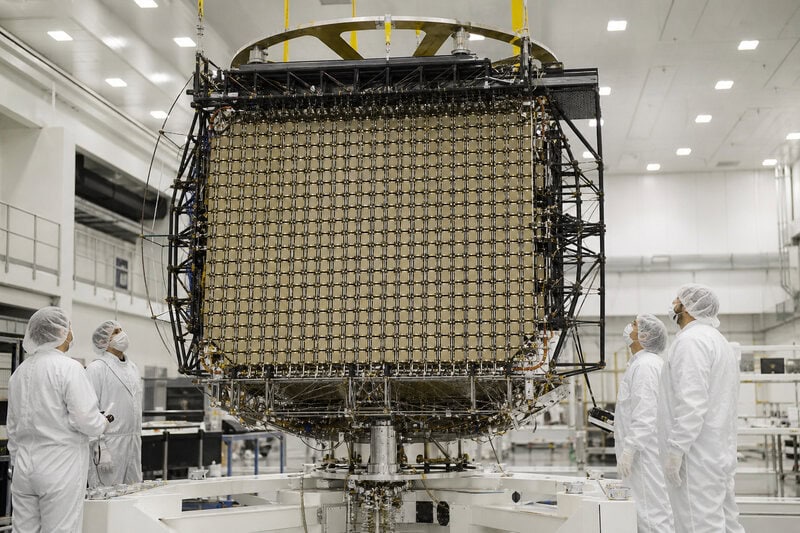
AST SpaceMobile’s primary technical answer to the path-loss problem is the phased-array antenna. A phased array is an assembly of many small individual antenna elements whose signals are shifted in phase by precisely controlled amounts, causing their combined radio wavefront to constructively interfere — that is, to add together — in one chosen direction. The result is an electronically steerable beam that can be aimed at a specific location without any moving parts.
Electronic beam-steering is essential for a satellite communicating with phones on the ground. The satellite is moving; the phone may also be moving; and any mechanical gimbal system capable of tracking that geometry continuously would be too slow, too heavy, and too mechanically unreliable for sustained orbital operation. A phased array can redirect its beam in microseconds, tracking a target phone across the sky in real time.
The larger the phased-array aperture, the narrower and more powerful the focused beam. AST SpaceMobile’s BlueBird Block 1 satellites carry antenna arrays spanning roughly 64 square meters — described by the company as the largest deployable phased-array structures yet attempted in commercial low Earth orbit (LEO). Phased-array technology itself is well-established in radar systems and military communications, with foundational antenna theory formalized through the mid-20th century. The active engineering frontier is not the physics but the economics: building arrays of this scale within the mass, power, and thermal budgets of a commercial satellite bus, at a cost that makes a constellation financially viable.
Low Earth Orbit: Why Altitude Is the Whole Game

The choice of low Earth orbit — typically defined as altitudes between roughly 400 and 2,000 km — is not incidental to the D2C concept; it is load-bearing. Traditional geostationary (GEO) satellites orbit at approximately 35,786 km, which produces a round-trip signal latency of around 600 milliseconds. That delay is too large for real-time voice calls and perceptibly disruptive even in data sessions. LEO constellations operating at 400-700 km reduce that latency to roughly 20-40 milliseconds, within the range of a workable phone call.
LEO’s lower altitude also means the signal travels a far shorter distance, reducing free-space path loss significantly relative to GEO. That reduction in path loss is what makes it physically achievable to close the link budget — the accounting of signal power from transmitter to receiver — with an antenna compact enough to fit on a spacecraft and a receiver as small as a smartphone chip.
The tradeoff is coverage persistence. A LEO satellite crosses the sky as seen from the ground in roughly 5 to 10 minutes, which means any single satellite provides only brief, intermittent coverage of a given location. Continuous service requires a constellation of dozens to hundreds of satellites executing seamless handoffs as they pass overhead — the same engineering problem cellular networks solved horizontally across geography, now applied in three dimensions at orbital velocities. AST SpaceMobile has stated plans for a constellation of up to 168 BlueBird satellites to achieve equatorial and mid-latitude coverage, a figure that analysts have identified as the critical variable determining whether the network can meet commercial service-level commitments.
SpaceX’s Role: Catalyst, Competitor, or Both?
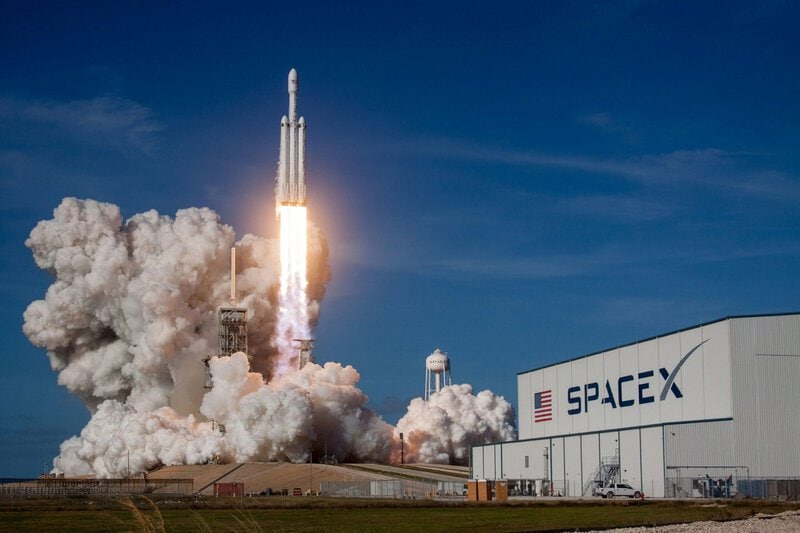
SpaceX occupies an unusual position in the D2C satellite story: it is simultaneously the sector’s most powerful sentiment catalyst and one of AST SpaceMobile’s most formidable potential competitors. SpaceX’s Starlink program has established beyond reasonable dispute that LEO broadband is commercially viable, normalizing investor appetite for space infrastructure and reducing the perceived technology risk that once made satellite-connectivity equities difficult to value. Trending coverage has noted how space stocks including ASTS have moved in sympathy with broader SpaceX momentum, even when the underlying business drivers are distinct.
SpaceX has separately pursued direct-to-cell capability through a partnership with T-Mobile, equipping a subset of Starlink satellites with cellular payloads to provide coverage in areas where terrestrial networks are absent. That places Starlink in potential direct competition with AST SpaceMobile for exactly the same coverage-gap use case — rural and remote areas where MNOs have no economic incentive to build towers.
The competitive distinction AST SpaceMobile emphasizes is antenna aperture. The company’s argument is that its purpose-built, large-array satellites can deliver broadband-class data rates to standard phones, while SpaceX’s D2C service — according to SpaceX’s own initial public descriptions of the T-Mobile partnership — was targeted first at text messaging and basic connectivity rather than full broadband throughput. Whether that aperture advantage constitutes a durable competitive moat, or whether SpaceX’s launch cost advantage and deep vertical integration eventually override it, is the central contested question in the emerging D2C market. Competitive intelligence on SpaceX’s satellite programs has become a growing area of institutional research focus as the commercial stakes have risen.
It is also worth noting that the two companies are not purely adversarial. SpaceX has served as a launch provider for AST SpaceMobile’s satellites, meaning the competitor’s rockets have delivered the competitor’s hardware to orbit — an interdependence that complicates any simple narrative of a zero-sum race and underscores how concentrated launch capacity has become in the current commercial space environment.
Spectrum, Partnerships, and the Business Model Beneath the Science

AST SpaceMobile’s revenue model is wholesale rather than retail. The company provides what it calls space-based cellular broadband capacity to MNOs, which then offer the connectivity to their existing subscribers — typically as an extension of coverage for rural, maritime, or remote-area use cases. Revenue is expected to flow through per-gigabyte or per-minute wholesale rates negotiated with partner carriers, a structure that ties AST’s financial performance directly to how aggressively its MNO partners market and provision the service to end users.
This model has a clear historical parallel that serves as both a template and a cautionary example. Iridium’s original corporate structure, which collapsed into bankruptcy in 1999, failed in part because it overestimated consumer willingness to pay premium prices for specialized satellite handsets at a time when terrestrial cellular was rapidly expanding. LightSquared’s spectrum disputes in the 2010s illustrated a different failure mode: the gap between a technically sound concept and commercially deployable spectrum rights. Industry observers routinely cite both cases when assessing D2C ventures, not to suggest the same outcomes are inevitable, but to underscore that the transition from technology demonstration to recurring revenue has historically been where satellite ventures encounter their most serious obstacles.
AST SpaceMobile’s wholesale partnership structure attempts to sidestep the consumer-acquisition problem that doomed earlier ventures: the MNO partners already own the customer relationships, the billing infrastructure, and the spectrum licenses. The satellite layer is positioned as invisible infrastructure rather than a consumer brand. That structure reduces AST’s go-to-market risk but concentrates execution risk in the hands of partners whose commercial priorities — and whose willingness to aggressively market a nascent, partially deployed service — AST cannot fully control.
What the Options Market Is Signaling
Analysis of the options market in ASTS has flagged elevated implied volatility, which derivatives analysts have interpreted as the market pricing binary uncertainty: either commercial contracts scale meaningfully through 2025 and 2026, validating the constellation build-out, or launch cadence and spectrum negotiations delay revenue generation long enough to stress the company’s capital structure.
The implied volatility term structure carries an additional signal worth unpacking. When near-term options show higher implied volatility than longer-dated contracts — a condition known as an inverted or downward-sloping volatility term structure — it typically reflects that sophisticated market participants are positioning around specific near-term catalyst events rather than making open-ended long-horizon technology bets. In ASTS’s case, those catalysts are identifiable: FCC regulatory filings for commercial operating authority, formal MNO contract disclosures, and launch manifest confirmations that would clarify the constellation deployment timeline.
Elevated implied volatility is not inherently bullish or bearish. It reflects the market’s collective acknowledgment that the range of plausible outcomes is wide, and that the width of that range will narrow materially once specific near-term events resolve. Investors treating options pricing as a sentiment gauge should read the current signal as the market saying: we do not know which way this breaks, but we expect the ambiguity to resolve soon.
The Monetization Question: Where Technology Meets Revenue Reality
The shift in analyst focus from “can the technology work?” to “can the business scale?” is a meaningful inflection point, and it is precisely where AST SpaceMobile finds itself in mid-2025. The physics are no longer the primary obstacle. The demonstrated ability to complete a voice call through a standard smartphone via a LEO satellite moves the core question from the engineering lab to the revenue model — and that is where the hard work begins.
Monetization in a wholesale satellite-connectivity business depends on several variables operating simultaneously. First, constellation density must reach the threshold where service-level agreements with MNO partners can be met reliably across the coverage footprint those partners have committed to market. Second, regulatory approvals must be secured jurisdiction by jurisdiction, since spectrum coordination rules differ materially between countries and no single global approval exists. Third, partner carriers must actively sell and provision the service rather than treating it as a passive backstop, because AST’s revenue is a direct function of end-user adoption driven by those partners’ marketing and pricing decisions.
Independent space-industry analysts have noted a structural economic characteristic of LEO constellations that makes early financial results inherently difficult to interpret: the unit economics improve nonlinearly with constellation size. The first satellites deployed serve the fewest users at the highest cost per subscriber. Only as the constellation approaches its design density do the per-user economics become compelling. Early revenue figures, when they arrive, should therefore be read as indicators of trajectory and commercial traction rather than as proxies for steady-state profitability.
Broader Investor Attention: Space Infrastructure as an Asset Class
Broader investor interest in space infrastructure — including discussion of space-focused ETFs as diversified ways to access the sector — reflects genuine recognition that LEO connectivity has crossed from science project to nascent industry. That shift in perception matters for how the asset class is valued. When a sector moves from pure speculation to early commercialization, the investor base tends to broaden from early-stage risk capital toward institutional capital that requires visible revenue pathways and defensible competitive positioning.
That broadening brings stricter scrutiny. Investors who were willing to underwrite technology risk in 2021 and 2022 are now asking different questions: What are the contracted revenue commitments from MNO partners? What is the cost per satellite of the next constellation tranche? What is the regulatory timeline in the company’s highest-priority markets? Those are not hostile questions — they are the normal questions of a sector maturing into commercial reality — but they require answers that go beyond engineering milestones.
What Comes Next: Honest Signals, Honest Uncertainty
AST SpaceMobile has indicated that initial commercial service in the United States depends on two conditions it does not fully control: Federal Communications Commission approval for commercial operations, and the deployment of sufficient BlueBird satellites to meet the coverage density required by service-level agreements with partner carriers. Both timelines are subject to launch scheduling and regulatory review processes that involve external agencies and third-party launch providers.
The honest summary of where AST SpaceMobile stands in mid-2025 is this: the core technology is demonstrated and the underlying physics are sound. A satellite with a large enough phased-array antenna, operating in low Earth orbit, can deliver a usable cellular signal to an ordinary smartphone — that is no longer a theoretical claim but an observed result. The engineering frontier has moved. The business frontier has not yet moved at the same pace, and the gap between the two is what the options market, the analyst community, and prospective institutional investors are all attempting to measure.
Scaling a global LEO constellation to commercial reliability while simultaneously managing launch cadence, spectrum coordination across dozens of regulatory jurisdictions, and partner carrier negotiations has historically proven as demanding as the engineering that preceded it. The satellites can call your phone. The harder question — and the one on which the investment thesis ultimately turns — is whether the business can answer back at scale, on a timeline that does not exhaust the capital available to reach that point.