
Roughly 150 million years ago, a massive sauropod — a long-necked, four-legged dinosaur potentially the size of a city bus or larger — trudged through soft Jurassic mud in what is now Colorado, pressing each enormous footfall into sediment that would spend the next 150 million years slowly turning to stone. When paleontologists finally read those prints, they found something unexpected: the animal had not walked in a straight line. Its path curved back on itself in a looping arc, and the footprints themselves told the story of a creature moving unevenly, as though one side of its body bore a burden the other did not share.
A 150-Million-Year-Old Mystery Pressed Into Colorado Stone
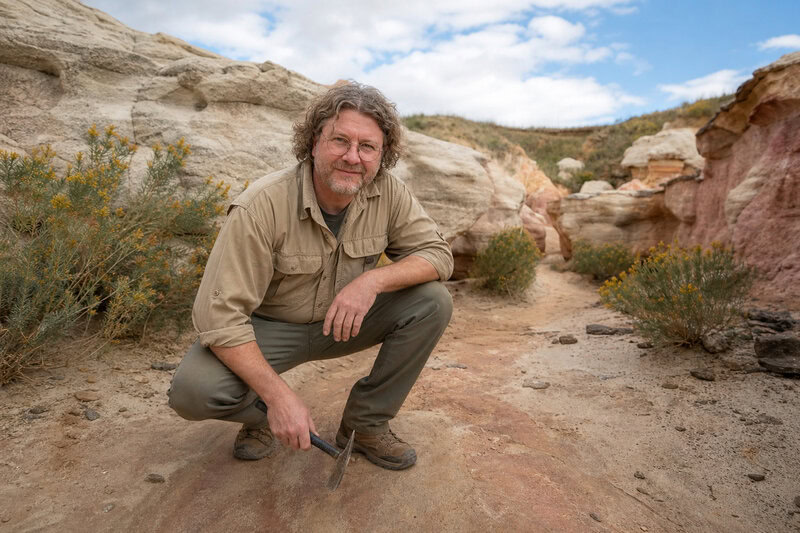
The discovery at the heart of this story is a rare looping trackway of fossilized footprints found in Colorado — a sequence of impressions described by researchers in Discover Magazine as unlike almost anything previously documented in the sauropod fossil record. The animal did not travel in a straight line. It arced, curved, and ultimately looped back toward the direction it came from — a pattern paleontologists can observe but cannot yet fully explain.
To understand why this matters, it helps to understand what a fossilized trackway actually is. Unlike an isolated footprint, a trackway is a preserved sequence of impressions left by a moving animal — long enough and continuous enough to reveal the rhythm and pattern of its movement. Trackways are among the only direct records science has of how living dinosaurs actually moved. Bones tell us what an animal looked like; footprints tell us what it did. And this particular set of footprints, approximately 150 million years old, is doing something strange.
The central puzzle is deceptively simple: the evidence strongly suggests an injured animal, but injury alone does not account for the unusual, looping geometry of the path. A limping dinosaur walking in a straight line would be remarkable enough. A limping dinosaur whose trail curves back on itself raises questions that current evidence cannot cleanly answer.
What Paleontologists Actually Found — and Why It’s So Rare
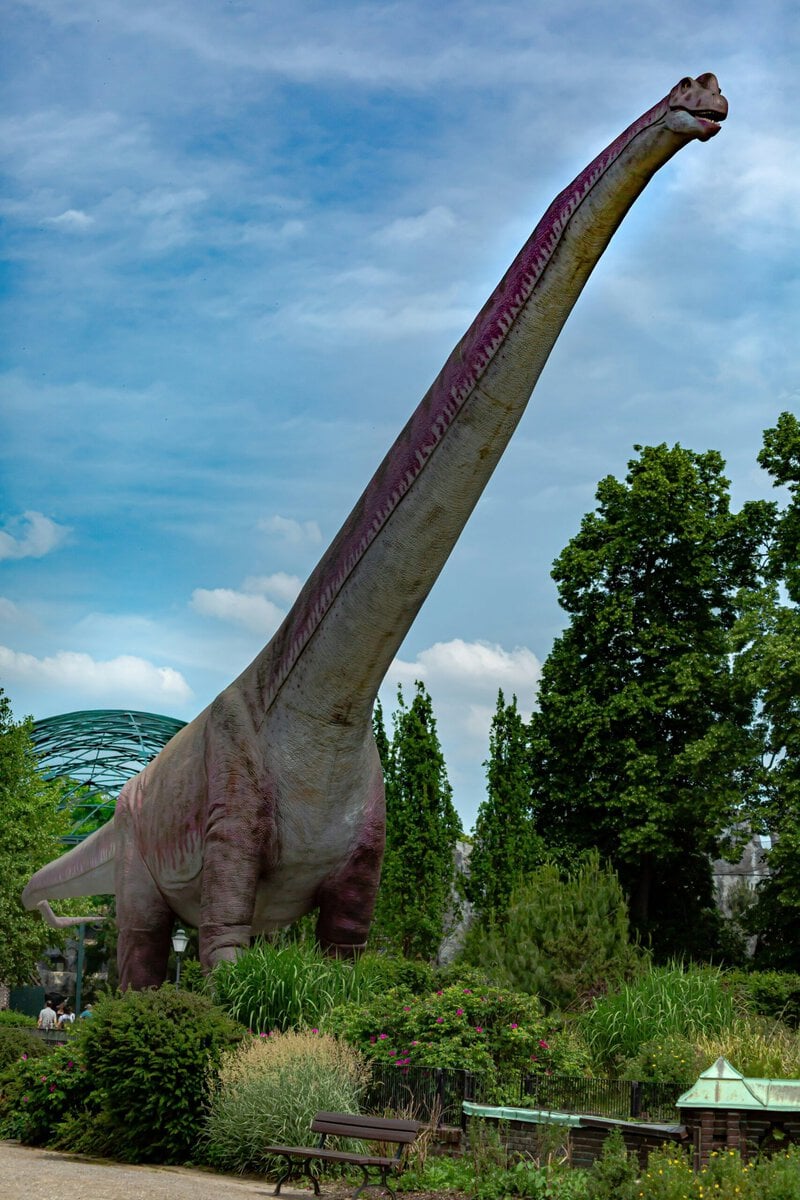
Sauropods — the group of long-necked, four-legged herbivorous dinosaurs that includes giants like Brachiosaurus and Diplodocus — were among the largest land animals ever to exist, with some species exceeding 30 meters in length and weighing dozens of metric tons. When animals of that mass moved across soft sediment, they left deep, clear impressions. But for those impressions to survive 150 million years, the conditions at the moment of fossilization had to be precisely right: the mud wet enough to record the print faithfully, then dry enough afterward to harden before erosion could erase it. That narrow window of preservation makes intact, continuous sauropod trackways extraordinarily rare.
What makes the Colorado site exceptional is not merely the age of the prints — Jurassic-era sauropod footprints have been found before — but the length and behavioral information encoded in the sequence. As Sci.News reports in its coverage of the find, continuous trackways long enough to reveal directional patterns and gait characteristics are extremely rare windows into Jurassic-era locomotion. Most sauropod footprint discoveries amount to a handful of isolated impressions. A looping trail is something else entirely.
The looping character of the path — the fact that the animal’s trajectory curved back on itself rather than continuing in any consistent direction — is what elevates this trackway from unusual to genuinely puzzling. Paleontologists studying the site can observe the loop. Explaining it is another matter.
Reading a Fossil Footprint Like a Medical Record
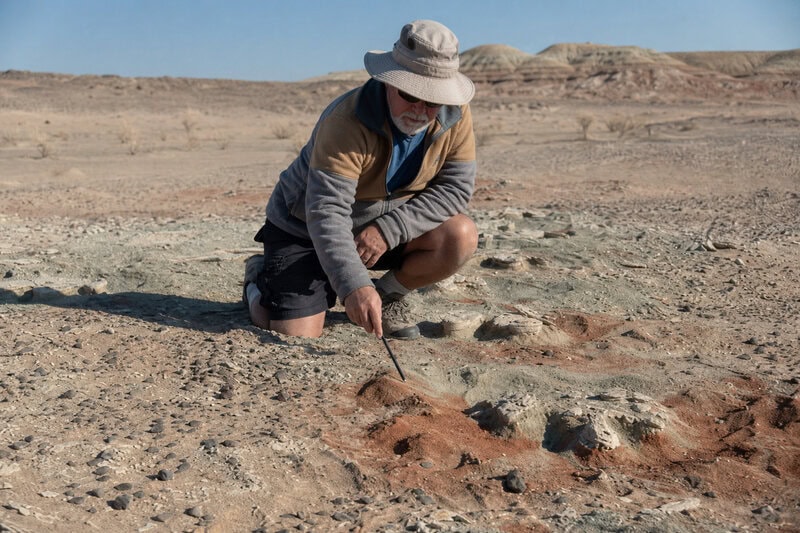
Paleontologists who study trackways treat fossilized footprints as biomechanical data. The key measurements are stride length — the distance between successive prints of the same foot — step width, the lateral spacing between left and right prints, and the relative depth of impressions on each side of the body. Together, these variables reconstruct how an animal distributed its weight across its limbs during locomotion.
In healthy large quadrupeds, these measurements are roughly symmetrical. Left and right prints are similar in depth. Stride length is consistent. Step width follows a predictable pattern relative to body size and speed. When those symmetries break down — when one side leaves deeper impressions than the other, or when spacing becomes irregular — the trackway is recording what biomechanists call a gait asymmetry: the animal was loading its limbs unevenly.
In living animals, gait asymmetry is almost universally linked to pain, injury, or neurological disruption. It is, in functional terms, a limp. The Colorado trackway shows precisely this kind of asymmetry, according to reporting by the New York Post on the paleontologists’ findings. The footprints show variations in depth, spacing, and alignment between left and right prints consistent with the animal favoring one side — the fossil equivalent of a limp pressed into stone.
The interpretive framework paleontologists use to reach these conclusions is well-established. Analysis of dinosaur trackways as behavioral and biomechanical evidence has been a recognized subdiscipline for decades. Researchers cross-reference sauropod prints with biomechanical models built from skeletal anatomy to distinguish normal variation from pathological gait, giving the injury hypothesis a solid methodological foundation even when no skeleton accompanies the trackway.
The Injury Hypothesis — What the Evidence Supports
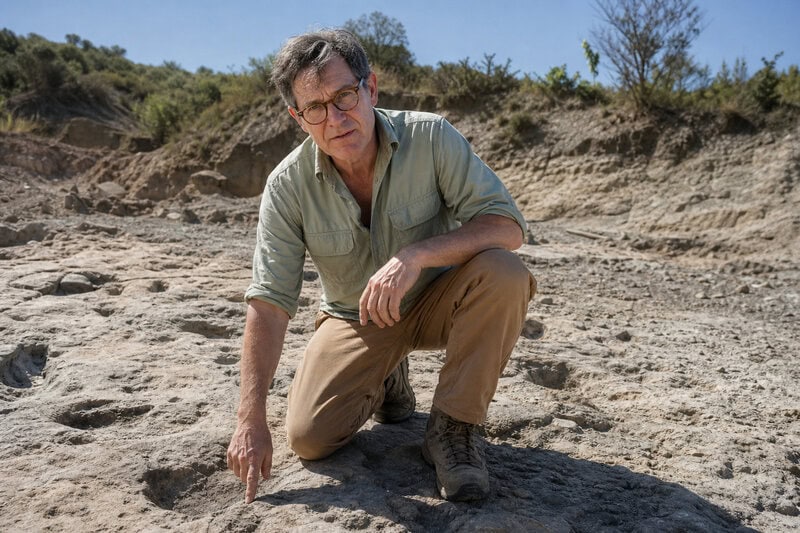
The leading interpretation of the Colorado trackway is that the animal was injured. This is not speculation dressed up as science — it is a conclusion grounded in observable asymmetry in the footprints and supported by a well-developed framework for reading gait from fossilized trails. Paleontologists describe the trackway as showing evidence of a limping sauropod, and that characterization is consistent with what the prints directly record.
The biological mechanism connecting injury to a curved path is also plausible. An animal experiencing pain in one limb will instinctively shift weight away from that side, altering the forces that normally keep a large quadruped moving in a straight line. In severe cases, this asymmetric loading affects the animal’s turning radius and directional control. Veterinary and wildlife research on large living quadrupeds — elephants, rhinoceroses, large bovids — has documented cases in which severe limb injuries cause uncontrolled directional drift during locomotion, lending biological plausibility to the hypothesis without elevating it to proven fact.
The honest boundary of the evidence must be stated clearly: fossil footprints record behavior, not anatomy. There is no preserved skeleton from this individual sauropod. The exact nature, location, and severity of any injury the animal carried remains unknown. What the prints record is the consequence — the uneven walk — not the cause.
Why the Looping Path Remains Unexplained
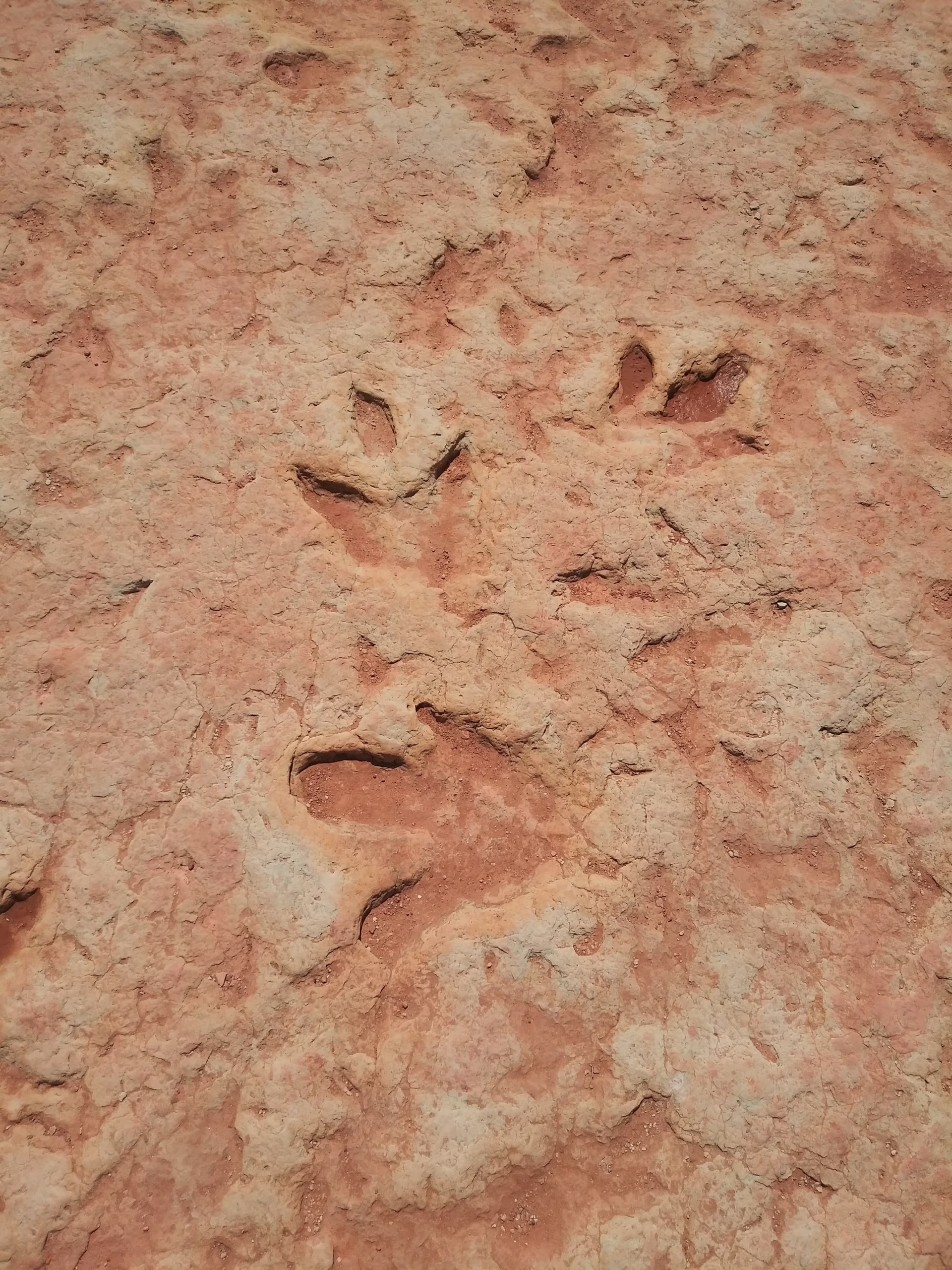
Here is where the science becomes genuinely open-ended. Injury explains the limp. It does not fully explain the loop.
A straight-line trackway with gait asymmetry would be unusual but interpretively manageable: an injured animal, uneven stride, consistent direction of travel. What the Colorado site presents is something more confounding — a path that curves back on itself. As Fox News notes in its coverage of the discovery, paleontologists cannot fully account for why the animal’s path took this form.
Several hypotheses are scientifically plausible. The animal may have been disoriented by its injury or by pain-related neurological stress. It may have been responding to terrain features — slopes, water sources, vegetation — that no longer exist in the landscape and left no trace in the rock. It may have been searching for food or water and changing direction repeatedly as its condition worsened. Each of these explanations is possible; none is confirmed by current evidence.
It is important to be precise about what is established and what is active interpretation. The existence of the trackway, its approximate age, its looping character, and its asymmetric gait signature are all observable, documented features of the physical record. The behavioral cause of the loop — why this animal moved the way it did on a specific day 150 million years ago — is an open scientific question, not settled science.
That distinction matters beyond this single animal. If paleontologists can determine why large sauropods curved their paths under duress — whether through injury-induced disorientation, environmental navigation, or some other mechanism — it would add a new layer of understanding to how these animals perceived and responded to their world. That is knowledge bones alone cannot provide.
What This Changes — and Doesn’t Change — About Dinosaur Locomotion
The Colorado discovery does not overturn the scientific consensus on how large sauropods moved. Decades of trackway analysis and skeletal biomechanical modeling have established that sauropods typically moved with a slow, energy-efficient, columnar gait — limbs held relatively upright beneath a massive body, weight distributed across four broad feet. That picture remains intact.
What the looping trackway genuinely adds is evidence of individual variation under duress: that a sauropod could experience injury serious enough to alter its locomotion dramatically, expressed in ways complex enough to produce a path geometry paleontologists are still working to explain. This is a dimension of individuality that is rarely visible in the fossil record, where most evidence describes species-level anatomy rather than the life history of a specific animal.
The methodological implication is also worth noting. Trackways can capture a single moment of an animal’s life in a way that bones cannot. The growing recognition of their behavioral and biomechanical value has led some researchers to call for more systematic documentation of fossil footprint sites before they are lost to erosion, weathering, or land development. The Colorado site is a reminder of what that documentation can reveal.
One significant gap remains: without identifying the species of sauropod that made the prints, scientists cannot yet build precise biomechanical models of this individual’s locomotion or compare the trackway to skeletal material from the same species found in the region. Future excavation in the area might help close that gap, but for now it remains open.
What Wounded Dinosaurs Teach Us About Deep Time
Evidence of injury and pathology in dinosaurs — healed fractures preserved in bone, signs of infection in vertebrae, and now asymmetric trackways — consistently points to the same conclusion: these animals were physiologically robust enough to survive significant trauma, and they lived long enough for that survival to leave a mark in the fossil record. A dinosaur that simply died from its injury would not have produced a looping trail. The animal that left these prints kept moving.
The Colorado trackway joins a small but growing body of evidence suggesting that sauropods were not simply large, slow, mechanical eating machines but animals whose movement and behavior were shaped by individual life experience — by injury, by decisions, possibly by something that functioned like distress. Discussion among paleontology enthusiasts and researchers following the discovery reflects genuine scientific interest in what the looping path implies about sauropod cognition and environmental awareness — questions that remain speculative but are no longer entirely without fossil grounding.
The trackway raises more questions than it answers. That is precisely what makes it valuable. In paleontology, an unexplained loop in 150-million-year-old mud can reopen fundamental questions about animal behavior, perception, and survival that seemed settled by the bones alone. As more trackway sites are documented and analytical tools — including three-dimensional surface scanning and computational gait modeling — continue to improve, the gap between what scientists can observe in fossil footprints and what they can confidently explain about dinosaur behavior is expected to narrow. But for now, one Jurassic giant’s strange, looping walk through Colorado mud remains an open case.