
Roughly 13.3 billion miles from Earth — so far that a radio signal traveling at the speed of light takes approximately 18.5 hours to arrive — a spacecraft the size of a small car was quietly approaching the end of its scientific life. Then engineers at NASA’s Jet Propulsion Laboratory found a reserve of electrical power that nobody had been drawing on, and Voyager 2’s science mission got an unexpected reprieve.
The Only Spacecraft Beyond Our Solar System With Working Plasma Sensors
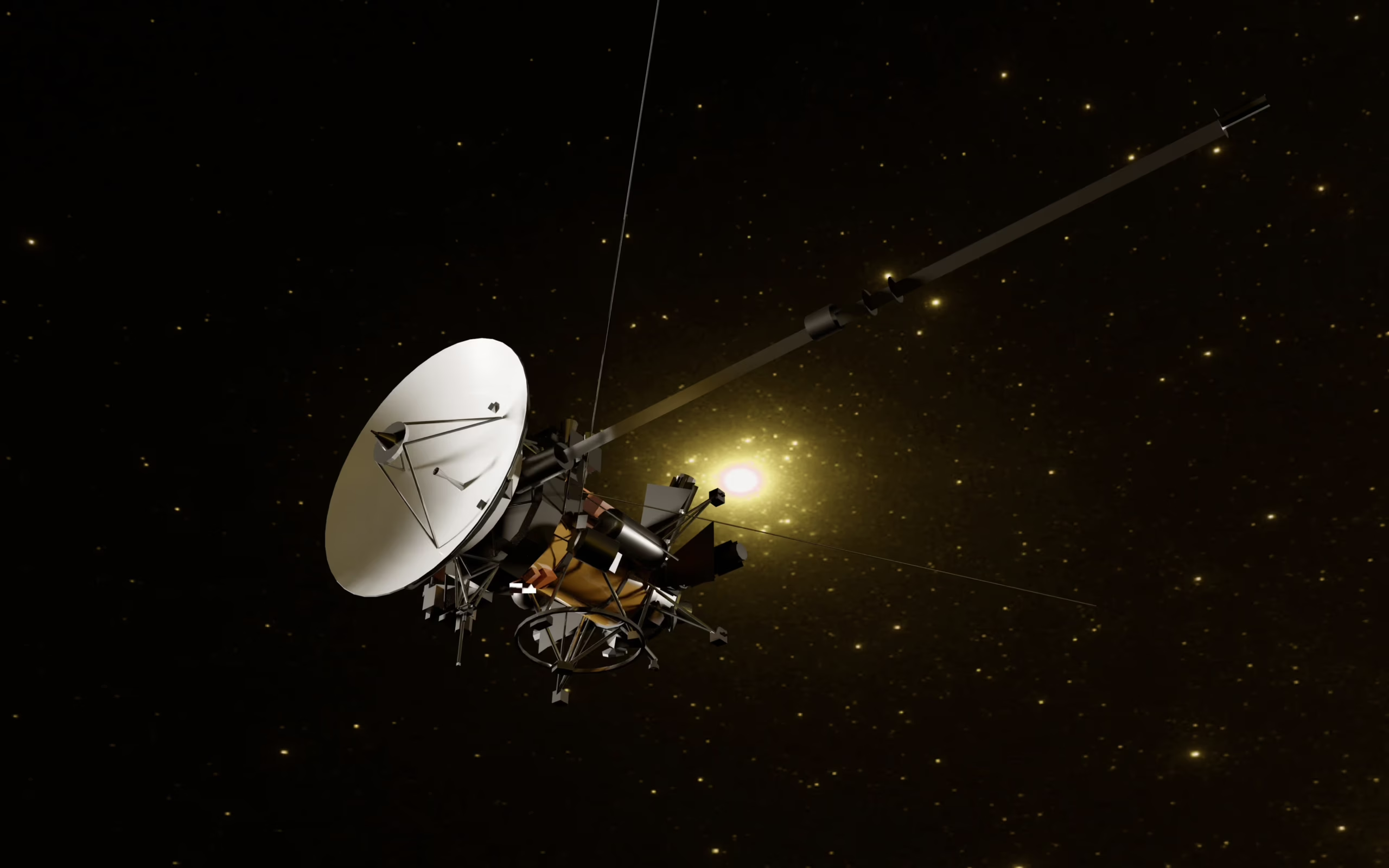
Voyager 2 is the only spacecraft in history to have flown through the heliopause — the boundary where the Sun’s outward-streaming solar wind yields to the interstellar medium — while carrying a functioning Plasma Science instrument. That single fact explains why engineers at JPL, which manages the Voyager mission for NASA, fought to recover power from a previously untapped voltage reserve aboard the spacecraft rather than accept the loss of another science instrument. They were not simply extending a historic mission for sentimental reasons. They were preserving humanity’s only active, in-situ sensor on the far side of the solar system’s edge, at a moment when no replacement is anywhere near launch.
The engineering challenge driving this effort is unforgiving in its simplicity: Voyager 2’s nuclear power source loses roughly 4 watts of electricity per year, a slow and physics-mandated decline that forces mission controllers to choose, repeatedly, between keeping the spacecraft warm enough to survive and keeping its science instruments switched on. The power fix confirmed by NASA and JPL — recovering usable electricity from a previously locked protective reserve — temporarily inverts that trend, buying the mission additional operational time without requiring another instrument shutdown.
What Powers a Spacecraft 13 Billion Miles From the Sun

Voyager 2 carries no solar panels. At interstellar distances, sunlight is roughly 1,800 times fainter than at Earth, making photovoltaic power completely impractical. Instead, the spacecraft runs on a Radioisotope Thermoelectric Generator, or RTG — a device that converts heat produced by the natural radioactive decay of plutonium-238 directly into electricity through the Seebeck effect. There are no moving parts, no combustion, and no conventional batteries. There is only the steady, irreversible release of nuclear energy, slowly winding down.
Plutonium-238 has a half-life of approximately 87.7 years, meaning the material loses roughly half its radioactive potency over that span. Because Voyager 2 launched in 1977, its RTG has been operating for nearly five decades — long enough that usable electrical output has declined substantially from the approximately 470 watts available at launch. Today, engineers estimate the RTG produces roughly 70 watts or fewer, spread simultaneously across every system on the spacecraft: science instruments, the telecommunications array, and the heaters that keep sensitive electronics above their minimum survivable temperature in an environment that hovers near minus 270 degrees Celsius.
That is less electricity than a standard incandescent light bulb, divided among systems that are each individually critical to the mission’s survival. The power budget is allocated across three broad categories — science instruments, thermal heaters, and communications — and any watt freed from one category becomes a watt available to another. That arithmetic has governed every major engineering decision on Voyager 2 for decades, and it is the arithmetic the 2025 fix directly improves.
Creative resource reallocation has always been part of this mission’s survival strategy. In 1998, engineers switched off nonessential instruments to redirect dwindling electricity toward the systems that mattered most. The 2025 power recovery builds on that same philosophy, but in reverse: rather than surrendering capability, engineers recovered it.
How JPL Engineers Unlocked the Hidden Reserve
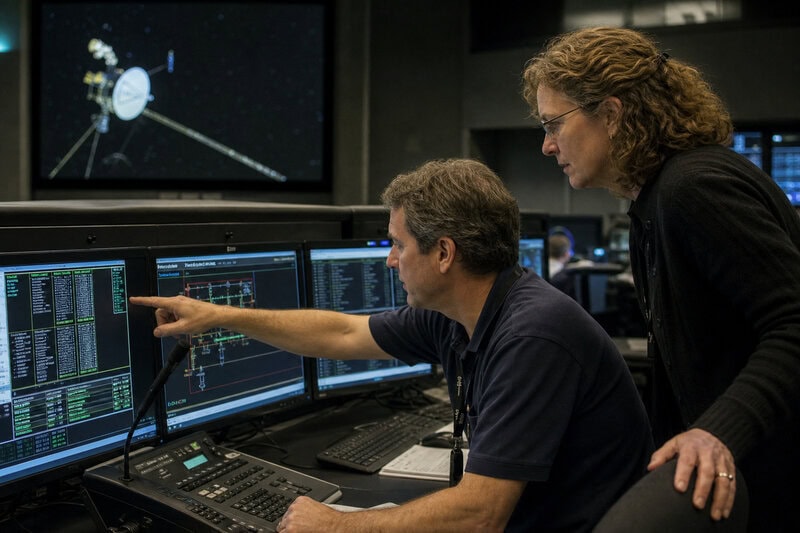
According to NASA and JPL, engineers identified a voltage-regulating safety mechanism aboard Voyager 2 that had been holding a small reserve of power as a protective buffer. By carefully adjusting how that mechanism operates, they redirected those watts back into the spacecraft’s active power supply without compromising the systems the safeguard was originally designed to protect. The confirmed result is that science instruments which would otherwise have required shutdown — to keep the spacecraft thermally stable within its shrinking power budget — can instead remain operational.
The difficulty of executing such a maneuver across interstellar distances cannot be overstated. Every command sequence must be meticulously validated on Earth-based simulators before transmission, because the one-way signal delay of approximately 18.5 hours means a round-trip communication takes roughly 37 hours. Engineers send a command and then wait more than a day and a half to learn whether it worked — with no ability to intervene in real time if something goes wrong. The successful execution of the power fix represents a significant feat of planning, institutional knowledge retention, and precise command sequencing under conditions that offer no margin for improvisation after the fact.
What remains uncertain is how much additional time the fix has purchased. NASA has not specified a new projected end date for the science mission. Voyager 2’s longevity will continue to depend on the RTG’s ongoing power decline, the health of individual instruments, and future engineering decisions by a team that regularly devises solutions to problems no one anticipated when the spacecraft was designed in the early 1970s.
What Voyager 2 Is Actually Measuring — and Why the Data Cannot Be Replicated
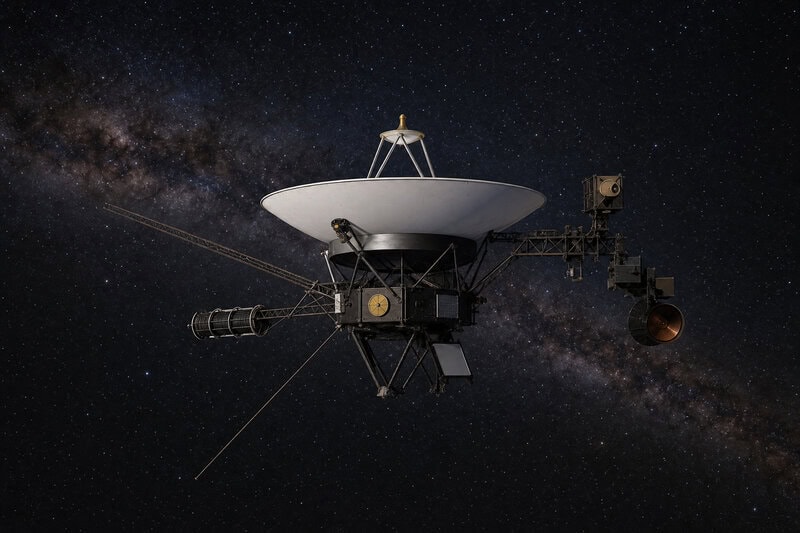
The interstellar medium, or ISM, is the diffuse material — gas, dust, and charged particles — that fills the space between star systems. It is the environment Voyager 2 entered after crossing the heliopause in December 2018, becoming the second human-made object to reach interstellar space, following Voyager 1’s crossing in 2012. Both crossings confirmed the heliopause’s existence as a physical boundary, but the precise structure, thickness, and variability of the heliosheath — the turbulent transition region just inside the heliopause — remains an active area of research that Voyager 2’s ongoing data continues to characterize.
The reason Voyager 2’s contribution is genuinely irreplaceable comes down to instrument history. Voyager 1 is farther from Earth and crossed into interstellar space first, but its Plasma Science instrument failed due to a hardware problem in 1980. Voyager 2’s Plasma Science instrument still functions. That means Voyager 2 can directly measure the density, temperature, and velocity of plasma particles in the ISM — measurements no other spacecraft is currently positioned to collect. Every data transmission from Voyager 2 represents humanity’s only direct, in-situ observations from that region of space.
Researchers are using those measurements to study how the Sun’s heliosphere — the vast bubble of solar wind surrounding our solar system — interacts with interstellar material. The scientific implications extend well beyond academic interest. Understanding heliospheric structure informs models of cosmic ray shielding relevant to long-duration human spaceflight planning, and it provides a comparative framework for understanding stellar wind dynamics around other stars, contributing to broader knowledge of how stars and the interstellar environment interact across the galaxy.
The Thermal Cliff: Why Every Watt Is a Crisis Deferred
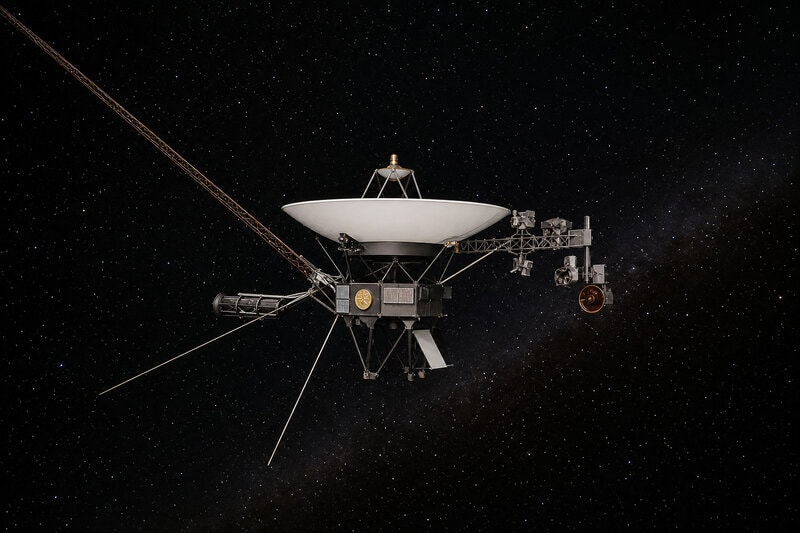
The cascading risk embedded in Voyager 2’s power situation is not a gradual fade to silence. It is a potential cliff. As available power drops, engineers approach a thermal tipping point: if heater power falls too far, science instruments can suffer irreversible cold-damage, ending the mission abruptly rather than gradually. The 2025 power fix matters precisely because it creates additional buffer against that threshold, reducing the likelihood that engineers will be forced into an emergency instrument shutdown to prevent permanent hardware damage.
The pattern of conservation decisions across the mission’s lifetime illustrates how narrow the margins have become. The 1998 instrument shutdowns were followed by further power-conservation steps in subsequent years, each one narrowing the spacecraft’s scientific capability while extending its operational life. That pattern reflects a deliberate mission philosophy of managed decline — preserving the most scientifically valuable systems for as long as possible while accepting the loss of lower-priority capabilities. The 2025 fix is significant precisely because it represents a departure from that pattern, recovering power rather than ceding it.
NASA has not publicly committed to a specific end date for Voyager 2’s science mission. Estimates within the scientific community have generally pointed toward the late 2020s as a realistic horizon, though those projections carry significant uncertainty and depend on variables that remain partially outside engineers’ control.
The Human Challenge: Engineering Across Time and Distance
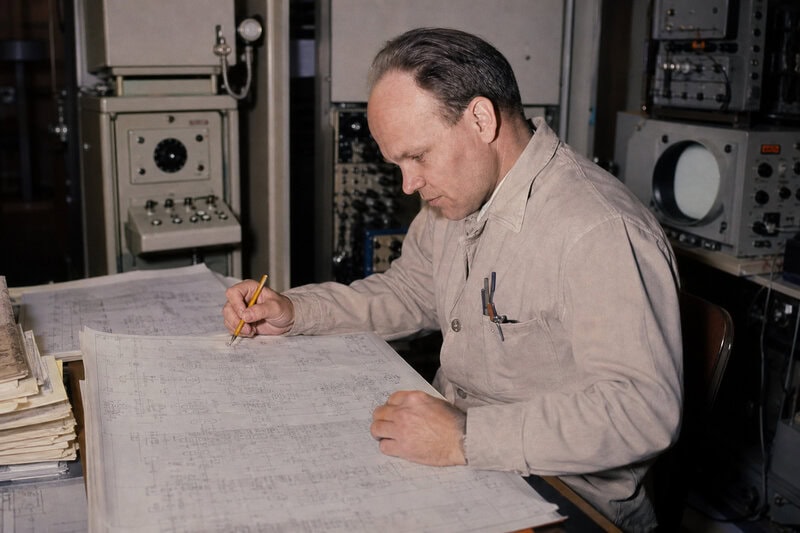
There is a generational dimension to this work that is easy to overlook. Many of the engineers who designed Voyager 2’s original systems are no longer professionally active, meaning today’s JPL team works from decades-old documentation — some of it on paper — to understand a spacecraft whose architecture predates the personal computer era. The command language used to communicate with Voyager 2 is a legacy system maintained specifically for this mission, one that has outlived the technological context in which it was built.
The 18.5-hour one-way signal delay defines the entire rhythm of mission operations. JPL’s controllers compose command sequences, transmit them, and then wait nearly two days for a reply. That constraint demands exceptional precision before transmission and an unusual professional tolerance for uncertainty afterward — careful preparation followed by patient waiting, with no opportunity for real-time correction if something goes wrong.
JPL’s ability to execute the 2025 fix reflects a deliberate institutional policy of knowledge preservation. NASA has maintained active mission teams for both Voyager spacecraft because the scientific return from interstellar space has consistently justified the operational cost. Without that sustained investment in people, documentation, and simulator infrastructure, the voltage reserve would have remained permanently inaccessible — known, if at all, only as a footnote in an aging engineering manual.
What Happens When Voyager 2 Eventually Goes Silent
NASA has not approved a successor mission designed to follow Voyager 2’s trajectory into the interstellar medium. A dedicated Interstellar Probe concept was assessed during NASA’s 2023-2032 Planetary Science Decadal Survey, but no such mission has been approved for development. Even if funding were committed today, it would take decades for any new spacecraft to reach the distances Voyager 2 currently occupies. When Voyager 2 eventually goes silent, humanity will lose its only direct sensor in the interstellar medium for the foreseeable future — a fact that gives urgency to every additional month of data the spacecraft can still return.
By recovering usable power from a previously locked voltage reserve, JPL engineers have extended the operational life of the only in-situ instrument humanity has on the far side of the heliopause. The precise scientific value of that additional time — measured in months or years of plasma measurements, magnetic field readings, and particle counts — will not be fully understood until researchers have had years to analyze what Voyager 2 continues to send back across 13.3 billion miles of space.
The engineering achievement is real, the scientific stakes are high, and the timeline remains genuinely uncertain. But for now, a spacecraft launched before the first space shuttle flight, before the fall of the Berlin Wall, before the World Wide Web existed, is still calling home — and the scientists and engineers who listen are still learning from what it says.