
They lay in one of the world’s most inhospitable deserts, nearly 4,000 years old and almost perfectly preserved — reddish-blonde hair still braided, faces angular and pale, bodies tall by the standards of any ancient population. When archaeologists first pulled the Tarim Basin mummies from the sands of what is now China’s Xinjiang region, the instinct was immediate: these people must have come from Europe. That instinct, it turned out, was wrong in the most illuminating way possible.
The Faces That Rewrote a Map
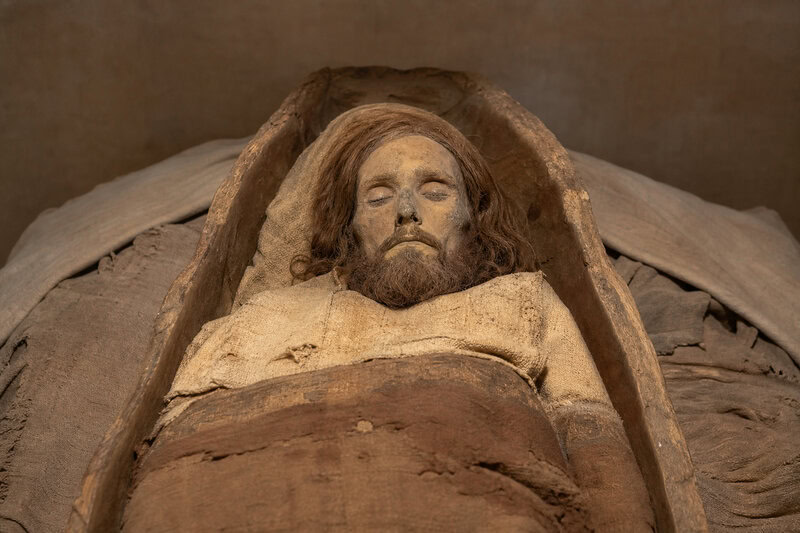
For much of the twentieth century, the mummies discovered in China’s Tarim Basin were treated as archaeological proof of long-distance migration — wanderers from the western steppes or even Europe itself who had pushed east along routes that would later become the Silk Road. Their light hair, tall frames, and facial structures seemed to demand a western origin. The assumption was logical, widely published, and, as a landmark 2021 genomic study in Nature demonstrated, fundamentally incorrect.
The study revealed that the Tarim Basin mummies were not migrants from anywhere. They were local — descended from an ancient genetic lineage that had been isolated in Central Asia for thousands of years, with no detectable ancestry from European or western steppe populations. Nearly a century of confident origin theories collapsed against a single dataset of ancient DNA.
The core lesson embedded in that finding extends far beyond one archaeological site: physical appearance is not ancestry. The Tarim mummies are the most dramatic example in the current archaeological record of why that distinction matters, and of what genomic science can reveal when our eyes mislead us.
Who Were the Tarim Mummies? Setting the Scene

The Tarim Basin occupies a vast desert depression in Xinjiang, ringed by mountain ranges including the Tian Shan to the north and the Kunlun to the south. The basin’s extreme aridity — in places among the driest on Earth — creates conditions that preserve organic material with extraordinary fidelity. Skin, wool clothing, wooden grave goods, and, most strikingly, human hair have survived nearly four millennia in a state that would be impossible in wetter climates.
It is that hair, ranging in color from blond to red to deep brown, that made the mummies internationally famous. Paired with tall statures and facial bone structures that researchers associated with European rather than East Asian populations, the physical evidence seemed to point unmistakably westward. Ancient mummies with apparently European features found deep inside China became a recurring headline across decades of popular coverage, each one reinforcing the assumption that these were outsiders.
Mummies began surfacing in the late nineteenth and early twentieth centuries, drawing archaeologists from Europe and China alike. Excavations continued throughout the twentieth century, gradually producing a substantial body of human remains and associated artifacts. The question of who these people were — and where they came from — became one of Bronze Age archaeology’s most contested puzzles, touching live debates about the spread of languages, technologies, and cultures across Eurasia.
The Old Theory: Westward Wanderers Who Headed East

The dominant pre-genomic hypothesis held that the Tarim mummies were Indo-European-speaking migrants who had traveled east from the Pontic-Caspian steppe, the vast grasslands stretching north of the Black Sea. The most compelling candidate for their ancestors was the Yamnaya culture — a Bronze Age steppe society dating roughly to 3000-2500 BCE that geneticists and archaeologists have identified as a primary engine for spreading Indo-European languages and herding cultures both into Europe and across Central Asia.
The Yamnaya connection seemed to have genuine supporting evidence. Burial practices at Tarim sites shared features with steppe traditions. The presence of wheeled vehicles and domesticated horses — both strongly associated with Yamnaya culture — added to the circumstantial case. Skeletal morphology studies further suggested affinities with western Eurasian populations rather than eastern ones.
This theory was not fringe speculation. It was widely taught, peer-reviewed, and cited across the disciplines of archaeology, linguistics, and physical anthropology for decades. That context makes the 2021 genomic results genuinely disruptive — not merely a refinement of existing knowledge, but a direct challenge to an established scientific consensus.
What the DNA Actually Showed: A People Apart
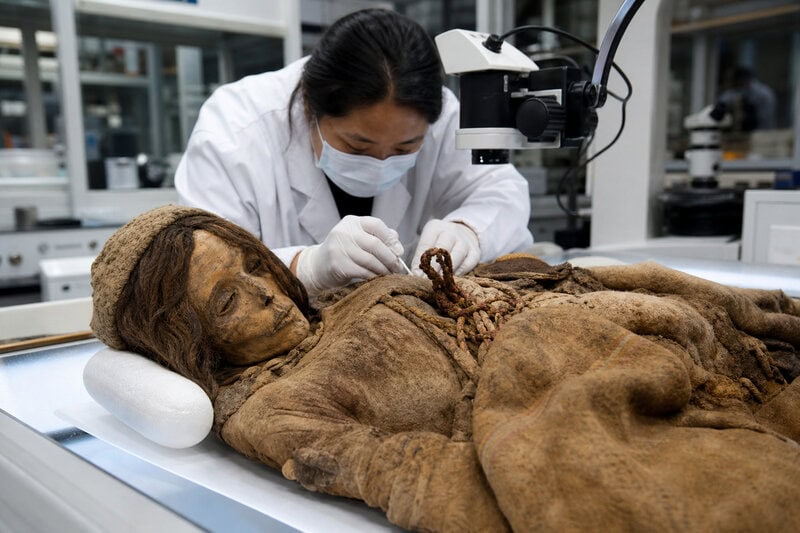
The 2021 study, published in Nature and led by researchers including teams from the Max Planck Institute for Evolutionary Anthropology, sequenced the genomes of 13 Tarim Basin mummies and compared them against dozens of ancient and modern reference populations from across Eurasia. The headline result was unambiguous: the Tarim mummies showed no detectable ancestry from the Yamnaya steppe groups or from early East Asian populations.
Instead, their ancestry traced entirely to an Ancient North Eurasian (ANE) population — a now-extinct genetic lineage identified only through ancient DNA, ancestral to many Eurasian groups but not directly represented in any living population today. The ANE lineage is, in effect, a ghost population: we know it existed because its genetic signal appears in ancient genomes, but it has no direct living descendants as a distinct group.
More striking than the ancestry itself was the isolation finding. The Tarim mummies appear to be the last known survivors of an ANE-derived group that remained genetically sealed — showing no significant intermarriage with surrounding peoples — even as neighboring Bronze Age cultures were mixing extensively across Eurasia. At a time when genetic exchange between distant populations was accelerating across the ancient world, the people of the Tarim Basin remained apart, a living relic of a much older genetic order.
Researchers discussing the findings on specialist archaeology forums noted that the degree of isolation was itself one of the study’s most surprising conclusions — the mummies were not just unrelated to proposed western migrants, they were essentially unrelated to any neighboring population of the period.
The Yamnaya Twist: A Surprising Genetic Overlap

The story carries one counterintuitive wrinkle that prevents a clean, simple narrative. Even though the Tarim mummies are not descended from the Yamnaya, the ancestral lineage of the Tarim people made up about 50% of the Yamnaya’s own genetic makeup. This reshapes the relationship between the two groups entirely.
Rather than a parent-child relationship — the Yamnaya producing the Tarim people or vice versa — the two groups are more accurately understood as genetic cousins. The ANE-derived lineage that produced the Tarim mummies was also a major founding source population for the Yamnaya. Both groups share a common ancient ancestor, but that ancestor predates either group’s existence as a distinct culture, and no evidence of direct historical contact between them has been identified.
This distinction matters and deserves precision: the Tarim people did not contribute to Yamnaya populations through migration or intermarriage during the Bronze Age, nor did the Yamnaya contribute to theirs. The genetic relationship is ancestral, operating at a timescale far deeper than any historical encounter could account for. How and when the ANE lineage divided into the branch that remained isolated in Central Asia versus the branch that fed into the steppe Yamnaya remains an open question — one that future ancient DNA studies, as sequencing costs continue to fall, are well positioned to address.
Why Do They Look European? Unpacking Appearance Versus Ancestry
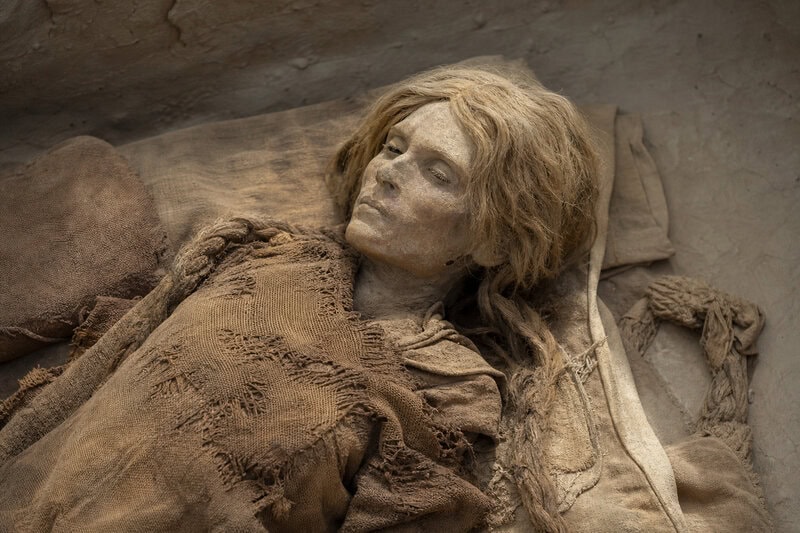
The most intuitive question for any reader encountering this story is also the most important one to answer carefully: if the Tarim mummies are not from Europe, why do they have blond and red hair, lighter skin tones, and facial features so consistently associated with European populations?
The scientific answer rests on a fundamental principle of genetics: traits like light hair pigmentation and certain facial bone structures are controlled by a relatively small number of genes, and those genes were present in the ANE population ancestral to the Tarim mummies long before European populations, as we know them today, existed as a distinct genetic group. Light coloring did not originate in Europe — it evolved across multiple lineages under shared selective pressures, and the ANE ghost population carried many of the same genetic variants for these traits independently.
Physical appearance, in other words, can converge across genetically unrelated or distantly related groups. It is shaped by a handful of genes under strong evolutionary selection and is a poor proxy for deep ancestry. Genomic research across multiple ancient populations — including earlier DNA analyses of Tarim individuals that hinted at the complexity later confirmed by full genome sequencing — has reinforced this point repeatedly.
There is also a preservation factor that amplifies the visual impression. The extreme aridity of the Tarim Basin preserved hair pigment and texture in a way that most ancient burials cannot. A mummy with intact reddish-blonde braids makes an indelible impression precisely because such preservation is so rare. That vividness can distort interpretation, making superficial similarities to modern Europeans feel more diagnostically meaningful than they actually are.
What Remains Open: Unresolved Questions and Why They Matter
The current scientific consensus, anchored by the 2021 Nature study, is clear: the Tarim Basin mummies are an indigenous Bronze Age people descended from a long-isolated ANE lineage. They are not migrants from Europe, not Yamnaya descendants, and not travelers from the east. This finding is not in serious dispute within the relevant scientific community.
What remains genuinely open is substantial. Researchers do not yet know what language the Tarim people spoke, whether they were the origin point or the inheritors of the distinctive material culture found in their graves, or precisely when and how their ANE ancestor population became geographically and genetically isolated from other ANE-derived groups spreading elsewhere across Eurasia. Answering those questions will require additional ancient genomes, more refined archaeological analysis, and potentially the recovery of ancient linguistic evidence — an unlikely but not impossible outcome given the basin’s exceptional preservation conditions.
The stakes extend well beyond academic archaeology. The Tarim Basin sits at the crossroads of routes along which languages, technologies, and belief systems diffused across the ancient world. Understanding who actually lived there during the Bronze Age rewrites the logistical map of that diffusion — it changes which groups could plausibly have transmitted which cultural innovations to which neighbors, and when. The mummies are not merely a curiosity of preservation; they are a data point about the deep structure of Eurasian prehistory.
Almost a century after their first discovery, the Tarim mummies continue to produce results that revise what researchers thought they knew. With whole-genome sequencing costs falling, new excavations ongoing, and analytical methods improving steadily, the Bronze Age history of Central Asia is almost certainly not finished surprising us. The people buried in China’s driest desert, their hair still intact after nearly four millennia, have more to say.