
Eight hours. That is the precise window separating an astronaut from the void of open space — the total life-support capacity built into NASA’s Extravehicular Mobility Unit before oxygen runs out, cooling fails, and battery power dies. On July 27, 2026, NASA announced it will host a spacewalk preview news conference at 2 p.m. EDT on Thursday, July 30, from Johnson Space Center in Houston, ahead of three US spacewalks planned for August 2026 — each one a carefully choreographed race against those finite consumables.
What NASA Is Planning: Three Spacewalks and a Public Briefing
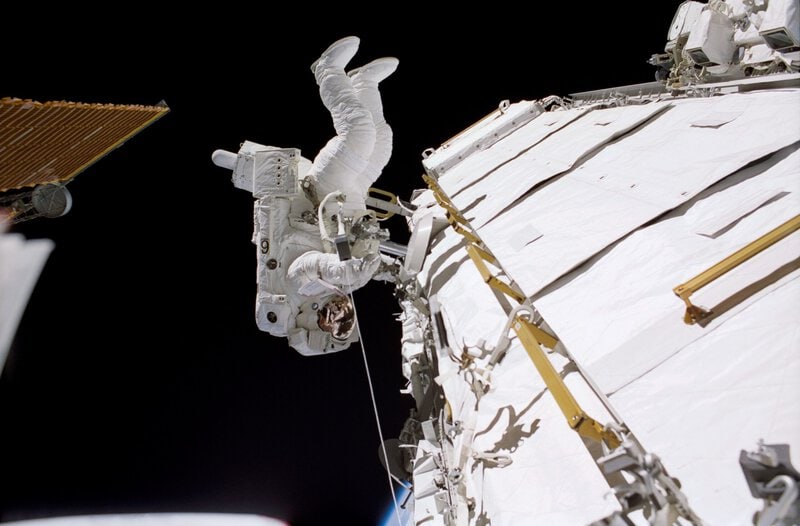
NASA will provide live coverage as astronauts venture outside the International Space Station during three separate spacewalks across August 2026. The details — crew assignments, specific objectives, and contingency procedures — will be publicly walked through at the July 30 news conference, where flight controllers, suit engineers, and crew members are expected to participate. NASA’s official news release, published July 27, 2026, confirms the briefing originates from Johnson Space Center, the operational hub for all US extravehicular activity (EVA) planning.
Each US spacewalk follows a highly choreographed sequence vetted by NASA’s EVA Office, which has overseen more than 260 ISS spacewalks since the station’s first assembly EVA in December 1998. Upcoming EVA objectives typically include hardware installation, maintenance of external science payloads, and thermal system upgrades — work that cannot be performed robotically or from inside the station. Additional scheduling context for the August EVAs reflects how tightly these operations are sequenced within the station’s ongoing maintenance calendar.
The Suit as Spacecraft: How the EMU Keeps Astronauts Alive

NASA’s Extravehicular Mobility Unit is not clothing. It is a self-contained spacecraft comprising 14 pressurized layers, a life-support backpack called the Primary Life Support Subsystem (PLSS), and a heads-up display inside the helmet visor. Understanding how it works is essential to understanding why every EVA carries inherent operational risk — and why the eight-hour ceiling is not arbitrary.
The PLSS supplies pure oxygen at approximately 4.3 pounds per square inch (psi) — roughly 30 percent of Earth’s sea-level atmospheric pressure. That level is enough to sustain respiration and maintain joint mobility, while deliberately omitting the nitrogen that makes up 78 percent of the air breathed on the ground. Nitrogen, useful at sea level, becomes a physiological hazard in the transition to near-vacuum conditions.
Thermal regulation is handled by a sublimator inside the PLSS, which converts a small reservoir of water into ice to dump the waste heat generated by the astronaut’s working body. Outside the ISS, temperatures swing from approximately +250 °F in direct sunlight to -250 °F in shadow, sometimes within minutes as the station passes in and out of Earth’s shadow every 45 minutes. The suit must counteract both extremes simultaneously.
According to NASA’s Human Research Program, the EMU’s consumables are sized for a nominal six-to-six-and-a-half-hour EVA with roughly 30 minutes of emergency reserve. That math produces the widely cited eight-hour maximum — a hard operational ceiling, not a guideline.
The Physics of Surviving Open Space

Without pressurization, the human body would experience ebullism — the boiling of bodily fluids caused by near-zero ambient pressure — within seconds. The EMU’s pressurized shell prevents this entirely. This is why a suit breach, even a small one, is classified as an immediate life-threatening emergency requiring rapid airlock return.
The suit’s outermost layer, the Thermal Micrometeoroid Garment (TMG) — visible in photographs as the bright white exterior — uses aluminized Mylar and woven Kevlar to reflect solar radiation and resist puncture from micrometeoroids traveling at up to 17,500 mph. The visor assembly incorporates a gold-coated polycarbonate sun filter that blocks ultraviolet and infrared radiation, adapted for the harsher solar environment of low Earth orbit.
Galactic cosmic rays and solar particle events pose a radiation dose risk that EVA suits cannot fully shield against. NASA’s Space Radiation Laboratory at Brookhaven National Laboratory continues to study cumulative dose limits for career astronauts — this remains an area of active research, and EVA scheduling accounts for solar weather forecasts to minimize peak exposure during each sortie.
The Hidden Hours Before Any EVA: The Prebreathe Protocol
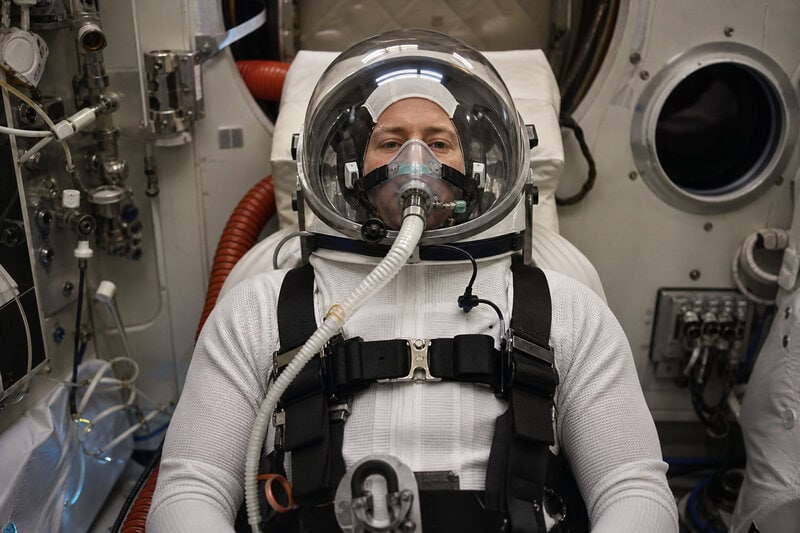
What the public rarely sees is the preparation that precedes every spacewalk by several hours. Before any EVA, astronauts spend up to four hours breathing pure oxygen to purge dissolved nitrogen from their bloodstream. Skipping or shortening this step risks decompression sickness — commonly called “the bends” — the same condition that endangers deep-sea divers who ascend too quickly. At the EMU’s operating pressure of 4.3 psi, any residual nitrogen in the blood can form dangerous bubbles in joints and tissues.
NASA flight rules allow a shortened “campout” prebreathe protocol in which crew members sleep overnight in the Quest airlock at a slightly reduced cabin pressure of 10.2 psi, cutting the morning prebreathe time to approximately 75 minutes. This campout approach has become operationally standard for ISS EVAs because it preserves crew schedule flexibility without compromising safety margins.
The prebreathe timeline is so operationally significant that it appears on the critical-path schedule for every ISS EVA planning document reviewed by the Mission Evaluation Room at Johnson Space Center. Emerging research from NASA’s Human Research Program suggests that prebreathe protocols may need to be recalibrated for next-generation suits operating at different pressure levels — a finding still under active review and not yet reflected in current flight rules.
ISS Spacewalk Science: Why Humans Still Go Outside
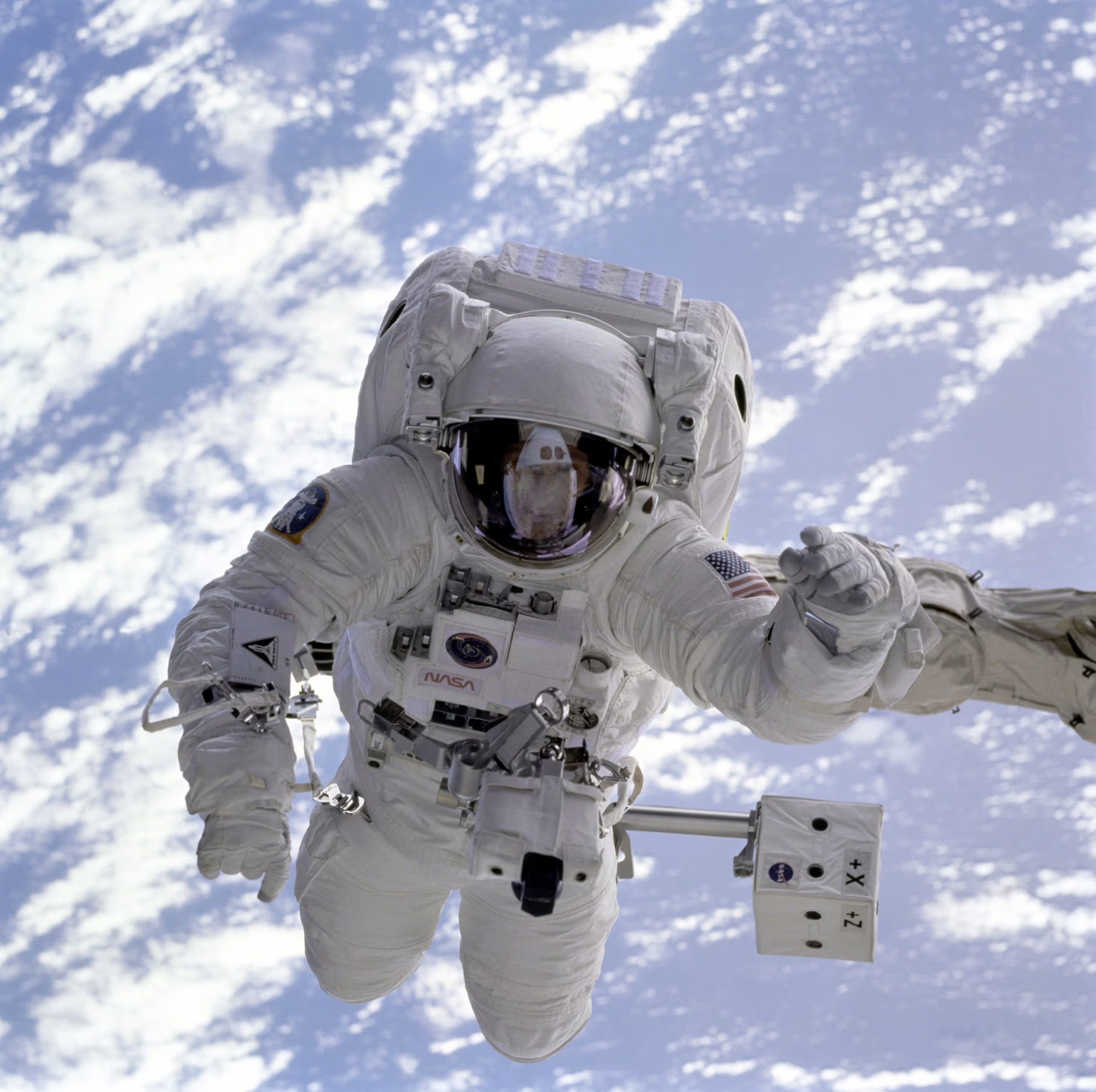
The ISS exterior hosts science experiments and technology demonstrations at any given time, many of which require hands-on installation, sample retrieval, or sensor realignment that exceeds the dexterity of the station’s Canadarm2 robotic arm. This is a core reason human EVAs remain irreplaceable despite advances in robotics.
EVA-deployed experiments have contributed to materials science, astrobiology — the study of life’s potential beyond Earth — and space weather monitoring, including the MISSE (Materials International Space Station Experiment) series, which has tested thousands of material samples in the actual space environment since 2001. That long-duration exposure data cannot be replicated in ground laboratories, making each EVA a scientific opportunity as much as a maintenance operation.
Astronaut situational awareness during an EVA — the capacity to improvise around unexpected hardware conditions in real time — remains a capability that robotic systems cannot yet replicate. Each of the three August 2026 spacewalks will likely generate procedural and engineering data relevant to NASA’s broader Moon-to-Mars strategy, since EVA suit technology and crew experience gained on the ISS directly inform Artemis lunar surface operations planning.
The Future of EVA Suit Technology
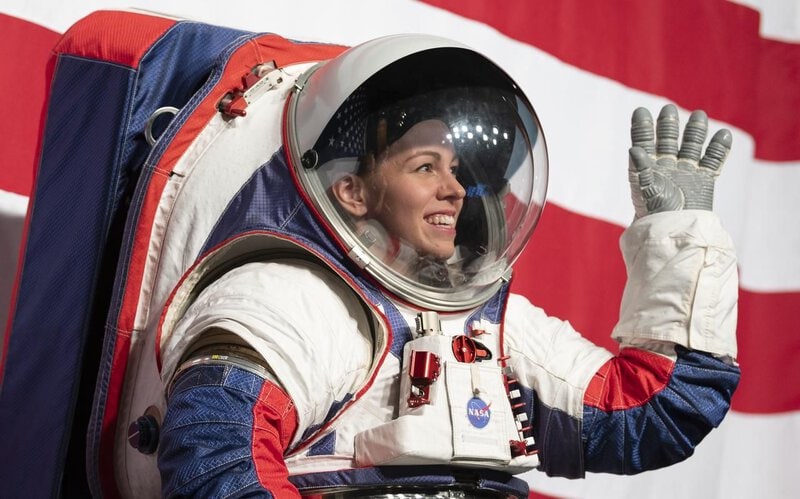
NASA’s next-generation Exploration Extravehicular Mobility Unit (xEMU), developed under the Artemis program, is designed to operate at a higher suit pressure of 8.3 psi. The key operational benefit: a higher operating pressure would eliminate the lengthy prebreathe requirement, potentially saving several hours of crew time per EVA. The xEMU has faced schedule delays and remains in certification testing as of mid-2026.
Axiom Space is developing the AxEMU suit for Artemis lunar surface EVAs under a NASA commercial contract. NASA has stated that competition between commercial suit providers is intended to accelerate innovation while reducing program risk — a departure from the agency’s historical practice of developing suits entirely in-house.
One unresolved design question within NASA’s EVA physiology community is whether future suits should prioritize mobility — favoring lower pressure and greater joint flexibility — or reduced prebreathe time, which favors higher pressure. The tradeoff has direct implications for how long astronauts can work productively on a lunar surface and how quickly they can respond to emergencies requiring rapid airlock return.
The three August 2026 ISS spacewalks, previewed at the July 30 Johnson Space Center news conference, will add to the operational EVA database that engineers use to validate life-support consumable models. That database ultimately informs mission planning for destinations far beyond low Earth orbit — where the eight-hour window, and everything engineered to sustain it, will matter even more. Community discussion of the NASA spacewalk announcement reflects broad public interest in both the near-term August missions and the longer arc of human spaceflight they represent.