
Salmon nigiri is today the single best-selling sushi topping in Japan. It appears on every menu, fills every supermarket tray, and carries the quiet authority of something that has always been there. It has not always been there. For virtually all of Japanese culinary history, placing raw salmon on rice would have been considered not merely unusual but genuinely dangerous. The tradition underpinning this now-iconic dish is barely thirty years old, and it traces its origins not to an Edo-period fish market but to a Norwegian government trade office facing a surplus crisis in 1986.
Why Japan Avoided Raw Salmon for Centuries
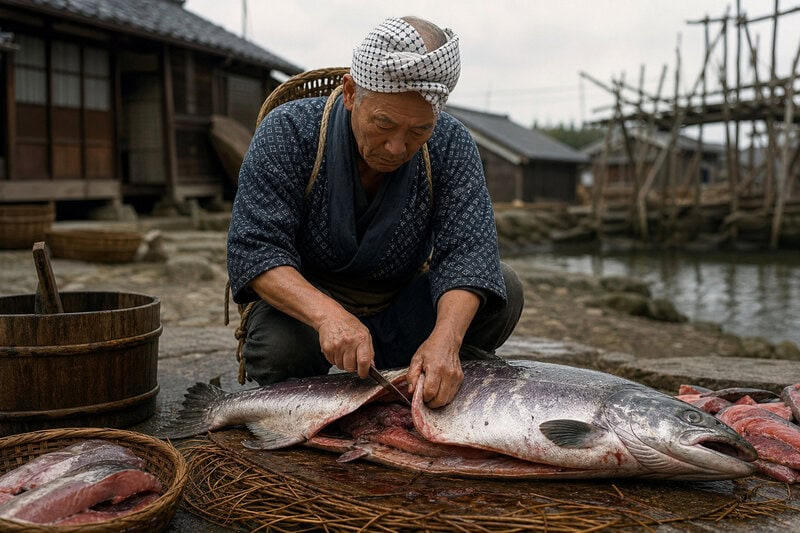
The prohibition on raw salmon in Japanese cuisine was not cultural squeamishness. It was an empirically grounded response to a genuine and well-documented public-health threat. The Pacific salmon species that migrate through Japanese waters — including chum, pink, and sockeye — carry a high burden of Anisakis, a genus of parasitic roundworm whose larvae can embed in the human stomach lining and cause severe illness. Clinicians call this condition anisakiasis. Its symptoms — intense abdominal pain, nausea, and vomiting — can appear within hours of eating infected fish, and in serious cases the larvae must be removed surgically or by endoscopy.
Japanese sushi masters developed their craft around this biological reality over centuries. Tuna, yellowtail, and sea bream were safe to serve raw because their parasite profiles were manageable within the context of careful sourcing and preparation. Salmon was explicitly excluded from the raw-fish canon and was instead eaten salted, grilled, or cured. The Japanese Ministry of Health historically warned consumers against eating raw salmon, and the professional sushi community treated the prohibition as settled food-safety knowledge rather than mere culinary preference. Until the 1990s, the Japanese simply did not eat raw salmon — a fact that surprises most contemporary sushi consumers, for whom the dish feels deeply traditional.
The biology behind this prohibition is straightforward. Anisakis parasites complete their life cycle through a chain of marine hosts — crustaceans, small fish, and finally large predatory fish or marine mammals. Wild fish that eat other wild fish accumulate larval worms in their flesh as they ascend this chain. This mechanism meant that wild Pacific salmon, feeding naturally in open water, were reliably contaminated. No amount of sushi-chef skill could change what the fish had eaten before it arrived at the kitchen.
Norway’s Surplus Crisis and the Birth of Project Japan

By the mid-1980s, Norway had industrialized Atlantic salmon aquaculture to the point of producing far more fish than its traditional European markets could absorb. The surplus created an urgent commercial problem: Norway needed a major new export destination. In 1986, the Norwegian Seafood Council launched what became known informally as “Project Japan,” a formal trade initiative that targeted the Japanese market as a potential outlet for the country’s excess farmed Atlantic salmon. The effort was led by trade negotiator Bjørn Eberg, whose persistence over the following years would prove decisive.
The Norwegian pitch met immediate and consistent rejection. Japanese importers, chefs, and government health officials all pointed to the same objection: salmon was not safe to eat raw, and there was no cultural appetite for it in a sushi context. As documented by Norwegian trade sources themselves, the initiative accumulated nearly a decade of rejections before any commercial breakthrough occurred.
What made the Norwegian position scientifically defensible — and ultimately persuasive — was a crucial biological distinction. Farmed Atlantic salmon (Salmo salar) raised in controlled sea-pen environments in Norwegian fjords were fed parasite-free pelleted feed rather than wild prey. Because they were excluded from the marine food chain that transmits Anisakis, they did not carry the parasite loads associated with wild Pacific salmon. Norwegian aquaculture authorities documented this low Anisakis prevalence in their farmed stock, providing the food-safety data that would eventually give Japanese health regulators and chefs a scientifically grounded reason to treat Norwegian farmed salmon differently from the Pacific wild salmon they had always avoided.
The Science Behind the Safety Argument
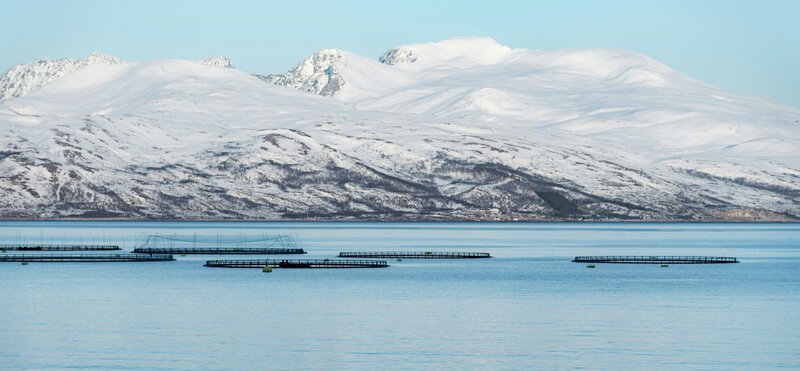
The distinction between Atlantic and Pacific salmon is not merely geographic. These are distinct genera — Salmo (Atlantic) and Oncorhynchus (Pacific) — with different ecological behaviors. More importantly for food safety, the real-world parasite burden of any salmon depends critically on how it is raised, not on species identity alone. A farmed Atlantic salmon fed manufactured pellets in a Norwegian fjord occupies an entirely different position in the parasite transmission chain than a wild sockeye feeding on krill and smaller fish in the North Pacific.
Food scientists note that freezing fish to minus 20 degrees Celsius for at least 24 hours also kills Anisakis larvae — a technique now codified in both European Union food-safety regulations and U.S. Food and Drug Administration guidance for raw fish consumption. Norway’s primary argument to Japanese regulators and wholesalers, however, was not that the problem could be managed after harvest through freezing. It was that the problem had been removed at the source, through aquaculture practice. The fish had never been exposed to the transmission chain in the first place. The story of how Norway gave the world salmon sushi is, at its core, a story about food-safety science enabling cultural change — not marketing overcoming scientific objection.
A Decade of Rejection, Then a Single Breakthrough
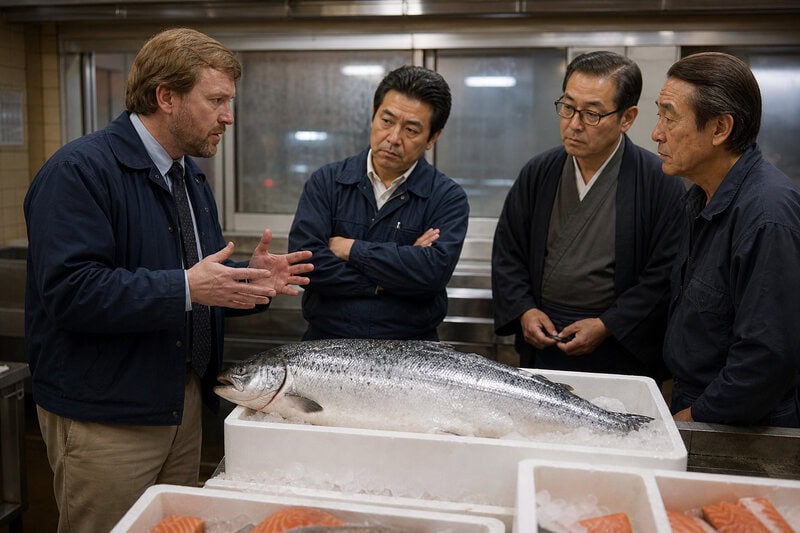
The Norwegian trade mission spent the better part of a decade accumulating rejections from Japanese wholesalers and sushi distributors. Negotiations repeatedly stalled over food-safety concerns and the complete absence of consumer demand for raw salmon. The turning point came in the early 1990s when a large Japanese food company — identified in trade accounts as Nichirei Corporation — agreed to purchase Norwegian salmon, initially for use in cooked preparations rather than raw sushi. The volume deal gave Norway a foothold, even if it fell short of the raw-sushi market it had originally targeted.
Consumer exposure through supermarket ready-meals and cooked salmon products gradually reduced psychological resistance to the fish itself. By the mid-1990s, raw Norwegian salmon was beginning to appear in sushi restaurants and supermarket sushi packs. Uptake accelerated once early adopters reported positive experiences and suffered no ill effects — practical confirmation that the food-safety argument had been sound. By all credible accounts, sushi with salmon is a product of a Norwegian trade and marketing effort, not an organic evolution of Japanese culinary tradition.
By the late 1990s and into the 2000s, salmon had risen from a curiosity to the top of sushi popularity rankings in Japan. The transformation in cultural preference took roughly one decade from first commercial acceptance — an extraordinarily compressed timeline for a change of this magnitude in a cuisine as codified and tradition-conscious as Japanese sushi.
How a Trade Campaign Becomes an ‘Ancient’ Tradition
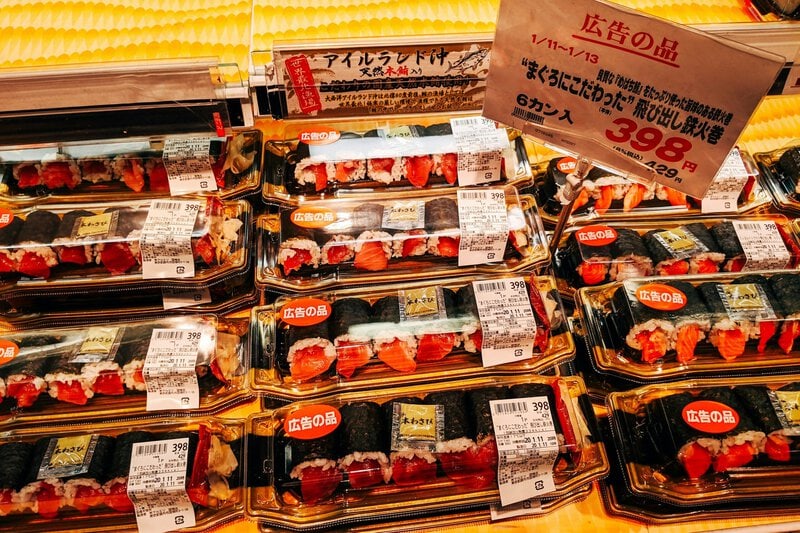
Researchers who study food culture observe that within a single generation, a novel food can acquire the subjective feeling of deep tradition — particularly when it is consumed in a ceremonially loaded context. A sushi restaurant carries centuries of ritual weight in its presentation, its vocabulary, and its social etiquette. When raw salmon entered that context in the 1990s, it inherited that aura of antiquity even though the ingredient itself was brand new to the setting.
Salmon sushi’s rapid normalization was amplified by Japan’s efficient food-media ecosystem. Food television, restaurant guides, and supermarket marketing all treated salmon as an established sushi item within years of its commercial introduction, with little reference to its recent and foreign-influenced origins. As ABC News Australia has noted, it is a little-known fact that salmon sushi was once actively unpopular in Japan before Norwegian trade efforts changed that reality. The Norwegian origin is now a well-documented case study in food diplomacy and export strategy, discussed in business schools and acknowledged openly by the Norwegian Seafood Council — yet it remains almost entirely unknown to the Japanese and international consumers who order the dish every day.
Food anthropologists use the term “invented tradition” — a concept formalized by historians Eric Hobsbawm and Terence Ranger in their 1983 edited volume of the same name — to describe practices that feel ancient but are demonstrably recent constructions, often serving specific political or commercial interests. Salmon sushi is among the most thoroughly documented examples of the phenomenon in modern food history: a dish with a traceable birth year, a named architect, and a paper trail of trade negotiations, now consumed by millions as though it has always existed.
Three Lessons That Extend Beyond the Dish
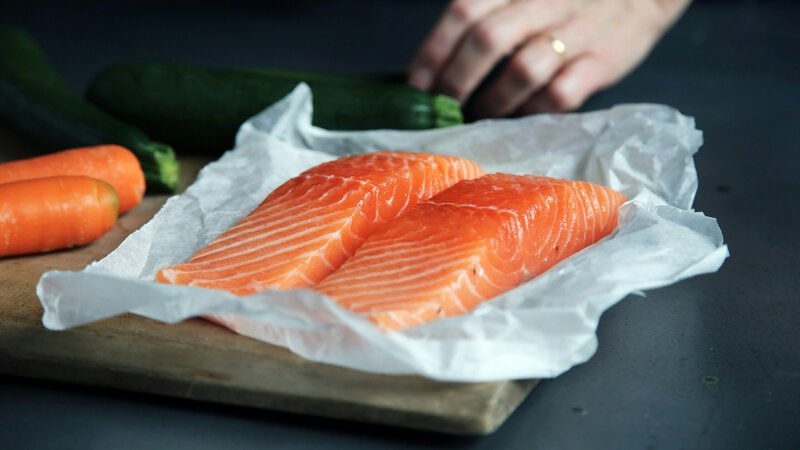
The salmon sushi story carries implications that reach well beyond Japan or Norway. The first is that food-safety science — not marketing persuasion alone — is what makes cultural food change durable. Without the verifiable low-parasite profile of Norwegian farmed Atlantic salmon, no advertising campaign could have overcome Japan’s well-founded historical prohibition. The science had to be real, and it had to be communicated credibly to regulators and professional chefs, before any commercial or cultural shift became possible. The marketing followed the science; it did not substitute for it.
The second lesson concerns aquaculture’s capacity to dissolve public-health constraints on culinary tradition. The Norwegian salmon model demonstrated that the question of whether a fish is safe to eat raw is not fixed by species identity but is substantially determined by how that fish was raised. This dynamic has significant ongoing relevance as fish farming expands globally and new species become candidates for raw consumption in contexts where they were previously excluded.
The third lesson is a corrective to everyday assumptions about food tradition. Some of the most confidently performed culinary traditions are recent, contingent, and driven by economic forces entirely remote from the culture that adopted them. Salmon sushi is not Japanese in its origins in the specific sense that its existence as a raw preparation was made possible by Norwegian aquaculture science and willed into being by Norwegian trade strategy. The dish that feels most quintessentially Japanese at the sushi counter was engineered into existence by a Scandinavian government agency managing a fish surplus.
Salmon sushi’s trajectory — from a Norwegian surplus problem in 1986 to Japan’s most popular sushi topping by the early 2000s — may be the clearest modern example of how a single, well-resourced trade initiative, backed by credible food science and sustained through years of rejection, can permanently and almost invisibly alter the food culture of an entire nation. Until the 1990s, the Japanese did not eat raw salmon. The dish tastes ancient. It is not.