
Florida’s rocket launch schedule this week centers on a single SpaceX mission: the NROL-95 Falcon 9 launch from Cape Canaveral, opening its window at 3:09 AM EDT on July 30, 2026. For sky-watchers across the Southeast, it is also one of the more visually striking launches of the summer — a pre-dawn liftoff with a ground landing recovery, producing two separate light-and-sound events within eight minutes of each other.
NROL-95: The Only Florida SpaceX Launch This Week
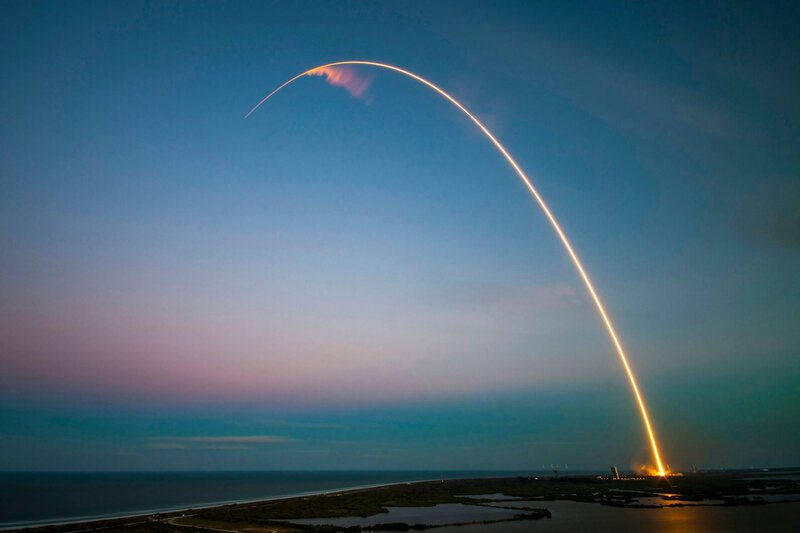
The NROL-95 mission carries a classified payload for the National Reconnaissance Office on a Falcon 9 Block 5 rocket. The launch window opens at 3:09 AM EDT (07:09 UTC) on July 30, 2026, from Space Launch Complex 40 at Cape Canaveral Space Force Station. Backup opportunities may exist later in the week, though NRO missions historically receive less public scheduling notice than commercial flights. Confirm the latest status at Visit Space Coast or SpaceX’s official launch page in the 24 hours before the window.
This is the only confirmed SpaceX launch from Florida on the manifest through the first week of August. For the week of July 28 through August 3, July 30 is the sole opportunity.
One feature makes NROL-95 particularly worth watching: the Falcon 9 booster is targeting a ground landing at a Landing Zone at Cape Canaveral rather than a droneship recovery at sea. The result for observers is a dual-event viewing window — the ascent plume followed by a booster return flight and a rolling sonic boom arriving at the coast approximately eight minutes after liftoff.
Coming Up After This Week
The Florida manifest beyond July 30 includes Starlink flights in early-to-mid August, with additional missions tracked on Spaceflight Now and Next Spaceflight. Dates for those missions remain subject to change. The Crew-13 crewed Falcon 9 mission is also on the broader Florida manifest for a future date. For a continuously updated view of all SpaceX launches, RocketLaunch.live and Space Launch Schedule are reliable references.
Why Pre-Dawn Launches Look the Way They Do
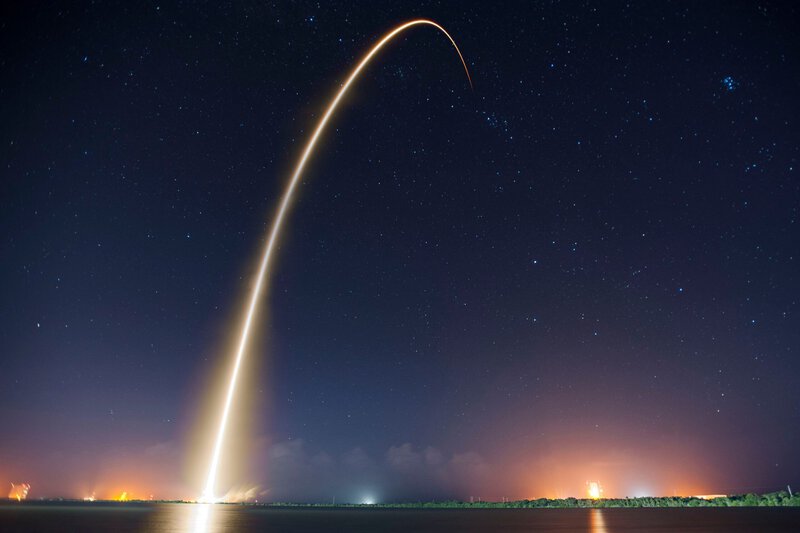
The glowing, twisting streak a Falcon 9 leaves across a dark Florida sky is not flame in the upper atmosphere. It is sunlight scattered by a cloud of ice crystals — and understanding four steps explains everything visible from the ground.
Step 1: Exhaust Chemistry
The Falcon 9’s Merlin engines burn RP-1 kerosene and liquid oxygen, producing an exhaust jet composed primarily of water vapor, carbon dioxide, and carbon soot. At sea level, this exhaust is narrow and contained. As the rocket climbs, the surrounding atmosphere thins rapidly, and the exhaust behavior changes entirely.
Step 2: Plume Underexpansion at High Altitude
Above roughly 40 kilometers, atmospheric pressure drops to the point where it can no longer contain the exhaust jet. The plume expands laterally — sometimes to diameters exceeding one kilometer — because the pressure inside the nozzle exit is higher than the surrounding air. Aerospace engineers call this condition plume underexpansion. It is the primary reason a Falcon 9 plume appears to bloom and widen dramatically in the upper atmosphere.
Step 3: Ice Crystal Formation and the Glow
As superheated water vapor exits the engines and enters stratospheric temperatures that can reach −60 °C (−76 °F), ice crystals form almost instantaneously. It is these ice crystals — not the rocket flame — that catch and scatter sunlight to produce the prolonged golden or white glow visible from the ground. The rocket itself has climbed into sunlight while observers at ground level remain in full darkness, creating a dramatic brightness contrast against the black sky. This geometric condition, sometimes called the twilight phenomenon, is why pre-dawn and post-dusk launches consistently produce the most dramatic plume displays.
Step 4: The Spiral Shape
The corkscrew or spiral pattern common in Florida Falcon 9 launches occurs when the rocket executes a programmed roll maneuver to align its trajectory with the target orbital plane. The rotating exhaust column freezes into a helical structure as it disperses through thinning air. The shape is not random — it is a direct, readable record of the rocket’s commanded attitude changes, encoded in ice and exhaust chemistry across the sky.
How Long Will the Display Last?
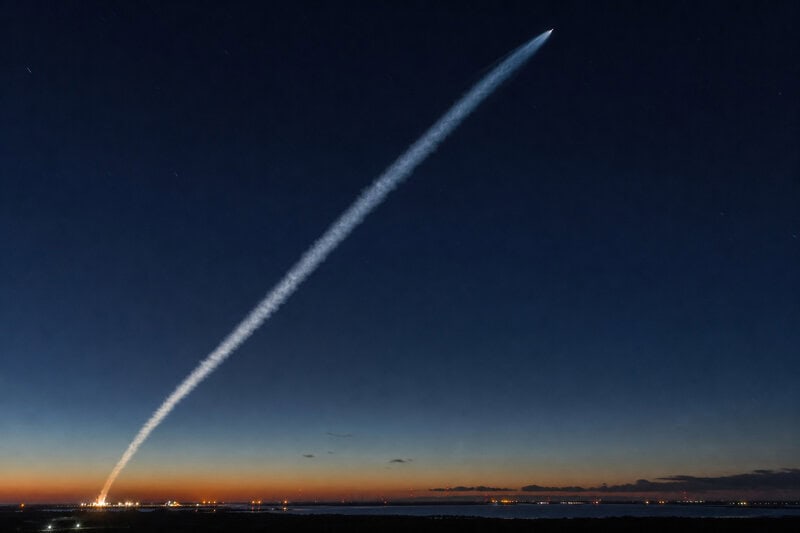
The peak visual display for the NROL-95 ascent plume will occur between approximately T+3 minutes and T+8 minutes — the period when the first-stage booster is still thrusting and the plume column is at its widest before stage separation. How long the glow persists after that depends on mesospheric wind conditions. When winds at 50 to 85 kilometers altitude are calm, the ice-crystal cloud can hold its visible shape for 10 to 20 minutes. When mesospheric winds are strong, shear forces can disperse it within seconds. No forecast reliably predicts mesospheric calm for a specific launch night, but calm conditions are statistically more common over Florida during summer months.
Photographers should use a shutter speed of 10 to 30 seconds on a stable tripod to capture the full plume structure during the ascent. A smartphone pointed at a clear, dark sky can capture the brightest phases. No telescope or binoculars are required.
The Booster Return: A Second Event Eight Minutes After Liftoff
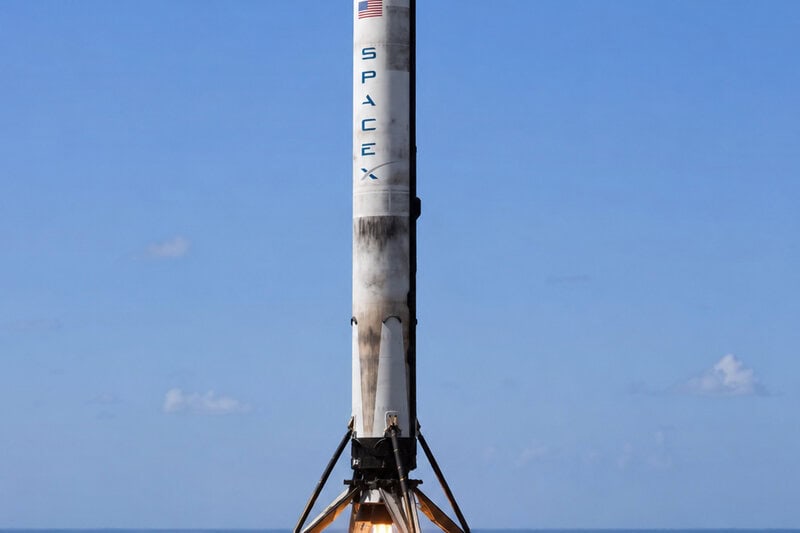
Because NROL-95 is targeting a Landing Zone ground recovery, Florida coast observers get a second performance. After stage separation, the booster performs a boostback burn — reigniting its engines to reverse downrange velocity and arc back toward Cape Canaveral. This creates a second, smaller visible plume two to three minutes after stage separation.
The landing burn that follows produces a distinctive expanding toroidal — or donut-shaped — exhaust pattern around the engine bell, driven by the same underexpansion physics that shapes the ascent plume. Sonic booms from the landing reach the Cape Canaveral shoreline approximately eight minutes after liftoff, a straightforward consequence of the distance between the booster’s landing trajectory and the coast divided by the speed of sound at sea level. The low, rolling double-boom is often the first audio confirmation that the booster has successfully fired its landing engines.
Where to Watch the July 30 Launch

The best viewing locations are along Florida’s Space Coast. Cocoa Beach, Jetty Park at Port Canaveral, and the area near the Kennedy Space Center Visitor Complex all offer unobstructed sight lines to SLC-40 and a clear view of the full ascent arc before the rocket turns east over the Atlantic. From these locations, face northeast and look for a bright point of light climbing rapidly from the horizon at 3:09 AM EDT.
Observers up to 300 miles away in Georgia, South Carolina, and Alabama may see the high-altitude plume glow if skies are clear, based on visibility reports from comparable pre-dawn Falcon 9 missions. The farther an observer is from the launch site, the higher in the sky the plume appears — which can improve the viewing angle for the twilight illumination effect.
Because NRO missions carry tighter scrub criteria than commercial flights — weather, range safety, and payload-readiness constraints can each close a window quickly — check Visit Space Coast and SpaceX’s launch page in the final hours before the window. A scrub on July 30 does not necessarily mean a long delay, but the reschedule timeline for an NRO mission may not be announced publicly with the same lead time as a commercial Starlink flight.
A Note on What Remains Uncertain
Because NROL-95 carries a classified NRO payload, SpaceX has not publicly disclosed all orbital parameters. The precise geometry of the ascent plume — its exact curvature and heading — cannot be independently confirmed before launch. What is predictable is the general northeast-to-east arc over the Atlantic characteristic of SLC-40 launches into mid-inclination orbits.
On a broader note, the environmental impact of repeated high-altitude launches on the mesosphere and stratosphere is an active area of scientific research. A 2023 study published in Geophysical Research Letters documented measurable aluminum oxide and soot deposition from rocket exhaust at high altitudes, while explicitly stating that long-term cumulative effects on stratospheric chemistry are not yet fully quantified. The plume visible from the ground poses no established hazard to observers; the open research question concerns cumulative effects at scale over years of high-cadence launches — a consideration that grows more relevant as Florida’s overall launch pace increases.
The physics behind the streak will be identical whenever NROL-95 lifts off: exhaust chemistry meeting atmospheric optics, with geometry doing the rest. July 30 is the week’s one opportunity to see it.