
The first time most people hear an Aztec death whistle, they instinctively look around for the source of what sounds like a human scream. The ceramic instrument — small enough to fit in a palm, shaped like a human skull — produces a sound so harmonically complex and viscerally unsettling that it stops conversations mid-sentence. On Thursday, July 30, inside the Loma Alta Park Gymnasium at the Altadena Library District, musician and researcher Martin Espino will play that instrument, along with others that Spanish colonial authorities spent centuries trying to eradicate, for an audience that will almost certainly be hearing them for the first time.
The Sound That Stops a Room
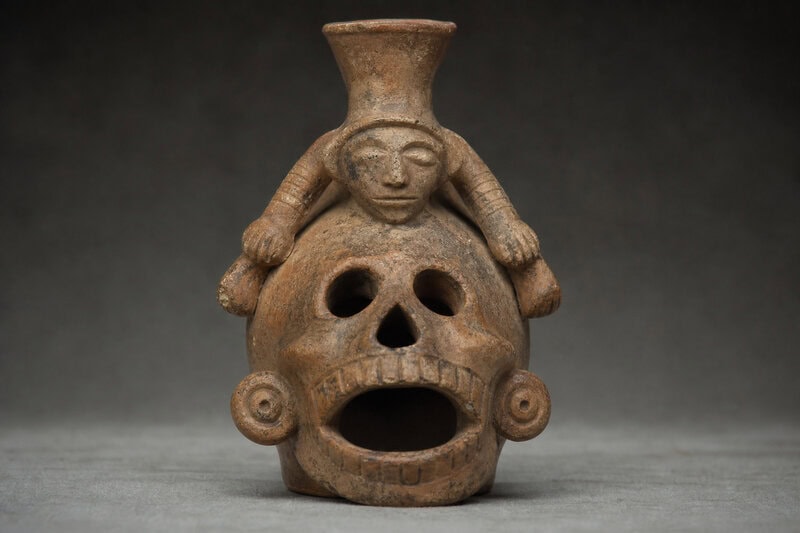
What makes the Aztec death whistle so disorienting is not volume but geometry. The instrument’s internal cavity is shaped to produce complex, harmonically dense waveforms — a characteristic documented through CT scanning of surviving ceramic examples — that standard flutes and ocarinas do not replicate. The result is a sound that registers to the human auditory system as distinctly organic, even vocal, in ways that are difficult to prepare for. No peer-reviewed consensus yet exists on the precise ceremonial function of the death whistle, but researchers broadly agree that its unsettling acoustic properties were intentional, engineered into the instrument’s design rather than incidental to it.
This is not a niche curiosity. Pre-Columbian musical traditions were largely suppressed following the 1521 Spanish conquest of the Aztec Empire, when colonial and ecclesiastical authorities systematically banned Indigenous ceremonial practices as part of a broader campaign to replace Indigenous religious life with Catholicism. The instruments survived in fragments — excavated from archaeological sites, depicted in colonial-era codices, described in Nahuatl-language documents — but the living transmission of how to play them, tune them, and use them together in ceremony was severely disrupted. Reconstructing that tradition requires pairing physical archaeology with historical linguistics, iconographic analysis, and Indigenous oral tradition. What Espino does is not performance alone. It is a form of acoustic archaeology, rebuilding sounds that were systematically silenced for five centuries.
Who Martin Espino Is — and Why His Credentials Matter
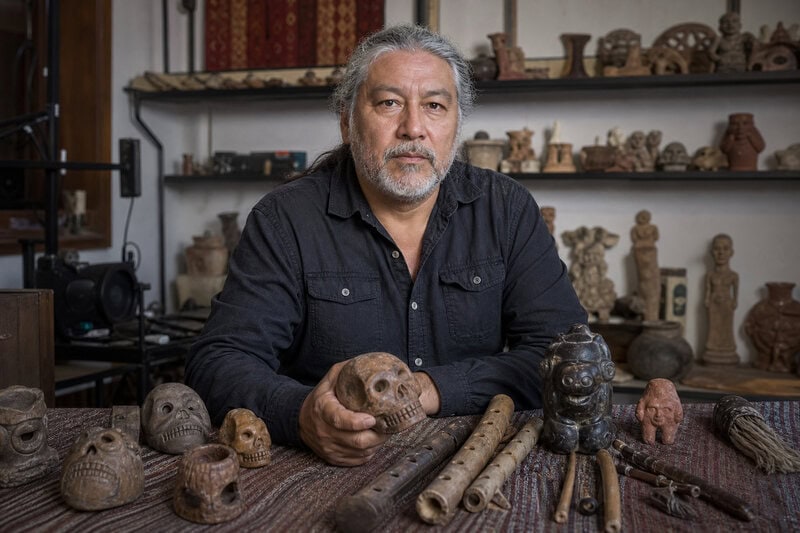
Espino is a musician, researcher, and educator with more than 40 years of experience specializing in the music and culture of Ancient Mexico. He describes himself as both a practicing traditional artist and an experimental sound artist — a dual identity that shapes how he approaches reconstruction. The distinction matters: a purely academic approach might produce historically documented replicas that no one knows how to play in ensemble; a purely performative approach risks prioritizing effect over evidence. Espino occupies the overlap, which is where the most productive scholarship in this field tends to live.
He spent over 25 years researching prehispanic musical practices — an investment of time that places him among a small, specialized cohort of scholar-performers worldwide working at the intersection of Mesoamerican music history and living performance. He is best known for performing authentic prehispanic music with his ensemble MEXIKA, which functions as both a performance group and a living laboratory for testing how reconstructed instruments sound when played together, in real acoustic space, by musicians who have internalized their physical demands.
His Altadena Library session on July 30 runs from 12:30 to 1:30 p.m. and is free and open to the public. Participants are invited to explore the music, culture, and history of Ancient Mexico through direct engagement — including singing songs in Indigenous languages such as Maya and Nahuatl. That participatory structure matters: it transforms the scholarship from a passive presentation into something tactile and communal, the kind of encounter that stays with people in ways a lecture does not.
What Was Lost: The Suppression of Mesoamerican Music After 1521
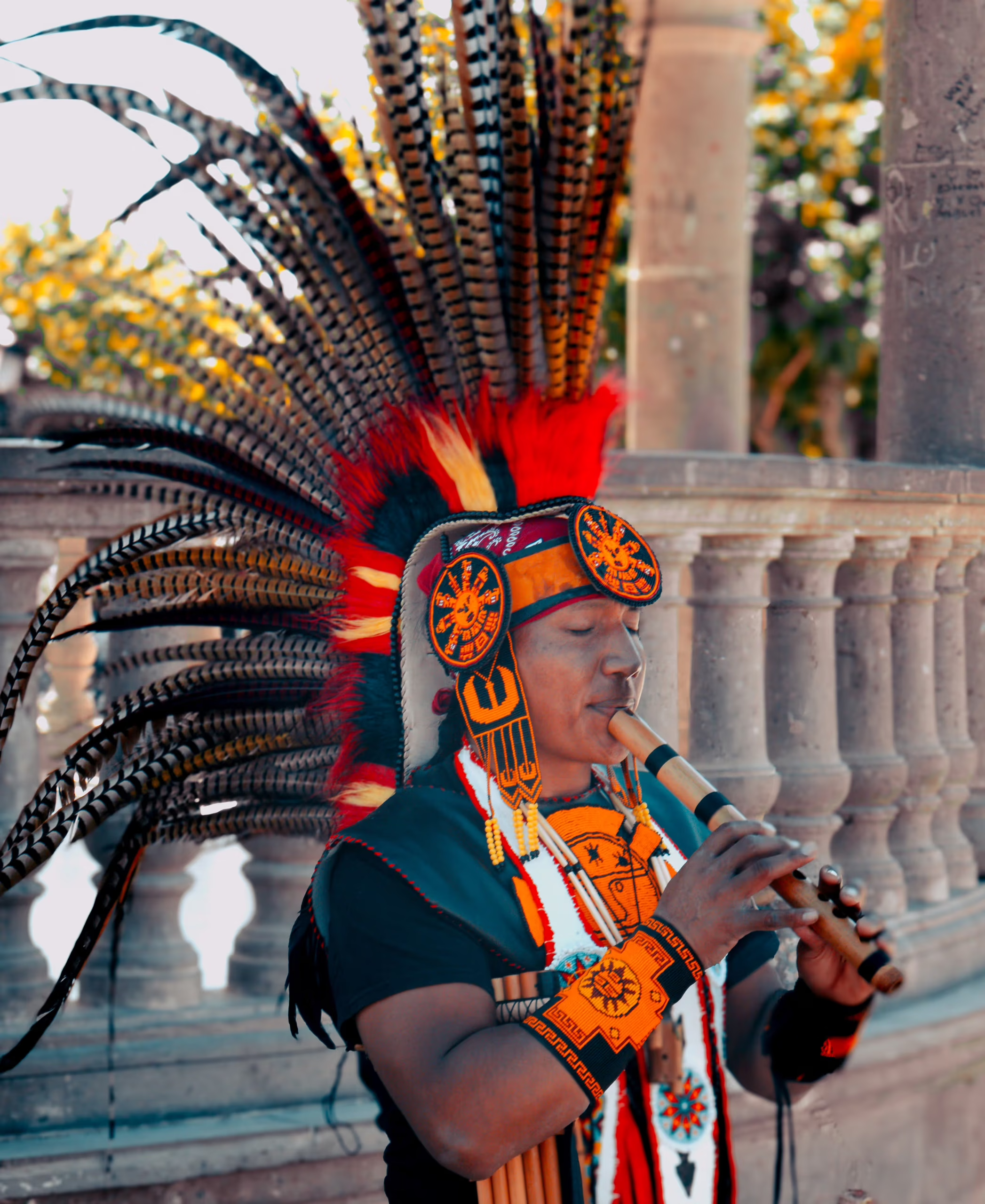
When Hernán Cortés and his Indigenous allies defeated the Aztec Empire in 1521, the consequences for Indigenous musical culture were severe and deliberate. Spanish colonial authorities documented many pre-Columbian instruments — including the huehuetl (a vertical drum), the teponaztli (a horizontal slit-drum), clay flutes, conch-shell trumpets known in Nahuatl as quiquiztli, and ceramic ocarinas — while simultaneously restricting or banning their ceremonial use. Early colonial chroniclers produced written and illustrated records of these instruments, which is why researchers today have a foundation to work from. But documentation is not transmission. Knowing what an instrument looked like is not the same as knowing how it was tuned, what repertoire it carried, or how it functioned within the social architecture of a ceremony.
A note on terms: ethnomusicology is the academic study of music from cultural and social perspectives, typically involving fieldwork with living communities; prehispanic refers to the period in the Americas before European contact and colonization. Both are central to Espino’s work. It is well established among historians that colonial suppression disrupted Indigenous musical transmission across Mesoamerica. What remains actively debated among scholars is the precise sonic character of pre-Columbian music — its scales, tuning systems, interval relationships, and compositional structures — because those elements were rarely captured in colonial documentation with enough specificity to allow confident reconstruction.
The Science of Rebuilding Ancient Sound
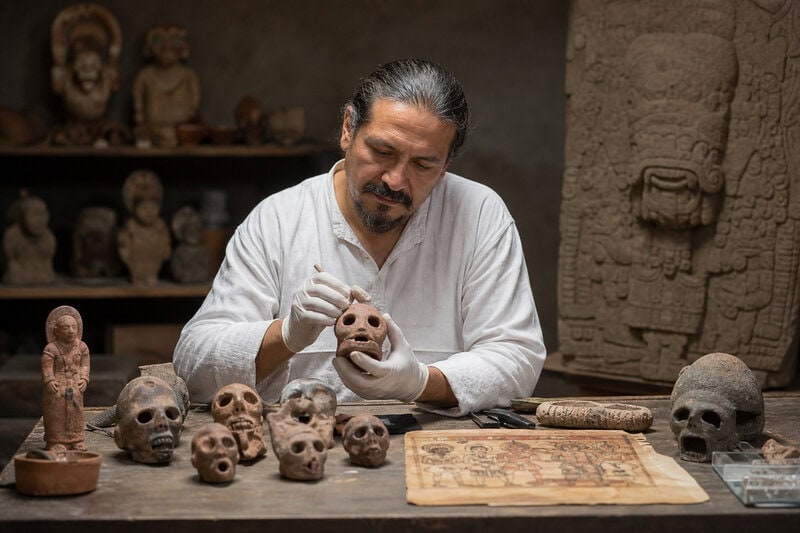
Ancient Mexican instrument reconstruction draws on at least four disciplines simultaneously. Archaeology provides physical analysis of surviving instruments. Iconography involves studying depictions in pre-Columbian codices and stone carvings to understand how instruments were held, combined, and used. Acoustical physics allows researchers to measure the resonance, pitch, and timbre of replica instruments and compare them against surviving originals. Historical linguistics — interpreting Nahuatl-language descriptions of music in colonial-era documents — adds a layer of cultural context that physical analysis alone cannot provide.
Replica-making is a recognized scholarly method in this field. Researchers at institutions including Mexico’s Museo del Templo Mayor have collaborated with instrument makers to produce functional replicas whose acoustic profiles can be measured and compared. Archaeoacousticians — researchers who study the acoustic properties of ancient spaces and instruments — have identified conch-shell trumpet use at multiple Mesoamerican sites, suggesting a pan-regional tradition of shell-horn performance that predates the Aztec Empire by centuries. These findings situate Aztec musical culture within a broader, older Mesoamerican tradition rather than treating it as an isolated phenomenon.
Espino’s more than 25 years of dedicated research position his reconstructions within this international scholarly effort. His work applies both historical rigor and the embodied knowledge that only comes from actually playing these instruments in performance — understanding, for instance, how breath pressure affects pitch on a clay flute, or how the huehuetl and teponaztli must be tuned relative to each other to produce the resonance documented in colonial sources. That embodied knowledge is not a supplement to the academic record. In many cases, it is the only way to test whether a reconstruction is acoustically plausible.
What These Instruments Actually Sound Like

Pre-Columbian instruments were not designed to replicate the Western harmonic scale. Many clay flutes and ocarinas produce pentatonic or non-tempered pitches — intervals that fall outside the standardized tuning system that European classical music normalized over several centuries. For listeners trained on that tradition, the effect is genuinely disorienting, and that disorientation is itself historically meaningful: it is an acoustic reminder that European harmonic structures are one solution to the problem of organizing sound, not the universal baseline they are often treated as in Western music education.
The huehuetl and teponaztli — the two most iconic Aztec percussion instruments — were documented in colonial sources as central to large public ceremonies. Their deep, resonant tones carry over long distances, a practical design feature for outdoor ritual use in spaces that could hold thousands of people. The quiquiztli, or conch-shell trumpet, produces a penetrating, directional sound that archaeoacousticians have studied in the context of Mesoamerican ceremonial architecture, where certain spaces appear to have been designed to amplify and channel specific frequencies.
These are not exotic curiosities. They are the functional acoustic technology of complex civilizations, engineered for specific social, ceremonial, and communicative purposes. Understanding them requires treating them with the same analytical seriousness that musicologists bring to any other tradition — which is precisely what Espino’s work represents.
Why Altadena, and Why a Library
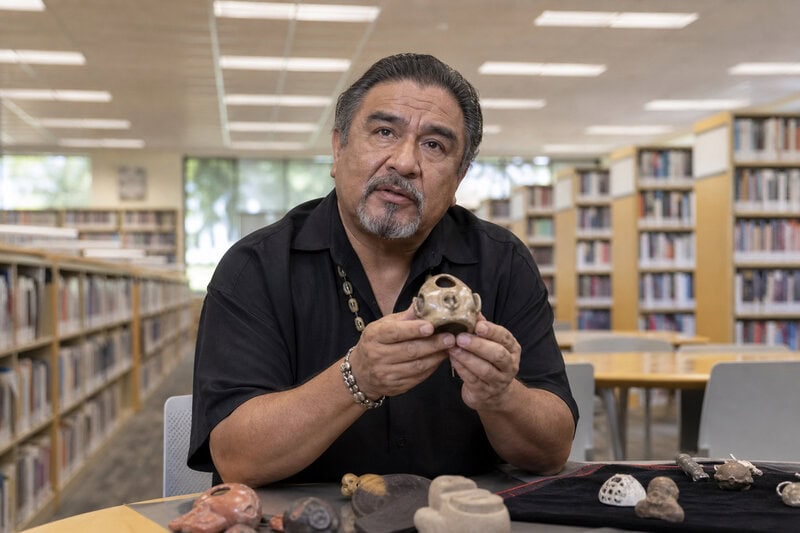
The Altadena Library District’s decision to host Espino reflects a growing movement among public libraries to present living scholarship — not just texts about culture, but direct encounters with practitioners who embody it. Altadena sits within Los Angeles County, home to one of the largest Mexican and Mexican-American populations in the United States. For many attendees, Espino’s session will connect family heritage to documented, researchable history in a way that no book or documentary quite replicates.
Public programs like this one serve a function that academic publications cannot. They place contested, reconstructed knowledge in front of community members who can ask questions, push back on assumptions, and carry the information forward in their own ways. The participatory singing component — in Maya and Nahuatl, two of the major Indigenous languages of Mesoamerica — transforms the session from passive reception into active linguistic and cultural engagement. Participants leave having produced sounds in languages with deep historical roots, not merely having observed someone else do so.
The Larger Stakes: Why Ancient Sound Matters Now
UNESCO’s 2003 Convention for the Safeguarding of the Intangible Cultural Heritage formally recognized that sound — music, oral tradition, performance practice — is as endangered and as worth preserving as physical monuments. That framework gives scholarly and community work like Espino’s an international policy context: the reconstruction of prehispanic musical practices is not a nostalgic exercise but a contribution to a globally recognized preservation effort.
The work also contributes to active debates in historical musicology about the diversity of human musical systems. The assumption that European harmonic structures represent a universal or optimal organization of sound has been challenged by ethnomusicologists for decades; hearing pre-Columbian instruments played in ensemble provides a visceral, non-abstract version of that challenge. For Indigenous and mestizo communities with Mesoamerican heritage, the experience is sometimes described as a form of cultural repatriation — the return of something taken, even if what is returned is necessarily an informed approximation built from incomplete evidence rather than an unbroken tradition.
Espino’s four-decade body of work — and the ongoing research that underlies it — is a reminder that the most durable archive is not always a hard drive or a museum case. Sometimes it is a person who has spent a lifetime learning to listen, and who is willing to walk into a gymnasium in Altadena on a July afternoon and play a skull-shaped whistle until the room goes quiet.
Event details: Martin Espino performs at the Altadena Library District, Loma Alta Park Gymnasium, on Thursday, July 30, from 12:30 to 1:30 p.m. The program is free and open to the public. Registration and full event information are available at the Altadena Library website.