
On a clear winter night above Tromsø, Norway, a single auroral curtain can shift from electric green near the horizon to deep crimson high above — all within minutes, all within the same display. That color change is not random: the specific hue an aurora produces is determined by which atmospheric gas is struck by incoming charged particles and at what altitude, not simply by how powerful the solar storm is.
What the Northern Lights Actually Are — and What to Call Them
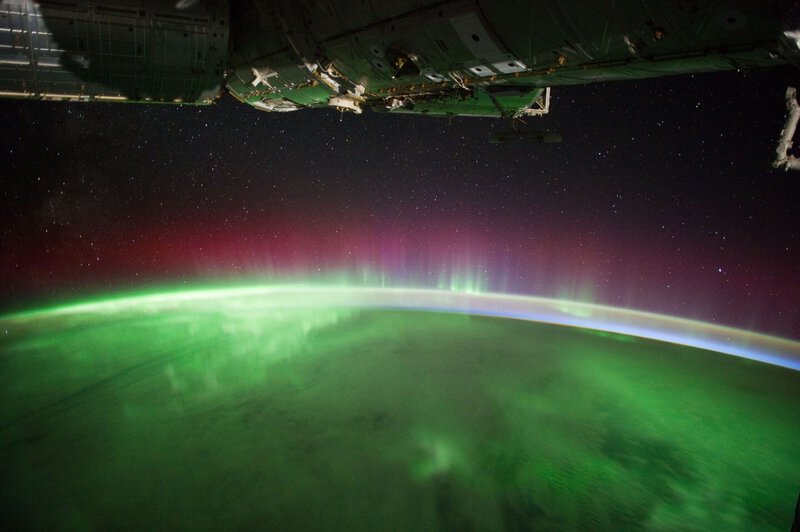
The phenomenon is formally named aurora borealis in English — Latin for “northern dawn” — a term that has been in scientific use since the French philosopher and mathematician Pierre Gassendi recorded the phrase in 1621. Spanish speakers refer to the same display as aurora boreal or luces del Norte. The Cambridge English Dictionary defines “aurora borealis” as the bands of colored light seen in the night sky near the North Pole, while WordReference confirms that “aurora boreal” is the standard Spanish-language equivalent. Whatever the language, the physics behind the colors is identical.
At the opposite end of the planet, the same process produces the aurora australis — the southern lights — visible from southern New Zealand, the tip of South America, and Antarctica. Both polar light shows are driven by the same engine: the solar wind.
What Causes the Northern Lights: Solar Wind and Earth’s Magnetic Shield
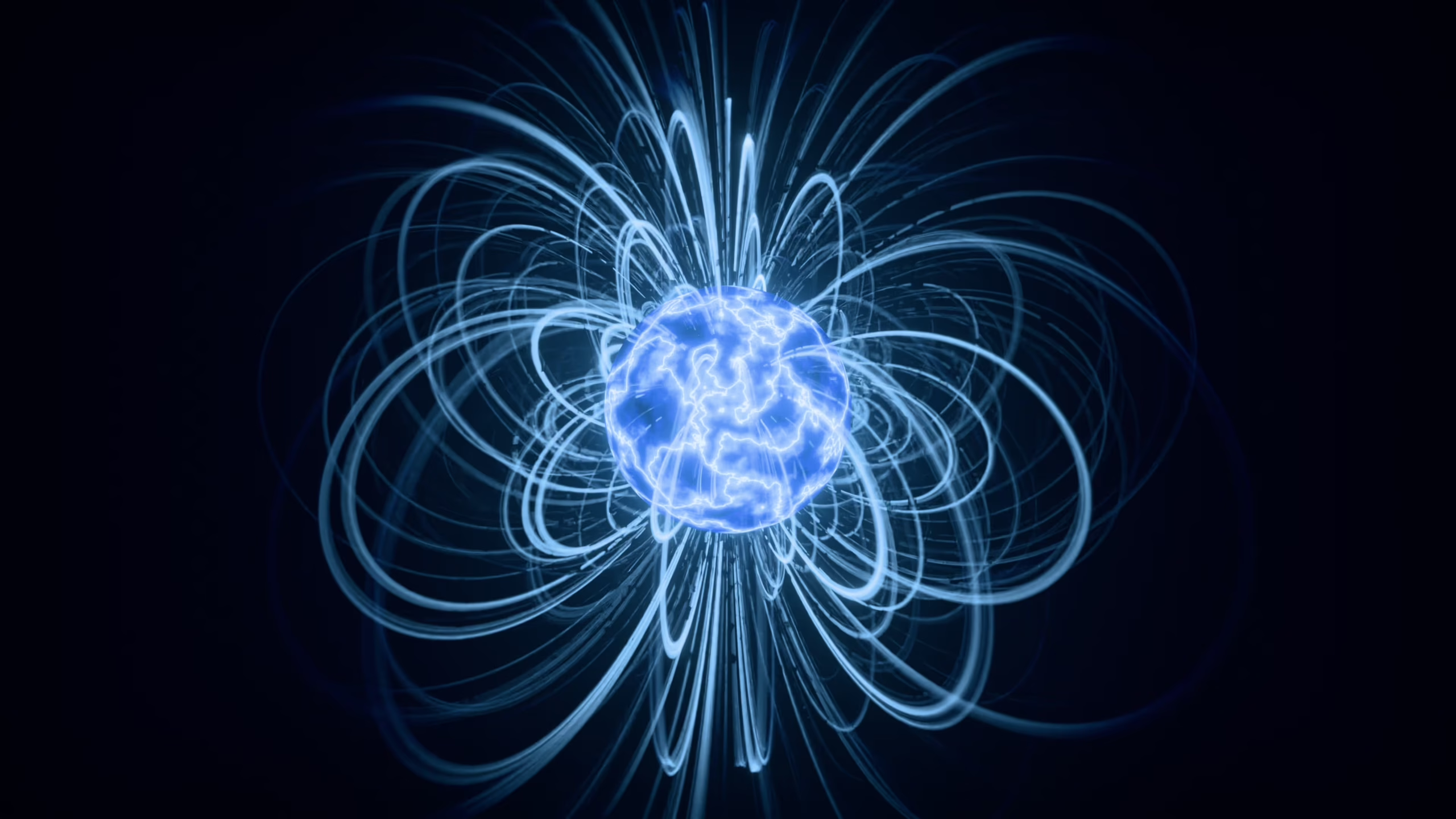
Solar wind is a continuous stream of charged particles — mostly electrons and protons — ejected from the Sun’s outer atmosphere, or corona, at speeds ranging from roughly 400 to 800 kilometers per second. That stream flows outward in all directions, reaching Earth in roughly one to three days depending on its speed.
Under normal conditions, Earth’s magnetosphere — the protective magnetic bubble generated by the planet’s molten iron core — deflects the majority of this particle flow around the planet. At the polar regions, however, the magnetic field lines converge and dip downward toward the surface, funneling charged particles into the upper atmosphere. This geometry is why auroras form in roughly oval-shaped rings centered on the magnetic poles, not randomly across the sky. NASA’s science portal on auroras describes this channeling effect as fundamental to understanding why high-latitude regions experience auroral activity on a near-nightly basis during favorable conditions.
The intensity of auroral displays scales with solar activity. Coronal mass ejections — sudden, massive eruptions of solar plasma abbreviated as CMEs — send far larger quantities of charged particles toward Earth than the baseline solar wind. When a CME reaches Earth’s magnetosphere, it can compress and distort the magnetic field, pushing the auroral oval to lower latitudes and producing displays visible as far south as the central United States or central Europe. NOAA’s Space Weather Prediction Center tracks these events on a geomagnetic storm scale running from G1 (minor) to G5 (extreme) and issues public alerts in advance of significant events.
That solar wind causes auroras is firmly established scientific consensus, supported by decades of satellite data and ground-based observations. A more precise question — exactly how Alfvén waves, a type of electromagnetic wave propagating along magnetic field lines, accelerate electrons to the energies needed to produce the sharpest auroral structures — remained an area of active investigation until recently. A 2021 study published in Nature Communications by Schroeder and colleagues provided the first laboratory confirmation of this acceleration mechanism, offering direct experimental support for a model that had been theoretically accepted but not yet empirically verified at that scale.
Aurora Borealis Colors Explained: Why Each Gas Glows Differently
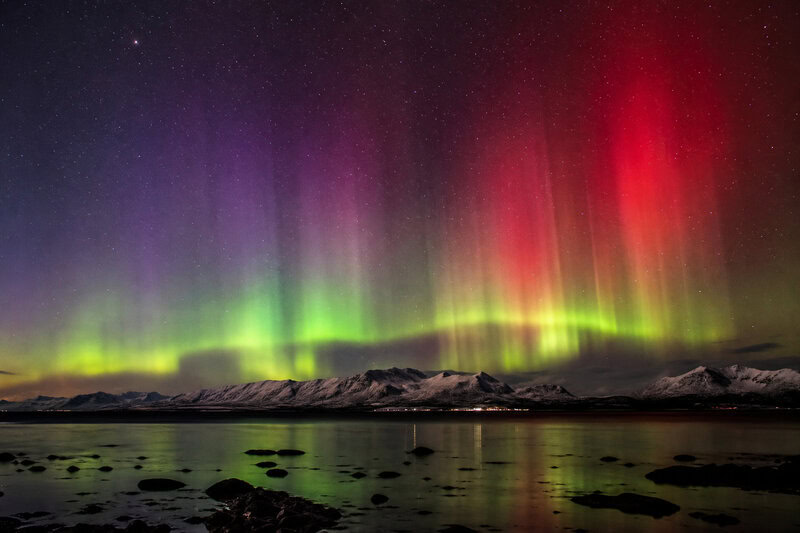
The color an aurora displays is determined by a straightforward but elegant piece of atomic physics: each gas emits light at wavelengths unique to its atomic structure, and the altitude at which that gas is struck determines whether the emission has time to occur at all. The Wikipedia entry on Aurora provides a useful overview of the altitude-color relationship, and the underlying spectroscopic data is cataloged by the National Institute of Standards and Technology (NIST) in atomic spectra databases used by scientists to identify gases in distant stars — the same quantum fingerprints, operating on a planetary scale.
Green: The Signature Color of Aurora Borealis
Green is by far the most commonly observed aurora color, and its source is atomic oxygen at altitudes of roughly 100 to 150 kilometers. When a solar-wind electron collides with an oxygen atom at this altitude, it boosts one of the atom’s electrons to a higher energy level. When that electron returns to its ground state, it releases the energy difference as a green photon with a wavelength of approximately 557.7 nanometers. This emission process takes about one second to complete, which is why green auroras appear to ripple and shimmer rather than flash instantaneously. At 100-150 km altitude, collisions between atoms are frequent enough to occasionally interrupt the emission, but not so frequent that the photon is never released — a balance that makes green the dominant color visible to the naked eye.
Red: The Rarest Color and a Marker of Extreme Storms
Atomic oxygen above 150 to 300 kilometers produces red light. Because air density is far lower at these altitudes, collisions between atoms are rare, and a red-emitting oxygen atom has sufficient time to complete a much slower emission process before any collisional interruption occurs. This makes red auroras both physically distinct from green ones and diagnostically significant: they typically signal extreme geomagnetic storm conditions, when particle bombardment is energetic enough to excite oxygen at very high altitudes in measurable quantities. Most observers see red auroras only a handful of times in a lifetime of aurora watching.
Blue, Violet, and Purple: Nitrogen’s Contribution
Molecular nitrogen (N₂) and ionized nitrogen (N₂⁺) dominate below approximately 100 kilometers altitude, where the atmosphere is denser and nitrogen is the most abundant gas. When struck by energetic electrons, nitrogen molecules emit blue and violet light — colors that appear at the lower fringes of an auroral curtain, where the display meets the darker sky near the horizon. These colors are physically real and well-documented, but they are systematically underrepresented in photographs because the human eye is significantly less sensitive to blue and violet wavelengths under low-light conditions, and many camera sensors require specific white-balance adjustments to record them accurately.
Pink and Magenta: Where Gases Overlap
Pink and magenta edges appear where low-altitude nitrogen emissions blend with the green oxygen layer above — a color mixture that is physically explainable and not a photographic artifact. These fringes are most visible at the very base of an auroral curtain and are more common during active displays when multiple emission altitudes are simultaneously excited.
The Mechanism in Plain Language: Excitation and Emission

A useful analogy for the underlying process is the neon sign. A neon sign glows its characteristic orange-red not because of how much electricity passes through it, but because of the specific atomic structure of neon gas. Substitute argon and the light turns blue-violet; substitute mercury vapor and it shifts toward ultraviolet. The gas determines the color; the electricity merely supplies the energy. Auroras operate on exactly the same quantum principle, at a planetary scale driven by a star approximately 150 million kilometers away.
In more precise terms, a solar-wind electron collides with an atmospheric atom — oxygen or nitrogen — and transfers enough energy to push one of that atom’s electrons into a higher orbital. This is called excitation. The excited state is unstable: within a characteristic time that varies by atom and energy level, the electron drops back to a lower orbital and releases the energy difference as a photon of a very specific wavelength. That wavelength is the color. This same emission process allows astronomers to identify the chemical composition of distant stars and nebulae from their light alone — and auroral spectra match the NIST atomic reference values exactly.
Altitude acts as a natural filter on which colors are visible. Higher altitude means lower air density, fewer collisions, and more time for slowly emitting atoms — such as high-altitude red oxygen — to complete their emission before being disturbed. Lower altitude means denser air, more frequent collisions, and a bias toward faster emission processes — such as the blue and violet nitrogen emissions that dominate below 100 kilometers. The color gradient visible in a single auroral curtain is therefore a direct, real-time readout of atmospheric density structure.
Where and When to See the Aurora Borealis
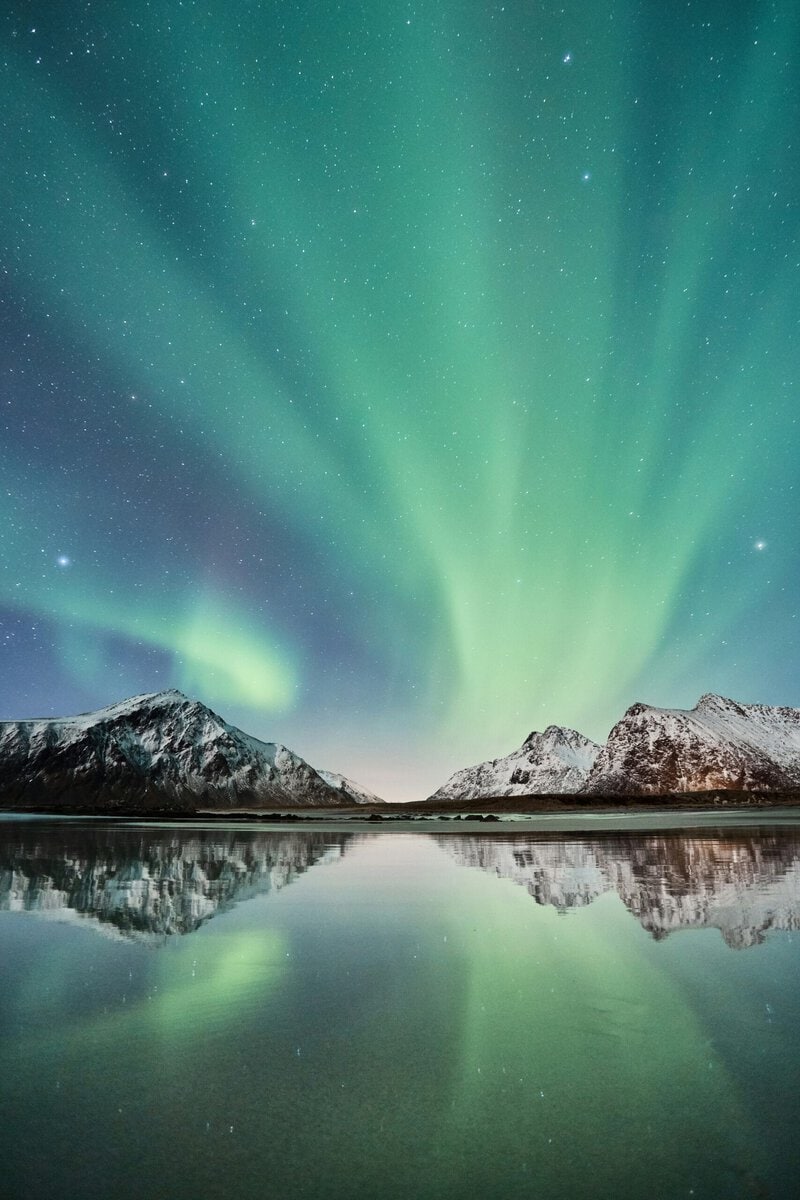
Auroras are concentrated in a permanent ring-shaped zone called the auroral oval, centered on Earth’s magnetic poles and lying roughly between 65° and 72° latitude. NOAA and ESA satellites map this oval continuously, and it shifts equatorward during geomagnetic storms. Northern Scandinavia — including Norway’s Tromsø, Finnish Lapland, and northern Sweden — sits directly beneath this oval and is consistently regarded as one of the world’s premier aurora observation locations. The practical viewing season runs from late September to late March, when Arctic nights are long and dark enough to see the displays. Space.com’s guide to the northern lights provides detailed practical guidance on optimal viewing conditions and locations.
Timing also matters at the solar-cycle scale. The Sun’s activity follows an approximately 11-year cycle of rising and falling output. The current Solar Cycle 25 was projected to reach solar maximum around 2025, according to NASA and NOAA’s Solar Cycle 25 Prediction Panel, meaning auroral activity is near a multi-year high at the time of publication. Displays are both more frequent and more likely to reach mid-latitude locations during this period.
Emerging Science: What Researchers Are Still Working Out

The basic cause of auroras — solar wind particles entering the atmosphere along magnetic field lines and exciting atmospheric gases — is not in scientific dispute. Several finer-grained questions, however, remain genuinely open.
One of the most striking examples is STEVE, an acronym for Strong Thermal Emission Velocity Enhancement. First documented by citizen scientists through the Aurorasaurus project and formally described in a 2018 paper in Science Advances by MacDonald and colleagues, STEVE appears as a narrow, ribbon-like arc of purple-white light at latitudes well south of the normal auroral oval. Researchers confirmed that STEVE is a distinct thermospheric phenomenon — arising from a narrow band of fast-moving, hot plasma in the upper atmosphere — and is not produced by the same electron-excitation mechanism responsible for traditional auroral colors. Its full physical mechanism remains under active investigation.
A second area of open research involves pulsating auroras — rapid, rhythmic flickering displays linked to electromagnetic waves called chorus waves in the magnetosphere. Japan’s JAXA Arase satellite directly observed a correlation between chorus wave activity and pulsating auroras in research published in Scientific Reports in 2021 by Kasahara and colleagues. One downstream question that remains unresolved is how much energy pulsating auroras deposit into the middle atmosphere and what role, if any, they play in localized ozone chemistry.
These emerging findings do not challenge the established color-and-gas model described earlier in this article. They represent additional layers of complexity in a system that science has understood at a foundational level for decades, while confirming that the aurora remains an active area of research at its edges.
A Natural Spectrometer in the Sky
The aurora borealis is, in effect, a natural emission spectrometer: each color is the atmosphere’s own readout of which gas is being excited and at what altitude by the solar wind. Green means atomic oxygen between 100 and 150 kilometers. Red means atomic oxygen above 150 kilometers under extreme storm conditions. Blue and violet mean nitrogen below 100 kilometers. Pink and magenta mean the two zones overlap. The same quantum process that makes a neon sign glow orange-red or a sodium streetlamp cast yellow light operates on a planetary scale above the Arctic, driven by a star 150 million kilometers away.
As Solar Cycle 25 continues near its predicted maximum, NOAA’s Space Weather Prediction Center offers free, real-time geomagnetic storm alerts — a practical, science-backed tool that transforms what can seem like a random spectacle into a predictable and understandable natural event. Whether you call it aurora borealis, northern lights, aurora boreal, or luces del Norte, the physics — and the colors — are exactly the same.