
The most celebrated image in the history of astronomy may be a portrait of something that no longer exists. The towering columns of gas and dust known as the Pillars of Creation sit roughly 6,500 light-years from Earth — meaning the light captured in every photograph of them departed during the early Iron Age, and whatever has happened to them since is still silently traveling toward us at the speed of light.
What the Pillars of Creation Actually Are
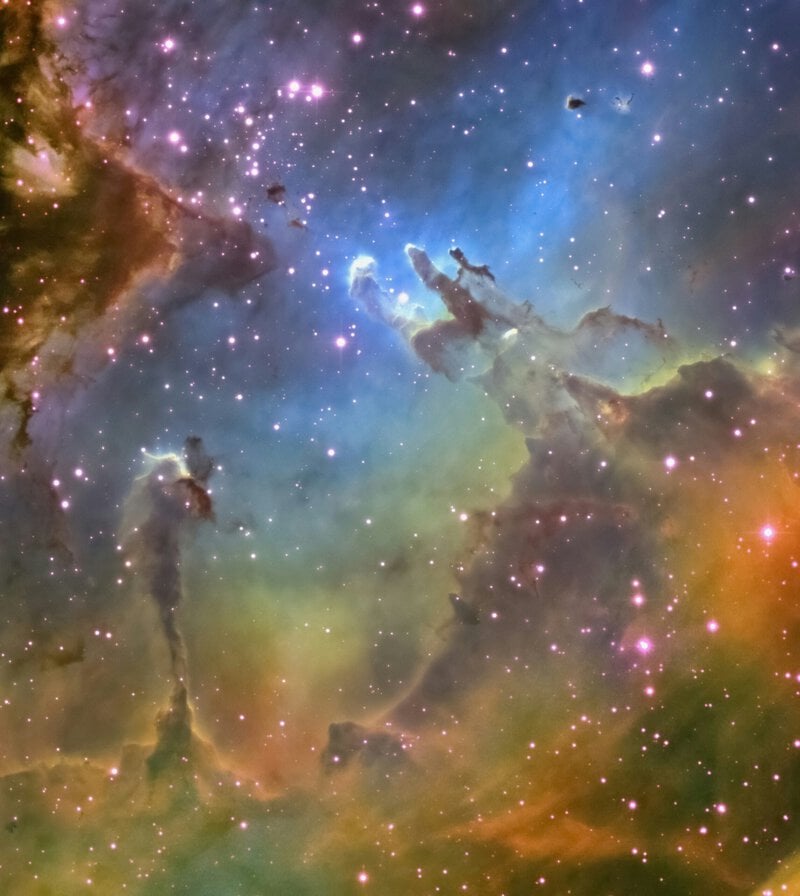
The Pillars of Creation are towering columns of interstellar gas and dust — the raw material from which stars are born — stretching several light-years in height inside the Eagle Nebula (also catalogued as M16), an active star-forming region located approximately 6,500 light-years away in the constellation Serpens. Their distinctive elephant-trunk silhouettes are not coincidental. They are sculpted by intense stellar winds — streams of charged particles blasted outward by massive nearby stars — which erode the surrounding gas and leave behind these denser, finger-like protrusions through a process called photoevaporation: the gradual destruction of molecular cloud material by high-energy ultraviolet radiation.
Hidden within the semi-transparent folds of gas and dust are newborn stars still in the process of formation, making the pillars simultaneously a stellar nursery and a demolition site. The same radiation that carves their dramatic shape is also slowly destroying them from the outside in. NASA describes the structures as “ever-changing” — a reminder that on cosmic timescales these columns are not permanent monuments but transient episodes in an ongoing stellar lifecycle. The tallest pillar reaches roughly four light-years in height, a length that would stretch from our Sun to the nearest star system, Alpha Centauri, and back.
Two Telescopes, Two Windows into the Same Slice of Cosmic Time
The original Hubble Space Telescope image captured the pillars in visible light, emphasizing their dramatic dark silhouettes against a glowing backdrop of ionized hydrogen gas. The palette was arresting enough to make the photograph an instant cultural icon and one of the most recognized scientific images ever produced. But visible light, for all its power, could not penetrate the semi-transparent dust enshrouding the structures’ interiors.
In 2022, the James Webb Space Telescope re-imaged the same region in near-infrared light, which passes through dust more effectively than visible wavelengths. Webb’s portrait revealed previously hidden newborn stars embedded within and around the pillars, along with crimson lava-like formations along the columns’ edges — not molten rock, but jets and shock waves produced by young stellar objects still actively pulling in surrounding material. Webb’s version did not contradict Hubble’s image; it added an entirely new layer of physical detail to the same structures, answering questions that visible light was incapable of addressing.
Together, the two images illustrate how the choice of observing wavelength is itself a scientific instrument. Each telescope answered different questions about the same structures, drawing on the same 6,500-year-old slice of cosmic time. Neither image shows the pillars as they exist today. Both show them as they were millennia before the first human civilization left a written record.
The Supernova Hypothesis: Are the Pillars Already Gone?
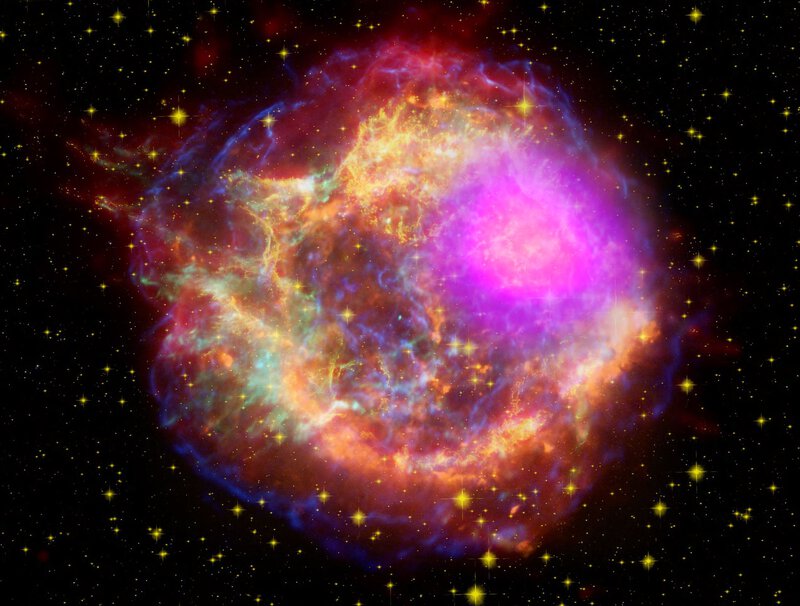
The most dramatic possibility surrounding the pillars’ fate comes from a 2007 analysis by astronomer Nicolas Flagey and colleagues, who used data from NASA’s Spitzer Space Telescope to identify what appeared to be a supernova remnant — the expanding debris shell of an exploded massive star — in the vicinity of the Eagle Nebula. The implication was significant: a shockwave from that explosion may have already reached the pillars, or may still be en route.
If such a shockwave has already arrived, the destruction would have occurred thousands of years ago in the pillars’ own reference frame — but the light confirming that event would not reach Earth for thousands of years more, given the distances involved. NASA has openly acknowledged that the pillars “may have already been destroyed” by such a shockwave, while stopping well short of declaring this established fact. Precision matters here: this remains an unconfirmed hypothesis. Subsequent research has not produced a definitive consensus on the supernova remnant’s precise location, its age, or the trajectory and timing of any associated shockwave. The question is genuinely open.
Even setting aside the supernova scenario, the pillars face a slower but equally certain end. Photoevaporation driven by the relentless radiation of neighboring massive stars is actively eroding them at a measurable rate. Scientific models suggest the pillars would be fully dispersed on timescales of millions of years regardless of any explosive event — a supernova shockwave would simply accelerate what stellar radiation was already accomplishing gradually.
Light-Speed Lag: Why Every Deep-Sky Image Is a Historical Document
Light travels at approximately 299,792 kilometers per second — fast enough to circle Earth more than seven times in a single second — but the universe is so vast that even at this speed, light from 6,500 light-years away takes 6,500 years to arrive. This is not a quirk or an approximation. It is a direct consequence of the finite speed of light, one of the most rigorously tested principles in all of physics.
The practical result is that there is no way to observe the present state of the Pillars of Creation. Any telescope pointed at them, regardless of its power or sophistication, is collecting photons that departed during the early Iron Age on Earth. The James Webb Space Telescope, despite being humanity’s most capable space observatory, is no exception. Its exquisite 2022 image of the pillars is, by the unalterable physics of light travel, a 6,500-year-old photograph.
This phenomenon is not unique to the pillars. The Andromeda Galaxy appears to us as it was approximately 2.5 million years ago. Distant quasars are observed as they existed when the universe was less than a billion years old. Astronomy is inherently retrospective — every observation is an act of looking backward through time, with the depth of the past increasing with distance. The Pillars of Creation make this abstract reality viscerally concrete, because the timescale of uncertainty about their survival is close enough to human history to feel comprehensible in a way that millions or billions of years do not.
Why the Pillars Still Matter — Even If They’re Gone
The scientific value of the Eagle Nebula’s pillars does not depend on whether they still exist 6,500 light-years away. Data gathered from both Hubble and Webb observations continues to inform theoretical models of the interstellar medium — the diffuse gas and dust filling the space between stars — helping astrophysicists understand how galaxies regulate the birth of new stars over billions of years. The newborn stars detected by Webb within the structures provide direct observational evidence of how stellar nurseries collapse, ignite, and begin dispersing their parent clouds, a sequence that plays out across the galaxy but is rarely visible with such clarity and spatial resolution.
The pillars’ semi-transparent, layered gas and dust also make them an unusually productive laboratory for studying photoevaporation itself. Understanding precisely how radiation from massive stars shapes and ultimately destroys molecular clouds is essential to modeling star formation rates not just in the Eagle Nebula but across the Milky Way and in other galaxies. NASA’s Universe of Learning has developed extensive educational resources around the pillars precisely because they sit at the intersection of so many fundamental astrophysical processes — star formation, radiation physics, and the lifecycle of molecular clouds — in a single visually striking location.
There is also a pedagogical dimension that astronomers and science communicators consider nearly as significant as the raw data. The pillars serve as a vivid, publicly accessible demonstration that the universe operates on timescales and distances that fundamentally exceed human intuition. A structure that may no longer exist, observed through two of the most sophisticated instruments humanity has ever built, tells a story about the nature of observation itself — and about the humbling gap between what we can see and what is actually there.
What Comes Next: Watching the Ghost Evolve
Future observations by Webb and next-generation ground-based facilities such as the Extremely Large Telescope, currently under construction by the European Southern Observatory in Chile’s Atacama Desert, may resolve finer structural details of the active photoevaporation zones and the young stellar objects embedded within the pillars’ gas. Over human timescales — decades of repeated, high-resolution imaging — astronomers can directly measure the rate at which the pillars’ edges are being eroded, turning the question of their remaining lifespan from a theoretical estimate into an observed, quantified rate of change.
The question of whether a supernova shockwave is inbound may eventually be addressed not by the shockwave’s arrival but by more precise mapping of the Eagle Nebula’s surroundings using X-ray and radio observatories capable of tracing the remnant’s structure and expansion history with greater accuracy. Better data on the remnant’s location and age could either strengthen or significantly weaken the case for imminent destruction.
Whether or not the pillars still stand 6,500 light-years away, the story they tell — about the violence and creativity of star formation, about the strangeness of observing across cosmic distances, and about what it means to perceive something that may no longer exist — is far from finished. The ghost, as it turns out, has a great deal left to teach.