
At exactly 2:16 a.m. on November 18, 2026, a spacecraft built with 1970s-era hardware and less computing memory than a modern email will cross a threshold no human-made object has ever reached: one full light-day from Earth, at a distance of 16,094,799,096 miles. NASA has calculated this moment to the precise second, and the number — extraordinary enough on its own — becomes genuinely staggering once you understand what a light-day actually represents.
What “One Light-Day” Actually Means

A light-day is the distance light travels in exactly 24 hours, moving at 186,282 miles per second. That works out to approximately 16.1 billion miles, or about 25.9 billion kilometers. Expressed in astronomical units — where one AU equals the average Earth-Sun distance of roughly 93 million miles — one light-day equals approximately 173.14 AU. When Voyager 1 crosses this threshold, it will be more than 173 times farther from Earth than the Sun is.
A few reference points help put that number in perspective. The Moon is roughly 1.3 light-seconds away — a gap a radio signal crosses in less time than it takes to blink. Mars, at its farthest from Earth, sits about 22 light-minutes away, far enough that a single exchange with a Mars rover involves a round-trip signal delay of nearly 45 minutes. One light-day dwarfs both distances by orders of magnitude, placing Voyager 1 in a realm of space that no human technology had ever meaningfully engaged with before the probe entered it.
It is equally important to clarify what one light-day is not. It falls far short of one light-year, which spans 365.25 light-days. Even after nearly five decades of travel, Voyager 1 has covered only a small fraction of the distance to the nearest stars. The milestone is a measure of human achievement, not a sign that interstellar destinations are within reach.
How NASA Calculates a Milestone to the Exact Second

The precision behind that 2:16 a.m. timestamp is itself a significant feat. NASA’s Jet Propulsion Laboratory (JPL), which manages the Voyager mission, tracks the probe continuously using the Deep Space Network — a global array of large radio antenna complexes in Goldstone, California; Madrid, Spain; and Canberra, Australia. Signals from all three sites allow JPL’s navigation teams to triangulate Voyager 1’s position with remarkable accuracy across billions of miles.
The primary measurement tool is the Doppler shift — the change in frequency of Voyager 1’s radio signal caused by its motion away from Earth. As the spacecraft moves, it stretches the radio waves it transmits, and that shift in frequency encodes precise velocity information. Integrated over time, those velocity measurements yield an accurate position. Voyager 1 currently travels at approximately 38,000 miles per hour relative to the Sun, a speed that has remained stable enough for long-range trajectory modeling.
Signal travel time independently confirms the calculation. A radio signal from Voyager 1, moving at the speed of light, now takes close to 23 hours to reach Earth — meaning a round-trip communication takes nearly 46 hours. JPL publishes Voyager 1’s distance publicly on a daily basis, and because the probe’s gradual deceleration under solar gravity is well-characterized, the one-light-day crossing can be pinpointed to a specific second well in advance.
The Journey: 1977 to Interstellar Space
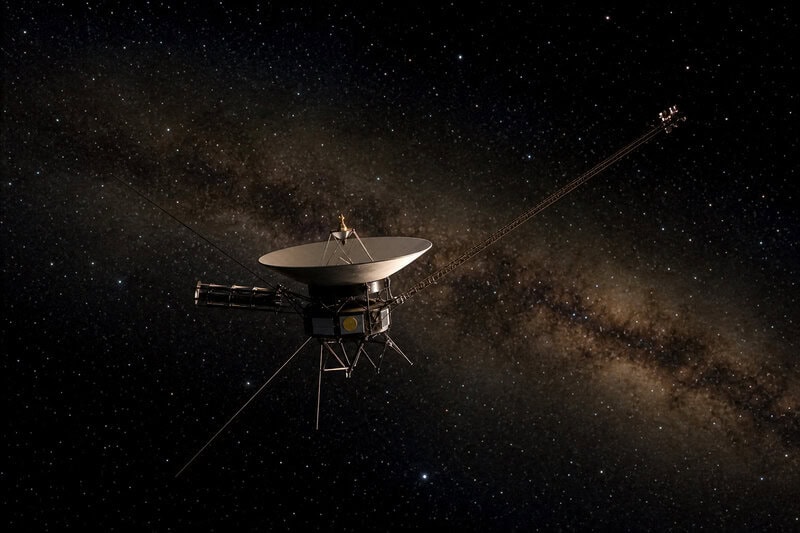
Voyager 1 launched on September 5, 1977, from Cape Canaveral aboard a Titan IIIE/Centaur rocket. Its primary mission was to study Jupiter and Saturn, using each planet’s gravity to bend and accelerate its trajectory outward — a technique called a gravity assist. The probe completed both flybys successfully, returning the closest and most detailed images of those worlds that humanity had ever seen.
What followed was decades of quiet travel through the outer solar system. In August 2012, NASA confirmed — based on measurements of plasma density around the spacecraft — that Voyager 1 had crossed the heliopause, the boundary where the Sun’s solar wind yields to the interstellar medium. It became the first human-made object confirmed to have entered interstellar space. The probe had already held the record for most distant human-made object since 1998, when it surpassed Pioneer 10.
Voyager 1 continues to transmit scientific data. Its instruments measure cosmic ray intensities, magnetic field orientations, and plasma conditions in the interstellar medium — observations that help scientists model the structure of the heliosphere and better understand the local galactic environment. NASA has estimated that the probe’s nuclear power source can support at least basic operations until sometime in the late 2020s, though the precise endpoint depends on how engineers manage the diminishing power supply across remaining instruments.
Why 16,094,799,096 Miles Would Have Been Science Fiction in 1977
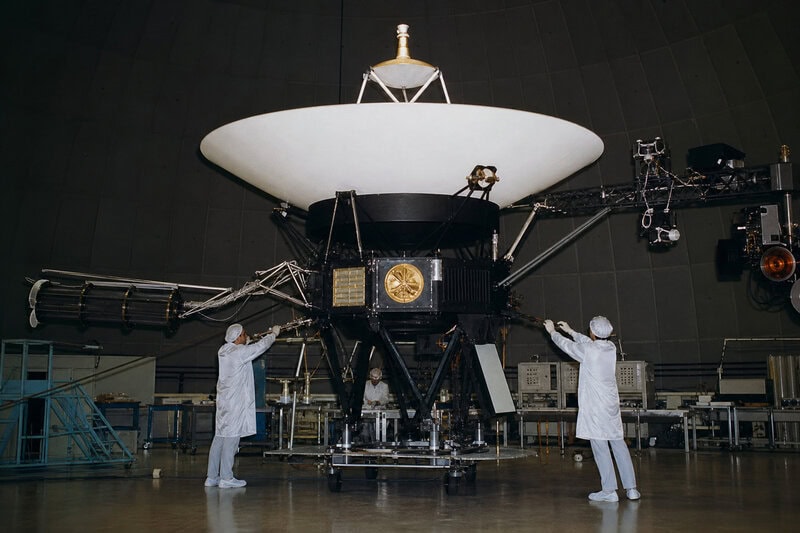
When Voyager 1 lifted off nearly five decades ago, Saturn was the outermost planet any spacecraft had visited. Uranus would not receive its first visitor — Voyager’s twin, Voyager 2 — until 1986. The notion that a probe could survive long enough to reach interstellar space, let alone be tracked with second-level precision across 16 billion miles, existed primarily as theoretical possibility rather than operational expectation.
The hardware onboard makes the achievement more remarkable, not less. Voyager 1 carries an 8-track digital tape recorder and a central computer with roughly 69.63 kilobytes of memory — a fraction of what is stored in a single photograph on a modern smartphone. Its radio transmitter broadcasts at 23 watts, roughly the output of a dim incandescent light bulb. That signal, spread across 16 billion miles of space, arrives at Earth so faint that the Deep Space Network’s massive dish antennas must operate near the limits of their sensitivity to detect it at all.
The precision with which JPL now forecasts the November 2026 milestone — down to the minute, months in advance — reflects not the simplicity of the problem but five decades of accumulated expertise in astrodynamics, radio science, and deep-space operations. The one-light-day crossing has attracted wide attention precisely because it places a human-scale timestamp on what would otherwise be an almost incomprehensible number.
What the Milestone Means for Science — and What It Doesn’t
The one-light-day boundary is not a physical feature of space. Nothing changes in the interstellar medium at that distance; there is no detectable transition, no new region Voyager 1 will enter. Its significance is partly symbolic and partly operational. At one light-day from Earth, any command transmitted from JPL takes approximately 23 hours to arrive at the spacecraft, meaning mission controllers must anticipate and pre-program the probe’s responses nearly a full day before they are needed. That communication constraint is a concrete illustration of the challenges any future crewed or robotic mission to deep space would face.
Scientists are careful to draw a firm line between this milestone and more expansive interpretations. Voyager 1 is not meaningfully approaching any star. Its closest stellar neighbor along its current trajectory, a dim red dwarf catalogued as AC+79 3888, will not be reached for roughly 40,000 years. The one-light-day mark is a measure of how far humanity has sent a physical object — not evidence that the interstellar frontier is within reach on any human timescale.
What the milestone concretely offers is continued science. Voyager 1’s instruments continue detecting magnetic fields and particle densities in the interstellar medium, data that refines models of how the heliosphere interacts with the broader galaxy — questions that no Earth-based telescope can answer directly. The approaching date has renewed both public and scientific interest in what the probe is still measuring at this extraordinary remove.
The Power Budget: A Clock Running Down
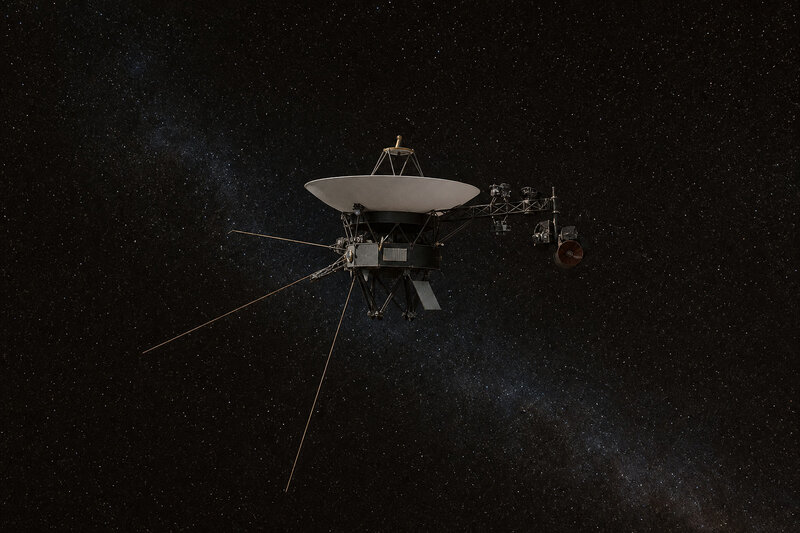
After crossing the one-light-day threshold, Voyager 1 will continue outward without any change to its trajectory. Its speed relative to the Sun will decrease very slightly as solar gravity acts over increasing distances, but that deceleration is gradual and well-modeled. The more urgent countdown is the power budget.
Voyager 1’s energy comes from radioisotope thermoelectric generators (RTGs), devices that convert heat from the radioactive decay of plutonium-238 into electricity. RTGs produce progressively less power as the plutonium decays, and NASA engineers have already shut down several non-essential systems to conserve energy for the instruments that matter most. At some point in the late 2020s, the power level is expected to fall below the threshold needed to operate any scientific instrument. At that point, Voyager 1 will go silent — not destroyed, but no longer transmitting.
Silent does not mean stopped. After its last signal reaches Earth, Voyager 1 will continue traveling through the Milky Way for billions of years. Onboard is the Golden Record — a gold-plated copper disk containing sounds, music, greetings in dozens of languages, and images representing life on Earth, assembled under the direction of a committee that included astronomer Carl Sagan. It was included on the remote chance that some other intelligence might one day find it.
A Human-Scale Moment for an Incomprehensible Journey
The November 2026 milestone offers something genuinely rare in space exploration: a specific, human-scale moment at which to measure an almost incomprehensible journey. A machine designed with slide rules, powered by a source no larger than a car battery, launched when pocket calculators were new — now a light-day from the world that built it, and still, for a little while longer, talking.
Milestones like this one matter not because they change anything about Voyager 1’s physics, but because they give human beings a foothold in numbers that would otherwise remain abstract. On the morning of November 18, 2026, if you step outside and look up, the signal reaching Earth from Voyager 1 will have left the spacecraft the previous morning. That single fact, more than any statistic, conveys what one light-day of distance actually means.