
When the universe was less than 5 percent of its current age — a mere 670 million years after the Big Bang — two colossal black holes were already consuming matter at a ferocious rate and blazing with the energy of a trillion suns each. The European Space Agency’s Euclid space telescope has now identified these two objects as the most ancient quasars ever observed, part of a haul of 31 previously unknown quasars discovered in a single survey pass. The findings deepen one of astronomy’s most pressing unsolved problems: how did supermassive black holes get so enormous, so fast, in a universe that had barely begun to exist?
What Euclid Found — and Why 31 New Quasars Matters
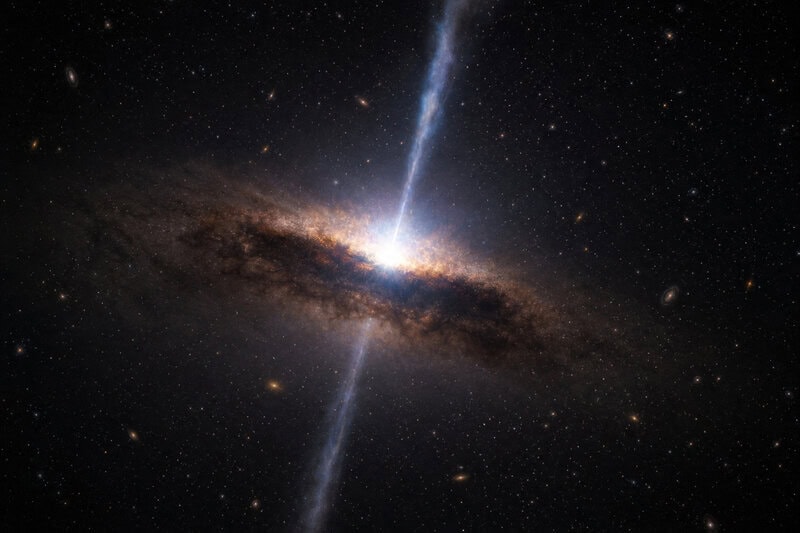
Euclid’s wide-field survey identified 31 quasars — intensely luminous galaxy cores powered by actively feeding supermassive black holes — that had never previously been catalogued. Two of them set a new cosmic record as the earliest such objects ever detected, dating to an era astronomers call cosmic dawn. According to the European Space Agency’s announcement of the discovery, these objects represent record-breaking ancient supermassive black holes observed at a point when the universe was extraordinarily young.
The sheer number of simultaneous discoveries is scientifically significant in a way that a single detection would not be. Finding 31 ancient quasars in one survey gives astronomers a statistical population to study rather than an isolated anomaly. A single extreme object might be dismissed as a cosmic fluke; dozens of them demand a coherent explanation. Each new entry in the census tightens the constraints on theoretical models of early black hole growth, because any successful theory must account for an entire population, not merely one outlier.
Euclid’s broad sky coverage, originally engineered to map dark matter and dark energy across cosmic time, turns out to make it exceptionally efficient at catching rare, extremely distant objects that narrowly targeted deep-field telescopes might statistically miss. The mission is also being used to uncover key properties of the host galaxy surrounding at least one of the earliest known supermassive black holes — extending the science well beyond simple detection and into the question of how black holes and galaxies shaped each other in the universe’s first chapter.
Quasars Explained: What Happens When a Black Hole Feeds
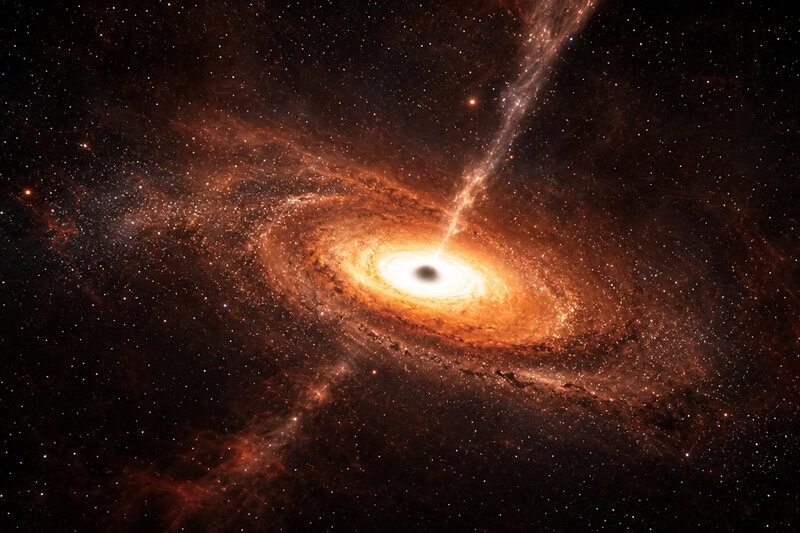
A quasar — short for “quasi-stellar object,” a name given because early observers mistook them for unusual stars — forms when gas and dust spiral into a galaxy’s central supermassive black hole. The infalling material compresses and superheats into a swirling structure called an accretion disk, which releases energy so intense it can outshine every star in the host galaxy combined. The two record-breaking quasars Euclid identified each radiate more energy than a trillion suns — not from nuclear fusion as stars do, but from the gravitational violence of matter being consumed at the edge of a black hole.
Supermassive black holes are defined as those exceeding one million times the mass of the Sun. The objects Euclid found at cosmic dawn are described by researchers as gargantuan, a characterization suggesting masses potentially billions of times solar — an extraordinary scale for objects that existed when the universe itself was still in its infancy. Because light travels at a finite speed, observing these quasars at a distance corresponding to 670 million years after the Big Bang means Euclid is not seeing them as they are today; it is capturing them precisely as they existed nearly 13 billion years ago, providing a direct observational window into conditions that no longer exist anywhere in the modern universe.
Detailed reporting on Euclid’s ancient quasar discoveries describes these objects as giant and dazzling galaxy cores — language that reflects the genuine extremity of the luminosities involved rather than rhetorical exaggeration.
The Central Mystery: How Did They Grow So Large So Quickly?
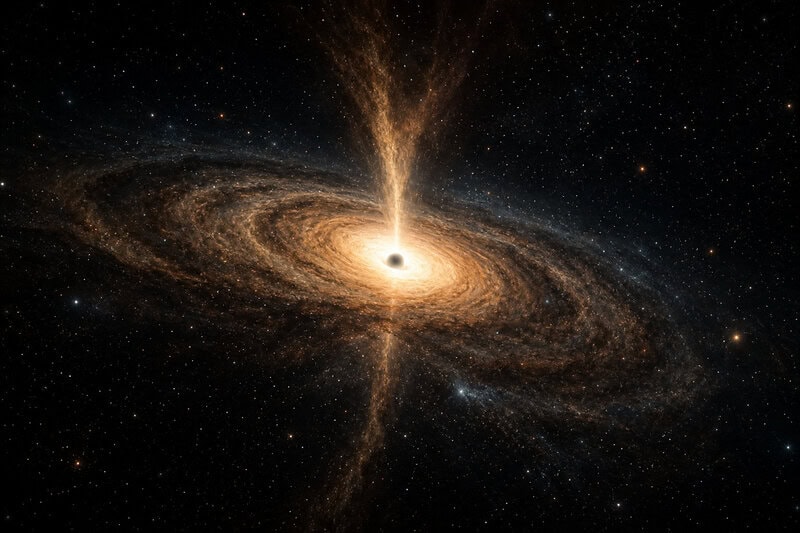
The existence of billion-solar-mass black holes less than 700 million years after the Big Bang is not comfortably explained by standard models of black hole growth. In the conventional picture, stellar-mass black holes — the remnants of massive stars — accumulate matter gradually over billions of years to reach supermassive scales. The timeline available before cosmic dawn is far too short for that process alone to produce the objects Euclid is now observing.
Several competing hypotheses attempt to resolve this tension, though none has yet been confirmed by direct observational evidence. One leading idea proposes that massive primordial gas clouds collapsed directly into heavy-seed black holes in the early universe, bypassing the stellar phase entirely and starting the growth process from a much larger initial mass. Another hypothesis invokes episodes of super-Eddington accretion — a state in which a black hole swallows matter faster than classical physics suggests is sustainable over long periods — allowing rapid mass accumulation in relatively short bursts. Both remain actively debated.
Researchers working on these findings have noted that discovering two record-holders simultaneously, rather than one, hints that the conditions enabling rapid black hole growth in the early universe may have been more common than previously assumed. As covered by Live Science’s analysis of the Euclid black hole discovery, the dual detection raises the possibility that these extreme objects were not vanishingly rare flukes but rather a recognizable feature of early cosmic structure. That interpretation, however, remains emerging rather than established, and the full picture will depend on accumulating a much larger sample.
Euclid’s Unexpected Superpower: Hunting the Earliest Light
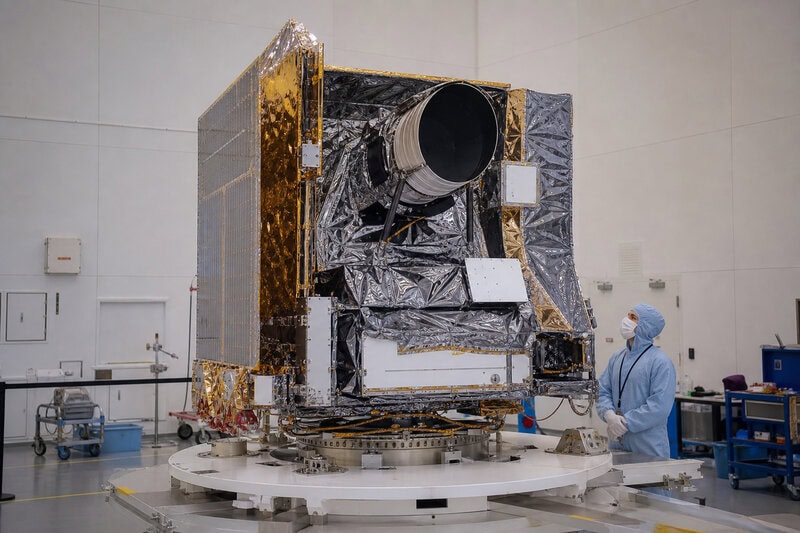
Euclid was engineered with a primary mission of measuring the shapes of billions of galaxies and mapping the large-scale structure of the universe to probe dark matter and dark energy. Its combination of wide sky coverage and near-infrared sensitivity, however, makes it unexpectedly adept at spotting high-redshift quasars — objects so distant that the expansion of the universe has stretched their light into infrared wavelengths through a process astronomers call cosmological redshift.
Detecting a quasar from 670 million years after the Big Bang requires identifying objects at a redshift above 7, a threshold at which the ultraviolet radiation characteristic of quasars shifts entirely out of the visible spectrum and into the near-infrared range that Euclid’s instruments cover. This is precisely the observational window that makes Euclid valuable for this science, even though early-universe quasar hunting was not the telescope’s original design priority.
Euclid’s ability to survey large swaths of sky in a single observation run means it can identify rare objects that statistically require enormous search volumes to find — objects that might never appear in the comparatively small patches of sky examined by ultra-deep targeted telescopes. This makes Euclid and the James Webb Space Telescope (JWST) complementary rather than competitive: Euclid finds candidates across vast cosmic volumes, while JWST can dissect the spectra and internal structures of individual objects in extraordinary detail. Follow-up observations from ground-based facilities are also used to confirm and characterize candidates that Euclid flags, establishing a discovery pipeline that astronomers expect to yield many additional finds as the full survey accumulates more sky coverage.
What the Host Galaxies Reveal About Early Cosmic Structure

Beyond cataloguing the black holes themselves, the Euclid mission is using the new data to probe the host galaxies surrounding these extreme objects. Research highlighted by the Max Planck Society’s coverage of Euclid’s quasar host galaxy investigation describes efforts to uncover key properties of the galaxy hosting one of the earliest known supermassive black holes — examining characteristics such as mass, star-formation rate, and overall structure.
Understanding host galaxy properties matters because the relationship between a supermassive black hole and its surrounding galaxy is bidirectional and still incompletely understood, even in the modern universe. Scientists want to determine whether the central black hole drives galaxy growth by blasting surrounding gas with energy and radiation, whether galaxy-scale processes feed the black hole, or whether both effects operate simultaneously. Answering that question at cosmic dawn — when both the black holes and their host galaxies were in their earliest formative stages — would constrain models of galaxy evolution across the full span of cosmic history.
Early galaxies hosting quasars as bright as a trillion suns are thought to be extremely gas-rich environments undergoing intense activity. Mapping their structures challenges theoretical models that predict galaxies should still be relatively small and disorganized at redshifts corresponding to 670 million years after the Big Bang. Research perspectives from Waseda University on the discovery of the most ancient supermassive black holes underscore how findings like these push the boundary of what early-universe galaxy formation models must explain.
What Comes Next — and Why It Matters
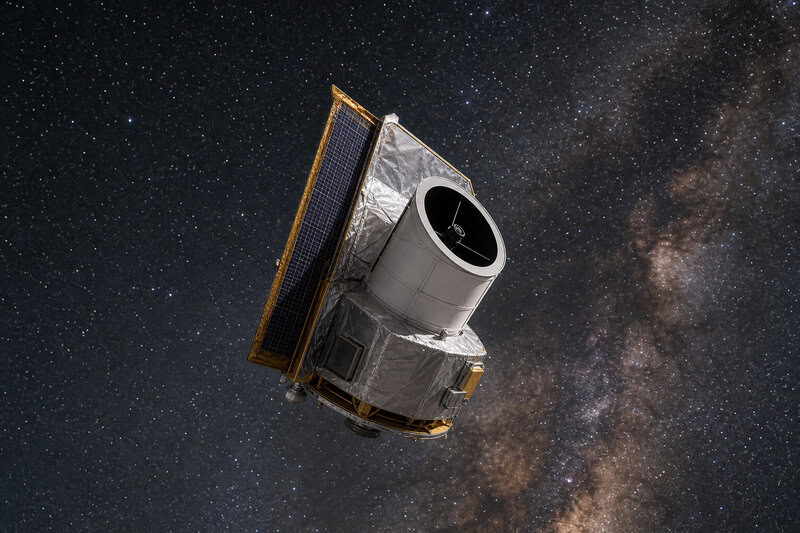
Euclid’s full six-year survey is expected to cover roughly one-third of the entire sky — a volume so large that astronomers anticipate it will uncover hundreds of additional high-redshift quasars, potentially extending the discovery frontier even closer to the Big Bang. The current haul of 31 previously unknown quasars, impressive as it is, represents only an early science result from a mission that is still in its opening operational phase.
The record set by these two ancient quasars may not stand for long. Both the Euclid team and researchers running competing surveys are actively searching for objects at even higher redshifts, and the statistical likelihood of finding them increases as Euclid’s surveyed sky area grows. The combination of Euclid’s wide-field census capability and JWST’s spectroscopic precision creates a two-telescope strategy that astronomers believe will ultimately reconstruct the complete history of black hole growth from the first galaxies to the present day.
At stake is a question that sits at the heart of modern cosmology: whether the universe’s first black holes were born small and gradually grew into the monsters astronomers observe today, or whether they arrived at enormous masses almost from the beginning through processes that current physics does not fully predict. The answer will reshape how scientists understand not just these extreme ancient objects, but the formation and evolution of all galaxies — including the Milky Way, which itself hosts a supermassive black hole at its center approximately four million times the mass of the Sun.