
On July 5, 2026, a spacecraft the size of a small car skimmed within roughly 800 meters of an asteroid hurtling through the inner solar system — closer than most commercial aircraft fly above a city — and the engineers who planned that razor-thin pass were not nervous. They were taking notes.
800 Meters From an Asteroid — and That Was the Point
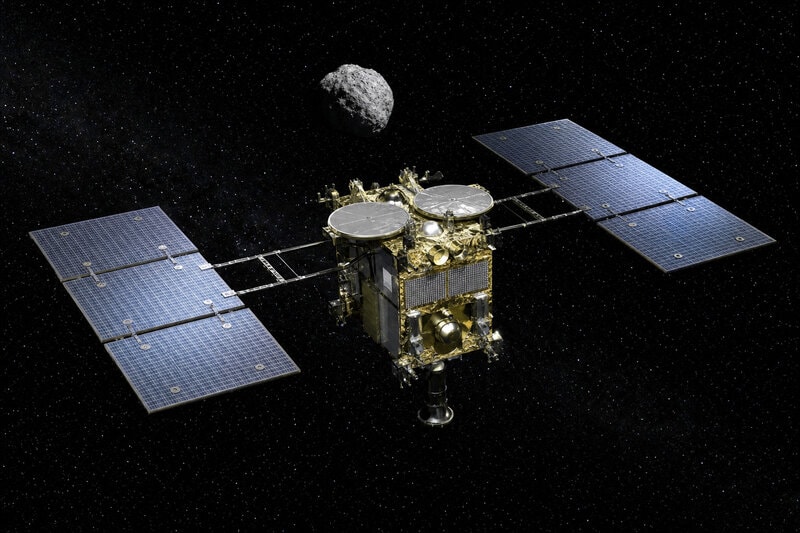
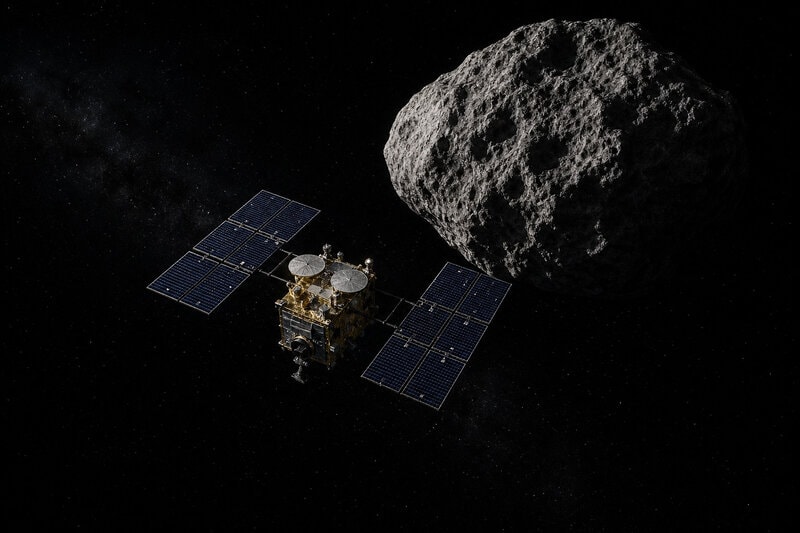
Japan’s Hayabusa2 probe executed a precision close approach of asteroid Torifune on Sunday, July 5, 2026, with JAXA (the Japan Aerospace Exploration Agency) confirming the spacecraft successfully captured images of the rocky body during the flyby. The maneuver was reported by AFP from Tokyo as a deliberate test of technology that could one day help protect Earth from a space rock on a collision course with the planet.
The flyby was not a scientific accident or a convenient navigation shortcut. It was the mission’s core objective — a carefully engineered rehearsal of the observation, tracking, and characterization skills that humanity would need if a real asteroid were ever confirmed to be heading toward Earth. By completing it successfully, Japan joins NASA as one of only two space agencies to have conducted hands-on, hardware-in-space planetary defense operations, a field that barely existed as an engineering discipline two decades ago.
What Planetary Defense Actually Means — and Why It Requires Practice
Planetary defense is the branch of space science and engineering dedicated to detecting, tracking, and — if necessary — deflecting or disrupting near-Earth objects (NEOs), a category that includes asteroids and comets whose orbits bring them within roughly 1.3 astronomical units of the Sun. Unlike missile defense, which responds to threats measured in minutes, asteroid defense operates on timelines of years to decades. The critical skills are therefore reconnaissance and characterization: knowing an object’s size, shape, spin rate, composition, and precise trajectory long before any intervention is attempted.
Agencies cannot improvise these techniques during an actual emergency. The sensors, software, and spacecraft must be tested against real asteroids under real deep-space conditions. That is exactly what the Hayabusa2 Torifune flyby was designed to validate. The field also distinguishes between two broad intervention strategies — kinetic impactors, which physically ram an asteroid to nudge its speed, and slower methods such as gravity tractors — and accurate characterization data is the prerequisite for choosing correctly between them. Without that data, even a technically successful deflection attempt could fall short of moving an asteroid enough to matter.
Hayabusa2: The Veteran Probe That Keeps Working
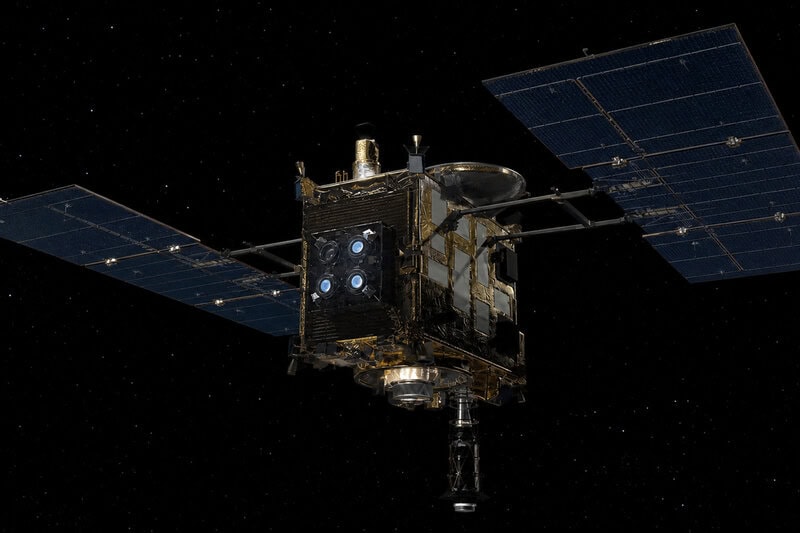
Hayabusa2 is not a new spacecraft. JAXA launched it in December 2014, and it became internationally celebrated after collecting samples from asteroid Ryugu and returning them to Earth in December 2020 — delivering the largest asteroid sample haul in history at the time. Rather than retiring the still-functional probe, JAXA extended its mission, redirecting Hayabusa2 toward new asteroid targets. It is a cost-efficient strategy that turns a completed science mission into a pathfinder for planetary defense technology, extracting continued value from hardware that has already proven itself in deep space.
The probe’s demonstrated ability to navigate to, image, and operate in close proximity to a small irregular body made it an ideal testbed for the close-approach observation techniques JAXA wants to refine. JAXA has framed this extended mission phase as treating the spacecraft’s remaining operational capacity as a strategic asset rather than a legacy artifact — a model other agencies are watching closely. The decision also sidesteps the substantial cost and lead time of developing and launching a purpose-built reconnaissance spacecraft from scratch.
Torifune: A Small Rock With a Significant Role
Torifune is a near-Earth asteroid — meaning its orbit crosses or approaches Earth’s orbital neighborhood — selected as a flyby target because its trajectory made a close approach feasible within Hayabusa2’s post-Ryugu fuel budget. At 800 meters of closest approach, the flyby gave JAXA’s imaging systems an unusually detailed look at Torifune’s surface features. That dataset will feed into models of how such objects reflect light and how their physical characteristics can be inferred from remote observation alone, sharpening techniques that would apply to any future target of concern.
Characterizing small near-Earth asteroids matters because objects in the 100-to-500-meter size range occupy a particularly dangerous category: large enough to devastate a city or coastal region, yet numerous enough and faint enough that many remain untracked. JAXA has not publicly designated Torifune as an impact threat; the flyby’s value lies in technique validation, not in any alarm about this specific object. Torifune is, in effect, a stand-in for any asteroid that might someday matter far more.
How NASA’s DART Mission Set the Benchmark — and What Japan Is Adding
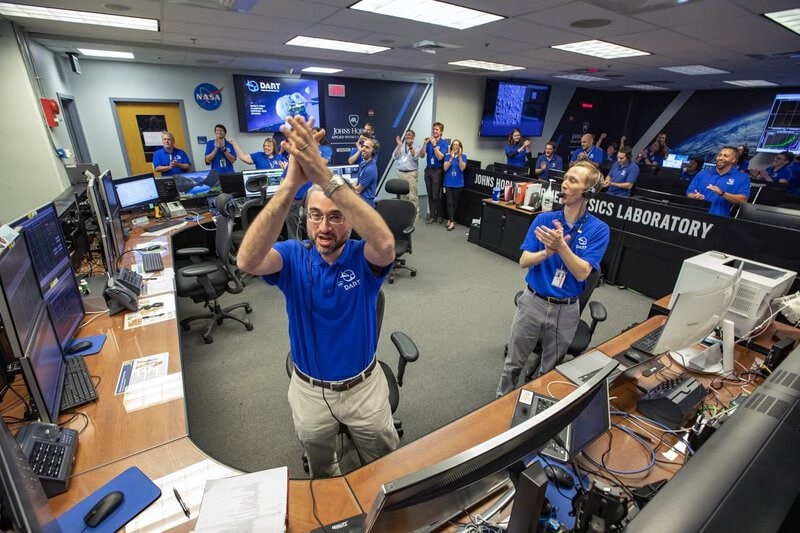
In 2022, NASA’s Double Asteroid Redirection Test (DART) spacecraft deliberately collided with Dimorphos, a 160-meter-wide moonlet orbiting the asteroid Didymos, successfully shortening Dimorphos’s orbital period by about 33 minutes. It was the first demonstrated kinetic deflection of a celestial body in history, and it proved that humanity can, in principle, move an asteroid. But DART also revealed a persistent gap: predicting how much any deflection attempt will actually work still requires precise pre-impact knowledge of an asteroid’s mass, porosity, and internal structure — information that a short-warning mission might not have time to gather.
ESA’s Hera mission, launched in October 2024, is now en route to Dimorphos to measure the aftermath of DART in detail. Japan’s Hayabusa2 extended mission — including the Torifune flyby — focuses on the reconnaissance and characterization side of the same problem. Together, these missions represent a meaningful division of labor across space agencies: NASA tested the hammer; ESA is auditing the damage; Japan is practicing reading the target before anyone swings. Each effort addresses a different node in the chain of actions that a real planetary defense response would require.
The DESTINY+ Connection: Japan’s Longer Planetary Defense Arc
The Torifune flyby does not stand alone in Japan’s strategic thinking. JAXA’s broader planetary defense ambitions extend to DESTINY+ (Demonstration and Experiment of Space Technology for INterplanetary voYage with Phaethon fLyby and dUst Science), a mission designed to fly past 3200 Phaethon — the unusual asteroid associated with the annual Geminid meteor shower and a formally designated potentially hazardous asteroid (PHA).
A PHA designation is applied to objects larger than roughly 140 meters whose orbits bring them within 0.05 astronomical units of Earth’s orbit. Phaethon meets both criteria, making it scientifically and strategically important. DESTINY+ is planned to study Phaethon’s surface, dust emission behavior, and physical properties — precisely the data types that would be essential if any object in that class ever required a deflection assessment. The Hayabusa2 Torifune flyby and the planned DESTINY+ Phaethon encounter together form a coherent institutional strategy: build expertise in close asteroid operations mission by mission, compounding knowledge rather than relying on a single high-stakes flight.
How Real Is the Threat — and How Ready Is the World?
NASA’s Center for Near Earth Object Studies (CNEOS) tracks more than 35,000 known near-Earth objects as of mid-2026, of which roughly 2,400 meet the potentially hazardous designation. None currently carries a significant probability of impacting Earth within the next century. However, survey completeness for objects below 140 meters in diameter remains well below 50 percent, meaning a substantial fraction of the mid-sized threat population has not yet been catalogued — and an uncatalogued object cannot be deflected in time.
The scientific consensus, as reflected in guidance from the International Asteroid Warning Network (IAWN) and the UN Committee on the Peaceful Uses of Outer Space (COPUOS), is that the threat is real but manageable — provided detection and deflection capabilities are developed before a specific threat emerges rather than after. The key contested question among researchers is not whether deflection is physically possible, but how much warning time is sufficient, and whether kinetic impactors alone would be adequate for all threat scenarios or whether nuclear standoff options would need to remain available for large objects discovered on short timescales.
Japan’s incremental, flyby-and-characterize approach reflects one well-supported school of thought: that the highest near-term return on investment lies in reconnaissance technology that makes any eventual deflection mission far more likely to succeed. That position is broadly consistent with current international coordination frameworks. The Hayabusa2 Torifune flyby adds one more verified data point to a growing body of hard-won, real-world knowledge — the kind that cannot be simulated in a laboratory, and that may prove more valuable than it looks on a quiet Sunday in July.