
At least some Neanderthal communities in northwestern Europe were far more genetically diverse and socially connected than scientists had long assumed — a finding published June 24 in the journal Nature that quietly dismantles one of paleoanthropology’s most comfortable explanations for why our closest evolutionary relatives vanished. If inbreeding wasn’t their primary undoing, something stranger, and far more intimate, may have been.
The Cousins We Misread for Decades
The story of Neanderthal extinction has always carried an uncomfortable undertow for modern humans: roughly 1 to 4 percent of the DNA carried by most people outside sub-Saharan Africa is Neanderthal in origin. Their disappearance, in other words, is not purely someone else’s history. It is threaded into the genomes of billions of living people. That biological intimacy makes the question of how they vanished not just an archaeological puzzle but a quiet piece of human self-understanding.
For decades, the leading genetic explanation pointed inward — toward the Neanderthals themselves. Small, scattered populations, the reasoning went, had been mating within their own tight social circles for so long that harmful mutations accumulated faster than natural selection could clear them, eventually eroding the species’ resilience. It was a tidy, melancholy narrative: a people brought low by isolation. New research now suggests that narrative was, at minimum, incomplete.
What Scientists Thought They Knew: The Inbreeding Hypothesis
The case for inbreeding as a central Neanderthal extinction cause was built on real and carefully gathered evidence. Genetic analysis of Neanderthal fossils repeatedly revealed low heterozygosity — the technical term for the degree of genetic variation between the two copies of each chromosome that any individual carries. When heterozygosity is low across a population, it typically means individuals are closely related to one another, sharing stretches of identical DNA inherited from common ancestors in the not-so-distant past.
The biological danger is straightforward. Every genome harbors harmful recessive mutations — think of them as bad genetic typos that only cause problems when a matching copy arrives from both parents simultaneously. In large, outbreeding populations, those dangerous pairings are relatively rare. In small, inbreeding ones, they become increasingly likely with each generation, gradually burdening the population with reduced fertility, weakened immune responses, and diminished capacity to adapt to environmental stress.
Certain high-profile Neanderthal genomes gave this hypothesis its sharpest teeth. The genome of a Neanderthal individual recovered from the Altai Mountains in Siberia, for example, showed unmistakable signs of close-relative mating — the genetic signature of a population so small and isolated that relatives were effectively the only available mates. For a time, that discovery felt like a smoking gun. Study after study seemed to reinforce the picture of a species in slow genetic freefall well before Homo sapiens arrived in sufficient numbers to matter.
The New Study: What Changed and Why It Matters
The June 24 Nature paper introduces a crucial methodological distinction that earlier analyses had difficulty making cleanly. Using advances in ancient-DNA sequencing and updated statistical modeling, the researchers worked to separate two genetic patterns that can appear deceptively similar in raw sequence data: population-wide low diversity caused by a prolonged historical bottleneck — a long squeeze that reduced overall genetic variety slowly over thousands of years — and acute inbreeding, the rapid accumulation of shared DNA from recent close-relative mating within just a few generations.
These two processes leave overlapping but ultimately distinguishable fingerprints in ancient genomes. The new study applied those finer-grained tools to specimens from northwestern Europe and found that at least some of those populations showed patterns more consistent with historical bottlenecks than with recent, acute inbreeding. In short, these groups had low diversity — but not because cousins were routinely mating with cousins. The squeeze had been slower, older, and less catastrophic than the inbreeding model implied.
What the study does not do is equally important to state plainly. It does not exonerate inbreeding as a factor across all Neanderthal populations, and it does not resolve the broader question of why Neanderthals went extinct. It narrows one explanation’s role for specific groups in a specific region while leaving the larger, multi-causal picture very much open. Neanderthal population size research may also need recalibration: if some communities were more genetically diverse and geographically networked than previously estimated, reconstructions of total Neanderthal numbers and their social range could require meaningful upward revision.
A Subtler Culprit: Genetic Swamping by Homo Sapiens
In place of the inbreeding model, the paper proposes a mechanism that is, depending on one’s perspective, either more hopeful or more haunting. The study suggests that Homo sapiens may have driven Neanderthals to extinction not primarily through violence or disease or even direct competition for food and shelter, but through interbreeding — a process geneticists sometimes describe as genetic assimilation or demographic swamping.
The mechanism is worth unpacking carefully. Imagine two groups repeatedly encountering and mating with each other, but with a profound demographic imbalance: modern humans were arriving and expanding in numbers that far outstripped Neanderthal populations. Over successive generations, even relatively modest interbreeding rates could progressively dilute Neanderthal genetic identity into the expanding Homo sapiens gene pool. The result would not look like a massacre. It would look like a slow, intimate erasure — Neanderthals not eliminated but absorbed, their distinctness dissolving generation by generation.
This idea deserves careful calibration against what is and is not established science. That some interbreeding between Neanderthals and Homo sapiens occurred is settled scientific consensus, supported by Neanderthal DNA detectable in modern human genomes worldwide. That this interbreeding was the primary extinction mechanism is an emerging and contested hypothesis — plausible and supported by the new modeling, but not yet broadly accepted across the field. The distinction matters: one is a fact written in living DNA, the other is an interpretation still being tested.
The 1 to 4 percent of Neanderthal ancestry carried by most non-African modern humans is the residue of that contact. Neanderthals as a reproductively distinct population vanished completely. But fragments of their genome did not. They persist, quietly, in immune-system genes, in variants that influence skin and hair, and in other stretches of DNA whose functions researchers are still working to understand.
What the DNA Actually Shows: Reading Ancient Genomes
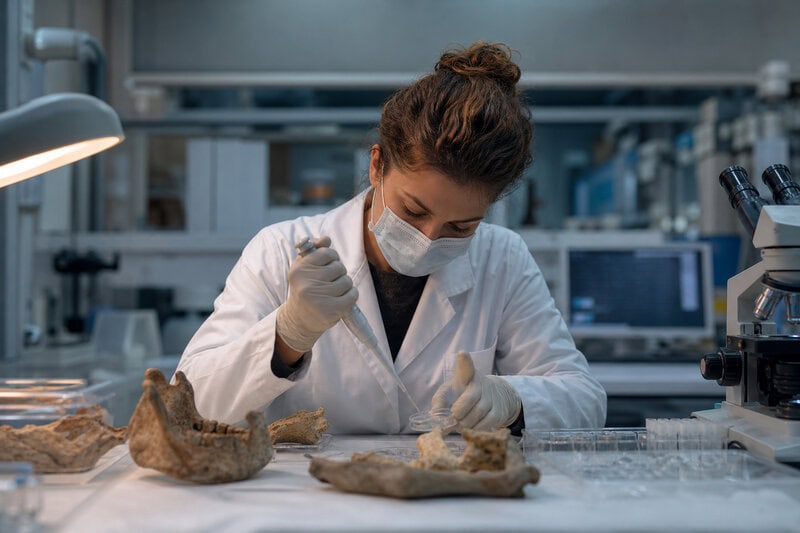
To appreciate why this research is both powerful and provisional, it helps to understand how scientists reconstruct Neanderthal genetics in the first place. Genetic material extracted from bone and tooth fragments — sometimes tens of thousands of years old — is typically fragmented, chemically damaged, and contaminated with microbial DNA. Researchers use computational pipelines to identify, authenticate, and assemble readable sequences from this degraded material, a process that has improved enormously since the first draft Neanderthal genome was published in 2010.
The key analytical challenge the new study addresses is distinguishing the cause of low heterozygosity. High genetic similarity across a population can arise two ways: either individuals shared close relatives recently, pointing to acute inbreeding, or a lineage passed through a prolonged population bottleneck spanning many centuries or millennia, leaving its diversity reduced through a very different mechanism. Teasing those two signatures apart required new statistical approaches applied specifically to northwestern European specimens, and it is the application of those methods — not merely the collection of new fossils — that gives the paper its analytical leverage.
Geographic variation is also a crucial caveat the field has not always honored sufficiently. The Neanderthals of the Altai Mountains and the Neanderthals of what is now Belgium or France were not the same population with the same history. Their genomes can tell meaningfully different stories, and treating all Neanderthals as a monolithic genetic unit has almost certainly distorted earlier conclusions. The new study’s northwestern European focus is a strength, but it also underscores that any single regional study cannot speak for the species as a whole.
Honest acknowledgment of the data’s limits is essential. Ancient DNA degrades. Sample sizes across all Neanderthal genomic research remain small relative to the species’ geographic range and 300,000-plus year existence. Each newly sequenced specimen can shift interpretations. Scientists working in this field describe the evidence as compelling but recognize the picture is still being assembled from scattered fragments.
Where Experts Agree, Disagree, and Why It’s Complicated
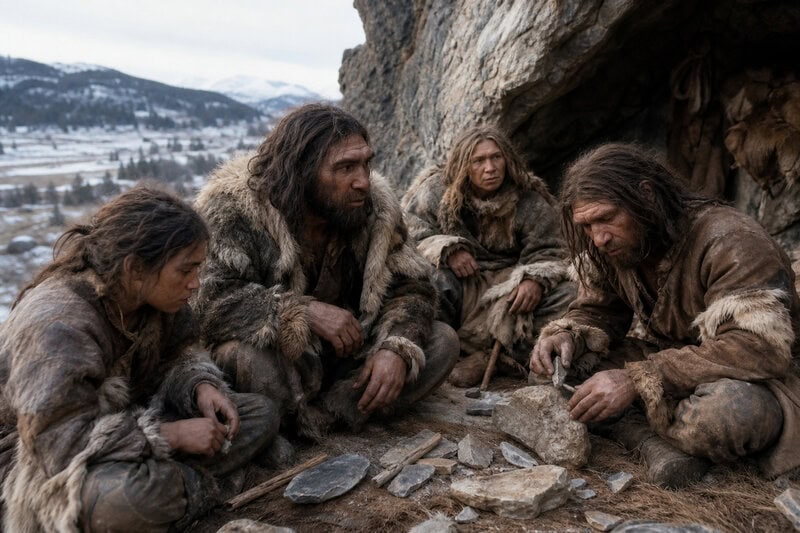
Several things remain firmly established regardless of how the new study’s arguments are ultimately received. Neanderthals are fully extinct as a distinct, reproductively coherent population. Their disappearance aligns broadly — though not perfectly — with the arrival and expansion of Homo sapiens across Europe and western Asia roughly 40,000 years ago. And some degree of interbreeding between the two groups is beyond scientific dispute.
What remains actively debated is the weighting of causes. Climate deterioration, which drove dramatic shifts in vegetation and prey availability across Europe during this period; resource competition with Homo sapiens; exposure to novel pathogens carried by incoming populations with different immune histories; the possibility of direct conflict; and now the refined interbreeding hypothesis — all of these are live candidates, and most specialists favor a multi-cause model over any single explanation. The new paper does not overthrow that pluralism; it reassigns relative weights within it.
Reasonable skepticism is warranted. Some researchers will note that the study’s sample, while analytically sophisticated, remains geographically and temporally limited. A finding about northwestern European Neanderthals in a particular time window cannot straightforwardly generalize to Iberian, Middle Eastern, or central Asian populations who lived and died under different ecological and demographic pressures. Revising the textbooks requires convergent evidence from multiple regions and multiple research groups.
What the emerging body of Neanderthal population research does suggest, however, is that the old stereotype — isolated, cognitively limited groups stumbling toward inevitable genetic collapse — was always more a projection of older assumptions than a faithful reading of the evidence. The populations revealed by recent genomics are more behaviorally complex, more socially networked, and more demographically varied than that story allowed.
Why This Rewrites More Than Prehistory
The deeper implication of the genetic assimilation hypothesis, if it continues to gather support, is a blurring of the boundary that has always felt most fundamental: the line between Neanderthals and us. If Homo sapiens absorbed rather than simply outcompeted or outlasted Neanderthal groups, then the clean species boundary implied by their extinction was never as solid as it looked. The two lineages merged at the edges, and what we call modern humanity carries the evidence of that merger in every non-African genome on Earth.
The research horizon here is genuinely promising. Larger ancient-genome datasets are being assembled from understudied regions across the Middle East, North Africa, and central Asia. Statistical methods for analyzing ancient population structure continue to improve. Newly discovered or re-analyzed fossil specimens could reinforce, complicate, or overturn the new study’s conclusions within a few years. The field is moving faster than it ever has, powered by sequencing technology that would have seemed implausible to researchers working even twenty years ago.
The Neanderthal extinction is no longer a simple tale of a weaker species failing. It is increasingly a story of merger, loss, and the genetic echo of a people who never entirely disappeared.