
On a cleanroom floor in Bremen, Germany, the primary load-bearing structure of ESA’s Ramses spacecraft is now standing upright — a skeletal frame of metal and composite that represents humanity’s opening move in a race against orbital mechanics. The clock is running: asteroid (99942) Apophis will skim closer to Earth in April 2029 than most geostationary satellites orbit, and a mission that does not launch in April 2028 will miss the most scientifically valuable asteroid encounter in recorded history.
Apophis: From Scare Story to Scientific Prize
Asteroid (99942) Apophis was discovered in June 2004, and early orbital calculations briefly assigned it a non-trivial probability of striking Earth in 2029 — enough to place it near the top of planetary-defense watch lists worldwide. Subsequent observations eliminated the impact threat, but confirmed something almost as striking: in April 2029, Apophis would pass within roughly 32,000 kilometers of Earth’s surface, closer than the belt of geostationary communications satellites that ring the planet at approximately 36,000 kilometers.
That confirmed close-approach geometry transformed Apophis from a cautionary headline into a rare scientific prize. For the first time, planetary scientists would be able to watch Earth’s own gravity reshape a sizeable near-Earth asteroid in real time — a natural experiment that no laboratory instrument or ground-based telescope could replicate independently.
The Science Case: Tidal Forces and What They Reveal
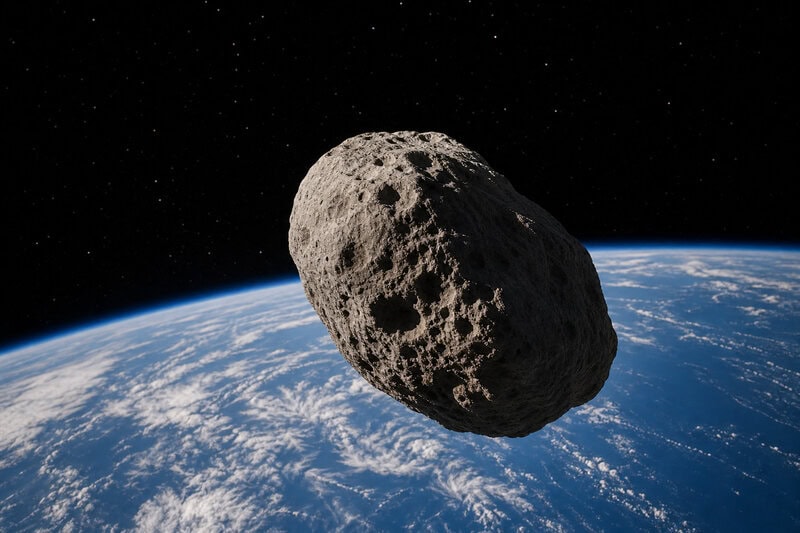
As mission planners studied the 2029 geometry, one phenomenon moved to the center of the scientific agenda: tidal effects. When an asteroid passes extremely close to a massive body like Earth, gravitational forces stretch and squeeze it — forces capable of altering rotation rates, triggering surface landslides, and revealing whether an asteroid is a solid monolith or a loosely bound rubble pile held together mainly by its own weak gravity. These structural questions had never been answered by direct observation during an actual planetary flyby.
The stakes extend well beyond pure science. Understanding how an asteroid’s interior responds to gravitational stress is directly relevant to planetary defense: any credible scheme for deflecting a threatening asteroid — whether by kinetic impactor, gravity tractor, or other means — depends on knowing what the target is made of and how it holds together under stress. The Apophis encounter offered a chance to gather that knowledge for free, courtesy of celestial mechanics.
ESA Formally Commits to Ramses
ESA approved the Ramses (Rapid Apophis Mission for Space Safety) spacecraft as its dedicated scientific response to the 2029 flyby. The mission’s defining objective is to rendezvous with Apophis well before the close approach, so that instruments can characterize the asteroid both in its undisturbed state and during the period of peak tidal influence from Earth — not merely photograph it from a distance after the encounter has already passed.
ESA explicitly described Ramses as a mission racing to reach Apophis, a framing chosen to communicate the unusually compressed development timeline that the fixed celestial mechanics of the flyby impose on the entire program. There is no negotiating with an asteroid’s orbit: the science window opens in April 2029 and does not wait.
A Launch Window That Cannot Slip
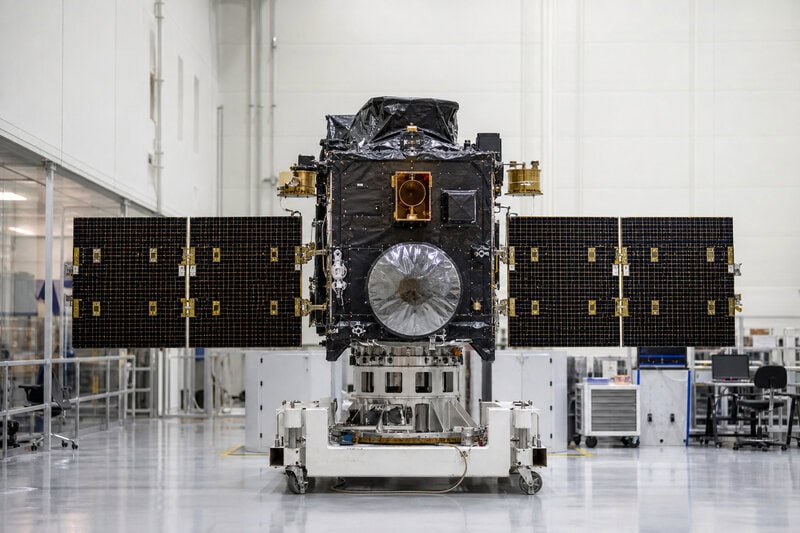
According to the Ramses mission’s own published launch scenario, the spacecraft must lift off during a three-week window that opens on April 20, 2028 to complete its interplanetary cruise and rendezvous with Apophis before the asteroid’s closest approach to Earth. Unlike many deep-space missions where a missed launch window can be recovered by shifting to an alternative opportunity months later, the orbital geometry of the Apophis encounter makes the 2028 window effectively non-negotiable. Missing it means missing the science event entirely.
This hard deadline is the central architectural fact of the entire program. It requires flight hardware to be ready for integration and testing far earlier than a conventional deep-space development schedule would ordinarily demand, compressing phases that typically unfold over a decade into a fraction of that time. Every delay anywhere in the build sequence has consequences that cannot be absorbed by simply pushing the launch date back.
Parallel Integration: Two Modules, Two Countries, One Schedule
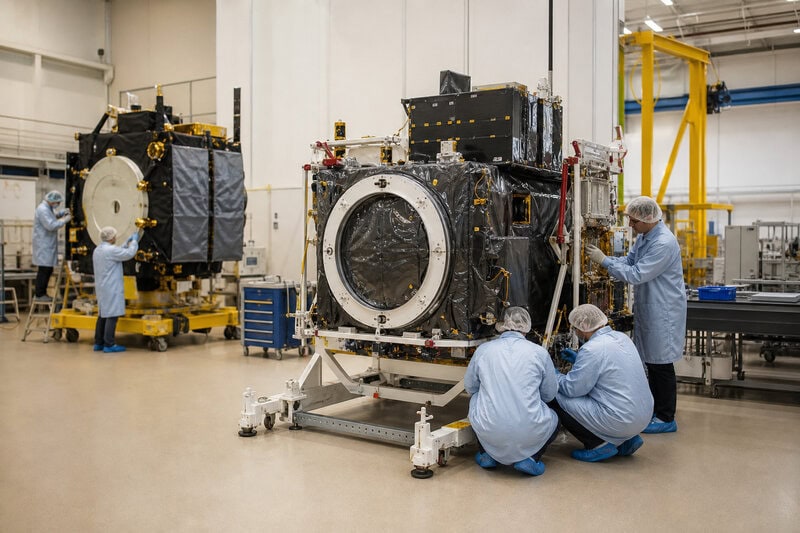
To meet that demanding schedule without sacrificing build quality, the Ramses spacecraft was designed as two primary modules, with integration proceeding simultaneously at two separate facilities. One module is being assembled in Bremen, Germany; the other is under integration in Milan, Italy. Running both tracks in parallel rather than sequentially is a deliberate strategy to compress the overall build timeline and preserve margin against the immovable launch date.
ESA described the pace from this point forward as “full speed,” signaling that the mission had moved decisively out of design and approval phases and into hardware reality. Every week saved in integration is a week of schedule margin preserved.
The Primary Structure Stands Upright in Bremen
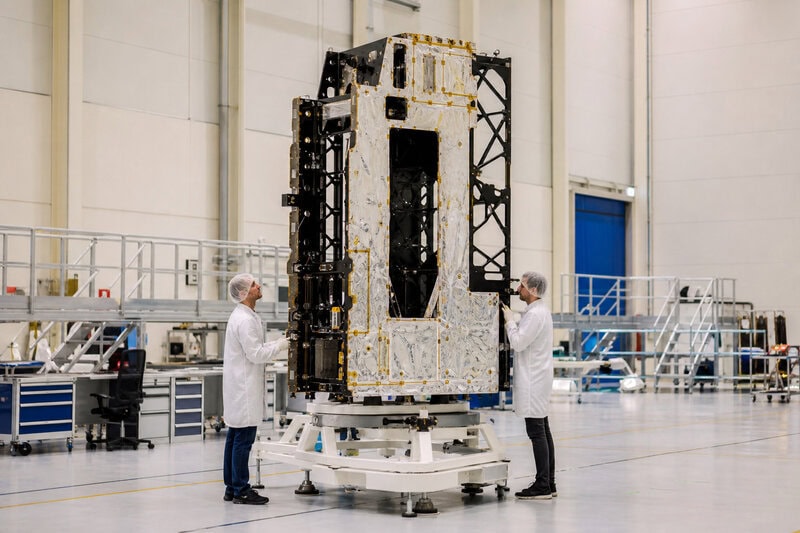
The most recent concrete milestone in that hardware journey is the one that gives this update its name. The primary load-bearing structure of the Ramses spacecraft — the backbone onto which every subsystem, instrument, cable harness, and propulsion component will eventually be mounted — was successfully installed and stood upright in ESA’s Bremen cleanroom. In spacecraft engineering, a completed and verified primary structure is a critical programmatic gate: nothing else can be permanently attached until the skeleton exists and has been confirmed to meet structural requirements.
ESA’s Hera account on X announced the achievement, confirming that development is proceeding at full speed. The image of that frame standing in a cleanroom is, in practical terms, the earliest visible proof that Ramses is becoming a real spacecraft rather than a paper concept — a distinction that matters enormously at this stage of the schedule.
April 2029: Apophis Skims Earth — and a Fleet Will Be Watching
The April 2029 close approach is the moment the entire Ramses program is designed to capture. Apophis will pass within roughly 32,000 kilometers of Earth — close enough that the asteroid will be briefly visible to the naked eye from parts of the world, tracing a path across the sky. Ramses’s instruments are intended to observe how Earth’s gravity alters the asteroid’s rotation state, reshapes its surface, and stresses its internal structure in real time, generating a dataset with no historical precedent for any asteroid flyby.
According to The Planetary Society, as many as three spacecraft may be present at Apophis during the encounter, making it potentially the most closely observed asteroid event in history. That convergence of independent instruments would allow cross-comparison of measurements — a degree of scientific redundancy and richness rarely available for any single solar-system object.
The Broader Payoff: A Live Test Bed for Planetary Defense
The tidal-effects data Ramses collects will help scientists determine whether close planetary flybys can trigger landslides, structural shifts, or spin changes on asteroids — physical processes that directly affect how a deflection mission targeting a similar object must be designed. If Apophis proves to be a loosely bound rubble pile that measurably reshapes under tidal stress, that finding changes the calculus for every kinetic-impactor or gravity-tractor scenario aimed at a comparable asteroid. ESA intends the mission’s findings to inform planetary defense planning more broadly, turning a naturally occurring event into a controlled scientific baseline for future asteroid-threat response.
Apophis’s 2029 flyby is considered by the planetary science community a rare alignment of accessibility and scientific value: the asteroid is large enough to be geophysically interesting, its trajectory brings it close enough to Earth for rendezvous with a modestly sized spacecraft on a compressed budget, and the tidal forces it will experience are strong enough to produce measurable, observable effects. When the backbone of Ramses stood upright in a Bremen cleanroom, it was the first physical step toward being present for that alignment.
From a brief moment of fear in 2004 to a standing spacecraft skeleton in Bremen, the story of Apophis and the Ramses mission is ultimately about converting a planetary-defense problem into a planetary-science opportunity — and about the engineering discipline required to meet a deadline set not by any project manager, but by the laws of orbital mechanics.