
On June 12, 2026, NASA’s X-59 research aircraft flew at Mach 1.4 — roughly 924 miles per hour — at 55,000 feet, crossing the sound barrier without producing the window-rattling double-crack that has kept commercial supersonic flight banned over the United States for more than fifty years. The shockwave that reached the surface was closer in perceived loudness to a car door closing down the block than to the jarring boom that grounded the Concorde era over American land. That distinction, if it holds up under rigorous measurement, could eventually rewrite federal aviation law.
Why a Sonic Boom Is Not What Most People Think It Is
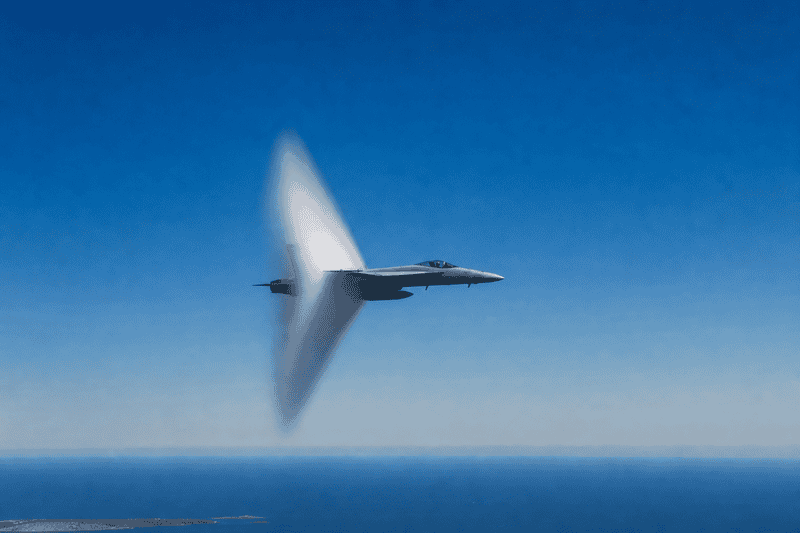
The sonic boom is one of aviation’s most persistently misunderstood phenomena. It is not a single event at the dramatic moment a plane “breaks” the sound barrier. It is a continuous cone of compressed air — a Mach cone — that trails behind any aircraft flying faster than sound and sweeps across the ground like an invisible rolling wave for as long as the aircraft remains supersonic. Every surface of the plane generates its own pressure disturbance. At supersonic speeds those disturbances pile up and typically merge into two dominant shockwaves — one at the nose, one at the tail — that strike the ground in rapid succession and produce the familiar double-crack.
The intensity of that impact depends on altitude, speed, weight, and shape. Higher altitude gives shockwaves more distance to spread and weaken. But shape is the variable engineers can most directly control through design. The Concorde generated ground-level noise measured at approximately 105 PLdB — Perceived Level decibels, the unit researchers use to quantify how loud a sound actually registers to human hearing, weighted for the ear’s sensitivity across frequencies. At 105 PLdB, dishes rattle, conversations stop, and sleep is interrupted. That figure led the United States to prohibit overland commercial supersonic flight in 1973 under a regulation — 14 CFR Part 91.817 — that remains federal law today. One rule, unchanged for five decades, has effectively frozen the speed of commercial aviation over land at subsonic levels.
How the X-59 Is Designed to Reshape a Shockwave
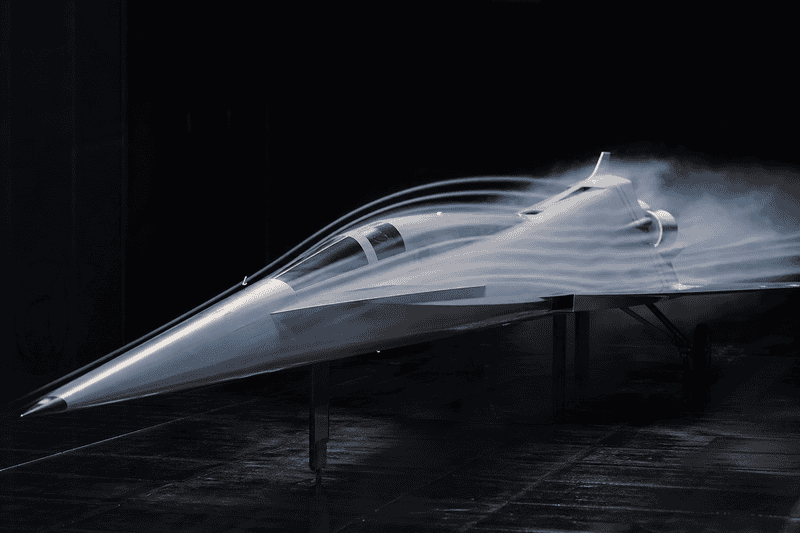
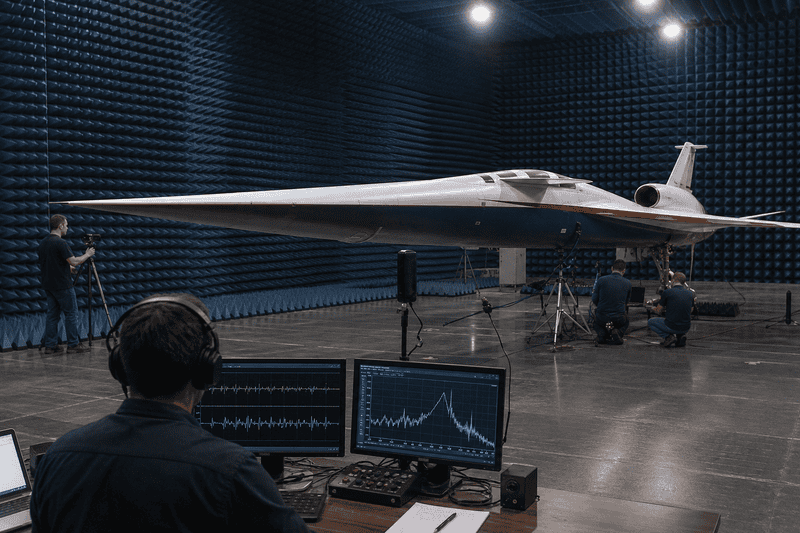
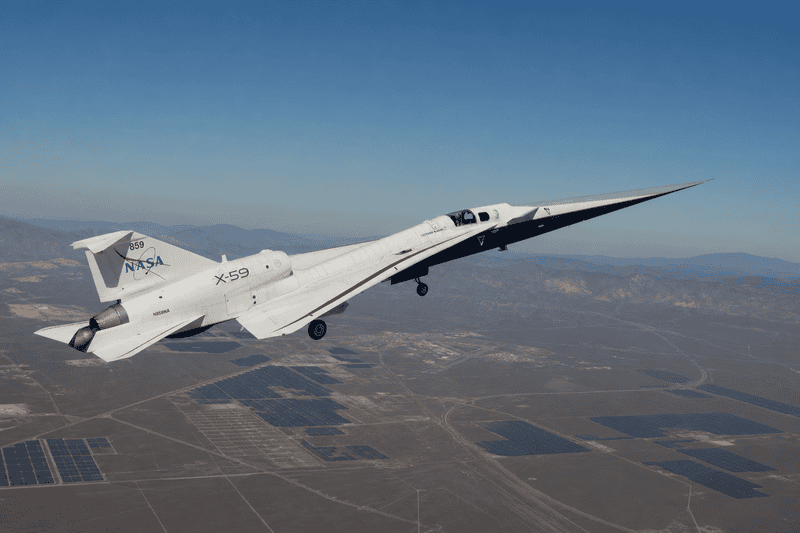
The X-59 was built by Lockheed Martin’s Skunk Works division — the advanced-projects unit responsible for the U-2 and the SR-71 — working to NASA’s precise aerodynamic specifications. The aircraft’s defining characteristic is its unusually long, slender fuselage, stretching roughly 99.7 feet from tip to tail — a geometry chosen not for aesthetics but for a specific acoustic purpose. By forcing the pressure disturbances generated by different parts of the airframe to originate so far apart from one another, the design prevents them from fully merging into a single powerful shockwave before they reach the ground. Separated, they arrive as a series of gentler pressure pulses rather than one unified high-energy crack.
The needle-like nose alone accounts for nearly a third of the aircraft’s total length. This extended forebody pushes the initial pressure disturbance far forward of the wings and engines, giving each successive wave room to disperse and weaken independently as it travels downward through miles of atmosphere. NASA engineers describe the intended result as a “quiet thump.”
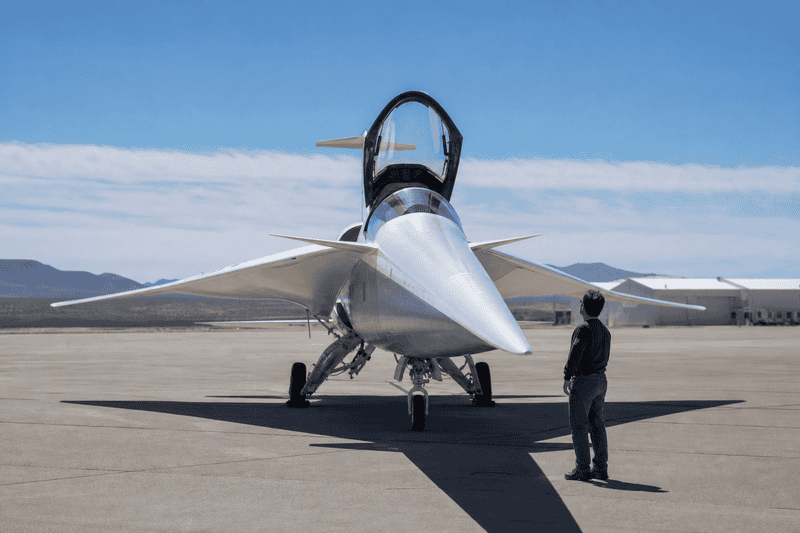
The design concessions required to achieve this geometry are substantial. The cockpit sits unusually far aft on the fuselage, and there are no conventional forward-facing windows for the pilot — even a standard windshield frame would disrupt the smooth, uninterrupted fuselage contour the shockwave-management strategy depends upon. Instead, the X-59 uses an External Vision System, or XVS: a network of cameras feeding a high-resolution cockpit display that gives the pilot the situational awareness a windshield would otherwise provide. Every centimeter of the aircraft’s external surface carries an acoustic consequence.
NASA’s computational fluid dynamics modeling and wind-tunnel testing predict this architecture will produce a ground-level noise signature of approximately 75 PLdB under design conditions — roughly one-sixth the perceived loudness of a Concorde sonic boom. That number is the design target. As of the June 12 flight, it remains a computational prediction, not a confirmed field measurement, a distinction the agency has been careful to maintain in its public communications.
The June 12 Milestone: What It Proved and What It Did Not
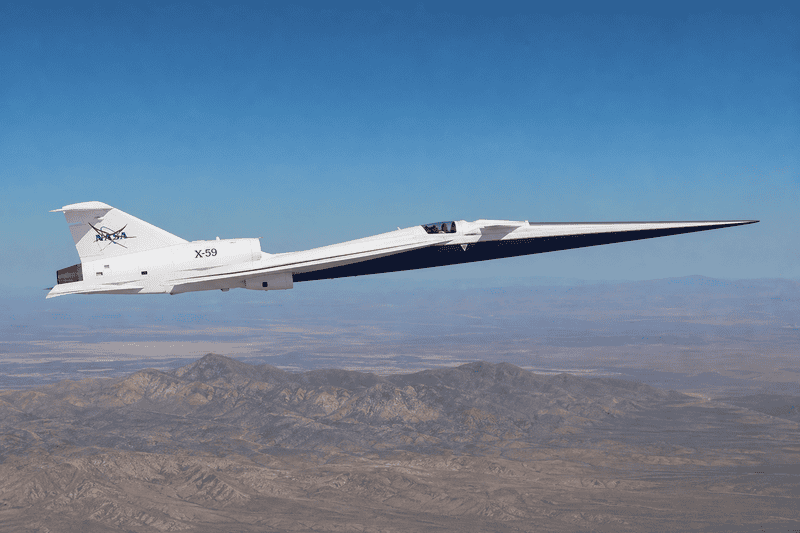
The June 12 supersonic flight is a landmark in the X-59 program’s timeline, but its significance is aerodynamic rather than acoustic. Reaching Mach 1.4 at 55,000 feet confirmed that the aircraft’s behavior in actual supersonic flight matches the years of computational modeling and simulation that preceded it — a validation that is necessary before any meaningful acoustic data collection can begin. The thin atmosphere at that altitude naturally amplifies the attenuation of shockwaves over distance, and it also reflects the realistic operational envelope a future quiet supersonic airliner might use, making whatever acoustic data eventually emerges directly relevant to real-world commercial scenarios.
What the June 12 flight did not yet produce is verified ground-level acoustic measurement. NASA has not released confirmed PLdB readings from this specific flight. The critical question — does the aircraft actually hit its 75 PLdB target in real atmospheric conditions, with all the wind shear, temperature gradients, and terrain variability that computational models can only approximate? — remains open. The flight is best understood as a critical precursor: the aerodynamic proof of concept that makes the next phase, community acoustic data collection, possible.
The Quesst Mission: Turning Science Into Policy
The X-59 is the centerpiece of NASA’s Quesst mission — Quiet SuperSonic Technology — which has a goal that is as much regulatory as it is scientific. The mission’s explicit purpose is to generate real-world acoustic and human-perception data that the Federal Aviation Administration and the International Civil Aviation Organization would need in order to consider revising the overland supersonic flight ban. A decibel figure from a computer simulation cannot change a federal regulation. Community response data from actual overflights over actual American cities carries a fundamentally different kind of evidentiary weight.
The Quesst community overflight phase — which the June 12 milestone is designed to make possible — will involve flying the X-59 over selected U.S. cities and surveying residents afterward. Those surveys will not simply ask whether people heard something. They will ask how annoying or disruptive residents found the experience, because the threshold regulators need to write a new noise standard is a human-perception threshold, not a raw physical measurement. A sound registering at 75 PLdB on an instrument may be perceived very differently depending on the time of day, the community’s prior exposure to aircraft noise, or the local acoustic environment — variables that instruments cannot capture but carefully designed surveys can.
NASA has indicated it intends to deliver its findings to the FAA and ICAO by the late 2020s. Whether those bodies ultimately act on the data, and on what timeline, remains entirely at their discretion — an outcome the agency has consistently described as uncertain and outside its control.
What Remains Unknown — and Why It Matters
The X-59 program represents serious, methodologically rigorous science. But several important questions remain unresolved, and intellectual honesty requires stating them plainly.
- Ground-truth acoustic validation is still pending. The 75 PLdB design target derives from computational fluid dynamics models and wind-tunnel data. Real atmospheric variability — wind shear, temperature inversions, terrain reflection — could shift actual ground measurements meaningfully in either direction.
- The acceptable noise threshold has not been established. Research on noise annoyance consistently shows that community tolerance varies substantially by context. What PLdB level the public will broadly accept across different community types and times of day has not yet been studied at the scale Quesst’s overflights will eventually permit.
- Cumulative exposure effects are unstudied. A single quiet thump on a Tuesday afternoon may register as unremarkable. The effect of frequent daily supersonic overflights on residential communities over months or years is a separate question that existing research does not yet answer.
- Commercial translation is not guaranteed. The X-59 is a one-of-a-kind research aircraft that will never carry passengers. Translating its shockwave-management geometry into a commercially viable airliner — one that must also carry revenue payload, meet range requirements, and pass airworthiness certification — is an engineering challenge that falls to the aerospace industry, not to NASA.
Private companies are developing commercial supersonic aircraft on the working assumption that the regulatory environment will eventually evolve to permit overland supersonic flight. NASA’s Quesst data represents the most scientifically credible foundation those regulatory arguments could have. But the path from research aircraft to commercial route remains long, and the June 12 milestone marks a point near the beginning of that journey rather than anywhere near its end.
The Deeper Significance of a Quiet Thump
If regulators ultimately permit overland supersonic commercial flight, the practical implications for air travel would be substantial. Routes like New York to Los Angeles, which currently require roughly five hours in the air, could in principle be completed in under three at Mach 1.4 — though fare economics and market viability at supersonic speeds remain genuinely speculative at this stage of development.
Beyond travel-time arithmetic, the X-59 program advances aeronautical knowledge in ways that extend well past supersonic flight. Its shockwave-management techniques, its external vision system replacing conventional windows, and the computational modeling frameworks developed to predict its acoustic signature are all design innovations with potential applications across aerospace engineering more broadly.
But the June 12 milestone is perhaps best understood not as a triumph of raw speed — Mach 1.4 is well within the range military aircraft have flown for decades — but as a proof of concept for a different kind of engineering ambition. The sonic boom was once treated as an inescapable consequence of supersonic flight, a physical imposition as fixed as gravity. The X-59’s design, and the careful science of the Quesst mission behind it, is a methodical argument that hard constraints embedded in the physics of sound can, with sufficient ingenuity and geometric precision, be reshaped by the shape of the machine that moves through the air.
Whether that argument ultimately prevails — in the laboratory, in the community survey, and in the regulatory hearing — is a question the coming years of data collection will begin, but not yet finish, answering.